Video wird geladen...

Video konnte nicht geladen werden

Zur Startseite

🚀I built Voltra, an npm package that lets you: ship custom Live Activities, Widgets, Dynamic Island + more with React. No Swift, Xcode, or extra JS runtime needed. ⚡ Hot reload ⛽ Server push ✻ AI coding agent-friendly 𝝠 Expo + React Native ready Demo + must-read Thread⬇️

283,277 Aufrufe • vor 11 Monaten •via X (Twitter)

0 Kommentare

Keine Kommentare verfügbar

Kommentare vom Original-Post werden hier angezeigt

Ähnliche Videos

Hell froze over: announcing FormKit for React. Secretly framework-agnostic since inception, today we’re open sourcing the most popular Vue form library…for React. Why is this a big deal? 1. Forms are still hard. We (the creators of FormKit) thought form libraries were no longer necessary, given the trajectory of coding agents. It turns out we were wrong, and we learned this the hard way. Need repeating conditional fields nested 3 layers deep inside a dynamic component, with accessibility, validation, internationalization, and backend error placement? Turns out coding agents aren’t great at that. It’s table stakes for FormKit. 2. Single component. This matters more than you would think, but FormKit doesn’t ship lots of different components each with its own props. Instead, it has a single one: and unified props. This was done to provide a better DX to human engineers. It makes it easy to spot when a given component was part of the form’s data structure vs a presentational component. It turns out this matters even more to coding agents than humans. No matter where your coding agent is, whenever it sees “FormKit” it immediately knows “oh, that’s part of the form’s data”. 3. No plumbing. FormKit doesn’t require any manual data collection, event listening, or state tracking. It does all this for you on a heavily tested, framework agnostic, self-assembling graph. The only code your agent needs to write is declarative templates and submission handlers that respond to the state. 4. Dense colocation. FormKit’s syntax happens to be ideal for coding agents; nearly everything you need to know about a given input is *on* the input: Colocation dramatically improves the efficacy of coding agents. 5. DOM. FormKit, unlike most form frameworks in React, renders the actual DOM. This also increases colocation and best practices, meaning your coding agent is far more likely to produce consistent and high-quality output that looks and acts the way its supposed to. 6. Schema. FormKit’s own inputs are not written using Vue or React — instead, FormKit has its own render schema — think of it like an AST for the DOM — and you can modify it on the fly. It’s not very human-friendly to write, but it turns out most models are already pretty well trained on FormKit’s schema. Want your inputs to look a bit different on one form than another? No problem, your coding agent can easily make those changes *without* modifying the JSX structure at all. Oh, and any inputs you create for Vue work with React and vice versa. 7. Plugins. FormKit leans into the unstructured tree graph hard. The graph doesn’t just collect data, it also passes down configuration and plugins. Want one form to work a bit differently than another one? No problem — just add a plugin to the top of that form or group and its children will all receive that feature. You can even mass assign props and configuration this way. Of course, FormKit has been solving these exact issues for a long time, but it wasn’t until we started using it on our own projects with coding agents that we realized what a huge advantage it is. With so many people using coding agents with React, it made sense to unveil FormKit for what it has always been — a completely framework-agnostic form framework that happens to unlock your coding agents. ➡️

Justin Schroeder

11,677 Aufrufe • vor 5 Monaten

I built a mobile app to check Paddle revenue (because they don't have one): 👉 - Use your Paddle API key (read-only and scoped) - Live data with beautiful and useful graphs built with native Swift UI. - Multi-account supported, unified revenue metrics. - Data stay on device, no server (api requests are sent directly from your phone) - Home widgets - I made it free to download on App Store (once it's approved) - Buy the source code for $19 and customize it however you want (save 5hrs of prompting if you try to do it yourself). Some interesting facts about this side project: - I vibe coded with 100% claude code remotely on my Mac Mini (with my AI assistant setup) in less than 24 hours. - I have read 0 line of code in this project and never opened Xcode myself. - My AI assistant designed the app with GPT Image 2, built the app with Swift UI, test it on simulator (via screenshots), send the test build to TestFlight for me to test, and invited me to the app store connect account so I can test on my phone, then the AI submitted the app to App Store and currently waiting for approval. - For the website, I ask it to come up with a domain name, I bought it via manually and give it access via Cloudflare API, the AI design and create a static website with GitHub, test it with lighthouse CLI, deploy via GitHub pages, config the domain DNS, deploy the website. - Then I sign up an account with Polar payment, create an API key and ask the AI to setup a store, add payment, link with the account, and add the payment to the website. The entire process happened in the last 24 hours with me only talking to the AI via Telegram. This is such a fun side project not only to create an app that I wish exists, but also to push the limit of what I can use AI for, and so far I'm very impressed. I'll create so much more apps! It feels like I have unlocked a super power.

Tony Dinh

43,922 Aufrufe • vor 3 Monaten

This is how you get 15x fable 5 usage. Fable -> Composer 2.5 reading Fable -> GPT 5.5 execution I built CNVS to make agent orchestration dead simple and insanely visual. You can watch fable 5 delegate work to cursor, codex, open code, all your agents. using your exsisting ai subs no api pricing. The canvas is fully voice controlled locally with nvidia parakeet for fast and free, or gpt realtime 2 for a fully conversational jarvis experience. The built in mcp and cli means agentic control is bidirectional they can prompt and spawn each other and read agent states. but there is more I built it from the ground up in swift for native performance on mac os. My old 16gb m1 mbp can easily spin up and control eight agents across multiple canvasses. The hermes integration + remote canvases allow you to run agents fully in the cloud on your VPS think google docs of vibe coding. You can literally turn off your mac and they keep working, open cnvs back up and pick up where you left off. I built a cross agent memory system based on 2026 research so all your agents feel like one brain. its SIMPLE and on demand. This eliminates context bloat, and the research supports a massive uptick in cross agent performance. There is soo much more. PS - I am a father building this project 100% solo in my basement on live stream everyday, my goal is to push vibe coding to the next level PPS - CNVS is a lifetime license becuase you DO NOT need another subscription in your life.

Max Blade

29,711 Aufrufe • vor 1 Monat

Stop paying $20–50/month for your AI agent to browse the web. i built the free version no API keys, no config, no rate limits😳 it's called Hound. An MCP server that does fetch, search, crawl, and screenshot — all keyless and now it ships a native Pi extension, so you get all 6 tools as first-class Pi tools, not through a generic MCP adapter what you get: → web_fetch — anti-bot fetch → clean markdown. PDFs get section maps + auto-OCR. Dead pages auto-recover from the Internet archive (honestly marked, never pretending it's live) → web_search — 10 keyless backends in parallel (DuckDuckGo, Brave, Mojeek, Yandex, Google…) + a local neural reranker → web_crawl — best-first same-domain walk. sitemap mode maps a whole site in one fetch → web_screenshot — anti-bot shots for multimodal models → cache_clear + hound_version what it replaces: -tavily — free tier -firecrawl — $16–50/mo -searXNG + browser + extractor glue — fragile -hound — $0, keyless, forever why it matters: >agent research needs web access, but everyone gates it behind a key or a limit >hound is honest about errors — a 404 says "Page doesn't exist" instead of dumping an error page as if it were content >archive recovery tags source= so the agent knows the content is historical, not live 2-minute setup: -pip install hound-mcp[all] -pi install npm: @houndmcp/hound-mcp-pi -/reload → tools are live. That's it Caveats (read): dataDome, Akamai, Cloudflare Turnstile — no free tool bypasses these hound tries the stealthy browser, then tells you to switch sources the [all] extra is ~100MB (onnxruntime + OCR). Works without it, but full install is recommended not a scraping-at-scale tool. Crawl caps at 100 pages by default — built for agent research Give your agent the web for free

Nahid

44,380 Aufrufe • vor 1 Monat

Anthropic's most viral feature is now open-source! Until now, Anthropic's Generative UI capabilities only existed inside its own products. CopilotKit🪁 just shipped Open Generative UI, an open-source implementation of Claude Artifacts that works in any app. The agent generates HTML/SVG at runtime, and CopilotKit streams it token-by-token into a sandboxed iframe inside the app's chat. So the user can watch the UI assemble itself in real time, not after the full response is ready. The sandbox is fully isolated with no access to the parent app, the DOM, or user data. So if the agent hallucinates broken markup or unexpected JavaScript, nothing leaks outside the iframe. Under the hood, the agent does not select from pre-built components. Instead, it generates arbitrary visuals from scratch every time. The output is unconstrained by default, but you can shape it by defining prompt-based skills that teach the agent specific visual formats or guidelines. For instance, a skill prompt can guide the agent toward producing a Chart.js dashboard with proper axis labels and responsive sizing, or an interactive 3D model with rotation controls. The video below shows this in action, and the output quality you see actually comes from the skills layer. Open Generative UI runs on AG-UI, so it works out of the box with LangGraph, CrewAI, Mastra, Google ADK, AWS Strands, and more. It also ships with a standalone MCP server that plugs into Claude Code, Cursor, or any MCP-compatible client. And the entire stack is built on top of CopilotKit, the open-source frontend framework for agents and generative UI. 30k+ GitHub stars, with SDKs for React, Next.js, Angular, and Vue. I have shared the GitHub repo and a live playground in the replies!

Akshay 🚀

87,048 Aufrufe • vor 3 Monaten

BADLAB V2: WHERE YOUR MEDIOCRE CODING DREAMS GO TO DIE 🔊 Listen up, code peasants. While you've been copy-pasting Stack Overflow answers, we've been revolutionizing how fucking development works. BADLAB V2 just dropped, and it's not just another update – it's a fucking paradigm shift. Let me break this down for you smooth-brains: 1️⃣ BADLAB V2 makes it easier and faster to build web apps, games, smart contracts, and data visualizations: No-code deployment, run, and share - without the headaches. 2️⃣ What This Means for Users: You can build bigger, better, and more useful projects and tools. Works with all the tools you love: React, Web3, Three.js, d3, and more—whether you’re building games, dApps, automation tools, or interactive charts, the sky is the limit. 3️⃣ Smart automation does the hard work: AI writes code for you, making it easier to start building without deep technical expertise. 4️⃣ CDN-backed hosting: Your projects load fast and reliably because they run from Cloudflare CDN, not some sketchy server. And now? You can share your creations with friends. 5️⃣ Easier debugging & updates: No more jumping through hoops to update files or fix errors. 6️⃣ Bottom Line: If you want to build web apps, games, or blockchain projects without dealing with all the messy setup and technical headaches, BADLAB V2 makes it easy. 🆕 WHAT’S NEW: ✔️ Multi-file projects – Because one file isn’t enough for real developers. ✔️ File updates that don’t require a PhD – No unnecessary complexity. ✔️ Examples even a brain-dead monkey could follow – Clear and simple. ✔️ Support for every major file format – JS, JSON, Markdown, 3D models, and more. ✔️ React components that don’t look like digital vomit – Finally, code that makes sense. ✔️ Server-side bundling – Because we’re not savages. ✔️ CDN-backed deployment – No lag, no downtime, just pure speed. ⚠️ WEAPONS OF MASS CREATION: 💧 d3.js – Interactive charts that don’t look like Excel’s morning sickness. 💧 Three.js – 3D visuals that push browsers to their limits. 💧 Effector – Business logic that actually makes fucking sense. 💧 Kaboom.js – Build browser games that aren’t complete garbage. 💧 React-Three/Fiber – 3D meets React without the usual drama. 💧 Framer Motion – Animations that are smooth as hell (and don’t cause seizures). 💧 Ethers & Web3.js – Blockchain development for the mentally stable. 🎮 Want to See It in Action? 🔗 Try our BADLAB V2 Agent Here: – Let AI do the hard work for you. ♟ Play the 4D Chess Game Here: – While you're playing checkers, we're transcending dimensions. 🎙 Welcome to the future, you beautiful disasters. Try not to break anything important. 🧪💀 C₈H₁₁NO₂

ARCH AI

44,480 Aufrufe • vor 1 Jahr

Anthropic's Claude Ai Agents Team just Educated how to build production AI agents in under 30 mins. For Free. From the engineers who built the stack. CANCEL Your Weekend Plans, and Learn to Build AI Agents Today. Bookmark it. Watch it. Build your first production agent this weekend. $5,000/month. $7,000/month. $12,000/month. People are building agents for clients and charging $$$ as Beginners. You're still stuck in the thinking about AI phase. This video fixes that tonight. Follow Himanshu Kumar for more high-signal content that actually moves your AI engineering career forward. ↓ Ivan Nardini runs Developer Relations for AI at Google Cloud. He just gave away the entire production agent stack in 30 minutes. This is the talk that separates people deploying AI agents that actually scale from people whose agents break the moment they leave localhost. Here's everything inside. I break down a production AI video like this every week. Follow Himanshu Kumar. ↓ The 4-part agent stack that actually scales. Most devs are duct-taping frameworks together and calling it an "AI agent." Ivan lays out the real stack: Agent Development Kit (ADK): open-source, code-first framework for building, evaluating, and deploying agents. Supports Claude models through Vertex AI directly. Model Context Protocol (MCP): lets your agent talk to any tool or data source with one standard. Vertex AI Agent Engine: managed platform for deploying, monitoring, and scaling agents in production. No DevOps headaches. Agent-to-Agent Protocol: open protocol so agents built on different frameworks can actually work together. This is the stack replacing every hacky agent setup in production right now. Full MCP + Claude breakdowns drop weekly on Himanshu Kumar. ↓ Building your first real agent. Ivan builds a birthday planner agent live. LLM Agent class. Name it. Define instructions. Pick the model. He uses Claude 3.7 Sonnet. You could use Opus 4.7 for better reasoning. Full agent built in minutes. Not weeks. Watch the build once and you'll never structure an agent the wrong way again. I post agent architectures people pay $500 courses to learn. Himanshu Kumar. ↓ Multi-agent systems without the chaos. Single agents are easy. Multi-agent systems are where 99% of builders fail. Ivan extends the birthday planner by: Adding a calendar service through MCP tools Creating an orchestrator agent to route requests between agents Handling state and context across agent handoffs This is production multi-agent architecture. Clean. Scalable. Debuggable. Most tutorials hand-wave this part. This one shows you every step. Multi-agent orchestration content drops weekly on Himanshu Kumar. ↓ Deployment without the DevOps nightmare. This is where most AI projects die. You build a cool agent locally. It works. You try to deploy it. Everything breaks. Vertex AI Agent Engine fixes this: Minimal code deployment Automatic monitoring of latency, CPU, and memory Built-in observability and logging No infrastructure setup needed You provide config and requirements. The platform handles the rest. This is how agents actually get to production. Deployment guides for Claude agents post every week. Himanshu Kumar. ↓ Agent-to-Agent Protocol: the future nobody's talking about. Most people don't know this exists yet. The A2A Protocol lets agents built in different frameworks communicate seamlessly. Your Claude agent. My LangChain agent. Someone else's CrewAI agent. All talking to each other. All solving parts of the same problem. All without custom integration code. This is the infrastructure layer of the coming AI economy. Getting in early on A2A Protocol is like getting in early on HTTP in 1995. A2A deep dive coming soon. Himanshu Kumar. ↓ 30 minutes from the team shipping this in production. You'll learn more from this than from 6 months of YouTube tutorials made by people who've never deployed an agent past localhost. People who watch this understand production AI agents at the architect level. People who skip it keep hacking together frameworks that break every time an API updates. Save the video. Watch it tonight. Build a real agent this weekend. Follow Himanshu Kumar for more high-signal content that actually moves your AI engineering career forward.

Himanshu Kumar

228,809 Aufrufe • vor 4 Monaten

voice prompting is 4x faster than typing. but i NEEEDED more. Nvidia parakeet allows me to fully voice control an agentic development environment with commands firing in under 300ms. and it runs 100% local. I added gpt realtime 2.1 mini, its 20% faster, 7 to 20x cheaper, and lets you have full jarvis style control of your vibe coding agents. but what about orchestration? agents can spawn each other, prompt each other, and read each others output with the CNVS mcp and cli. Fable 5 can create a plan, spawn 10 grok agents to execute, and a kimi k3 agent to review. parallel agents code at 1,000s of TPS anthropic's own research shows improvements ACROSS the board for multi agent workflows over single agent but only CNVS lets you choose exactly which orchestration, worker, and reviewer agent you would like to use. grok, kimi, qwen, claude, codex... the cross agent memory system is based on real 2026 research so all agents share the same brain, its on demand so it never bloats context. what about remote agents?? You can create remote canvasses that run agents your virtual private servers, they keep working even if your mac shuts off, and you can even vibe code straight to production. CNVS is built from the ground up ENTIRELY in swift for RAW performance on apple hardware. PS - its a LIFE TIME LICENSE because you don't need another subscription. PPS - I ship updates every week based off user feedback and livestream myself building it everyday. PPPS - it uses all your existing ai subs, so no api pricing here.

Max Blade

60,658 Aufrufe • vor 1 Monat

Everyone's building AI agents that run on someone else's server, store memory in someone else's database, and can be shut down by someone else's terms of service. I built one that can't be. FlowClaw is an AI agent that runs on a decentralized distributed computer. Your agent, your conversations, your memory, your tools — all stored onchain on Flow, a distributed network of validator nodes across the world. Not a centralized cloud. Not someone's S3 bucket. A blockchain that functions as censorship-resistant compute and storage for your AI. This isn't a wrapper. Your agent is a Resource — a first-class programmable object in Cadence (Flow's smart contract language) that physically lives in your account's on-chain storage. It can't be duplicated, seized, or deleted by anyone except you. Your encrypted messages, your cognitive memory, your scheduled tasks — they persist on a global distributed ledger that no single entity controls. It's an alpha build. It will break. But it works today on mainnet and I want people to push it this weekend. What it does: You go to authenticate with a passkey (Face ID, Touch ID), and you have a blockchain account in seconds. No wallet. No seed phrase. No tokens needed — gas is sponsored. You're immediately chatting with an AI agent that has real tool execution: live web data, token prices, on-chain balances, Cadence script execution, FLOW transfers. Every message is encrypted client-side before it touches the chain. The agent has a cognitive memory system — it doesn't just remember your last message, it builds molecular memory clusters where related knowledge bonds together for contextual retrieval across sessions. You can spawn sub-agents from a visual canvas to run parallel research. The memory tab shows you exactly what your agent knows. Everything is transparent and everything is yours. 11 smart contracts. No external dependencies. No keeper networks. No account abstraction hacks. Here's the part that matters for the censorship-resistance crowd: FlowClaw supports BYOK — bring your own key. You can plug in any LLM provider. But pair it with Venice and you get the full stack: a censorship-resistant AI model running inference with no content filtering, connected to an agent whose state lives on a decentralized network that no company can shut down, with end-to-end encrypted conversations that nobody can read — not the relay operator, not the LLM provider, not the blockchain validators. Venice doesn't log prompts. Flow can't read your encrypted storage. The relay never sees your plaintext. That's not a privacy policy. That's architecture. You can also use OpenAI, Anthropic, or any OpenAI-compatible provider. The agent platform doesn't care — it's model-agnostic. But the Venice pairing is the one that closes every gap in the stack. For the people tinkering with OpenClaw and the broader open-source agent ecosystem — FlowClaw is exploring what happens when you take the agent off the cloud entirely. Not just open-sourcing the code (though it is), but putting the actual runtime state on a distributed computer. Your agent's memory isn't in a SQLite file on your laptop or a Pinecone index on someone's cluster. It's on-chain, encrypted, and replicated across every validator node on Flow. You own it the way you own a private key — mathematically, not contractually. The blockchain here isn't a gimmick bolted onto an agent for token speculation. It's functioning as the infrastructure layer that replaces AWS. Flow accounts are programmable containers with their own storage, keys, and security capabilities. Passkey authentication works natively because Flow supports P-256 keys at the protocol level — the same curve your phone uses for biometrics. Gas sponsorship works natively because Flow transactions have separate proposer, authorizer, and payer roles built into the protocol. No proxy contracts. No relayers. No ERC-4337. Now here's the part that interests me economically. Every FlowClaw interaction is an on-chain transaction. Every message stored, every memory committed, every session created, every sub-agent spawned. An active user might generate dozens of transactions in a single conversation. Scale that and FlowClaw becomes a real contributor to Flow's transaction volume. Flow.com becomes deflationary at 250 TPS. Applications like FlowClaw that generate high-frequency, storage-heavy transactions are exactly what moves the needle. Every encrypted message uses account storage, which requires FLOW balance to back it. Every transaction burns fees. The more agents running, the more demand for $FLOW — not because of a tokenomics gimmick, but because the protocol literally requires it for compute and storage. FlowClaw doesn't have its own token. The token is $FLOW. The entire platform runs natively on the network — using Flow storage, paying Flow transaction fees, backed by Flow account balances. If FlowClaw succeeds, FLOW captures that value directly. I'm sharing this early because the AI agent space is moving fast and I think the decentralized infrastructure angle is underexplored. Most "crypto AI" projects are tokens with a chatbot attached. FlowClaw is the opposite — it's an agent platform that happens to use a blockchain because the blockchain solves real engineering problems that centralized infrastructure can't. Try it: Github: Create an agent, ask it something, spawn a sub-agent, check your memory tab, pair it with Venice for the full censorship-resistant stack. Break it and tell me what broke. If you think this direction matters, the best thing you can do is use it and give feedback. Your AI agent should be yours. Not your provider's. Not your platform's. Yours.

doodlifts

12,172 Aufrufe • vor 6 Monaten

GeoLibre v1.2.0 is here! GeoLibre is a free and open-source, lightweight, cloud-native GIS platform for visualizing, exploring, and analyzing geospatial data. One application that runs everywhere: in your web browser, as a native desktop app, on your phone, and inside a Jupyter notebook. No account, no server, no cost. Everything runs locally and your data stays private. This release packs in 35+ pull requests of new capabilities. A few highlights: - Run SQL right in the browser. The SQL Workspace pairs DuckDB Spatial with a new in-browser PostGIS engine (PGlite), so you can query layers, local files, and remote URLs without a server. - A smarter attribute table. Add fields, run a field calculator, and explore your data with a built-in Charts panel (histogram, scatter, bar, line, and box plots). - More ways to add data. OpenStreetMap PBF extracts, Cloud-Optimized NetCDF/HDF via kerchunk, georeferenced video overlays, authenticated 3D Tiles, and a Layer builder for custom overlays. - Better visualization. Heatmap rendering, point clustering, and H3 hexagonal grids for spatial binning. - New analysis and routing. A Directions plugin, plus Spatial Join, Select by Value, and Select by Location vector tools. - Print and share. A print layout composer that exports your map to PNG or PDF. - Work faster. A command palette (Ctrl/Cmd + K), global keyboard shortcuts, and undo/redo for layer and style operations. - Built for everyone. New internationalization framework, an accessibility pass with automated axe checks, an installable offline-capable PWA web build, React error boundaries, and Playwright end-to-end tests. Try the live demo: Star it on GitHub: Docs and roadmap: Release notes: #GIS #OpenSource #Geospatial #MapLibre #WebGIS #DuckDB #GeoLibre

Qiusheng Wu

39,959 Aufrufe • vor 2 Monaten

A founder turned down a $1M job offer from Meta to build a $5M ARR company with 9 people. His CAC is in cents. He has no sales team, no CS org, and no plans to build one (read on for the full playbook). Meet Ethan, the founder of Jobright, and if you are an early-stage lean AI company, this might be the most valuable thing you read this week. While every other AI startup was raising, hiring aggressively, and building org charts before they had customers, Ethan was talking to users (face-to-face). Their first million (revenue) was pure product-market fit mode. It came entirely from word of mouth, with users pulling in their friends because the product worked. The next four million came from clearly defining their ICP, tracking CAC, and obsessing over growth as a data-driven system. They built an experiment pipeline with a strict 7-day ship-or-kill rule. Channels that couldn't hit payback targets were automatically cut. And through all of it, the headcount barely moved. Because every time they spotted a repetitive workflow, their default instinct was to build an agent (when most founders hire). Their first internal AI agent took an enterprise manager from 5 accounts to 50, without any additional hires. Last month alone, they shipped 3 new internal agents: • An inbox agent that reads, classifies, and drafts responses • An ops agent that turns messy client requests into structured tasks • An outreach agent that finds relevant partners, writes personalized first messages, and runs follow-up sequences Each of those consumed hours of manual labor every week, but now they run on autopilot. That is what 9 people running like 50 looks like in practice. It is one of the best 0 to $5M stories I have come across in the lean AI space. So I spent hours going deep on every decision, system, and principle behind how they did this, and turned it into a super actionable playbook for founders who are pre-revenue or going from 0 to 1. Inside, you'll get: • The exact growth OS they used to go from $1M to $5M ARR • How they built internal agents that let 9 people do the work of 50 • The hiring filter that screens for true AI-native operators • The 2-question test every feature must pass before it gets built • How they structured growth after hitting PMF (the full funnel with owner metrics) • What building from $0 → $1M looks like vs. $1M → $5M • The data flywheel they've been compounding since day one that gets harder to replicate, and how to design yours from scratch Originally, I put this together as a resource for founders I work with directly. But the insights here are too actionable to keep internal, so I'm sharing them publicly. It's one of the most detailed operating blueprints I've put together for those aspiring to join the Lean AI Leaderboard. If you are one of them, grab this right away as it will save you months of expensive guesswork. Ethan, Eric, and team, welcome to the Lean AI Leaderboard!🚀 Link to the playbook:

Henry Shi

51,591 Aufrufe • vor 6 Monaten

Anthropic's in trouble, again! They spent years building what's now fully open-source. What made Claude feel different from a normal app is that the agent could act inside the interface instead of only talking in a chat box. For instance, Claude Artifacts let an agent render real UI, charts, dashboards, and interactive components that assemble live inside the response. Every major AI product tried to replicate it. But the problem was that unlike reasoning, planning, tool-calling, etc., none of it shipped natively with LangGraph, CrewAI, or Google ADK. So teams started building an owned version that required engineering the entire interface layer from scratch. Most teams, however, just settled for shipping the agent as a backend API in a chat box since rendering the UI is only one piece of it. To actually make it work, the interface layer also needed real-time streaming, state kept in sync between agent and UI, conversations that persist across sessions, and reconnection when a user refreshes mid-run. CopilotKit🪁 is now the only open-source framework that actually lets you build your own full-stack Claude-like apps. It decouples the agent from the interface, talking over AG-UI (an open protocol for agent-to-user communication). Being a standard protocol, the frontend never needs to know whether it is talking to a LangGraph or a CrewAI agent. You can change the backend anytime and the UI will never notice. In practice, CopilotKit's interface layer gives several pre-implemented React building blocks that wire the agent directly into the app, like: - generative UI, so the agent renders real components instead of text - chat windows, sidebars, and popups, or a fully headless setup - shared state, so the agent and app stay in sync - human-in-the-loop approvals, where the agent waits before acting - persistent threads that store the whole session, including the agent-user interactions and generated UI, not just text And because that full history is captured, those interactions can feed a self-learning layer that also improves the agent from real usage over time. The interface layer that Anthropic spent years engineering in-house is now literally available to any developer/team. CopilotKit is open-source with 30k+ GitHub stars, and AG-UI, the protocol underneath, is already supported across every major agent framework: LangGraph, CrewAI, Mastra, Google ADK, and more. CopilotKit GitHub repo → (don't forget to star it ⭐ ) If you want to go deeper, I found a detailed breakdown by Shubham Saboo recently on the three Generative UI patterns, with implementation. Read it below.

Avi Chawla

458,882 Aufrufe • vor 2 Monaten

🚨 OpenAI just launched Codex, a brand-new autonomous coding agent that can build features and fix bugs on its own. We’ve been using it Every 📧 for a few days, and I’m impressed. I invited Alexander Embiricos (ben davies), a member of the product staff responsible for Codex, to demo Codex and talk about it live on a special edition of AI & I: What Codex is and how it works Codex is designed to be used by senior engineers—it performs coding tasks like adding features or fixing bugs autonomously. It's built to allow you to start many sessions at once, so you can have multiple agents working in parallel. Codex is built to have "taste" OpenAI trained Codex to have the taste of a senior software engineer. It knows how big codebases work, how to write a good PR, and uses clean, minimal code. Why an “abundance mindset” is best for interacting with agents Codex is designed to allow users to delegate many tasks at once without getting caught up in the details. This lets you point an abundance of agents at a specific task like a difficult bug—it’s worth it even if only one of them succeeds. How OpenAI is thinking about agents Codex is one piece of a unified super-assistant OpenAI wants to eventually build—an agent that helps users easily get things done by selecting the right tools for them behind the scenes. OpenAI’s vision for the future of programming In the future developers will probably spend less time writing routine code and more time guiding agents, reviewing their work, and making strategy decisions. Programming will become more social, letting teams easily delegate multiple tasks at once, allowing people to focus on ideas and collaboration instead of routine coding. Watch below!

Dan Shipper 📧

145,487 Aufrufe • vor 1 Jahr

One of the most cracked engineers I know believes that local development is (mostly) dead. He walked me through why + his setup for using cloud agents in parallel... The big fucking problem: - You've got one codebase on your computer - Worktrees are supposed to let you run agents in parallel. On a real stack they don't (database contention, port conflicts, a dev server that only works in one tree) - So people flip back to one agent at a time and become the bottleneck themselves - Or they run multiple agents on the same machine: one writes a change, another writes over it, and they're fighting - Then you have to poke around, find everything each agent did, and test it independently - That's too much mental clutter - Locally you're operating like a CPU. You get an instruction, you build it, you queue a backlog The solution: - Stop sharing the computer. Give every agent its own - CJ Hess' setup is Amp "orbs": a full computer in the cloud that clones the repo, starts the dev server, and runs one agent with nothing else contending - A "portal" is a live URL into that running app so you can click around from any device before you trust it - Isolated like an actual team, each person on their own machine The payoff: - It feels like a GPU, not a CPU. A list of 10 tasks, all started, real progress, loop closed - Smaller, contained diffs hit main faster and create fewer conflicts, not more - Favorite prompt: "give me irrefutable evidence that this works." On his laptop he would never run something so heavy he can't use Slack and Chrome. In an orb he will (millions of simulated DB writes, full demo videos) - Smaller diffs, no mixed concerns, higher confidence, ship more often - Mental clutter is gone. One thread, one set of changes, one computer. He always knows the state. That's what lets him do more in parallel, not less - The last things he still does locally: read production logs, set a sensitive secret. He is not spinning up the app on his laptop

Alex Lieberman

97,722 Aufrufe • vor 8 Tagen

Here are a few things you probably did not know about Reddit's iOS and Android apps: they are ~2.5M lines of code each, with 500+ screens, and a total of 200 native mobile engineers work on the both of them (including a dedicated iOS and Android mobile platform team) But a few years ago, things looked very different - and Reddit quietly rebuilt their native apps from 2021. Today's conversation goes through what happened and how, with three engineers from Reddit’s mobile platform team who led this work: Lauren Darcey (Head of Mobile Platform), Brandon Kobilansky (iOS Platform Lead), and Eric Kuck (Principal Android Engineer) Watch or listen: • YouTube: • Spotify: • Apple: --- Brought to you by: • Graphite (we've moved to @graphite) — The AI developer productivity platform • Sentry — Error and performance monitoring for developers. Get 150k errors (three months of Team Plan) for free at --- Three of my takeaways from this episode: 𝟭. 𝗣𝗼𝗼𝗿 𝗱𝗲𝘃𝗲𝗹𝗼𝗽𝗲𝗿 𝗲𝘅𝗽𝗲𝗿𝗶𝗲𝗻𝗰𝗲 𝗰𝗮𝗻 𝘀𝗹𝗼𝘄 𝗱𝗼𝘄𝗻 𝗮 𝗰𝗼𝗺𝗽𝗮𝗻𝘆 – 𝘀𝗼 𝗽𝗮𝘆 𝗮𝘁𝘁𝗲𝗻𝘁𝗶𝗼𝗻! One of the reasons Reddit started investing heavily in modernizing its mobile stack was that the “old stack” was slowing down developers. Reddit’s platform team got proof of this simply by asking native engineers about the biggest development-related challenges they face. 𝟮. 𝗣𝗹𝗮𝘁𝗳𝗼𝗿𝗺 𝗲𝗻𝗴𝗶𝗻𝗲𝗲𝗿𝗶𝗻𝗴 𝗶𝘀 𝗵𝗮𝗿𝗱 𝘄𝗼𝗿𝗸. Advice from Brandon for anyone looking to work on a platform team: "You should try to work at a tech company for a year or two and actually see what happens after you ship a system — and then the assumptions change! You then have to figure out how to keep this thing going. You get a bunch of software design intuition because you have to like re-evaluate your assumptions for an incredibly long time. If you can do that, you're probably ready for platform stuff." 𝟯. 𝗚𝗲𝗻𝗔𝗜 𝗰𝗼𝗱𝗶𝗻𝗴 𝘁𝗼𝗼𝗹𝘀 𝗳𝗲𝗲𝗹 𝗹𝗶𝗸𝗲 𝘁𝗵𝗲𝘆 𝗮𝗿𝗲 𝗻𝗼𝘁 “𝘁𝗵𝗲𝗿𝗲” 𝘆𝗲𝘁 𝘄𝗶𝘁𝗵 𝗻𝗮𝘁𝗶𝘃𝗲 𝗺𝗼𝗯𝗶𝗹𝗲. LLMs integrated into IDEs seem to be increasingly helpful with backend, fullstack, web and even cross-platform (React Native / Expo) projects. However, Reddit’s mobile team shared that they get a moderate boost from the Apple and Android Studio LLM additions. Native mobile development is distinctively different from web, fullstack and backend coding – and it seems that these IDEs with AI functionality have not done much to optimize for the expereince of native mobile engineers. Over time, this will likely change – but it’s a reminder that there are differences between fullstack, backend and native mobile development.(I wrote a book reflecting on more of the challenges unique to native mobile titled Building Mobile Apps at Scale)

Gergely Orosz

67,275 Aufrufe • vor 1 Jahr

The rules of professional product development are being rewritten in real time. - PMs and designers can ship software as easily as engineers. - Software is no longer just built for humans—it’s also built for agents as first-class citizens. To better understand how we build products in this world, I invited Mike Krieger (Mike Krieger) on Every 📧’s AI & I podcast. Mike cofounded Instagram and is now a member of the technical staff at Anthropic, co-leading Anthropic Labs, their internal incubator for experimental products. He's been at the frontier of two transformative technology waves: mobile/social and now agent-native software. We discussed: - How to build a truly agent-native product. The best products today, like Claude Code, allow users to do things that their creators never intended. But that requires hard trade-offs between freedom and safety/reliability for frontier products, an issue that Mike's team is learning how to solve. - What's different about building now versus building Instagram. At Instagram, it took months to hit dead ends and learn what to cut. Now, that cycle runs in hours. - The trap of building too much, too fast with agents. You can go from idea to a nearly-shipped product in a day, but that process doesn’t give you the incremental feedback that used to tell you what not to build. The models are great at adding features, but can create a product that lacks coherence. - How Anthropic Labs structures product teams. New product experiments are led by only two people, usually a product manager or designer paired with an engineer. Mike says bigger teams tend to be too slow because of coordination costs. - Why you need to throw out your product and start over every three to six months. AI progress means most of your harness will be outdated quickly—the best teams build this into their product strategy. And much more! You should watch this one. Timestamps Introduction: What's gotten easier—and what hasn't—about building products in the age of AI: Why vibe coding creates "indoor trees": How rewrites have become a normal part of the development process: What "agent native" product design means: How Mike's labs team is structured and the cofounder model: The best signal for a product bet is someone with "break through walls" conviction: Navigating enterprise customers while keeping pace with rapid AI change: OpenClaw, personal agents, and the product question defining 2026:

Dan Shipper 📧

58,849 Aufrufe • vor 5 Monaten

Look ma new Codex Updates! 0.119.0 and 0.120.0 are here. And with it, a HUGE number of quality of life updates and bug fixes! > Hooks now render in a dedicated live area above the composer. They only persist when they have output, so your terminal stays clean. If you're running PreToolUse or PostToolUse hooks, this is a huge readability win. > Hooks are now available again on Windows > CTRL+O copies the last agent output. Small but clutch when you're pulling a code block into another file or chat. > New statusline option: context usage as a graphical bar instead of a percentage. Easier to glance at mid-session when you're trying to gauge how much runway you have left. > Zellij support is here with no scrollback bugs. If you've been stuck on tmux just because Codex was broken in Zellij, you're free now (shout out Felipe Coury 🦀) > Memory extensions just landed. The consolidation agent can now discover plugin folders under memories_extensions/ and read their instructions.md to learn how to interpret new memory sources. Drop a folder in, give it guidance, and the agent picks it up automatically during summarization. No core code changes needed. This is the first real extension point for Codex's memory system, and it opens the door for third-party memory plugins. > Did you know, you can /rename a thread? But what's really cool about that is, after you rename it, you can resume it with the same name, no more UUIDs. codex resume mynewapp or directly from the TUI: /resume mynewapp > Multi agents v2 got an update to tool descriptions More reliable multi agent environments and inter agent communication > You can now enable TUI notifications whether Codex is in focus or not. Modify this in your config: [tui] notification_condition = "always" > MAJOR overhaul to Codex MCP functionality: 1. Codex Tool Search now works with custom MCP servers, so tools can be searched and deferred instead of all being exposed up front. 2. Custom MCP servers can now trigger elicitations, meaning they can stop and ask for user approval or input mid-flow. 3. MCP tool results now preserve richer metadata, which improves app/UI handoff behavior. 4. Codex can now read MCP resources directly, letting apps return resource URIs that the client can actually open. 5. File params for Codex Apps are smoother: local file paths can be uploaded and remapped automatically. 6. Plugin cache refresh and fallback sync behavior are more reliable, especially for custom and curated plugins. > Composer and chat behavior smoother overall, resize bugs remain though. > Realtime v2 got several significant improvements as well. > You're still reading? What a legend. 🫶 npm i -g @openai/codex to update

am.will

742,298 Aufrufe • vor 4 Monaten

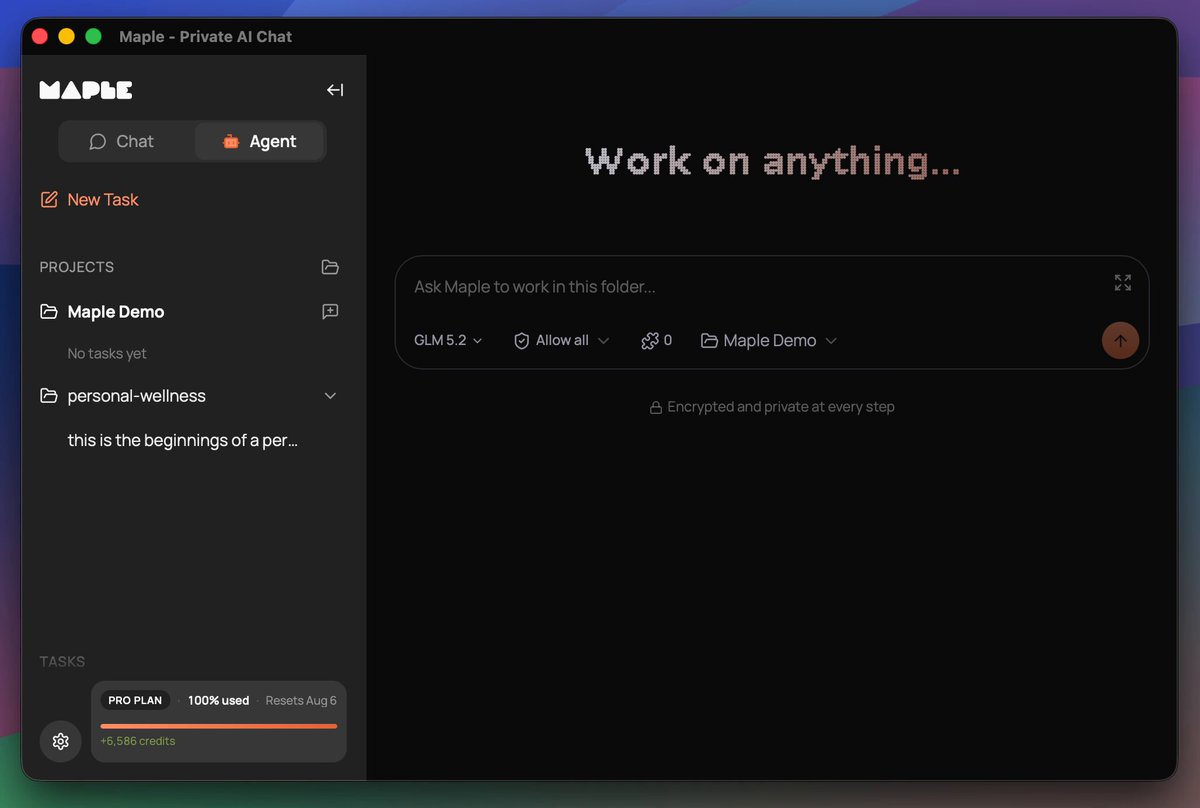
Maple is preparing for the release of a co-working agent. You install it locally and it works with your files, whether it's office work or building websites and apps. It's a turnkey solution, as easy as Claude Code, that keeps your data secure and private, no data sharing with closed AI labs. This is THE sovereign AI app for individuals and businesses who want powerful AI while retaining ownership of their information. Why build an agent into the Maple app when other agents already exist? Easy, we want to give you control over your work. We don't have a business plan that incorporates making money off our users' data. In the age of AI, your information, whether it's personal or company trade secrets, is the single thing that differentiates you from everyone else. We all have access to AI that can build a professional website for selling shoes. But your strategy and network for how you sell shoes should not be shared with your competitors. Sovereignty is the path to protecting what makes you, you. Maple sits at the intersection of Usability and Sovereignty. Maple gives you the best tools that are both easy to use and maintain your data sovereignty. Sovereign for one, sovereign for all. It has been a journey to get here. We brought to market the very first personal chatbot with end-to-end encryption using TEEs in late 2024. Prior to that there were proofs of concept but no full product offerings. Every other AI chat product on the market handled your data in plain text, either selling you a service to get your data or asking you to trust that they won't snoop on you. Quickly people found Maple and latched onto its open-source code and verifiable encryption. We didn't stop there. You may remember earlier this year we teased a product called "Maple Agent" and opened up a waiting list. That product is a mobile app that acts as your AI "friend", maintaining one long continuous chat, and getting to know you over time. I dislike using the word "friend" there, but it's the best way to convey the UX in a few words. AI is a tool, always has been, always will be. Any kind of friendly personality on top is just synthetic. In our testing, the UX of Maple Agent is really powerful for what it does. Think about the many short AI chats you have in your favorite app, whether it's looking up a historical fact or asking advice about a topic. With Maple Agent, those all go away in favor of the long-running chat with the friendly agent. It's like you have your own personal assistant who knows you so well and can look up anything for you. When I ask AI certain questions, I want to ask an expert who already understands my situation so I'm not repeating myself for the 100th time. That's the amazing value the personal agent brings to the table. We still see great utility for a personal agent like the "Maple Agent". Thousands of people on the waiting list, hoping to get their hands on it, agree that the concept is worth exploring and trying out. We were constrained in launching it due to a few circumstances, one of them being access to the scale of compute needed to power it. We have a clear path laid out for how to get there, but today is not the day to execute on that. It will be in the near future. Instead we have a different agent ready to go that we think is also incredible. We now have an agentic harness inside of the Maple Research app. This thing is a powerhouse. It even builds and publishes its own software releases. The agent in Maple Research works with your local filesystem, speaks to the largest open models running in TEEs, utilizes local models for certain tasks, is compatible with MCP tools, has an API for connecting to anything you need, and also supports the ACP protocol, which means it can be extended in the future to speak to other tools like Claude Code, Codex, and local models running on your own hardware. A big unlock for us was the Goose Development Kit, which powers the core of our agent harness. More on that to come as we publish articles and documentation later about the agent. The agent inside Maple Research doesn't have a name. At least not yet, not sure if it ever will. For now we call it "Chat Mode" and "Agent Mode". Think of this as the workhorse, the truck, the heavy lifter. Our other "Agent", the phone app, is your sidekick in your pocket, ready to help with quick things and ongoing conversations about life. I am incredibly excited about the Maple Research Agent. While I'm already seeing great results using it for internal work items, I'm especially thrilled about the personal health and wellness work it's doing for me. I know there are plenty of apps out there for compiling wellness data, but I'm having it build a tool tailored specifically for what I need, without the extra fluff. And none of my health data is being donated to the closed AI labs or sent to advertisers. I know that the AI logic is not being silently adjusted to fit the whims of a large corporation that has paid for product placement. It's me, state of the art AI, and my data. That's how I want it. Maple's new agent makes that possible. We can't wait for you to try it out. If you want early access, comment here, email us, reach out in some way. To those on the other agent waitlist, you're already in the queue. Thanks for reading this lengthy update. :)

Mark

44,707 Aufrufe • vor 1 Monat