Video wird geladen...

Video konnte nicht geladen werden

Zur Startseite

I have built a Windows x64 sampling profiler for native code+C# to be used by coding agents. Why? Because it is irresponsible to let computers write code but give them no tools to evaluate the performance of their code. Stop guessing, start measuring. -> How does it work? Just...

12,969 Aufrufe • vor 2 Monaten •via X (Twitter)

0 Kommentare

Keine Kommentare verfügbar

Kommentare vom Original-Post werden hier angezeigt

Ähnliche Videos

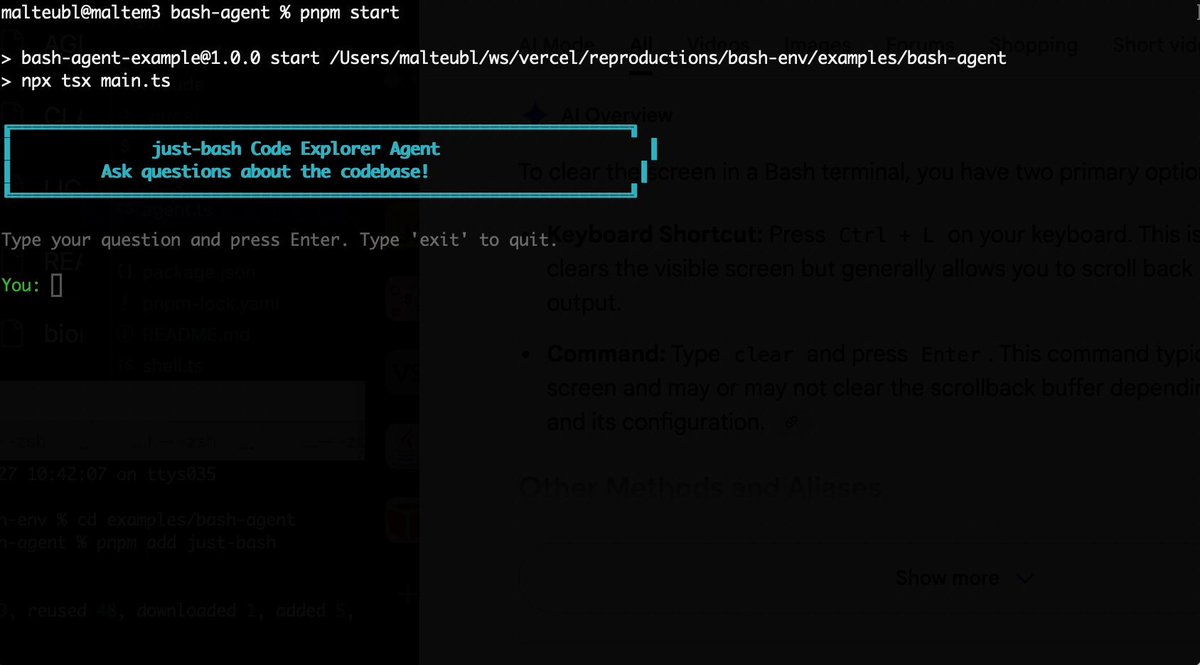
Bash is all you need! Which is why I'm introducing my holiday project: just-bash just-bash is a pretty complete implementation of bash in TypeScript designed to be used as a bash tool by AI agents. Because it turns out agents love exploring data via shell scripts, even beyond coding. It comes with grep, sed, awk and the 99th percentile features that an agent like Claude Code or Cursor would use. In fact, Claude Code can use it for secure bash execution. In the package - A bash-tool for AI SDK - A binary for use by yourself or your coding agents - An overlay filesystem to feed files to your agent securely - A Vercel Sandbox compatible API, so you can quickly upgrade to a real VM if you need to run binaries - An example AI agent that explores the just-bash code base using just-bash - I imported the Oils shell bash compatibility suite and just-bash passes a very good chunk What is interesting about this codebase: It was essentially entirely written by Opus 4.5. Coding agents love bash and they are good at reproducing it. They are also great at text-book recursive descent parsers and AST tweet-walk interpreters. That said, it is, like, a lot of code and I didn't read it all 😅. This is very much a hack, but it also seems to be _really_ useful. I haven't really found anything agents want to use that it doesn't support and it's fast and secure (caveats apply). It doesn't have write access to your computer and the filesystem is given a root that the agent cannot escape from. Find it at Related: Our recent blog post how we migrated our data analysis agent to bash tools and achieved incredible quality improvements The video shows the example agent investigating the just-bash code base

Malte Ubl

124,713 Aufrufe • vor 6 Monaten

New short course: Building Code Agents with Hugging Face smolagents! Learn how to build code agents in this course, created in collaboration with Hugging Face, and taught by Thomas Wolf, its co-founder and CSO, and m_ric, Hugging Face’s Project Lead on Agents. Tool-calling agents use LLMs to generate multiple function calls sequentially to complete a complex sequence of tasks. They generate one function call, execute it, observe, reason, and decide what to do next. Code agents take a different approach. They consolidate all these calls into a single block of code, letting the LLM lay out an entire action plan at once, which can be executed efficiently to provide more reliable results. You’ll learn how to code agents using smolagents, a lightweight agentic framework from Hugging Face. Along the way, you’ll learn how to run LLM-generated code safely and develop an evaluation system to optimize your code agent for production. In detail, you’ll learn: - How agentic systems have evolved, gaining greater levels of agency over time—and why code agents are a next step. - How code agents write their actions in code. - When code agents outperform function-calling agents. - How to run code agents safely in your system using a constrained Python interpreter and sandboxing using E2B. - To trace, debug, and assess the code agent to optimize its behaviours for complex requests. - How to build a research multi-agent system that can find information online and organize it into an interactive report. By the end of this course, you’ll know how to build and run code agents using smolagents, and deploy them safely with a structured evaluation system in your projects. Please sign up here!

Andrew Ng

124,382 Aufrufe • vor 1 Jahr

🚨 OpenAI just launched Codex, a brand-new autonomous coding agent that can build features and fix bugs on its own. We’ve been using it Every 📧 for a few days, and I’m impressed. I invited Alexander Embiricos (ben davies), a member of the product staff responsible for Codex, to demo Codex and talk about it live on a special edition of AI & I: What Codex is and how it works Codex is designed to be used by senior engineers—it performs coding tasks like adding features or fixing bugs autonomously. It's built to allow you to start many sessions at once, so you can have multiple agents working in parallel. Codex is built to have "taste" OpenAI trained Codex to have the taste of a senior software engineer. It knows how big codebases work, how to write a good PR, and uses clean, minimal code. Why an “abundance mindset” is best for interacting with agents Codex is designed to allow users to delegate many tasks at once without getting caught up in the details. This lets you point an abundance of agents at a specific task like a difficult bug—it’s worth it even if only one of them succeeds. How OpenAI is thinking about agents Codex is one piece of a unified super-assistant OpenAI wants to eventually build—an agent that helps users easily get things done by selecting the right tools for them behind the scenes. OpenAI’s vision for the future of programming In the future developers will probably spend less time writing routine code and more time guiding agents, reviewing their work, and making strategy decisions. Programming will become more social, letting teams easily delegate multiple tasks at once, allowing people to focus on ideas and collaboration instead of routine coding. Watch below!

Dan Shipper 📧

145,487 Aufrufe • vor 1 Jahr

Three skills I use every day in Claude Code and Codex to solve my hardest problems: 1️⃣ /agent-watchdog When I have one agent like Codex working on a task and I don't fully trust it's going to do everything right, I'll open up another one like Claude Code and tell it to watchdog the Codex thread. You can copy the Codex deep link into Claude Code and it'll look at the prompt you sent, watch the Codex thread until it's done, then compare the Codex solution to how it was planning to solve it and automatically fix anything that Codex missed. It can also test the work of the other agent end-to-end. Similar to the idea of OpenRouter's new Fusion feature, I've definitely found that two models thinking through a problem and checking each other's work can be wildly more impactful than just one. 2️⃣ /plan-arbiter Similar ideas as /agent-watchdog - but with this one you have both make plans, compare plans, negotiate the differences, and make a final plan to execute. I find Claude Code is better at writing plans, but Codex is faster and cheaper to execute on them. Then I usually have Claude Code watchdog the Codex work and fix anything that was missed. 3️⃣ /read-the-damn-docs One thing that drives me crazy with coding agents is they're so reluctant to look up docs. They'll just guess and guess and guess at the right API surface for things, or the right solution to an integration of two things. Once I explicitly tell it to look up the docs, it says "Oh, I see the answer," and it fixes the problem. So I made the /read-the-damn-docs skill. Add it and your agents will know when and how to do efficient web searches to look up docs for the types of problems you really should look up docs for. All of these are totally open source over on my GitHub. If you try them, let me know your feedback. Will link to them below:

Steve (Builder.io)

35,213 Aufrufe • vor 14 Tagen