Video wird geladen...

Video konnte nicht geladen werden

Zur Startseite

i just plugged jevrouter into claude code and it's actually insane 💀 same bug. same repo. same prompt. left is opus 5.5 doing everything right is claude code on jev, switching models mid task opus plans it. deepseek writes it. sol takes the hard fix. glm cleans up watch...

12,209 Aufrufe • vor 10 Tagen •via X (Twitter)

12 Kommentare

Profilbild von Kenneth Lau
Kenneth Lauvor 10 Tagen

glm on cleanup duty is the internship role of the model lineup

Profilbild von Christopher Jones
Christopher Jonesvor 10 Tagen

Interesting, I gotta try this out

Profilbild von Vadim
Vadimvor 10 Tagen

let me know how it goes broski

Profilbild von The AI Therapist
The AI Therapistvor 10 Tagen

Claude Code switches models and solves the bug quickly. That workflow looks smooth for developers who value speed over consistency

Profilbild von Max Bevza
Max Bevzavor 10 Tagen

Model routing is starting to look like the obvious way to optimize agent economics

Profilbild von Pablo Manjarres
Pablo Manjarresvor 10 Tagen

opus got benched by the box score

Profilbild von EDDY VU
EDDY VUvor 10 Tagen

How clean is the context handoff when passing the repo state between completely different model families?

Profilbild von catman
catmanvor 10 Tagen

The concrete result here is both setups passed all 9 tests, with Jev switching models mid-task and finishing in 44 seconds for $0.19.

Profilbild von 安叫兽|Bird🕊️ 🔶 BNB
安叫兽|Bird🕊️ 🔶 BNBvor 10 Tagen

这账单一摆,单模型有点尴尬了

Profilbild von Bajan
Bajanvor 10 Tagen

Do you read some guide how to setting this?

Profilbild von Datta
Dattavor 10 Tagen

How to set this up ?

Profilbild von Vishesh Gupta
Vishesh Guptavor 10 Tagen

Is it real ? Have you tested with multiple problems ?

Ähnliche Videos

Claude Code tip: once Opus 5.5 is your main model, stop letting your Fable 5.1 quota go to waste put it on call with /advisor run /advisor fable Opus 5.5 keeps doing the work Fable 5.1 sits on the sidelines, reads the whole session, and steps in at three moments: → before a plan: is this right? → when the same error comes back: am I going the wrong way? → before "done": did I miss anything? Fable 5.1 advises. Opus 5.5 writes the code the same idea sits under Jev engineering: the expensive model stops weighing in on every step and only gets called at the moments that change the outcome • the full setup > Opus 5.5 on high runs the main session > subagent one reads code > subagent two edits and runs tests > subagent three looks up docs > all three on medium > Fable 5.1 on call hand the tree and this prompt to Claude Code 👇 "Set up my Claude Code to match this tree: 1. Reuse fitting subagents from ~/.claude/agents and .claude/agents. > Propose new ones only for missing roles > Set each to model: opus, effort: medium > Leave any that set a different model alone and list them 2. Set main session effort to high via effortLevel in ~/.claude/settings.json 3. Check for env vars that disable the advisor (CLAUDE_CODE_DISABLE_ADVISOR_TOOL, DISABLE_TELEMETRY, anything that stops flag fetching) and CLAUDE_CODE_EFFORT_LEVEL, which overrides subagent effort. Report them, don't change them 4. Add a rule to ~/.claude/CLAUDE.md: ask the advisor before a big plan, when an error repeats, and before calling a long task done Show me the changes first. Don't edit files yet." ↳

Mr. Buzzoni

324,448 Aufrufe • vor 11 Tagen

This is f*cking insane. This Claude Code tip saved me thousands of dollars. once Opus 5.5 is your main model, stop burning it on work Sonnet 5.5 can do, while Fable 5.1 sits idle hand the grunt work to Sonnet 5.5 subagents and put Fable 5.1 on call run /advisor fable Opus 5.5 plans and ships the final code Sonnet 5.5 subagents read, edit and run the tests Fable 5.1 reads the full session, every tool call included, and only speaks up at three points: → before a plan: is this the right approach? → when the same error comes back: am I digging in the wrong place? → before "done": what did I miss? Sonnet 5.5 builds. Fable 5.1 reviews. Opus 5.5 ships Jev engineering is the same move one layer down: the forks that need no thinker (which file, which tool, retry or stop) go to Jev in under half a second, and the big models only see the ones that split anyone still running one model for everything is paying Opus prices to decide whether a file exists - the full tree > Opus 5.5 on high runs the main session > explorer reads the code on Sonnet 5.5 > worker edits and runs tests on Sonnet 5.5 > researcher pulls the docs on Sonnet 5.5 > all three on medium > Fable 5.1 on call for main and every subagent paste the tree and this prompt into Claude Code ↓ "Rebuild my Claude Code setup around this tree: 1. Check ~/.claude/agents and .claude/agents for subagents that already fit explorer, worker and researcher. > Draft new ones only for missing roles > Give each model: sonnet, effort: medium > Skip any that pin a different model and list them 2. Set the main session to high via effortLevel in ~/.claude/settings.json, and set advisorModel to fable 3. Find anything that keeps the advisor off (CLAUDE_CODE_DISABLE_ADVISOR_TOOL, DISABLE_TELEMETRY) plus CLAUDE_CODE_EFFORT_LEVEL, which overrides subagent effort. Report them, change nothing 4. Add one rule to ~/.claude/CLAUDE.md: consult the advisor before a large plan, when an error repeats, and before calling a long task done Show me every change as a diff first. No edits until I say go." ↳

delost

48,238 Aufrufe • vor 5 Tagen

Claude Code tip: once Opus 5.5 is your main model, stop leaving Fable 5.1 sitting idle put it on call with /advisor run /advisor fable Opus 5.5 keeps writing the code Fable 5.1 reads the full session, every tool call included, and only speaks up at three points: → before a plan: is this the right approach? → when the same error comes back: am I digging in the wrong place? → before "done": what did I miss? Fable 5.1 reviews. Opus 5.5 ships Jev engineering is the same move one layer down: the forks that need no thinker (which file, which tool, retry or stop) go to Jev in under half a second, and the big model only sees the ones that split - the full tree > Opus 5.5 on high runs the main session > explorer reads the code > worker edits and runs tests > researcher pulls the docs > all three on medium > Fable 5.1 on call as the advisor paste the tree and this prompt into Claude Code ↓ "Rebuild my Claude Code setup around this tree: 1. Check ~/.claude/agents and .claude/agents for subagents that already fit explorer, worker and researcher. > Draft new ones only for missing roles > Give each model: opus, effort: medium > Skip any that pin a different model and list them 2. Set the main session to high via effortLevel in ~/.claude/settings.json, and set advisorModel to fable 3. Find anything that keeps the advisor off (CLAUDE_CODE_DISABLE_ADVISOR_TOOL, DISABLE_TELEMETRY, any variable that stops feature-flag fetching) plus CLAUDE_CODE_EFFORT_LEVEL, which overrides subagent effort. Report them, change nothing 4. Add one rule to ~/.claude/CLAUDE.md: consult the advisor before a large plan, when an error repeats, and before calling a long task done Show me every change as a diff first. No edits until I say go." ↳

delost

693,243 Aufrufe • vor 10 Tagen

Claude Code tip: once Opus 5.5 runs your main session, stop leaving Fable 5.1 on the bench put it on call with /advisor run /advisor fable Opus 5.5 keeps writing the code Fable 5.1 reads the whole session, every tool call included, and only speaks up at three moments: → before a plan: is this the right approach? → when the same error comes back: am I digging in the wrong place? → before "done": what did I miss? Fable 5.1 reviews. Opus 5.5 ships jev engineering is the same move one layer down: the forks that need no thinker (which file, which tool, retry or stop) go to jev in under half a second, and the big model only sees the ones that split - the full tree > Opus 5.5 on high runs the main session > explorer reads the code > worker edits and runs tests > researcher pulls the docs > all three on medium > Fable 5.1 on call as the advisor paste the tree and this prompt into Claude Code ↓ "Rebuild my Claude Code setup around this tree: 1. Check ~/.claude/agents and .claude/agents for subagents that already fit explorer, worker and researcher. > Draft new ones only for missing roles > Give each model: opus, effort: medium > Skip any that pin a different model and list them 2. Set the main session to high via effortLevel in ~/.claude/settings.json, and set advisorModel to fable 3. Find anything that keeps the advisor off (CLAUDE_CODE_DISABLE_ADVISOR_TOOL, DISABLE_TELEMETRY, any variable that stops feature-flag fetching) plus CLAUDE_CODE_EFFORT_LEVEL, which overrides subagent effort. Report them, change nothing 4. Add one rule to ~/.claude/CLAUDE.md: consult the advisor before a large plan, when an error repeats, and before calling a long task done Show me every change as a diff first. No edits until I say go." ↳

Hanako

52,065 Aufrufe • vor 8 Tagen

Claude Code tip: keep Opus 5.5 as your main model, but stop paying Opus prices for your subagents move them to Sonnet 5.5 Opus 5.5 plans and decides Sonnet 5.5 subagents do the heavy reading, editing and testing at half the price ($2 / $10 vs $4 / $20 per 1M tokens) Fable 5.1 stays on call with /advisor and only speaks up at three points: → before a plan: is this the right approach? → when the same error comes back: am I digging in the wrong place? → before "done": what did I miss? Opus thinks. Sonnet does. Fable checks Jev engineering is the same move one layer down: the forks that need no thinker (which file, which tool, retry or stop) go to Jev in under half a second, and the big models only see the ones that split - the full tree > Opus 5.5 on high runs the main session > explorer reads the code > worker edits and runs tests > researcher pulls the docs > all three on Sonnet 5.5, medium > Fable 5.1 on call as the advisor paste the tree and this prompt into Claude Code ↓ "Rebuild my Claude Code setup around this tree: 1. Check ~/.claude/agents and .claude/agents for subagents that already fit explorer, worker and researcher. > Draft new ones only for missing roles > Give each model: claude-sonnet-5-5, effort: medium > List any that pin a different model before changing them 2. Keep the main session on Opus, set effortLevel to high in ~/.claude/settings.json and advisorModel to fable 3. Find anything that keeps the advisor off (CLAUDE_CODE_DISABLE_ADVISOR_TOOL, DISABLE_TELEMETRY, any variable that stops feature-flag fetching) plus CLAUDE_CODE_EFFORT_LEVEL, which overrides subagent effort. Report them, change nothing 4. Add one rule to ~/.claude/CLAUDE.md: consult the advisor before a large plan, when an error repeats, and before calling a long task done Show me every change as a diff first. No edits until I say go." ↳

delost

27,459 Aufrufe • vor 7 Tagen

This is f*cking insane. This tip saved me thousands of dollars. run Opus 5.5, Sonnet 5.5, and Fable 5.1 together, and stop burning Opus on work it was never needed for. the whole idea in one line: the strong model plans, the mid-tier model executes, Fable stays quiet until it's actually needed. roles, broken down: Opus 5.5, high effort, owns the plan and ships the final code Sonnet 5.5, medium effort, splits into explorer (reads the codebase), worker (edits files, runs tests), researcher (pulls docs) Fable 5.1, called through /advisor fable, reads everything happening in the session but stays silent unless something's actually wrong three moments where Fable speaks: → a plan goes out: is this actually the right call? → the same failure shows up again: is the search going nowhere? → the task gets marked finished: did something get skipped? Jev engineering does the same thing one level down. the forks that don't need real thought, which file, which tool, keep going or stop, go straight to Jev and come back in under half a second. the big models only ever see the forks that genuinely need a decision. anyone still running one model for everything is paying Opus prices to decide whether a file exists. drop this into Claude Code: "Rebuild my Claude Code setup around this structure: Look through ~/.claude/agents and .claude/agents for subagents already covering explorer, worker, and researcher. Only create new ones for roles that are missing. Set model: sonnet, effort: medium on each. If an existing subagent is locked to a different model, leave it as is and just list it. In ~/.claude/settings.json, set effortLevel to high and advisorModel to fable. Check for anything disabling the advisor, CLAUDE_CODE_DISABLE_ADVISOR_TOOL, DISABLE_TELEMETRY, or anything blocking feature-flag fetches, plus CLAUDE_CODE_EFFORT_LEVEL, which can override subagent effort settings. Report what you find. Don't change any of it yet. Add one line to ~/.claude/CLAUDE.md: check in with the advisor before a big plan, when the same error shows up twice, and before marking a long task done. Show every change as a diff first. Wait for my go-ahead before touching anything."

rvaniaaa

250,263 Aufrufe • vor 6 Tagen

Official Anthropic tip for Claude Code: stop burning Opus 5.5 on work Sonnet 5.5 can do, while Fable 5.1 sits idle hand the grunt work to Sonnet 5.5 subagents and put Fable 5.1 on call run /advisor fable Opus 5.5 plans and merges Sonnet 5.5 subagents read, edit and run the tests Fable 5.1 reads the full session and only speaks up at three points: → before a plan: is this the right approach? → when the same error comes back: am I digging in the wrong place? → before "done": what did I miss? Sonnet 5.5 builds. Fable 5.1 reviews. Opus 5.5 ships Jev engineering is the same move one layer down: the forks that need no thinker (which file, which tool, retry or stop) go to Jev in under half a second, and the big models only see the ones that split - the full tree > Opus 5.5 on high runs the main session > explorer reads the code on Sonnet 5.5 > worker edits and runs tests on Sonnet 5.5 > researcher pulls the docs on Sonnet 5.5 > all three on medium > Fable 5.1 on call for main and every subagent paste the tree and this prompt into Claude Code ↓ "Rebuild my Claude Code setup around this tree: 1. Check ~/.claude/agents and .claude/agents for subagents that already fit explorer, worker and researcher. > Draft new ones only for missing roles > Give each model: sonnet, effort: medium > Skip any that pin a different model and list them 2. Set the main session to high via effortLevel in ~/.claude/settings.json, and set advisorModel to fable 3. Find anything that keeps the advisor off (CLAUDE_CODE_DISABLE_ADVISOR_TOOL, DISABLE_TELEMETRY) plus CLAUDE_CODE_EFFORT_LEVEL, which overrides subagent effort. Report them, change nothing 4. Add one rule to ~/.claude/CLAUDE.md: consult the advisor before a large plan, when an error repeats, and before calling a long task done Show me every change as a diff first. No edits until I say go." ↳

delost

43,704 Aufrufe • vor 6 Tagen

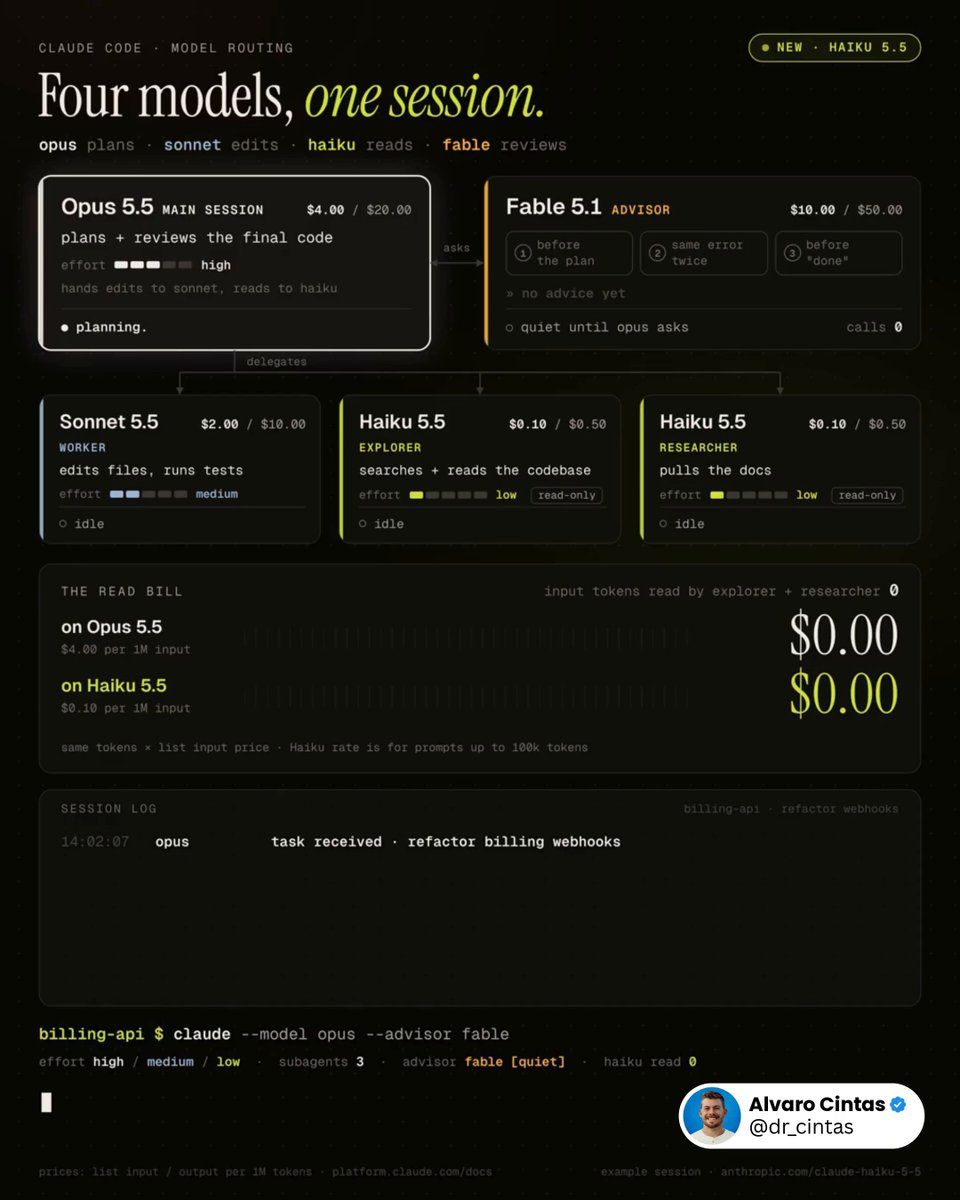
This workflow will save you thousands with Claude. Run Opus 5.5, Sonnet 5.5, Haiku 5.5, and Fable 5.1 together, and stop spending Opus tokens on work that doesn't need Opus. The entire idea in one line: Opus plans, Sonnet edits, Haiku reads, Fable reviews at decision points. Roles, broken down: - Opus 5.5, high effort, owns the plan and reviews the final code - Sonnet 5.5, medium effort, is the worker: edits files, runs tests - Haiku 5.5, low effort, splits into explorer (searches and reads the codebase) and researcher (pulls docs). it's the first Haiku with an effort setting - Fable 5.1, set with /advisor fable. Opus calls it at decision points, and it gets the full transcript each time Three moments Opus tends to call it: → before committing to a plan: is this the right approach? → the same error shows up again: is this going nowhere? → before marking the task done: did something get skipped? Why Haiku only reads: Anthropic's launch post says Sonnet 5.5 and Opus 5.5 are still the better choice for complex agentic coding (Terminal-Bench 4.0: 39.2% for Haiku 5.5, 70.6% for Sonnet 5.5) and that Haiku 5.5 fits narrowly scoped subagent work. so it gets the lookups, not the edits. Anyone still running one model for everything is paying $4 per million input tokens to check whether a file exists. Haiku 5.5 does it for $0.10. Drop this into Claude Code 👇 "Rebuild my Claude Code setup around this structure: Confirm Claude Code is v2.1.293 or later, so the haiku alias resolves to Haiku 5.5. If it isn't, stop and tell me to run claude update. Look through ~/.claude/agents and .claude/agents for subagents already covering explorer, worker, and researcher. Only create new ones for roles that are missing. Set model: haiku, effort: low on explorer and researcher, with no Edit or Write tools. Set model: sonnet, effort: medium on worker. If an existing subagent is locked to a different model, leave it as is and just list it. Name the explorer subagent Explore so it overrides the built-in one, which otherwise runs on my main model. In ~/.claude/settings.json, set advisorModel to fable, and set effortLevel to high for claude-opus-5-5 under modelSettings. A top-level effortLevel in user settings doesn't apply to Opus 5.5. Check for anything disabling the advisor: CLAUDE_CODE_DISABLE_ADVISOR_TOOL, DISABLE_TELEMETRY, or anything blocking feature-flag fetches. Also check CLAUDE_CODE_EFFORT_LEVEL, which overrides subagent effort settings, and CLAUDE_CODE_SUBAGENT_MODEL_FORCE, which makes Claude Code ignore subagent model fields. Report what you find. Don't change any of it yet. Add one line to ~/.claude/CLAUDE.md: consult the advisor before a big plan, when the same error shows up twice, and before marking a long task done. Show every change as a diff first. Wait for my go-ahead before touching anything."

Alvaro Cintas

51,598 Aufrufe • vor 1 Tag

this is straight f*cking gold for anyone on Claude Code you already pay for Fable 5.1, and while Opus 5.5 does all the work it just sits there one command puts it on your session as a senior reviewer: /advisor fable Opus 5.5 keeps writing the code Fable 5.1 reads the whole session, every tool call included, and speaks up at three moments only: > before a plan: is this the right approach? > when the same error comes back: am I digging in the wrong place? > before "done": what did I miss? Fable 5.1 reviews. Opus 5.5 ships Jev engineering does the same thing one layer down: forks that need no thinker (which file, which tool, retry or stop) go to Jev in under half a second, and the big model only sees the ones that actually split • the full tree > Opus 5.5 on high runs the main session > explorer reads the code > worker edits and runs tests > researcher pulls the docs > all three on medium > Fable 5.1 on call as the advisor paste the tree and this prompt into Claude Code ↓ "Rebuild my Claude Code setup around this tree: 1. Check ~/.claude/agents and .claude/agents for subagents that already fit explorer, worker and researcher. Draft new ones only for missing roles. Give each model: opus, effort: medium. Skip any that pin a different model and list them. 2. Set the main session to high via effortLevel in ~/.claude/settings.json, and set advisorModel to fable. 3. Find anything that keeps the advisor off (CLAUDE_CODE_DISABLE_ADVISOR_TOOL, DISABLE_TELEMETRY, any variable that stops feature-flag fetching) plus CLAUDE_CODE_EFFORT_LEVEL, which overrides subagent effort. Report them, change nothing. 4. Add one rule to ~/.claude/CLAUDE.md: consult the advisor before a large plan, when an error repeats, and before calling a long task done. Show me every change as a diff first. No edits until I say go" ↳

Annatar.md

74,132 Aufrufe • vor 9 Tagen