Video wird geladen...

Video konnte nicht geladen werden

Zur Startseite

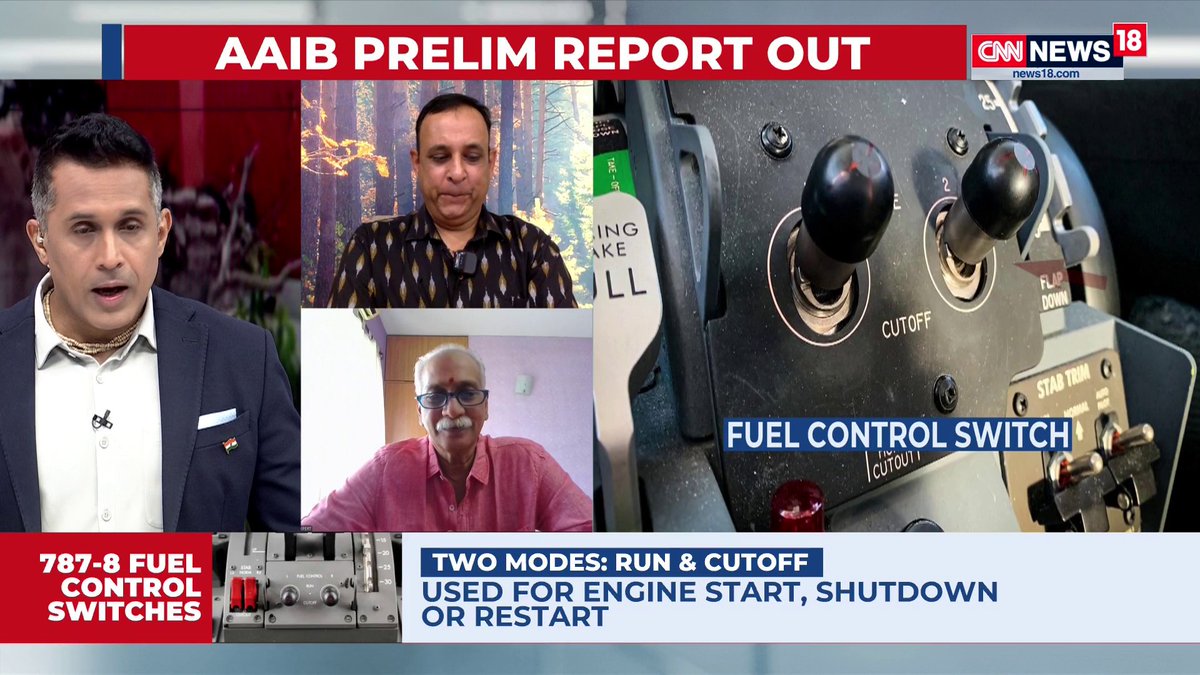
I recreated the scenario in VR using a Boeing 787 with the same Flaps 5 configuration to demonstrate what would have to occur for a dual engine failure on takeoff. The accident investigation report confirms that both engines were manually shut down — something no trained 787 pilot would...

57,228 Aufrufe • vor 1 Jahr •via X (Twitter)

11 Kommentare

Profilbild von Breaking Aviation News & Videos
Breaking Aviation News & Videosvor 1 Jahr

India's AAIB has released its Preliminary Report into the crash of AI flight 171: The aircraft achieved the maximum recorded airspeed of 180 Knots IAS at about 08:08:42 UTC and immediately thereafter, the Engine 1 and Engine 2 fuel cutoff switches transitioned from RUN to CUTOFF position one after another with a time gap of 01 sec. The Engine N1 and N2 began to decrease from their take-off values as the fuel supply to the engines was cut off. In the cockpit voice recording, one of the pilots is heard asking the other why did he cutoff. The other pilot responded that he did not do so. As per the EAFR data both engines N2 values passed below minimum idle speed, and the RAT hydraulic pump began supplying hydraulic power at about 08:08:47 UTC. As per the EAFR, the Engine 1 fuel cutoff switch transitioned from CUTOFF to RUN at about 08:08:52 UTC. The APU Inlet Door began opening at about 08:08:54 UTC, consistent with the APU Auto Start logic. Thereafter at 08:08:56 UTC the Engine 2 fuel cutoff switch also transitions from CUTOFF to RUN. When fuel control switches are moved from CUTOFF to RUN while the aircraft is inflight, each engines full authority dual engine control (FADEC) automatically manages a relight and thrust recovery sequence of ignition and fuel introduction. The EGT was observed to be rising for both engines indicating relight. Engine 1’s core deceleration stopped, reversed and started to progress to recovery. Engine 2 was able to relight but could not arrest core speed deceleration and re-introduced fuel repeatedly to increase core speed acceleration and recovery. The EAFR recording stopped at 08:09:11 UTC At about 08:09:05 UTC, one of the pilots transmitted “MAYDAY MAYDAY MAYDAY”. The ATCO enquired about the call sign. ATCO did not get any response but observed the aircraft crashing outside the airport boundary and activated the emergency response. At 08:14:44 UTC, Crash Fire Tender left the airport premises for Rescue and firefighting. They were joined by Fire and Rescue services of Local Administration. The flap handle assembly sustained significant thermal damage. The handle was found to be firmly seated in the 5-degree flap position, consistent with a normal takeoff flap setting. The position was also confirmed from the EAFR data. The landing gear lever was in “DOWN” position. The thrust lever quadrant sustained significant thermal damage. Both thrust levers were found near the aft (idle) position. However, the EAFR data revealed that the thrust levers remained forward (takeoff thrust) until the impact. Both fuel control switch were found in the “RUN” position. (fig.13) The reverser levers were bent but were in the “stowed” position. The wiring from the TO/GA switches and autothrottle disconnect switches were visible, but heavily damaged. The aircraft is equipped with two Enhanced Airborne Flight Recorders (EAFR) part number 866-0084-102. The EAFR are fitted at two locations, one in the tail section at STA 1847 and other in the forward section at STA 335. The two EAFRs are similar in construction and record a combined data stream of digital flight data and cockpit voice information, with both stored on the same device. The downloaded flight data contained approximately 49 hours of flight data and 6 flights, including the event flight. The recovered audio was two hours in length and captured the event. Initial Analysis of the recorded audio and flight data has been done. LINK:

Profilbild von Air Race
Air Racevor 1 Jahr

@aviationbrk That’s an eerie sound of silence

Profilbild von Chris Ryan
Chris Ryanvor 1 Jahr

@aviationbrk I cant image how horrific that expeirnce must have been as a passenger. From engines stopping to the feeling of falling out of the air. Unbelievably tragic.

Profilbild von RaOne
RaOnevor 1 Jahr

@aviationbrk The report never says manually shut down - and manually shutting down both 1 second apart seems improbable. Most likely a technical glitch in the systems or sabotage

Profilbild von Buddy
Buddyvor 1 Jahr

@aviationbrk No recreation sim has a study level 787 and you’re not even following appropriate engine failure procedures so this is useless.

Profilbild von Chris Ryan
Chris Ryanvor 1 Jahr

@aviationbrk It shows what would have to happen for fuel to stop flowing and what someone inside the cockpit would have to have done to cut off fuel to the engines. Its not an official accident recreation its a flight sim.

Profilbild von atuntable
atuntablevor 1 Jahr

@aviationbrk Indeed, the greatest threat to air safety has become the pilots themselves.

Profilbild von The Bear
The Bearvor 1 Jahr

@aviationbrk Can you do it again but turn them back on per the timeline please?

Profilbild von Chris Ryan
Chris Ryanvor 1 Jahr

@aviationbrk Don't forget I also don't have a big building in front of me like they did either. They only had one engine relight and give thrust and I have two and I still crashed.

Profilbild von atuntable
atuntablevor 1 Jahr

@aviationbrk If a Pilot had deliberately cut off the fuel why would they have then turned it back on again before the crash? With the timing it was possible that the engines would indeed have spilled up and they would have got away with it.

Profilbild von Rajesh Toppo
Rajesh Toppovor 1 Jahr

@aviationbrk Engine 1 and Engine 2 fuel cutoff switches transitioned from RUN to CUTOFF position one after another with a time gap of 01 sec. In the cockpit voice recording, one of the pilots is heard asking the other why did he cutoff. The other pilot responded that he did not do so. ????

Ähnliche Videos

NewsNation sat down with a whistleblower close to the Nancy Guthrie investigation and what he revealed about the case was disturbing. “The supervisor...never investigated a homicide before being installed as the supervisor for the homicide unit.” Senior correspondent Brian Entin sat down with unidentified man for a full-length interview. ENTIN: “What would you say are the biggest mistakes when it comes to the Nancy Guthrie investigation from what you know?” WHISTLEBLOWER: “Speaking with some people that actually know the intimate knowledges of this investigation, have told me that an immediate rush to judgement on what was happening at that scene, and it was that Nancy had somehow wandered off.” “They rushed to that judgment, stayed with that judgement, and then ran the investigation as if this was a search and rescue mission, as opposed to a possible criminal issue.” ENTIN: “From what you know, we're the initial people who responded, inexperienced?” WHISTLEBLOWER: “From what I understand, the people that were there on the scene were not tenured homicide detectives.” “They didn't have a lot of experience in homicide at that point, to include the supervisor, who, from my understanding never investigated a homicide before being installed as the supervisor for the homicide unit.” ENTIN: “So the supervisor, who first responded to Nancy Guthrie's house, had never investigated a homicide?” WHISTLEBLOWER: “Correct.”

Overton

13,552 Aufrufe • vor 3 Monaten

The name on one of the crew might ring a bell... June 19 1947: Pan Am Flight 121, a Constellation, crash-lands in Mayadine (Syria). 14 of 36 aboard die. In flight, the #1 engine failed due to a mechanical issue. Attempting to divert to an alternate airport, the #2 engine also failed. The crew made a belly landing in the desert, where the aircraft caught fire. Among the survivors was a dead heading 3rd officer named Gene Roddenberry, who would go on to create the iconic science fiction television series “Star Trek”. This was Roddenbery´s 2nd major plane crash, having survived another major accident during his service in the Pacific Theatre, during WW2 Accident description from ASN (One of many period accidents where an engine failure led to a fatal crash. Nowadays, an engine fail is nearly routine and at worst it causes a diversion...) "The Constellation, named "Clipper Eclipse", was cruising at FL185 when the no. 1 prop had to be feathered due to engine problems. The remaining three engines overheated, forcing the crew to reduced power. This resulted in a gradual descent. The crew elected to continue to Istanbul instead of landing at the nearby Habbaniya RAF Station in Iraq. While descending through FL100 a fire broke out in the engine no. 2 nacelle. A rapid descent was started during which the no. 2 engine separated from the wing. With the left wing on fire a belly landing was carried out in the desert. It appeared the no. 1 engine failure was due to a broken exhaust rocker arm on the no.18 cylinder. The no. 2 engine failure was due to a failure of the thrust bearing which in turn resulted in blocking the passage of oil from the propeller feathering motor to the propeller dome. PROBABLE CAUSE: "The Board determines that the probable cause of this accident was a fire which resulted from an attempt to feather the No. 2 propeller after the failure of the No. 2 engine thrust bearing."

Francisco Cunha

56,655 Aufrufe • vor 1 Monat

The Engine Start Levers or Fuel Cut off switches (different name, same switches) control the fuel and ignition for the engines. The 787 shares the same switches and very similar logic to the Boeing 737 Max. The switches have been designed in such a way that they require a very deliberate movement in order for them to move from one position to another. They’re also placed in such a position (below the thrust levers) so that it’s very unlikely that they’ll be knocked. But even if they were, the spring force and detent would prevent them from moving unintentionally. When we move the start levers from the “Run” or “Idle” position, to “Cutoff”, an electrical signal is sent to move the fuel valves from open to close. The engine ignitors are also then de-powered. This stops the supply and ignition of fuel and the engine spools down. Pilots are trained from day one to only touch those switches in flight when called for by a non normal checklist, such as an engine fire or failure. When a fuel switch has to be moved to cutoff in flight, we adhere to a very strict procedure… Pilot monitoring will place their hand on the switch of the damaged engine and both visually and audibly confirm with Pilot flying that the correct fuel switch has been selected. Only after both pilots have confirmed that the correct switch has been selected, will pilot monitoring move that switch to the cutoff position. As an additional layer of safety, some aircraft types only allow the switch to be moved to cutoff in flight if the thrust levers are in the closed or idle position. Do you think that this design feature should be implemented in all aircraft? 📸 by ig/airlinepilotperformance

aircraftmaintenancengineer

149,946 Aufrufe • vor 1 Jahr

AIR INDIA 787 ‘thoughts’ I’m surprised nobody, even the experts) have mentioned this… The 787 Dreamliner (all variants) has an ‘Air Ground Sensing’ system that opens the Main Gear doors immediately upon leaving the runway and prior to the (Flight Deck) Lever being moved manually to the ‘up’ position. I’ve witnessed this literally hundreds of times when filming The 787 and it’s clear on the footage attached: upon rotate, about one second from wheels off ground, the main Gear Doors open. Then, around three to four seconds (pilot discretion) Positive Rate is called/agreed and the Gear Lever is moved to the UP position. On a side note, the 787 is quite prone to brake malfunction, mostly down to the electric brake system that can fail from time to time on a single (or more) wheel. If the wheels are not retracted within a given amount of time due to a wheel continuing to spin, the gear doors will close back-up until the wheel(s) stop spinning and the gear is recycled at which time the doors will re-open and the gear will retract fully. This is the takeoff/gear-up procedure with all 787s. This is quite clearly not the case when observing the CCTV footage of the doomed Air India jet. I think it’s quite evident there was some kind of (electrical?) malfunction with the system(s). The question of the Flap (takeoff) Setting is still a mystery as, with poor quality footage, it’s difficult to completely confirm whether the flaps were extended or not. In my personal opinion they were not extended. There was a CNN reporter right next to one of the wings on the ground. Although it was heavily charred, it would’ve been clear to see if they were extended or not 🤷🏼‍♂️ Also, as for possible (engine) ingestion/failure, whether by birds or other FOD, there is no evidence of engine Compressor Stall, which is very clear to see in many videos online when it does happen with bird strikes, especially at rotate power/speed. The engine(s) will ‘pop’ flames out of the back. What is evident, is that the Jet uses all of the available runway, which is clear by the amount of dust being kicked-up on rotate. The Jet never seems to reach the optimal takeoff angle, right from the rotate point it appears to struggle, which would suggest either engine power issues or, as mentioned, the lack of lift from the Flaps/Slats. Witness accounts say there was a distinct lack of engine noise coming from the jet, which backs-up some theories of engine failure. You would expect, even with a lack of Flap setting the pilot would be able to increase to max (TOGA) power to give them some chance of climbing or at least gaining enough altitude to get themselves back to the airfield or to a safer (crash) landing zone. That ‘power up’ would be evident with black exhaust from the engines, but that didn’t happen - at all. You’ll see/hear from the (second part) footage I’ve filmed, that the engine sound is very evident at this height and that this climb-out is too Standard Operating Procedures. Personally I find it hard to believe the NFP would make such a rookie mistake as to raise the flaps (push and move the staggered lever) as opposed to the gear lever which is a simple up-down motion. The two levers are also in completely different positions: Gear lever on the facing panel and flap lever (with many settings) next to the throttles. Plus this is such a basic procedure that even the most rookie pilot wouldn’t make this mistake 🤷🏼‍♂️ Again, this is just my opinion and observations based on visual and actual experiences. The CVR and FDR will deliver the final evidence.

BIG JET TV

1,728,473 Aufrufe • vor 1 Jahr