正在加载视频...
视频加载失败
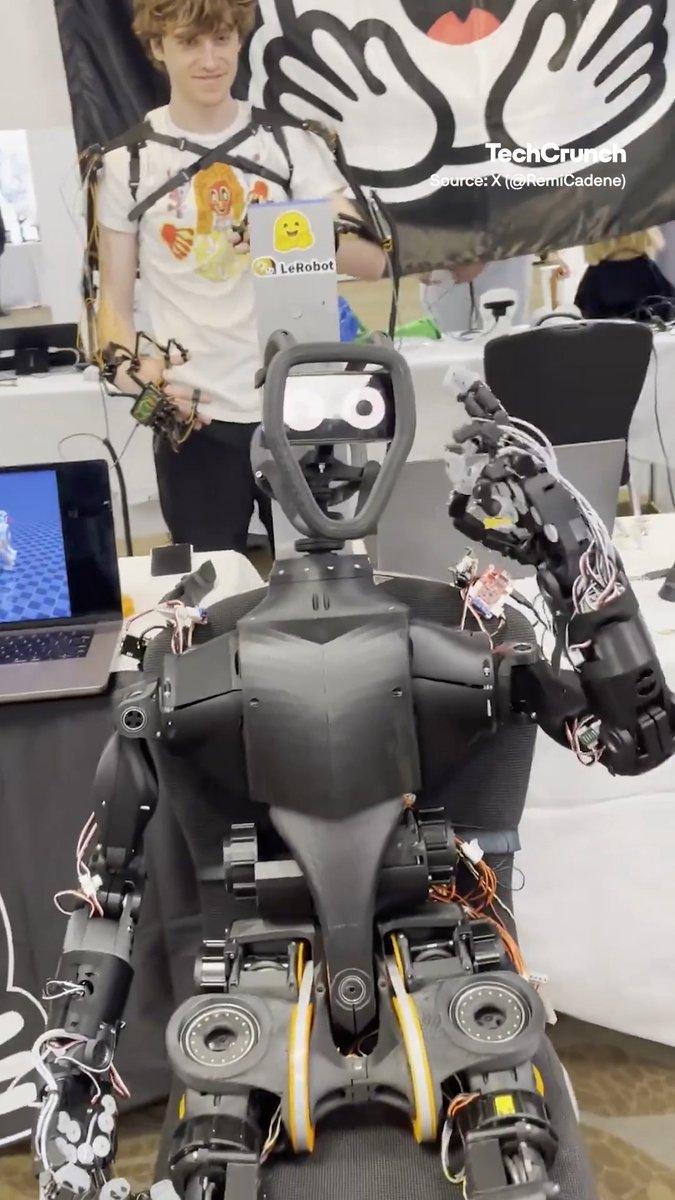
Introduce Open-𝐓𝐞𝐥𝐞𝐕𝐢𝐬𝐢𝐨𝐧🤖: We need an intuitive and remote teleoperation interface to collect more robot data. 𝐓𝐞𝐥𝐞𝐕𝐢𝐬𝐢𝐨𝐧 lets you immersively operate a robot even if you are 3000 miles away, like in the movie 𝘈𝘷𝘢𝘵𝘢𝘳. Open-sourced!

10 条评论

Real-time stereo video streaming provides spatial/depth understanding, so the operator is confident about the objects’ locations. This enables fine manipulation with challenging objects such as transparent boxes.
An active neck plus IK and retargeting enables intuitive perception and actuation for the operator. The operator just needs to look at the points of interest intuitively and the robot will follow the same head movements.
The system is easily accessible from any device with a web browser (Vision Pro, Quest, even mac, iPad, iPhone…).
Not possible without the joint efforts of @Jialong_LI_UIM @AaronYANG2000 @EpisodeYang @xiaolonw Try now even if you don’t have a VR device! More videos, code, hardware, and dataset at:

This is useful!
Thanks Huazhe!

This is awesome, congrats Xuxin!
Thanks Quanting!

The experiments show that the proposed system outperforms baseline models in terms of task success rates and completion times. The use of stereo video input is found to be crucial for the operator's spatial understanding and task performance. full paper:

@vateseif @arbwes
![Collect robot demos from anywhere through AR! Excited to introduce 🎯DART, Dexterous AR Teleoperation interface enabling anyone to teleoperate robots in cloud-hosted simulation. With DART, anyone can collect robot demos anywhere, anytime, for multiple robots and tasks in one sitting. Every data is automatically logged on our open-sourced cloud database DexHub for public use. 🧵[1/n]](https://image.24vids.com/tw-1853692712387572200/ext_tw_video_thumb/1853667567526727680/pu/img/MNcOecU2zgnNSiUb.jpg)




![Open-source robot arm meets hand tracking [📍GitHub below] It is designed with an industrial mindset but built as a 3D-printed desktop system. PAROL6 paired with a LEAP Motion controller is a nice example of how accessible robot teleoperation has become. • Hand motion is streamed to the robot at 100 Hz via UDP • A pneumatic gripper is controlled by simple fist open and close gestures • The entire robot stack is open source, from mechanics to control software Combine that with low-latency hand tracking and you get a very practical platform for learning manipulation, teleoperation, and human-robot interfaces. This kind of setup is great for experimentation, teleop, data collection, and teaching robots by demonstration All without proprietary hardware or locked software. Credit to SourceRobotics 📍Code: —— Weekly robotics and AI insights. Subscribe free:](https://image.24vids.com/tw-2014985571819548685/ext_tw_video_thumb/2014985526453886976/pu/img/LyUfTi8FQUF_UOXY.jpg)


