正在加载视频...

视频加载失败

Introducing InsForge Backend Branching. We made agentic coding production-safe. Your agent creates isolated backend branches when working. Every backend service, policy, and config is copied into a secure, isolated environment. Review PR-style diffs. Merge only when ready.

62,139 次观看 • 1 个月前 •via X (Twitter)

0 条评论

暂无评论

原始帖子的评论将显示在这里

相关视频

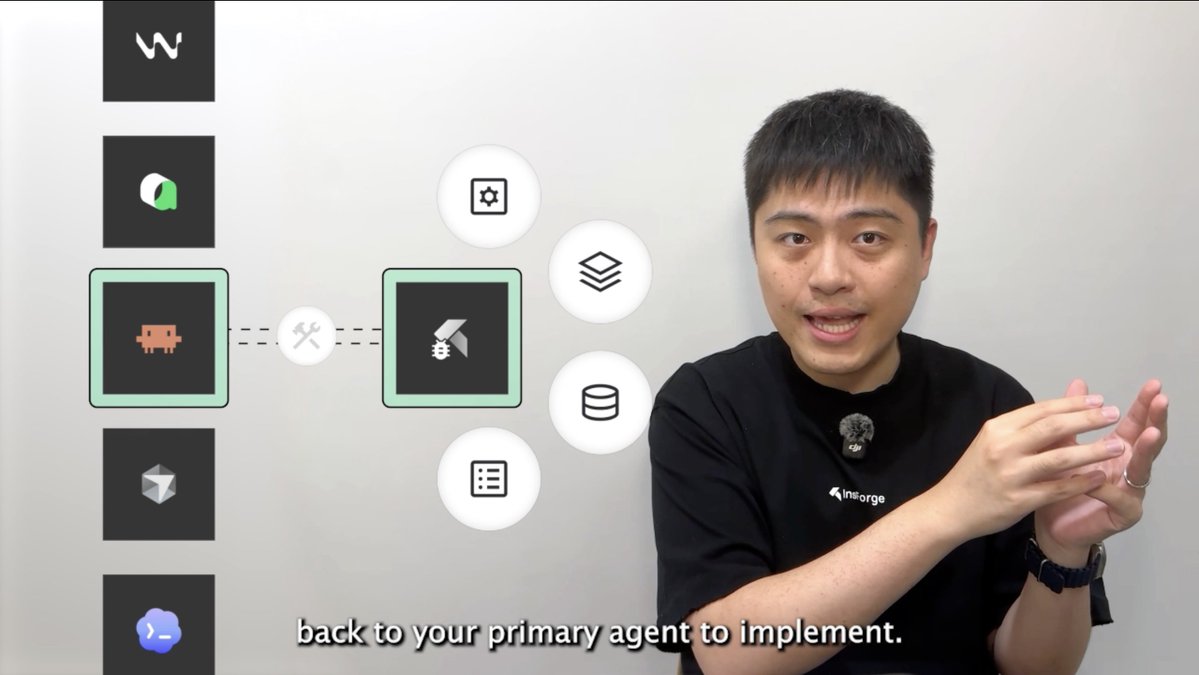
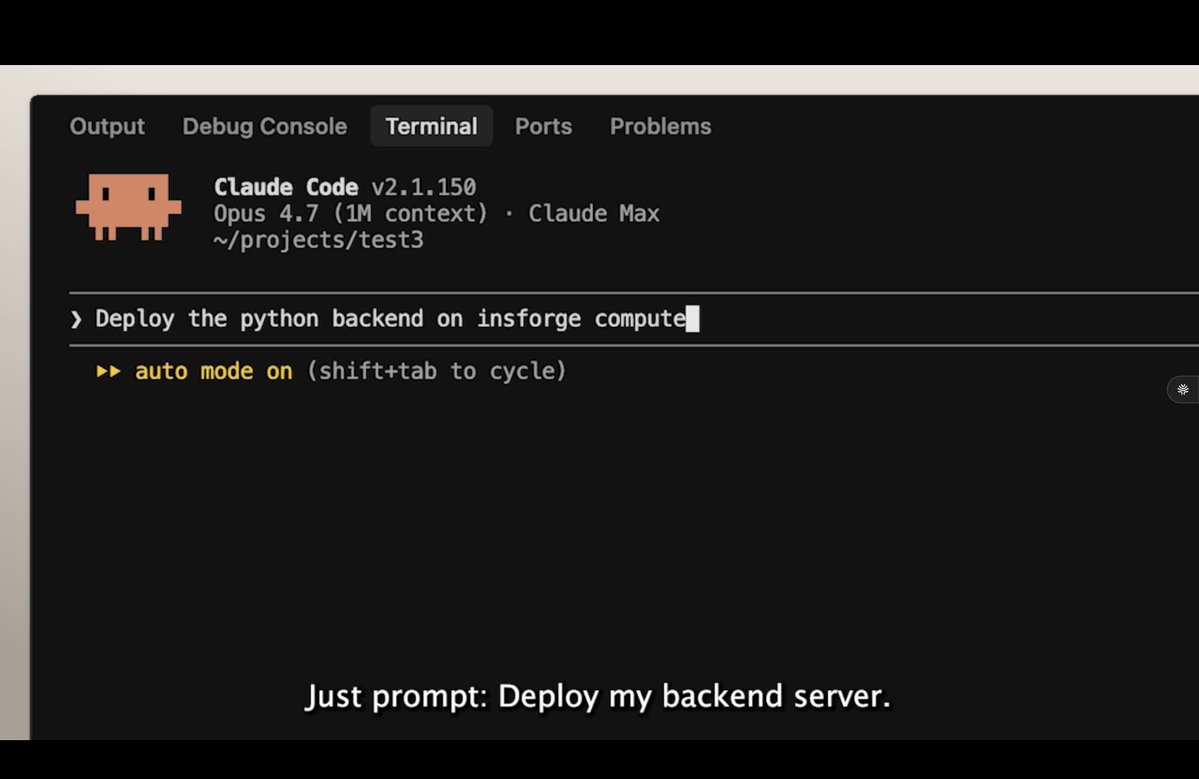
i just built a 4-agent software team. everything runs from Telegram and gets managed on a kanban board. a project manager who plans the work, a backend developer, a frontend developer, and a tester. the PM reads a goal, breaks it into linked tasks, and assigns each to the right agent. the thing that makes them a team instead of four strangers is a shared kanban board. every task is a row that survives crashes, and when an agent finishes, it writes a summary of what it built and what the next agent needs to know. the next agent reads that summary before it starts. so the frontend developer never has to guess the API shape, and the tester knows exactly what to verify. the hardest part was not the coordination. it was building an agent that could actually act like a backend engineer. a backend engineer stands up a database, wires auth, manages storage, deploys functions, and keeps all of it consistent while the rest of the team builds on top. an agent doing this from scratch drowns. it burns its context window remembering which tables exist and which endpoint it created three steps ago, and the work degrades fast. so the backend agent needs a backend built for agents, not for humans clicking through a dashboard. that is where InsForge came in. it is an open-source, agent-native backend, and i added it to my backend developer agent as a skill. a skill is a step-by-step guide that teaches the agent how to do a specific kind of work. with InsForge installed, the agent stopped improvising infrastructure and followed a reliable path: create the project, define the database, set up auth, deploy functions. to test the whole team, i had them build a working Google Docs clone, AI features included. the backend agent spun up the full service on its own. database tables, user auth, document handling, and edge functions running real TypeScript, all in one dashboard. the frontend agent read that summary and built the UI on top of it, and the tester closed the loop. the result was a backend an agent could reason about end to end, instead of one it kept getting lost inside. if you are building an AI backend engineer, InsForge is worth a look, it's 100% open-source. InsForge GitHub: (don't forget to star 🌟) the full article on Hermes Kanban: Mission Control for your Agents is quoted below.

Akshay 🚀

118,124 次观看 • 1 个月前

QVAC SDK 0.15.0 is live. This release adds multiple prompts batching, brings a native AMD GPU backend to the stack, moves more vision encoders onto mobile GPUs, and adds a second local coding-agent integration. Main highlights: - Prompt batching for the LLM addon. Batch multiple prompts into one job and process them concurrently, with each answer returned the moment its generation finishes. - Native AMD GPU backend. A first-class HIP/ROCm backend in @qvac/vla-ggml, auto-selected over Vulkan with clean fallback when ROCm is absent. - A second local coding agent. OpenClaw joins OpenCode for local, cloud-free agent workflows. AGENTS - OpenCode plugin update (@qvac/opencode-plugin). Aligned with the current SDK, CLI, and AI SDK provider packages. A fresh install runs OpenCode against managed local QVAC models out of the box, from the default qvac/qwen3.5-9b, with no manual qvac serve setup. - OpenClaw plugin (@qvac/openclaw-plugin). A second coding-agent integration alongside OpenCode. A fresh setup installs the plugin, creates a local qvac provider through onboarding, and runs a QVAC model through OpenClaw🦞's local service path. LANGUAGE MODELS - Prompt batching (LLM addon). Batch multiple prompts in one job and run them concurrently, each answer returns the moment its generation finishes, no waiting on the others. - Reasoning-context trimming on hybrid + recurrent models (@qvac/llm-llamacpp). remove_thinking_from_context now works beyond pure-attention models. Same JS API, no throw. VOICE AND SPEECH - Transcription (transcription-parakeet 0.9.0). More robust CPU fallback on GPU failure and a faster Vulkan backend on Pixel 9. - Text-to-speech features (tts-ggml 0.4.0). Adds LavaSR for noise removal and adjustable output frequency up to 48 kHz, plus Japanese via Chatterbox. - Text-to-speech fixes (tts-ggml 0.4.1). CPU fallback on GPU failure, a q8_0 KV crash fix on Metal with Chatterbox. VISION - Qwen3.5 vision encoder on GPU (Android). Image encoder moves onto the phone GPU, with a smarter tile-grid preprocessor and default image-token caps, for flagship Android: Vulkan on Mali (Pixel 9 Pro) and OpenCL on Adreno 830 (Galaxy S25). - Gemma-4 vision encoder on GPU (Android). Vision encoder runs on the phone GPU instead of CPU, same flagship Android targets. PLATFORM AND PERFORMANCE - AMD GPU backend (@qvac/vla-ggml). Native HIP/ROCm backend, auto-selected over Vulkan with clean fallback when ROCm is absent (Linux x64 only). Comes with ~23% faster than Vulkan, ~14% faster than PyTorch-ROCm, parity preserved. Unified code style. A cleaner, more consistent, easier-to-contribute codebase. Let's build. npm install @qvac/sdk

QVAC

17,700,244 次观看 • 7 天前

I cut Fable 5 token usage 2.5x with just one change! - Before: 5.5 M tokens · 7 errors · $8.94 - After: 2.3 M tokens · 0 errors · $4.17 The final build was the same for both, but the path the agent took wildly differed. In both runs, the agent started with the same thing, i.e., it understood the backend before building anything, like: - Permission policies - Available storage buckets - Auth providers configured - How edge functions are deployed The first run used Firebase, which was built for a human dev using a dashboard. While the dev can read the above state by clicking through tabs, an agent has no dashboard. So it gathered the same info through API calls. And there's no single Firebase call that returned this info. The agent required to query multiple times, and each query over-returned. For instance, when the agent asked how sign-in is configured, Firebase also returned the entire auth surface and every method it supported. This was far more context than what it needed. And it repeated across every part of the backend it inspected. Some states (like which auth providers are active) weren't queryable at all. I provided it myself. Otherwise, the agent would have guessed. Errors further compounded the token usage. When a dev sees "permission denied," they can look at the console and figure out whether it's a rule, a path, or an unauthenticated request. Firebase returned the same string to the agent as well, and it had none of that surrounding context to debug. So it guessed again, picked the most likely cause, and rewrote code, utilizing more tokens. This Firebase setup cost me 5.5M tokens and 7 manual interventions during errors on a full-stack RAG app. But I brought that down to 2.3M tokens and 0 manual interventions by using InsForge as the backend context engineering layer (open-source and self-hostable via Docker). It provides the same primitives as Supabase/Firebase, but structures the entire information layer for agents, instead of dashboards. In one CLI call that consumed ~500 tokens, the agent saw the full backend topology before writing a single line of code. This included auth, database, storage, edge functions, model gateway, micro VMs, and deployment. Also, instead of loading the entire product surface into context on every task, four narrowly scoped skills activated only when relevant to keep cognitive load minimal. And to ensure efficient retries if needed, every CLI operation returned structured JSON with meaningful exit codes, so the agent never guessed what to do next. Here's the InsForge GitHub Repo: (don't forget to star it ⭐) The video below depicts the final build, comparing Firebase and InsForge. To dive deeper, I recently published a full walkthrough building the same RAG app on both backends and inspected them end-to-end. Read it below.

Avi Chawla

112,879 次观看 • 1 个月前

HERMES AGENT NOW HAS AUTOMATION TEMPLATES. COPY-PASTE RECIPES FOR CRON JOBS AND WEBHOOKS. ANY MODEL. ANY DELIVERY PLATFORM. three trigger types: SCHEDULE → runs on a cadence (hourly, nightly, weekly) GITHUB EVENT → fires on PR opens, pushes, issues, CI results API CALL → any external service POSTs JSON to your endpoint all three deliver to Telegram, Discord, Slack, SMS, email, GitHub comments, or local files.Nous Research what templates ship right now: DEVELOPMENT: → nightly backlog triage (label + prioritize new issues) → automatic PR code review (posts review on every PR) → docs drift detection (finds code changes without doc updates) → dependency security audit (daily CVE scan, CVSS >= 7.0) DEVOPS: → deploy verification (smoke tests after every deploy) → alert triage (correlates alerts with recent changes) → uptime monitor (check endpoints every 30 min, notify only when something is down) RESEARCH: → competitive repo scout (monitor competitor PRs daily) → weekly AI news digest (headlines, papers, repos, industry) → daily arXiv scan (saves summaries to your notes) the webhook system is the part most people miss: hermes webhook subscribe github-pr-review \ --events "pull_request" \ --prompt "Review this PR for security, performance, and code quality." \ --skills "github-code-review" \ --deliver github_comment one command. every future PR gets reviewed automatically. the review posts as a comment directly on the PR. two cost-saving details from the docs: 1. use [SILENT] in prompts. "if nothing changed, respond with [SILENT]" prevents notification noise on monitoring jobs. 2. use script-only cron jobs for data collection. a Python script handles HTTP requests and file reads. the agent only sees stdout and applies reasoning. cheaper and more reliable than having the agent fetch. every template is copy-paste ready. every template works with any model. docs: full Hermes agent SOUL MD guide in the article 👇

YanXbt

37,775 次观看 • 1 个月前