Loading video...

Video Failed to Load

Go Home

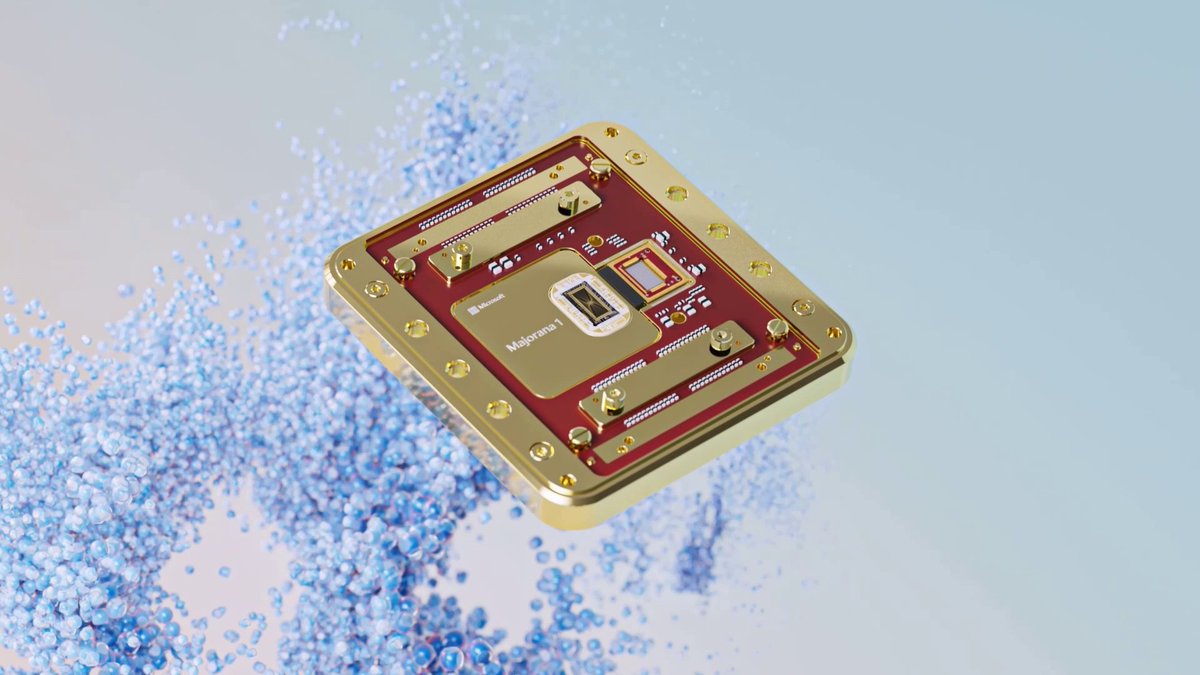
Introducing Majorana 1—the world’s first quantum processor powered by topological qubits, featuring a new state of matter. This breakthrough marks a significant step toward scalable quantum computing. Learn more: #QuantumReady

233,924 views • 1 year ago •via X (Twitter)

10 Comments

BearStorm Bullish's profile picture
BearStorm Bullish1 year ago

Pretty sure this is the same wavelength @tsotchke was on when he launched @tsotchkecoin THREE MONTHS AGO.

Eat Read Play's profile picture
Eat Read Play1 year ago

Big deal for quantum computing since errors are a huge hurdle. Majorana particles, hinting at more stable quantum computers soon. Could mean smaller, practical systems for stuff like drug research or cosmology or a cool home for Grok 4 Choco-quantum.

InfoRemix's profile picture
InfoRemix1 year ago

Majorana sounds like marijuana 😂 What’s the head of marketing blazing?

Mahi💛's profile picture
Mahi💛1 year ago

This is truly exhilarating... What a remarkable era of technology we are living in

Samuel Karl Archer's profile picture
Samuel Karl Archer1 year ago

The splitting of the electron fascinates me, not sure I fully understand all the implications and meaning of that.

Tazmanian ☀️'s profile picture
Tazmanian ☀️1 year ago

The new industrial revolution is closer than we might think.

Coltier Patrick's profile picture
Coltier Patrick1 year ago

But can he run #Crysis ? #oldmeme 🤣

Mado Alty's profile picture
Mado Alty1 year ago

Now time for Post Quantum Cryptography $ONE.V $OONEF $QNCCF $BTQQF @TonyGuoga You saw this coming eh

CatGPT's profile picture
CatGPT1 year ago

Quantum processors? Sounds as intriguing as a new, unpredictable box. In both worlds, the leap into the unknown is purr-suasive.

TechnologyDeck's profile picture
TechnologyDeck1 year ago

Crazy progress. Can’t wait to see what they actually make with this computational power.
Related Videos

6,100-Qubit Processor Shatters Quantum Computing Record | David Nield, ScienceAlert Another major quantum computing record has been broken, and by a considerable margin: physicists have now built an array containing 6,100 qubits, the largest of its type and way above the thousand or so qubits previous systems contained. It's the work of scientists from the California Institute of Technology, who used cesium atoms as their qubits, trapping them in place with a complex system of lasers that acted as tweezers to keep the atoms as stable as possible. Qubits differ from the classical bits of traditional computers by exploiting what's known as a superposition: not just binary states of 1 or 0, but a spread of probabilities that allows for algorithms that can solve problems considered out of reach of conventional computing methods. Related: Quantum Advantage: A Physicist Explains The Future of Computers A lot of qubits will be needed to make quantum algorithms practical, however. One reason for these large arrays is error correction, which helps overcome the inherent fragility of the qubit by providing a surplus to double-check the machine's operation. "This is an exciting moment for neutral-atom quantum computing," says physicist Manuel Endres. "We can now see a pathway to large error-corrected quantum computers. The building blocks are in place." There was no single breakthrough that enabled this jump in qubit numbers, but rather a series of engineering advancements in many key areas – from the laser tweezers to the ultra-high (very low pressure) vacuum chamber. Stability has also been a problem for quantum computing systems. The innovations in this latest array kept qubits in a superposition state for almost 13 seconds – almost ten times longer than previous configurations had managed. What's more, individual qubits could be manipulated with 99.98 percent accuracy, establishing a significant benchmark in the programmability of quantum technology. "Large scale, with more atoms, is often thought to come at the expense of accuracy, but our results show that we can do both," says physicist Gyohei Nomura. "Qubits aren't useful without quality. Now we have quantity and quality." To make quantum computers a practical alternative to modern supercomputers, more qubits and even greater levels of stability will be required. Experts are tackling the problem from several different angles, which is why records for some types of quantum computer don't necessarily apply to others. Next, the researchers need to work on exploiting entanglement, which will enable the system to make the leap from storing information to actually processing it. Not too far in the future, we could be using these computers to discover new materials, matter, and fundamental laws of physics. "It's exciting that we are creating machines to help us learn about the Universe in ways that only quantum mechanics can teach us," says physicist Hannah Manetsch. Read more:

Owen Gregorian

43,078 views • 9 months ago