Video wird geladen...

Video konnte nicht geladen werden

Zur Startseite

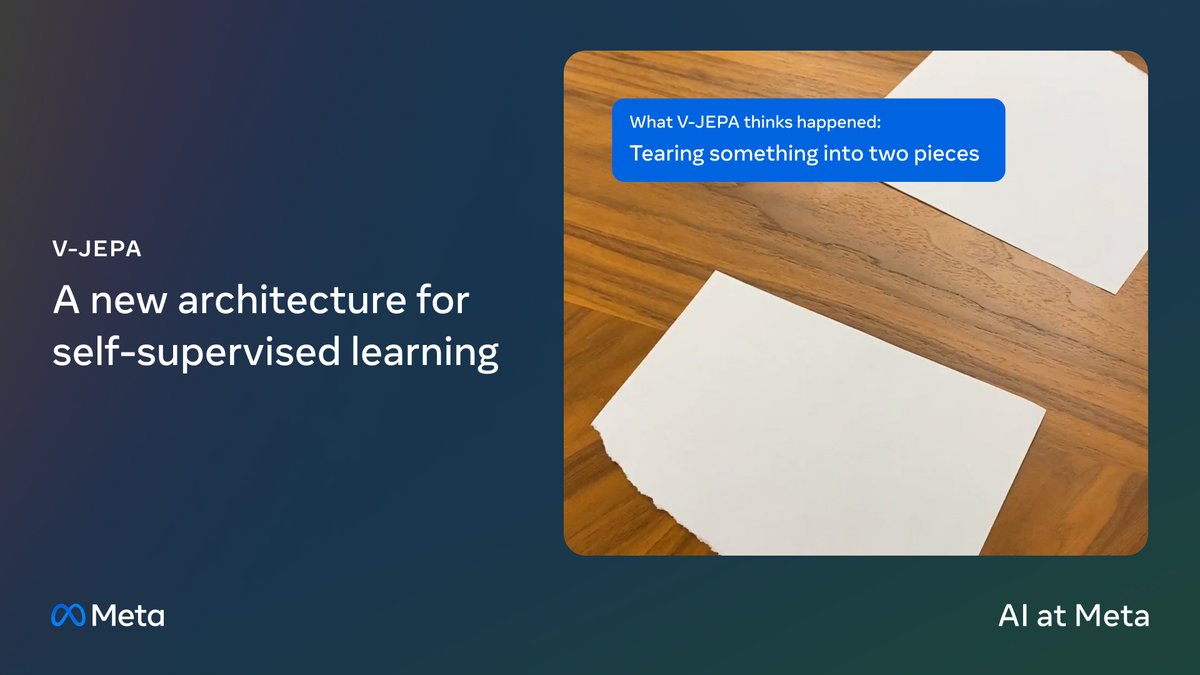
Introducing VL-JEPA: Vision-Language Joint Embedding Predictive Architecture for streaming, live action recognition, retrieval, VQA, and classification tasks with better performance and higher efficiency than large VLMs. • VL-JEPA is the first non-generative model that can perform general-domain vision-language tasks in real-time, built on a joint embedding predictive architecture. •...

90,144 Aufrufe • vor 7 Monaten •via X (Twitter)

0 Kommentare

Keine Kommentare verfügbar

Kommentare vom Original-Post werden hier angezeigt

Ähnliche Videos

3D-LLM: Injecting the 3D World into Large Language Models paper page: Large language models (LLMs) and Vision-Language Models (VLMs) have been proven to excel at multiple tasks, such as commonsense reasoning. Powerful as these models can be, they are not grounded in the 3D physical world, which involves richer concepts such as spatial relationships, affordances, physics, layout, and so on. In this work, we propose to inject the 3D world into large language models and introduce a whole new family of 3D-LLMs. Specifically, 3D-LLMs can take 3D point clouds and their features as input and perform a diverse set of 3D-related tasks, including captioning, dense captioning, 3D question answering, task decomposition, 3D grounding, 3D-assisted dialog, navigation, and so on. Using three types of prompting mechanisms that we design, we are able to collect over 300k 3D-language data covering these tasks. To efficiently train 3D-LLMs, we first utilize a 3D feature extractor that obtains 3D features from rendered multi- view images. Then, we use 2D VLMs as our backbones to train our 3D-LLMs. By introducing a 3D localization mechanism, 3D-LLMs can better capture 3D spatial information. Experiments on ScanQA show that our model outperforms state-of-the-art baselines by a large margin (e.g., the BLEU-1 score surpasses state-of-the-art score by 9%). Furthermore, experiments on our held-in datasets for 3D captioning, task composition, and 3D-assisted dialogue show that our model outperforms 2D VLMs. Qualitative examples also show that our model could perform more tasks beyond the scope of existing LLMs and VLMs.

AK

249,708 Aufrufe • vor 3 Jahren

Check out our latest work, "Actor-Critic Model Predictive Control: Differentiable Optimization meets Reinforcement Learning for Agile Flight," published in the IEEE Transactions on Robotics, where we reconcile #OptimalControl and #ReinforcementLearning, achieving the same super-human performance, but with superior generalizability, as our previous model-free deep RL! Code released! PDF: Code: Full Video: Model-free #ReinforcementLearning (RL) is known for its strong task performance and flexibility in optimizing general reward formulations. On the other hand, #ModelPredictiveControl (MPC) provides robustness, constraint handling, and powerful online replanning capabilities. In this work, we extend our previous AC-MPC paper (Romero, ICRA'24) by taking a deeper look at how both approaches can be unified. We introduce and extend Actor-Critic Model Predictive Control (AC-MPC), a framework that embeds a differentiable MPC inside an Actor-Critic RL architecture. This integration allows the MPC-based actor to perform short-term predictive optimization, while the critic facilitates long-horizon learning and exploration. We conduct a comprehensive study that highlights AC-MPC’s key advantages: - Better out-of-distribution generalization, both against unknown disturbances and changes in the quadrotor dynamics - Improved sample efficiency - A novel empirical analysis uncovering a relationship between the critic’s value function and the MPC cost function, providing deeper insight into their interplay. We validate our method in simulation and the real world on a quadcopter flying at superhuman speeds of up to 21 m/s, matching state-of-the-art model-free RL performance, and retaining the predictive structure of MPC for more reliable out-of-distribution behavior. Reference: Actor-Critic Model Predictive Control: Differentiable Optimization meets Reinforcement Learning for Agile Flight IEEE Transactions on Robotics (T-RO), 2025 PDF: Full Video: Code: Kudos to Ángel Romero, Elie Aljalbout, Yunlong Song! University of Zurich UZH Science UZH Space Hub AUTOASSESS European Research Council (ERC) UZHai

Davide Scaramuzza

27,090 Aufrufe • vor 6 Monaten

New short course: Build Long-Context AI Apps with Jamba. Learn about state space models (SSMs), which have emerged as an alternative to transformers! Specifically, Jamba is a hybrid transformer-Mamba architecture that combines strengths of the transformer with ideas from SSMs. This course is built with AI21 Labs and taught by Chen Wang and Chen Almagor. The transformer architecture is computationally expensive when handling very long input contexts. But there's an alternative called Mamba, a selective state space model that can process very long contexts with a much lower computational cost. However, researchers found that the pure Mamba architecture underperforms in understanding the context, and gives lower-quality responses. To overcome this, AI21 developed the Jamba model, which combines Mamba's computational efficiency with the transformer's attention mechanism to help with the output quality. In this course, you’ll learn about how state space models, and Jamba, work. You’ll also learn how to prompt Jamba, use it to process long documents, and build long-context RAG apps. - Learn how Jamba combines transformer and state space model architectures to achieve high performance and quality - Use the AI21 SDK, with an example of prompting over a large 200k-token annual financial report of Nvidia - Use Jamba for tool-calling, with hands-on examples from calling simple arithmetic calculations to a function that returns quarterly company financial reports. - Learn how training for long context is done, and the metrics used for its evaluation - Create a RAG app using the AI21 Conversational RAG tool and build your own RAG pipeline that uses Jamba and LangChain. By the end of this course, you'll learn how to build applications that can handle context as long as an entire book. Please sign up here:

Andrew Ng

77,792 Aufrufe • vor 1 Jahr

Google just proved that bigger isn't always better. Their 308M parameter model is outperforming models 2x its size. Google just released 𝗘𝗺𝗯𝗲𝗱𝗱𝗶𝗻𝗴𝗚𝗲𝗺𝗺𝗮, and it's proving that lightweight embedding models can punch way above their weight class. At just 308M parameters (578MB), it's the new state-of-the-art for models under 500M parameters across MTEB multilingual, English, and code benchmarks. But the really impressive part is that it ranks 8th overall on MTEB(Multilingual, v2) - that's 𝟭𝟳 𝗽𝗹𝗮𝗰𝗲𝘀 above the second-best sub-500M model, and it's delivering performance 𝗰𝗼𝗺𝗽𝗮𝗿𝗮𝗯𝗹𝗲 𝘁𝗼 𝗺𝗼𝗱𝗲𝗹𝘀 𝗻𝗲𝗮𝗿𝗹𝘆 𝗱𝗼𝘂𝗯𝗹𝗲 𝗶𝘁𝘀 𝘀𝗶𝘇𝗲. There are three key parts of their training recipe that sets it apart: 𝟭. 𝗘𝗻𝗰𝗼𝗱𝗲𝗿-𝗗𝗲𝗰𝗼𝗱𝗲𝗿 𝗜𝗻𝗶𝘁𝗶𝗮𝗹𝗶𝘇𝗮𝘁𝗶𝗼𝗻 Instead of starting from a decoder-only Gemma 3 model, they first adapted it to encoder-decoder, then used just the encoder. By basing EmbeddingGemma off an LLM that already has world and language understanding, it gives it a stronger starting point. 𝟮. 𝗧𝗵𝗿𝗲𝗲-𝗟𝗼𝘀𝘀 𝗧𝗿𝗮𝗶𝗻𝗶𝗻𝗴 They combine three different loss functions, instead of just having one: • Contrastive loss (NCE) with in-batch negatives and hardness weighting • Spread-out regularization to ensure embeddings utilize the full space (for quantization and ANN retrieval) • Embedding matching distillation from Gemini Embedding - not just learning from relevance scores, but directly aligning the embedding space with the teacher model 𝟯. 𝗠𝗼𝗱𝗲𝗹 𝗦𝗼𝘂𝗽𝗶𝗻𝗴 Rather than just averaging checkpoints from the same training run, they use optimization techniques to find multiple specialized training mixtures. Each mixture creates an "expert" model in different domains, and averaging all their parameters creates a final model that's actually better than individual models. Extras: • Matryoshka embeddings supporting 768, 512, 256, and 128 dimensions • Quantization-aware training - maintains quality even at int4 precision • 100+ languages from Gemma 3 pretraining • Exceptional performance on low-resource languages (check their XTREME-UP results) Is it the absolute best embedding model? No - Gemini Embedding still leads overall. But that's not really the point. EmbeddingGemma proves you can achieve state-of-the-art performance in a small package that's actually deployable on-device, in low-latency applications, and in resource-constrained environments. This makes good embeddings accessible for use cases that I'm seeing more and more: offline applications, privacy-sensitive deployments, and high-throughput scenarios where inference cost actually matters. Full paper: Shoutout to the EmbeddingGemma team at Google DeepMind for this awesome open source work 💙 and to Daniel Williams for helping me with this video! 🫶

Victoria Slocum

21,592 Aufrufe • vor 8 Monaten

Excited to announce GR00T N1, the world’s first open foundation model for humanoid robots! We are on a mission to democratize Physical AI. The power of general robot brain, in the palm of your hand - with only 2B parameters, N1 learns from the most diverse physical action dataset ever compiled and punches above its weight: - Real humanoid teleoperation data. - Large-scale simulation data: we are open-sourcing 300K+ trajectories! - Neural trajectories: we apply SOTA video generation models to “hallucinate” new synthetic data that features accurate physics in pixels. Using Jensen’s words, “systematically infinite data”! - Latent actions: we develop novel algorithms to extract action tokens from in-the-wild human videos and neural generated videos. GR00T N1 is a single end-to-end neural net, from photons to actions: - Vision-Language Model (System 2) that interprets the physical world through vision and language instructions, enabling robots to reason about their environment and instructions, and plan the right actions. - Diffusion Transformer (System 1) that “renders” smooth and precise motor actions at 120 Hz, executing the latent plan made by System 2. We deploy N1 on GR1 robot, 1X Neo robot, and a large collection of simulation benchmarks. N1 achieves up to +30% boost in diverse manipulation tasks for household and industrial settings. While humanoid robots are the main focus of N1, our model also supports cross-embodiment. We finetune it to work on the $110 HuggingFace LeRobot SO100 robot arm! Open robot brain runs on open hardware. Sounds just right. Let’s solve robotics, together, one token at a time. Links to our Whitepaper, Github repo, HuggingFace model, and open dataset page in the thread: 🧵

Jim Fan

466,148 Aufrufe • vor 1 Jahr