Loading video...

Video Failed to Load

Go Home

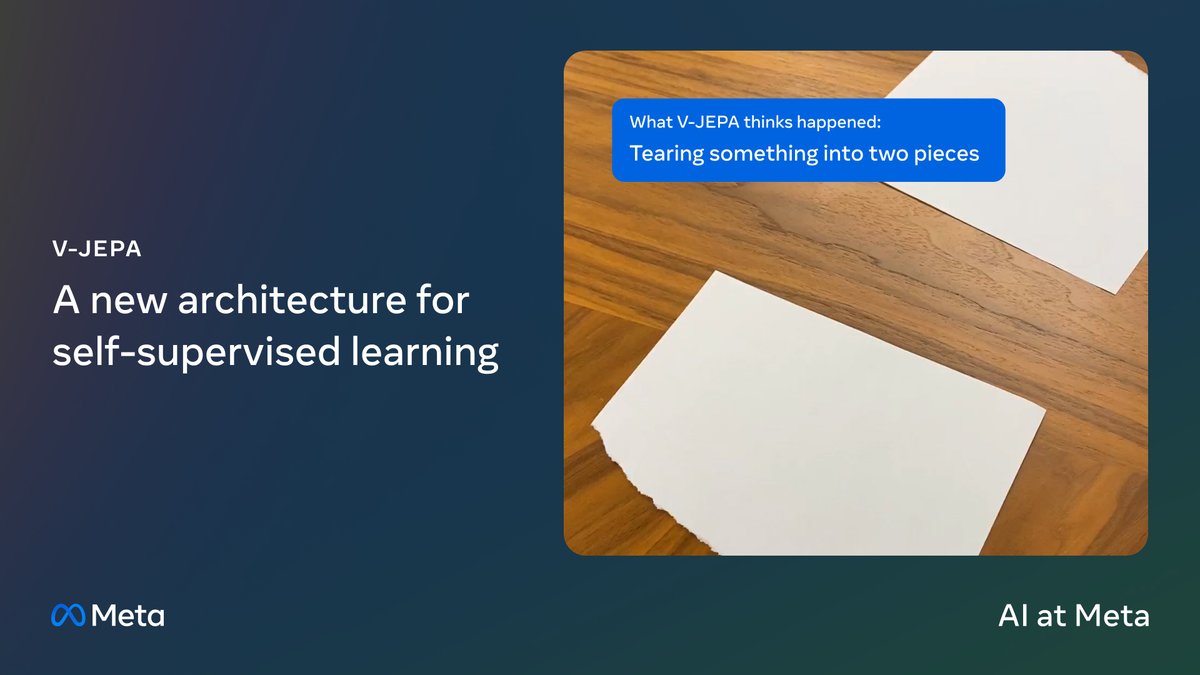
Introducing VL-JEPA: Vision-Language Joint Embedding Predictive Architecture for streaming, live action recognition, retrieval, VQA, and classification tasks with better performance and higher efficiency than large VLMs. • VL-JEPA is the first non-generative model that can perform general-domain vision-language tasks in real-time, built on a joint embedding predictive architecture. •...

90,522 views • 10 months ago •via X (Twitter)

10 Comments

harpreet's profile picture
harpreet10 months ago

This looks interesting. Do you have a repo or model weights released yet?

Himanshu Kumar's profile picture
Himanshu Kumar10 months ago

VL-JEPA predicts joint embeddings; model lacks generative capabilities.

Dhruv Diddi's profile picture
Dhruv Diddi10 months ago

Thanks for sharing! 🤗🦾💯

Ananth Kashyap's profile picture
Ananth Kashyap10 months ago

is the model released yet? would love to try it out

Ab Ospan's profile picture
Ab Ospan10 months ago

Amazing work, congrats! 🎉 Do you have a repo or a demo to try?

Archaneya's profile picture
Archaneya10 months ago

@ylecun Ohh this is cool...

Suresh's profile picture
Suresh10 months ago

Joint embeddings bridge vision and language, non-generative efficiency unlocks real-time multimodal

Vignesh S.'s profile picture
Vignesh S.10 months ago

Any repo to try this on?

Pronouns: I/My/Mine's profile picture
Pronouns: I/My/Mine9 months ago

PK fungi steals like PK

Chris's profile picture
Chris10 months ago

@bycloudai

Related Videos

3D-LLM: Injecting the 3D World into Large Language Models paper page: Large language models (LLMs) and Vision-Language Models (VLMs) have been proven to excel at multiple tasks, such as commonsense reasoning. Powerful as these models can be, they are not grounded in the 3D physical world, which involves richer concepts such as spatial relationships, affordances, physics, layout, and so on. In this work, we propose to inject the 3D world into large language models and introduce a whole new family of 3D-LLMs. Specifically, 3D-LLMs can take 3D point clouds and their features as input and perform a diverse set of 3D-related tasks, including captioning, dense captioning, 3D question answering, task decomposition, 3D grounding, 3D-assisted dialog, navigation, and so on. Using three types of prompting mechanisms that we design, we are able to collect over 300k 3D-language data covering these tasks. To efficiently train 3D-LLMs, we first utilize a 3D feature extractor that obtains 3D features from rendered multi- view images. Then, we use 2D VLMs as our backbones to train our 3D-LLMs. By introducing a 3D localization mechanism, 3D-LLMs can better capture 3D spatial information. Experiments on ScanQA show that our model outperforms state-of-the-art baselines by a large margin (e.g., the BLEU-1 score surpasses state-of-the-art score by 9%). Furthermore, experiments on our held-in datasets for 3D captioning, task composition, and 3D-assisted dialogue show that our model outperforms 2D VLMs. Qualitative examples also show that our model could perform more tasks beyond the scope of existing LLMs and VLMs.

AK

249,798 views • 3 years ago