Video wird geladen...

Video konnte nicht geladen werden

Zur Startseite

Introducing WorldForge: testable world-model workflows for physical AI systems. You can think of it, loosely, as “LangChain for world models”. The problem is that “world model” has become an overloaded label. Depending on context, it can mean a video generator, a cost model, a robot policy, a JEPA-style latent...

17,001 Aufrufe • vor 5 Monaten •via X (Twitter)

0 Kommentare

Keine Kommentare verfügbar

Kommentare vom Original-Post werden hier angezeigt

Ähnliche Videos

This is THE moment of Physical AI! We are officially announcing Cosmos 3: Omnimodal World Models for Physical AI 🚀 - Cosmos 3 is an omnimodal world model: within a unified architecture, it can understand and generate language, images, video, audio, and actions. - It is not just a VLM, not just a video generator, not just an audio-visual generative model, and not just a physics simulator / world-action model. It can understand images and videos, generate images, videos, and audio, simulate future worlds, predict actions, and generate robot policies—enabling models to truly begin to “touch the world.” - Cosmos 3 is the #1 open-weight reasoner / T2I / I2V / robot policy across many benchmarks. Huge thanks to every teammate who fought side by side on this journey—from architecture, data, training, infra, serving, and evaluation to post-training. Every part of this project carries an incredible amount of hard work. This was my first time leading a project as Tech Lead, and I feel truly fortunate. The future of Physical AI needs models that can not only “see” and “describe” the world, but also “imagine,” “simulate,” and “act”—and eventually close the loop with the real world. I hope Cosmos 3 can become an important starting point for this direction, and I’m excited to push Physical AI into its next stage together with the open-source community. Welcome to the era of Physical AI. HuggingFace: Project Website: Code:

Max Zhaoshuo Li 李赵硕

1,080,499 Aufrufe • vor 4 Monaten

I am stocked to announce that I won the OpenAI Developers Codex x Mollie Hacka Worldwide Hackathon in Paris. 60+ builders, every one of us working solo, one day to ship. I built mine around a single question: who gets to own intelligence? The default answer is scary. You hand your data to a handful of labs, they train the model, they own it, and you rent back a thin slice of what your own data made possible. That is the bargain on the table today. I do not accept it. So I built Lensemble: a Tapestry like distributed training platform for JEPA based World Models. What does it enable: World Models that a community improves together, keeps sovereign, and co-owns. Two bets sit underneath it. First, the paradigm. Language models predict the next token. Powerful for text, a dead end for the physical world. A robot does not need to autocomplete sentences, it needs to predict what happens next in the world. That is what JEPA does: it learns by predicting representations instead of pixels or tokens. I am convinced world models are the most underrated paradigm in AI right now, and the closest thing we have to a ChatGPT moment for robotics. Second, the politics. Your raw trajectories never leave your machine. Each participant trains locally against a shared protocol and ships only an update, never the data. A federated round folds those updates into one shared world model, a LeWorldModel based model, and the gain is measured, not claimed: a 12k-parameter adapter on a frozen backbone, held-out prediction error down about 12 percent, the model measurably less surprised by the world. Then the upside is split by contribution weight, so the people who improved the model own a share of what it earns. This is the thesis behind Project Tapestry, the AI Alliance and Yann LeCun's push for federated, sovereign frontier AI, carried into world models and robotics. Call it Tapestry for the physical world. All of it built solo, in a single day, with Codex as my pair the whole way. Thank you to OpenAI Codex and Mollie for backing builders who ship real things, and to Boris and the organizing crew for the room and the standard you set. Intelligence the world improves, and the world owns. That is the future I want for my kids, and the one I will keep building.

abdel

20,257 Aufrufe • vor 4 Monaten

Announcing DreamDojo: our open-source, interactive world model that takes robot motor controls and generates the future in pixels. No engine, no meshes, no hand-authored dynamics. It's Simulation 2.0. Time for robotics to take the bitter lesson pill. Real-world robot learning is bottlenecked by time, wear, safety, and resets. If we want Physical AI to move at pretraining speed, we need a simulator that adapts to pretraining scale with as little human engineering as possible. Our key insights: (1) human egocentric videos are a scalable source of first-person physics; (2) latent actions make them "robot-readable" across different hardware; (3) real-time inference unlocks live teleop, policy eval, and test-time planning *inside* a dream. We pre-train on 44K hours of human videos: cheap, abundant, and collected with zero robot-in-the-loop. Humans have already explored the combinatorics: we grasp, pour, fold, assemble, fail, retry—across cluttered scenes, shifting viewpoints, changing light, and hour-long task chains—at a scale no robot fleet could match. The missing piece: these videos have no action labels. So we introduce latent actions: a unified representation inferred directly from videos that captures "what changed between world states" without knowing the underlying hardware. This lets us train on any first-person video as if it came with motor commands attached. As a result, DreamDojo generalizes zero-shot to objects and environments never seen in any robot training set, because humans saw them first. Next, we post-train onto each robot to fit its specific hardware. Think of it as separating "how the world looks and behaves" from "how this particular robot actuates." The base model follows the general physical rules, then "snaps onto" the robot's unique mechanics. It's kind of like loading a new character and scene assets into Unreal Engine, but done through gradient descent and generalizes far beyond the post-training dataset. A world simulator is only useful if it runs fast enough to close the loop. We train a real-time version of DreamDojo that runs at 10 FPS, stable for over a minute of continuous rollout. This unlocks exciting possibilities: - Live teleoperation *inside* a dream. Connect a VR controller, stream actions into DreamDojo, and teleop a virtual robot in real time. We demo this on Unitree G1 with a PICO headset and one RTX 5090. - Policy evaluation. You can benchmark a policy checkpoint in DreamDojo instead of the real world. The simulated success rates strongly correlate with real-world results - accurate enough to rank checkpoints without burning a single motor. - Model-based planning. Sample multiple action proposals → simulate them all in parallel → pick the best future. Gains +17% real-world success out of the box on a fruit packing task. We open-source everything!! Weights, code, post-training dataset, eval set, and whitepaper with tons of details to reproduce. DreamDojo is based on NVIDIA Cosmos, which is open-weight too. 2026 is the year of World Models for physical AI. We want you to build with us. Happy scaling! Links in thread:

Jim Fan

231,019 Aufrufe • vor 8 Monaten

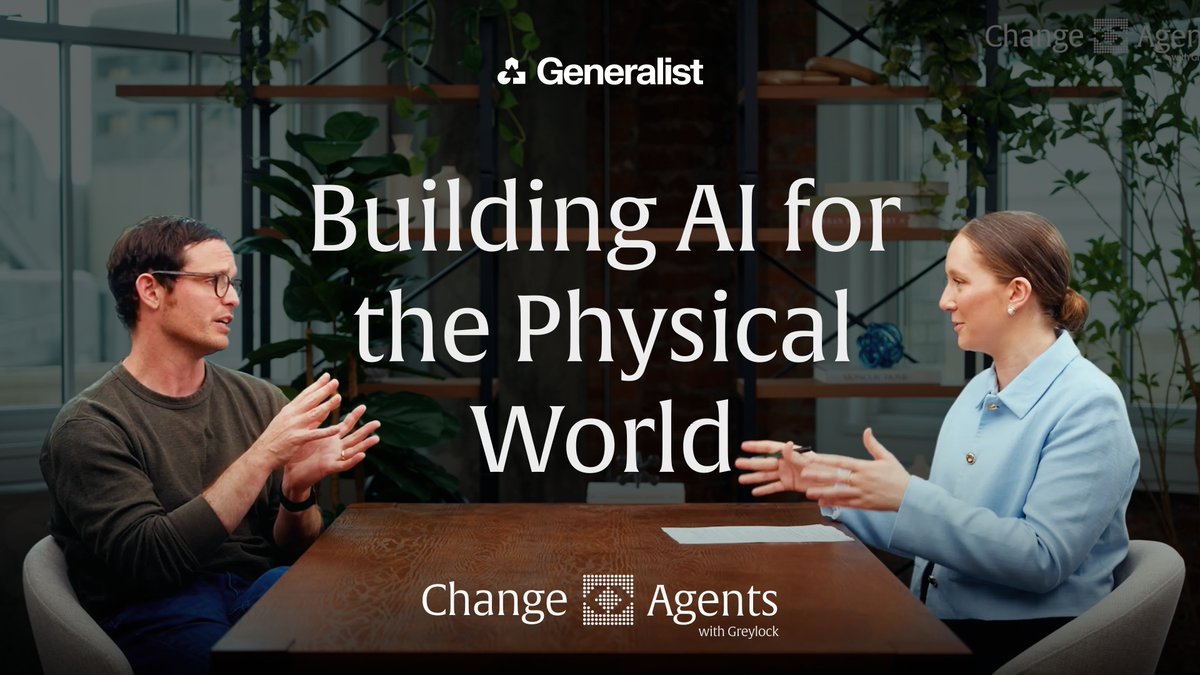
Feels like every week in robotics there’s a new ‘this is the GPT-3 moment for robotics 🤖’ announcement. We brought on Generalist CEO & Co-Founder Pete Florence on Greylock Partners Change Agents to dig into what’s going on at the frontier of robotics models. We covered the company’s latest Gen 1.5 model, few-shot learning, training robots on different embodiments, and the milestones towards a more generalized physical model. Timestamps: 00:51 The inception of Generalist 04:13 Long-term goal of the company 05:47 Parallels and differences between robotics and language models 12:05 Key differentiation in 1.5 Gen model 12:48 Robot vs banana 14:49 Emergent capabilities not explicitly trained for 17:13 Cross-embodiment and the importance of hands 22:26 Research vs working with customers 24:58 Beyond VLA vs world model 28:50 Future-looking milestones Some of the top takeaways: - One-shot and few-shot learning emerged without being trained for. Gen 1.5 can learn a new task from a single demonstration, and Pete compares it to the GPT-3 moment in language. In one example, a robot taught to sweep a cube into a bowl with a brush used a banana instead. Given a dustpan, it held the pan with one hand, swept with the other, then tipped the cube into the bowl. Neither behavior was explicitly trained, and Pete sees this as a signal of where the model's generalization is headed. -Generalizing to new hands remains a challenging problem for cross-embodiment. Physical hardware doesn’t stay static, and so cross-embodiment - the ability of a physical AI model to adapt to different hardware systems - is vital for success. -Customer deployments are a valuable source of research inputs. Generalist actively partners with their customers for feedback, which they use to inform their research and make real-world evaluations. -Generalist doesn't think in terms of "VLA vs. world model." Pete helped create early VLAs and has worked on world models, but he argues the goals matter more than the label, and the team is trained to think in a first-principled way when considering new research directions. Watch the full episode at the link in the comments. Thank you to Pete Florence for joining us!

Corinne Marie Riley

18,938 Aufrufe • vor 17 Tagen