Загрузка видео...

Не удалось загрузить видео

На главную

🇯🇵 Japan just pulled off a world-first: fired a ship-mounted electromagnetic railgun from the JS Asuka and nailed a target vessel at sea. The gun uses massive electricity to hurl projectiles at nearly 7 times the speed of sound, insane kinetic punch with no explosives needed. The US spent...

367,640 просмотров • 5 месяцев назад •via X (Twitter)

Комментарии: 0

Нет доступных комментариев

Здесь появятся комментарии из оригинального поста

Похожие видео

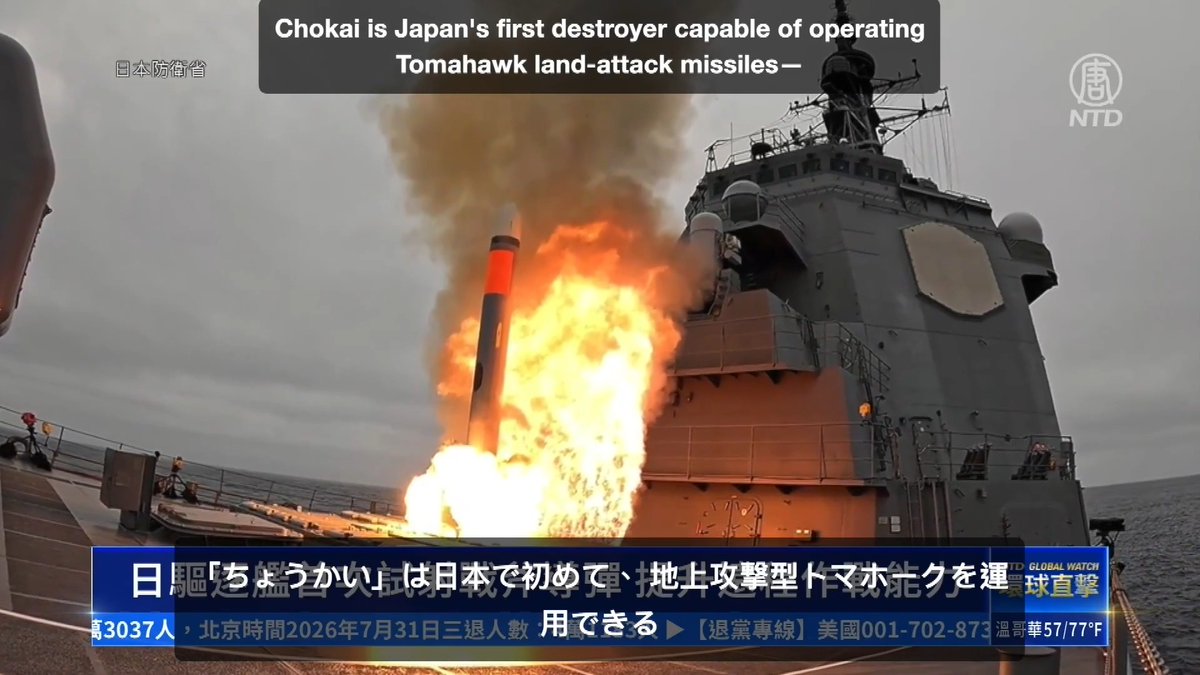
🇯🇵 Japan Just Fired Its First Tomahawk, And Beijing Should Be Worried For eighty years, Japan's military was built to defend, never to strike back. That era ended this week in the open Pacific. On July 29, the destroyer JS Chokai (DDG-176) launched a live Tomahawk cruise missile for the first time, a weapon that flies at near-supersonic speed, hugs the waves at extreme low altitude, and can gut a target hundreds of miles inland. Tokyo's Defense Ministry confirmed the shot, backed by the US Navy, calling it a milestone in allied warfighting power. Read the subtext plainly: Japan now owns long-range "counterstrike" capability, the centerpiece of its 2022 National Defense Strategy. It joins Australia and the Netherlands as only the third nation to fire Tomahawks from a surface warship. And it isn't stopping at one ship. More of its Aegis destroyers, and new-build warships still on the slipway, will be upgraded to launch the missile, feeding an arsenal of up to 400 Tomahawks ordered from the United States. Why the urgency? Because a bully sits next door. Beijing's warships shadow Japanese waters, its jets probe Japanese skies, and its missiles range every island in the first chain. Chokai's launch is a direct answer, a message that Japan can now reach out and hit back, hard. Defense Minister Shinjiro Koizumi has vowed the buildup will continue through 2027. The pacifist reflex is fading. In its place stands a Japan that has decided deterrence, not deference, keeps the peace against an aggressor that respects only strength. ACI — Aric Chen | Insights

Aric Chen

15,103 просмотров • 17 дней назад

💥🔫📐 Happy Rail Gun Proves Flat Earth Friday! As a former EM2 Nuclear Electrician’s Mate in the Navy (2010-2014), I know a thing or two and that this math 🧮 proves the globe false. 6,668 feet of missing curvature over 100 miles! 🤯It is clearly mathematically impossible on a globe for these hypersonic projections to hit targets low to the ground over 100 miles away! This absolutely destroys the fake globe and proves you have been duped by NASA lies and the Rockefeller globe brainwashing education system since the 40’s-50’s when they reached the firmament dome in Antarctica and began this Truman Show deception under 33rd US Pres. Truman. Wake up globers and stop fighting the obvious fact that we aren’t on a moving or curved ball! ⚓️💯🚢The US Navy rail gun has officially crossed from false globe theory to flat earth reality. The United States has announced its long discussed railgun concept and has entered military deployment phase. This weapon uses no gunpowder and creates no explosion. Instead it relies on electromagnetic force to launch solid metal projectiles at several times the speed of sound when fired. The projectiles rips through the air purely through kinetic energy and the most unsettling part isn’t the speed -it’s the cost. A traditional missile can cost millions of dollars per shot. A railgun round requires only electricity and a simple metal slug. That single difference rewrites the logic of modern warfare saturation. Attacks are no longer limited by missile stockpiles but by how much electrical power a nation can generate. This also creates a nightmare for defense systems. Hypersonic projectiles leave almost no time to detect, track, or intercept. There may be no warning and response window. US Department of Defense calls the railgun a defensive breakthrough. This one shifts war from who has the most missiles to who has the most energy.

Bret Flat Earth Bible Jesus

19,828 просмотров • 6 месяцев назад

Japan's Defense and Technology Japan today has a modern and powerful navy. The Japanese fleet currently has about one-quarter the number of VLS cells compared to the Chinese navy, and this number will increase with the commissioning of additional ASEV destroyers and Mogami-class frigates. I believe that within 6–8 years, the Japanese navy could become the fourth-largest in the world in terms of VLS cell count. However, there are areas where Japan, despite its cutting-edge technology, still needs to improve, specifically two: anti-ship missiles and drones, but also become more independent about naval air defense systems. The Japanese fleet still largely relies on the Type 90 SSM on many ships, which has a range of only 150 km, and on the Type 17 SSM, which is being introduced slowly and has a range of 300–400 km. In the coming years, there is talk of a version with up to 900 km range and the introduction of a ship-launched Type 12. Air defense systems remain heavily dependent on the United States, primarily using the SM-2/SM-6 and SM-3 on the most modern ships. Japan is an island nation and has historically always developed its own naval designs and equipment. It needs partners, but it must also maintain its own indigenous models. Another point is that a country as modern and pioneering in so many fields cannot afford to lack its own drone industry. Today, Japan operates American HALE drones such as the RQ-4 Global Hawk (manufactured by Northrop Grumman) and the MQ-9B SeaGuardian as its primary MALE platform for maritime surveillance. It is also testing Turkish and Israeli drones. This means that in any conflict, Japan could run out of reconnaissance drones in a very short time. The situation is quite different in South Korea, where there is a robust domestic drone industry led by companies such as Korea Aerospace Industries, Korean Air Aerospace Division, Hanwha Aerospace, and the Agency for Defense Development. Although South Korea still relies on foreign suppliers for HALE drones, it already has indigenous MALE models like the KUS-FS, along with other systems under development. In the next 5–10 years, long-range anti-ship missiles (1,000–4,000 km) will become a reality on Japanese ships and submarines. However, I still do not see independent projects in the fields of air defense systems or drones. South Korea obviously has different priorities from Japan, as it faces a much more precarious security situation. But if Japan also wants to establish itself as an exporter, and it is already doing so, it needs to demonstrate greater independence and a truly cutting-edge portfolio. On the current trajectory, if the country resolves the drone issue (as I believe it will), Japan should reach a world-leading level within 10 years or less.

Patricia Marins

43,210 просмотров • 7 месяцев назад

🚨America Just Changed the Economics of War… With Light For years Iran built a strategy around one brutal equation. Launch thousands of cheap drones. Force the defender to burn through million-dollar interceptors. Bleed the defense dry. It was simple math. A Shahed drone costs roughly $30,000. Stopping it with traditional missile defenses can cost hundreds of thousands… sometimes over a million dollars per intercept. Repeat that attack a thousand times and suddenly the defender is spending billions just to stay alive. Iran understood this. They designed an entire doctrine around it. Flood the sky with cheap weapons. Overwhelm air defenses. Make defense more expensive than offense. But something just changed. The United States Navy has now deployed HELIOS, a directed-energy weapon mounted on an American destroyer operating near Iran. HELIOS is not a missile. It is a laser. And it runs on something every warship already produces… Electricity. No missile to reload. No magazine to empty. No resupply ship needed. As long as the ship’s generators are producing power, the weapon keeps firing. That means the cost of stopping a drone is no longer measured in missiles. It is measured in electricity. In practical terms… Destroying a $30,000 drone can now cost less than the power bill of a large apartment building. That single change breaks the entire economic foundation of drone saturation warfare. For years Iran invested in the strategy that made Shahed drones valuable. Cheap. Numerous. Disposable. But if directed-energy weapons like HELIOS can burn drones out of the sky at near-zero cost… The math flips. Suddenly the attacker is spending money… while the defender spends almost nothing. CENTCOM has already released footage showing HELIOS mounted on a U.S. Navy destroyer in waters near Iran. Earlier tests confirmed the system successfully destroyed multiple drones during live trials. Now the system is deployed where hundreds of Iranian drones and missiles have been passing through the same airspace. This is not a laboratory experiment anymore. This is a real battlefield. And the world is about to find out whether the future of missile defense is not another interceptor… But a beam of light. Because when America decides to change the physics of war… It usually succeeds. #SilentMajoritySpeaks #AStoneGroove

A Gene Robinson

790,404 просмотров • 5 месяцев назад

🚨🇮🇷🇨🇳If America Can’t Handle Iranian Missiles, It’s Not Ready for China In just the first 16 days of war against Iran, the United States expended nearly 40% of its THAAD interceptors. If America’s most advanced air defenses are struggling against Iran—a regional power with a fraction of China’s capabilities—there is no plausible scenario in which the US is ready for a showdown with Beijing. The Chinese Arsenal The People’s Liberation Army operates the world’s largest missile inventory, backed by a rapid-action doctrine designed to dismantle U.S. bases and infrastructure in the early stages of conflict. Unlike Iran’s Kheibar Shikan and Sejjil missiles, China’s DF-27 anti-ship ballistic missile and DF-17 hypersonic glide vehicle offer advanced mid-air maneuverability and sustained hypersonic speeds. With an estimated range of 8,000 kilometers, the DF-27 places U.S. naval installations at Pearl Harbor and Everett, Washington within striking distance—allowing China to threaten American assets without deploying a single ship. Strategic Implications According to Dr. Andrew Erickson of the US Naval War College, China is the first nation to operationalize an armed ICBM. These capabilities could cripple U.S. operational effectiveness across East Asia and complicate the defense of American interests in Taiwan, South Korea, Japan, and the Philippines in the event of armed conflict. Depleted Defenses Even as Patriot and THAAD struggle against less sophisticated Iranian missiles, Western analysts warn that a large-scale Chinese attack could overwhelm U.S. defenses by depleting interceptor inventories entirely. With THAAD replenishment not expected until April 2027, the fragility of current stockpiles is increasingly difficult to ignore. The Central Question If US air defenses are depleted in the Middle East after just over two weeks of fighting Iran, how will they withstand a Chinese arsenal that dwarfs Iran’s—particularly when the DF-27 can already reach American soil?

NewRulesGeopolitics

137,298 просмотров • 4 месяцев назад

Today we're announcing our new office and autonomous fleet in Japan! 🙌 This has been a year in the making — here's the story behind Wayve's journey to Japan 🇯🇵 Just over one year ago I was looking over the Tokyo skyline as we were completing our Series C fundraise, wondering how our AI would navigate the narrow winding streets. At that point it was a dream, but in the last year, it has become reality. The right team at the right time: 6 months ago we made our first hire in Japan. I'm grateful for Masa Kameyama taking a bet on Wayve and for his partnership leading our presence in Japan (we have a lot of great people around Wayve called Masa 😄). I'm excited about the opportunity to welcome world-class and diverse experience to Wayve's team. We're hiring and building an awesome team in Japan! The right product at the right time: for a long time I've been impressed by Japanese automaker's scale and leadership in safety and lean manufacturing. Now I'm witnessing bold and brave decisions from automotive executives to lean into AV2.0. There is an opportunity for Japanese automakers to leap-frog other markets to be the first to bring AV2.0 to global scale. We are delighted to be partnering with Nissan Motor to make this a reality in 2027 and to be working with partners like Uber, タクシーアプリ S.RIDE(エスライド) 公式アカウント and SoftBank. Fast forward to yesterday, I landed in Tokyo and was treated by being picked up by one of our autonomous vehicles! Today, I’ve just got off stage at our press conference, launching our brand new Testing and Development Centre in Yokohama and autonomous vehicle fleet in Japan. Our fleet of autonomous vehicles are now testing around the world in UK 🇬🇧, Germany 🇩🇪, Canada 🇨🇦, US 🇺🇸 and now Japan 🇯🇵. This is an important proof point showing Wayve is capable of being a global company and delivering the benefits of Embodied AI to consumers around the world.

Alex Kendall

41,277 просмотров • 1 год назад

‼️‼️🇷🇺🇨🇳 BIG | Beijing and Moscow are taking their "no-limits" partnership deep into the Yellow Sea, flashing serious naval muscle right on Washington’s doorstep. The Chinese and Russian militaries have officially launched their massive "Joint Sea-2026" bilateral naval drills in the waters and airspace off the strategic port of Qingdao. Russia's Pacific Fleet deployment features high-value assets, including the guided-missile cruiser *Varyag*, the corvette *Rezkiy*, the diesel-electric submarine *Ufa*, and the specialized rescue vessel *Igor Belousov*. Mirroring this force, China's People's Liberation Army Navy has committed the advanced destroyers *Kaifeng* and *Anshan*, the frigate *Wuhu*, the comprehensive supply ship *Kekexili*, and a submarine rescue ship, all supported by shipborne helicopter units. Running until July 13, the high-stakes maneuvers will focus on aggressive joint operations, including anti-submarine warfare, coordinated air and missile defense, and joint artillery strikes, to be immediately followed by combined maritime patrols across the wider Pacific Ocean. This deployment isn't just a routine training exercise; it is a calculated geopolitical message aimed directly at the U.S. and its regional allies, coming just days ahead of the NATO summit. By conducting sophisticated multi-domain warfare drills in the highly sensitive Yellow Sea, Beijing and Moscow are signaling that their strategic alignment is actively hardening into an operational military axis capable of challenging Western maritime dominance in the Indo-Pacific. See the latest updates with us: Visioner

Visioner

14,697 просмотров • 1 месяц назад

When the US glide bomb struck the IRIS Shahid Sayyad Shirazi near Qeshm Island on March 4, the impact triggered an involuntary event that nobody in the coverage has fully examined: the stricken corvette spontaneously launched one of its own anti-ship missiles. The weapon fired itself. Not as a last act of defiance from a crew executing a terminal order. The structural damage from the strike activated the launch sequence without human input. That detail is the most technically significant event in the naval dimension of this war. The Shahid Sayyad Shirazi is the third vessel of the Soleimani-class, the IRGC Navy’s most advanced surface combatant. Pennant FS313-03. Commissioned February 2024. The class was Iran’s answer to the problem of contested littoral warfare in the Persian Gulf and Strait of Hormuz: a wave-piercing catamaran hull approximately 65 to 68 meters in length, composite construction designed to reduce radar cross-section, four indigenous diesel engines producing confirmed speeds of 32 knots with promotional claims reaching 45, and an armament package that makes every other ship in its weight class irrelevant by comparison. Six anti-ship cruise missiles of the Noor, Ghadir, or Nasir class on deck launchers. A vertical launch system carrying between six and sixteen Sayad surface-to-air missiles plus additional cells for Abu-Mahdi long-range cruise missiles. Six 20-millimeter Gatling guns. A helipad for a medium combat helicopter. Capacity to deploy three fast-attack boats simultaneously. On a 600-tonne displacement hull. Iran built this ship specifically for the Hormuz chokepoint. The catamaran design provides speed and stability in the confined, shallow waters of the Gulf that a conventional monohull cannot match. The composite hull reduces the radar signature that adversaries need to acquire targeting solutions. The VLS integration gives a vessel of this size a defensive envelope against air attack that most navies reserve for ships four times the displacement. The speed and fast-boat deployment capacity fit exactly into the IRGC Navy’s doctrine of saturation from multiple simultaneous vectors. A US aircraft dropped a single glide bomb. The ship caught fire. It spontaneously launched a missile. CENTCOM confirmed the strike. Multiple cameras captured the burning hull offshore Qeshm Island with smoke rising through the Strait of Hormuz. The spontaneous missile launch is the detail that defines the engagement. A VLS or deck-launched anti-ship missile under normal conditions requires crew input, targeting data, and deliberate firing authorization. When a strike disrupts the electrical and structural integrity of the vessel sufficiently to trigger an unintended launch, the weapon system designed to protect the ship becomes a hazard launched into the Strait of Hormuz at whatever bearing the launcher happened to be pointing. Every tanker, patrol boat, or allied vessel within the weapon’s acquisition envelope during those seconds faced a missile fired by a ship that no longer had a crew in control of it. No second-order casualties were reported from the spontaneous launch. The missile either failed to acquire a target, impacted water, or flew a trajectory that missed occupied vessels. The outcome was fortunate. The mechanism was not controllable. Iran commissioned this ship fourteen months ago. It was designed to be their most dangerous surface unit in the world’s most contested waterway. It fired its own weapon at the waterway it was built to control before going down.

Shanaka Anslem Perera ⚡

435,326 просмотров • 5 месяцев назад