Video yükleniyor...

Video Yüklenemedi

Ana Sayfaya Dön

Jeff Bezos: Orbital Compute > Terrestrial Compute "in the sun synchronous orbit, you're in daylight almost all the time, 99 plus percent. And so your solar cells are working for you the whole time. There are a lot of questions about orbital data centers and can it really work...

58,451 görüntüleme • 11 gün önce •via X (Twitter)

0 Yorum

Yorum bulunmuyor

Orijinal gönderinin yorumları burada görünecek

Benzer Videolar

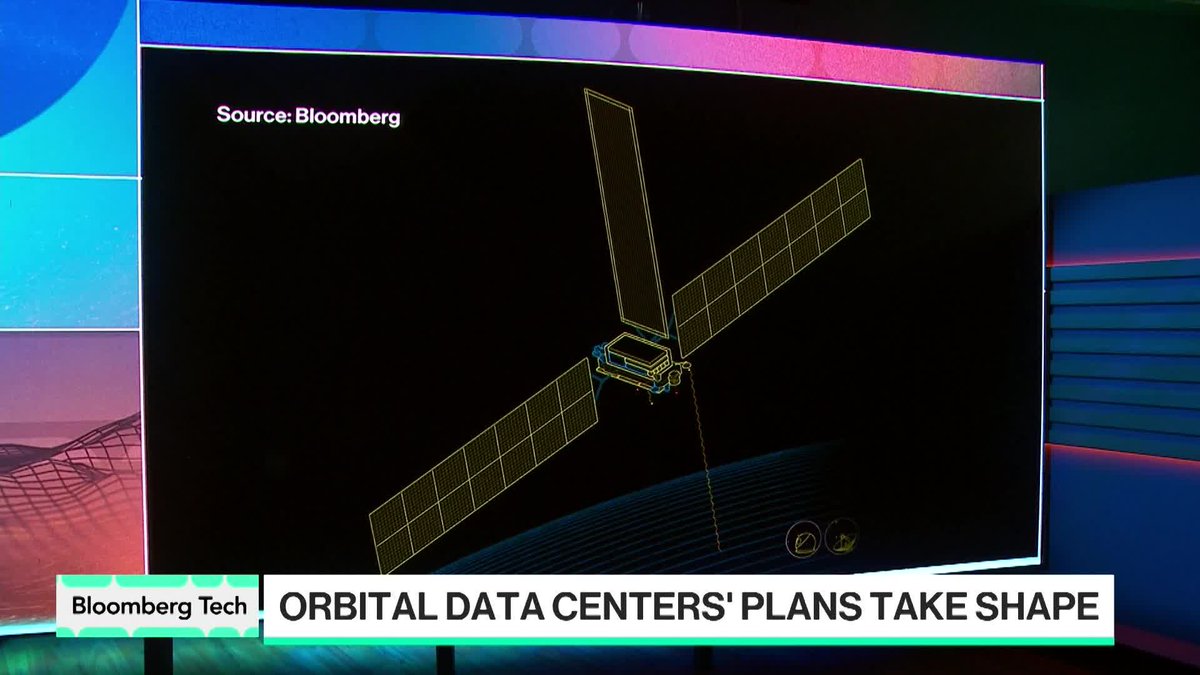
In our last conversation, Gavin said data centers in space will be the most important thing in 3-4 years. He explains that means "racks in space" and thinks orbital compute will solve the watts shortage: "When people hear data centers in space, they picture a Pentagon-sized building in space. That's not what it is. A Blackwell rack weighs 3,000 pounds. It's eight feet high. Four feet deep. Three feet wide. It's racks in space. It has these solar wings that are probably 500 feet long on each side. You keep it in a Sun-synchronous orbit, so those solar panels are always in the sun. And then because it's in an exactly Sun-synchronous orbit, the radiator, which extends behind it for hundreds of feet is in the shade. You link these racks using lasers traveling through vacuum which are already on every Starlink. SpaceX operates the world's largest satellite fleet, which is 98 or 99% of all satellites in orbit. Every Starlink, they're cooling it today. I think Starlink V3 is going to operate at 20 kilowatts. A Blackwell rack is only 100 kilowatts. And people talk a lot about density. Well, if you're connecting the racks with lasers through vacuum, you can make the rack bigger physically. In space, there's all sorts of things that SpaceX can do. They also now operate the largest data center on Earth. I've spent a lot of time at Starbase over the years, and I've talked to a lot of SpaceX engineers. It is the most talented group of engineers on planet Earth, and they're very confident they have solved this."

Patrick OShaughnessy

267,600 görüntüleme • 1 ay önce

A single gigawatt of orbital compute requires roughly 200 Starship launches and Elon Musk is not satisfied with gigawatts (Save this). The target is 100 gigawatts of orbital compute per year which means SpaceX is staring down a launch requirement that no organization in human history has ever attempted at anything close to that scale. He acknowledges that scaling to gigawatts per year in orbit is a very hard challenge, but then points to something most people have missed entirely, SpaceX has already demonstrated the foundational capability, because building and launching thousands of Starlink satellites per year is the same industrial problem applied to a different payload. When you understand the orbital compute satellite as a larger version of Starlink V3 with an Nvidia GPU rack at the center instead of a communications payload, the manufacturing and launch scaling challenge stops looking like science fiction and starts looking like a production ramp. The infrastructure to support that ramp is already being built. SpaceX is currently capacitizing for thousands of launches per year, two launch towers and pads in South Texas are operational, the first pad at Cape Canaveral is nearly complete, a second is on the way at Launch Complex 37, and additional locations are already in discussion. As the CFO says it "You need to have those cost curves as you ramp up in volume and time, your costs go down." The vision he describes for what this eventually enables is striking in its specificity. He imagines asking Grok a question on his phone, the inference running on an orbital compute satellite, and the answer coming back down through Starlink direct-to-cell, a complete AI query processed entirely in space, from prompt to response, without touching a single terrestrial data center. That moment, he says, is closer than the industry thinks, with initial capability demonstrations possible as soon as next year. The bottleneck that stands between now and that moment is not the satellite design, the cooling physics, or the silicon, all of which SpaceX has already worked through.

Milk Road AI

67,791 görüntüleme • 1 ay önce

This is the next big plan for SpaceX: AI Data Centers in Space. • To achieve even a small fraction of a Kardashev Type II civilization (harnessing the full energy of the Sun), AI compute will require orders of magnitude more energy than Earth can ever provide. • Earth only intercepts about 1–2 billionths of the Sun’s total energy output. • Massive-scale AI (e.g., a million times more energy than Earth could produce) can only be powered by capturing far more solar energy in space. • Space-based solar-powered AI satellites/compute clusters are therefore inevitable. • In space, sunlight is continuous (no night, no clouds, no atmosphere), so no batteries are needed. • Solar panels in space can be extremely lightweight and cheap (no glass, no storm-proof framing required). • Cooling in space is dramatically easier and simpler: just radiate heat directly into the cold vacuum — no water, no fans, no liquids, no massive cooling infrastructure. • Most of the mass/volume of current supercomputer racks (e.g., GB300) is cooling hardware; in space that largely disappears. • The cost-effectiveness of electricity and compute in space will soon be overwhelmingly better than on Earth. • Elon’s Prediction: within ~5 years (by ~2030), the lowest-cost way to run large-scale AI will be solar-powered satellites in space. • A terawatt/year of AI compute is essentially impossible on Earth with any realistic build-out of power plants. • Scaling both power generation and cooling on Earth at the required rate is physically and politically unfeasible.

Nic Cruz Patane

49,019 görüntüleme • 7 ay önce

Elon Musk just explained why the SpaceX IPO is an energy story and the energy constraint is why he believes space becomes the only viable path for AI to scale (Save this). The argument he is making is one of the most important and least understood things happening in technology right now. The United States currently consumes roughly 500 gigawatts of electricity on average. To double that capacity which is what continued AI expansion on the current terrestrial trajectory would eventually require would mean building as many power plants as currently exist in the entire country. He is not arguing that this is technically impossible, just that communities are not willing to accept it, that permitting timelines make it unrealistic, and that the hard ceiling on Earth based power generation means the expansion of AI compute will eventually hit a wall that no amount of capital can overcome on the ground. His observation is that in space, that wall does not exist. A solar panel in orbit produces roughly five times more power than the same panel on Earth, operates in continuous sunlight uninterrupted by weather or nighttime, and benefits from the vacuum of space as a completely passive cooling system meaning the two largest operating costs of any terrestrial data center, energy and cooling, are effectively eliminated. He then said that you could theoretically increase harnessed energy by a factor of one million and still be using less than a millionth of the sun's total energy output. This is the underlying physics of why SpaceX filed with the FCC to launch up to one million solar powered AI satellites, and why they described that constellation in their own filing as a first step toward becoming a Kardashev Type II civilization capable of harnessing the full power of the sun. To understand what makes this credible rather than visionary, you need to understand what SpaceX already controls that no other company on earth possesses. Starship, once operating at full cadence, can deliver 100 to 150 tons of payload to orbit per launch, at a target cost per kilogram that is an order of magnitude lower than any existing vehicle. Musk's stated ambition is to scale Starship to 10,000 to 30,000 launches per year, a frequency that would allow the deployment of orbital compute infrastructure at a pace that is currently unimaginable with any existing rocket. He told xAI staff earlier this year that achieving space-based AI at scale will eventually require manufacturing facilities on the moon, building solar panels and heat dissipation structures from lunar silicon and aluminum, and launching them into orbit from there rather than from Earth's surface because the moon's lower gravity makes the economics of launch dramatically more favorable. SpaceX's S-1 filing explicitly states that its launch capabilities could enable massive AI compute satellite constellations with the potential for millions of satellites for orbital data centers, with the first launch potentially occurring as soon as 2028. Google and Alphabet are already in advanced talks with SpaceX about deploying space-based data centers. Starcloud, a startup running Nvidia H100 GPUs in orbit, has already validated that high-performance AI inference workloads can operate in space, with plans to scale to five gigawatts of orbital compute power by 2035. This is why Musk believes the cost crossover happens in two to three years because SpaceX's launch cost trajectory intersects with the accelerating energy constraint on the ground in a way that makes space genuinely cheaper, faster, and less regulated at exactly the moment AI demand is hitting its hardest physical limits.

Milk Road AI

12,140 görüntüleme • 1 ay önce