正在加载视频...

视频加载失败

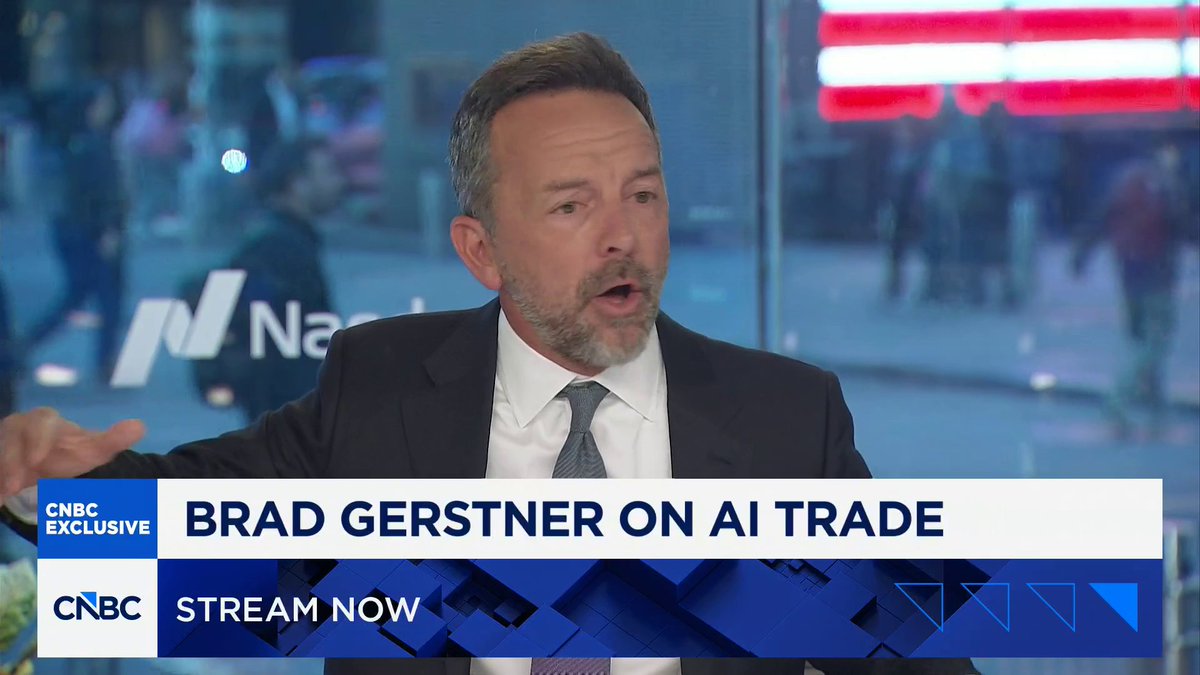
Jensen says Open Source can be MORE expensive for enterprises, Brad Gerstner explains why: Brad Gerstner: “Over the last two weeks, everybody's been saying that the Chinese have caught up, that open source tokens have caught up in intelligence, that they're much cheaper, etc. And Elon comes out and...

62,394 次观看 • 3 个月前 •via X (Twitter)

28 条评论

Bronson 的头像
Bronson3 个月前

@altcap Is this Gerstner invested in Anthropic?

Dominic Taguinod 的头像
Dominic Taguinod3 个月前

@altcap Every time Brad gives an opinion, I can’t help but wonder if his investment in those companies affect his words.

Srikanth Thiagarajan 的头像
Srikanth Thiagarajan3 个月前

@altcap The business model of any closed or open model companies may eventually evolve into “Share the weights, charge for the refresh” Models have half-life and as they age their value shrinks as new world kmowledge emerges. Why not just let enterprises own and run the weights, while monetizing the continuous refresh? I see this as a middle ground form all angles. The trade off is that the inference costs shifts to the customer that may be a compromise for safety and security of the enterprise data not leaving the premise. Do you think this is the model frontier companies would embrace in future even if the economics don’t make sense today? I wrote a longer take on this in LinkedIn -

Clay 的头像
Clay3 个月前

@altcap *checks his investments*

Yel 的头像
Yel3 个月前

@altcap Brad is just a shill for whatever investment he wants to go up. There's no DD just marketing his own portfolio

Yarko 的头像
Yarko3 个月前

Information about $NOW would be really useful here. It's playing a big role here. @ServiceNow just locked in multi-year deals with both OpenAI (Jan 2026) and Anthropic (Feb 2026), making Claude the default for building agent workflows while OpenAI powers voice and multimodal. Two frontier labs, one enterprise customer, both getting paid. That's the "cost differential is smaller than people think" argument in practice: ServiceNow isn't self-hosting an open-source model to save money. They're paying for closed frontier models specifically to skip the training, fine-tuning, and safety-guardrail overhead Jensen's talking about — and their AI Control Tower is on pace to cross $500M in annual contract value doing exactly that.

Ranjan Soni 🇨🇦 的头像
Ranjan Soni 🇨🇦3 个月前

“Open source is more expensive” feels a bit too broad. For a company doing modest inference, absolutely. Why build an inference team when I can buy tokens? At serious volume though, I’m not sure that math survives. And cost isn’t the only reason companies self-host in the first place.

blue 的头像
blue3 个月前

@altcap Shocker that everyone is reading their own book...

Jester 的头像
Jester3 个月前

@altcap free as in puppy, not free as in beer, Jensen just reinvented a saying from 1998

FullPort 的头像
FullPort3 个月前

@altcap You literally said last week open source is cheaper, make up your mind.

NSA 的头像
NSA3 个月前

@altcap When is the All in Podcast announcing donations to Trump Accounts ???

Barra 的头像
Barra3 个月前

@altcap solana:3f9LEP4RNM1yq5VnCD1LYMvq7FZis5tfGqyZMsiRpump

ByteCapital Labs 的头像
ByteCapital Labs3 个月前

@altcap

liquidaiwater 的头像
liquidaiwater3 个月前

That’s hilarious. Notice Jensen doesn’t tell you that the frontier model companies are losing money on each inference, but somehow it will be cheaper.? Like how is that going to continue? And we have to address the security aspect and the IP extraction risk, let alone outsourcing your intelligence rather than having it in house . (remember when they shut down Claude) Notice everything in AI is about keeping the bubble going. Jensen never talks about things like the backlog of power creation equipment . They don’t talk about how ROI is gonna be impossible for some of these data centers due to this bottle neck.. All they wanna do is keep the pyramid scheme going by just keep throwing computer at something no matter what the economic reality is. It’s quite fascinating and will be historic when this bubble blows up.

David 的头像
David3 个月前

@altcap The AI powers are trying ti hold up the system. The market rally last week was driven by a huge social media campaign the weekend before

Mr Salty 的头像
Mr Salty3 个月前

@altcap @jason needs to be bought out of @theallinpod

LomboyChristian 的头像
LomboyChristian3 个月前

@altcap the framing here is that people forgot training costs exist because open source lets you peek at the finished weights for free

distilled 的头像
distilled3 个月前

@altcap Same debate ran on Invest Like the Best this week (Baker's China/open-source segment, 50:14). The sticker comparison is per-token but the bill is per-task — reasoning output changes the token math, and serving utilization changes the rest.

Oleg Shulga 的头像
Oleg Shulga3 个月前

@altcap Open source can be cheaper per token and still more expensive per outcome. Someone has to deploy it, tune it, secure it and own the failure at 2am. Enterprises buy fewer headaches, not ideology.

emeritus 的头像
emeritus3 个月前

@altcap Love to hear @edzitron on the @theallinpod

InfoMatrice 的头像
InfoMatrice3 个月前

@altcap true but.. frontier models are so nerf and censored that for some use case its better to go with open source

Joel Roberts 的头像
Joel Roberts3 个月前

@altcap The real comparison is total operating cost, not token price. For most companies, model governance, maintenance and internal expertise will outweigh the apparent savings until usage reaches serious scale.

Carter Chen 的头像
Carter Chen3 个月前

@altcap Neocloud can help you set up the open source model you don't need to set it by yourself

Osman Sarood 的头像
Osman Sarood3 个月前

@altcap Brad it is ok for some investments to not 100x. No need to come up with incoherent justifications. Open source can replace the lion share of token consumption for foundation models

Kaan Can Guven 的头像
Kaan Can Guven3 个月前

@altcap Open source is cheaper until you have to staff the integration.

Christopher Malili 的头像
Christopher Malili3 个月前

@altcap This is obvious. It's basically why everybody moved to cloud computing instead of hosting their apps themselves. A ton of economies of scale and such.

Neostrix 的头像
Neostrix3 个月前

@altcap Interesting angle open source cost dynamics vs. perceived value for enterprises is not black and white. Would love to see the data behind the claims.

GraceHoney78✨ 的头像
GraceHoney78✨3 个月前

@altcap

相关视频

David Sacks says companies are trapped paying OpenAI & Anthropic because they can't figure out how to use open source models "I think enterprise CTOs would like to shift their token consumption to cheaper models for the obvious reason that it would be more efficient. They are seeing compute costs or token costs skyrocket right now, so everyone's trying to figure this out." "You also have the AI sovereignty issue that Alex Karp talked about. They're worried about giving up the secret sauce or the alpha in their business to a frontier lab that may one day be competing with them. "The problem is, I think in most cases, they don't have the technical ability to do it. Coinbase figured out how to do it. DoorDash figured out how to do it. They built a token routing system that allows them to send frontier tasks to frontier models and non frontier tasks to more mundane models. But I don't think your average enterprise has the technical capability to do that." "This is why the share of wallet of closed models, it actually increased. I think that open source went from 19% last year to 11% this year. So open source as a share of enterprise spending is actually decreasing." "I don't think that means usage is decreasing. I think usage is skyrocketing. It also may be the case that because the whole point of using an open model is you just pay for the compute costs, you don't have to pay a lab, so it may be that it's hard to measure that usage in terms of spend." "But nonetheless, anyone who's saying that these closed models are going to lose or are somehow losing, you're just not seeing it in the data."

dnap

141,614 次观看 • 4 个月前

Baseten Head of AI Model Training Charlie O'Neill says the future is many specialized LLMs dedicated to specific tasks, with bigger labs deployed on the frontiers of areas like science and math: "People are thinking about intelligence capabilities in the wrong way. People are thinking about intelligence relativistically. They say, 'OK, the open-source gap is like 6 months behind closed-source, and GLM 5.3 is as good as Opus 4.8,' or whatever." "The best way to think about what models can do for you, and for the world, is in an absolute sense." "So for any given task that you want to do with an LLM, there's some intelligence threshold where below that you can't do the task, and above that you have very diminishing returns to more intelligence on the task." "So when you think about it that way, the game of LLMs over the last 5 years has been, 'OK, we have these things we want to do with them. Closed source hits it first... but open-source can eventually do that task. And then for many reasons, once you have the base level of intelligence required to do it, you probably do want to swap to open-source." "It's not really about the [frontier lab] God model being better. Like, if I'm filing a tax return, there is a limit to how much intelligence I need to do that particular thing." "So I think the world is going to look like — frontier closed-source labs are going to continue to push the frontier. You do want to use the most intelligent model. You have very inelastic demand for intelligence when you're doing frontier science or frontier math." "But for a lot of the economically valuable things, it looks a lot like, 'I'm a Cursor, or I'm one of these big companies who are realizing I can't just be a wrapper anymore. I've been through the life cycle of building a product that people love. And I should be using that information to make my model better at the things that I care about, and not at anything else.'"

TBPN

50,531 次观看 • 2 个月前

Brad Gerstner: Companies Will Pay 5x More for the Best AI, No Evidence of Pricing Pressure from Open Source Brad Gerstner: “Jason, you talked about summarizing a document, it may take 20,000 cheap tokens to do. Of course, shoot that to a lagging model or an open source model. But if you're talking about replacing a software engineer for two hours, that may take two million expensive tokens, and the consequence of using something that's 95% as good is really high. Because you have a long-running task, and if the task breaks early, or it breaks in the middle, or it breaks at the end, there's a huge cost to that.” @jason: “You still burn the tokens, right? And back to this analogy I was using, you're pulling the slot machine, and you lose.” Brad: “And (you lose) the time and the compute. So if an AI agent is replacing a $200 an hour consultant, right? Take that as an example. So three consulting firms, they're competing. They need the smartest consultant. They're charging $200 an hour. The difference between spending $3 on a cheap model or $15 on an expensive model to replace a $200/hour consultant, it's just irrelevant. That inference cost difference is irrelevant if you're getting something that's bulletproof for $15, and so I think that's what we're seeing play out. The best evidence for all of this is just revenue growth. I'm talking about, what is Anthropic's revenue growth compared to OpenAI, compared to the open source models? Millions of independent actors are choosing every single day. The open source companies are growing, right? But they're growing selling something that is really, really cheap. And there's room in every single market for premium products, for mid-tier products, and for commodity products, and I think we see a lot of this token growth, people are speculating that the intelligence gap between that commodity stuff and the frontier stuff is going to collapse to the point that people won't pay for the frontier stuff. There is no evidence of that on the field today.”

The All-In Podcast

52,580 次观看 • 4 个月前

Chamath: Frontier AI Leaders “Created a Total F*cking Mess” Short-sighted fearmongering and immaturity from frontier AI leaders has created deep mistrust, threatening AI’s potential as an open engine of economic mobility. That mistrust gives hyperscalers the chance to position themselves as trusted gatekeepers, using KYC, audit trails, and compliance infrastructure to turn AI into an oligopoly. Chamath Palihapitiya on the All-In Pod: “I think the leaders of the frontier labs leave a lot to be desired. I think what we're seeing is a consistent pattern of evasiveness and immaturity, and I think that does a huge disservice to the entire movement of AI. The key to a vibrant life is rooted in economic mobility, and I think AI is the grand leveler. It is the thing that can enable everyone to have unique amounts of economic mobility because they are unencumbered to figure out what their upper bound is. And against that backdrop, we have to live in this constant doomerism, hype cycle, naivety, and I think it holds us back. How does it hold us back? Tactically, number one, it creates mistrust. I think that Silicon Valley was already decaying in the prestige that it held in American society. We built important things. Then we veered away from that, and we started building less important things. And now we're at a point where we've potentially started to rebuild important things again, but we have this veneer of negativity and mistrust that are created in large part because we just cannot get our sh*t together. And the leaders of the frontier labs are public enemy number one. Number two, I think what it creates, which I think is bad, but what it creates is an incredible opportunity for the hyperscalers. And the very simple opportunity is to convince governments all around the world, not just America, that they should be the gatekeeper. A: You can't trust these guys. B: These models are all over the place. C: Let us be the ones that provision them to the world. We will wrap it in KYC. I've been now talking about KYC for a while, right? Who are these customers? Do they have identification? Why are they allowed to run these models? What are they prompting? Let's keep them so that there's an audit trail. All of these things are going to become issues. The Frontier Lab folks made it an issue because of how they've handled all of this up until now. And what does that create? Now that creates an oligopoly for AI, the most powerful economically leveling instrument we've ever seen in the hands of maybe a handful of hyperscalers, who by the way, would make an incredibly compelling argument, and they would be right. And the only counterfactual to it would be, ‘Well, trust us, guys, it should actually be much more open and in a far more distributed environment.’ Can you imagine the cost and the complexity if you ask the neoscaler to build the same robust KYC or the same VPC infrastructure that Amazon and Microsoft and Google have spent decades investing trillions of dollars in? It's an impossibility, Jason. So you can take all of those datacenters off the map. You can take all of the neoscaler market off the map. All of this was preventable. So instead of a diverse, robust, open ecosystem giving a tool that is the fundamental unlock for humans, we are now going to debate gatekeeping and duopoly versus oligopoly. They have created a total f*cking mess, and it's a shame.”

The All-In Podcast

142,516 次观看 • 4 个月前

David Sacks Predicts the Regulatory Capture Playbook to Ban Open Source AI, Step by Step: David Sacks: “I got bad news for you, Chamath, an open source ban is coming. They're not going to call it that. They're going to say that we simply have to apply the same standards to open models that we apply to closed ones. Here's how they do it step by step, let me explain how regulatory capture actually works. So first of all, you have to get this regulatory apparatus. Dario wants an FDA for AI, but he doesn't have enough political support for that, so instead they do this Trojan horse of a FINRA for AI. They call it self-regulating, it's not really, but anyway, that gets them off the ground. Now they've created the standard-setting organization. Now they've got pre-release model testing. Then the pressure grows to codify that in law, so that happens next. And then what they do is they say, ‘Look, all these standards need to apply equally to all models.’ But here's the problem with that. Open models and closed models are technologically different. Once you release an open model into the world, you can't roll it back and you can't monitor exactly how people are using it because they run it on their own hardware. Dario says this is what makes open models dangerous. So what they're going to do is they're going to have the standard-setting body say, ‘Well, we have to set the standards for AI safety.’ By the way, Dario and OpenAI, they're going to fund the whole thing. They're going to contribute all the compute. They're going to be behind it. They're going to be the ones coordinating with the government officials because frankly, people in government have no idea how to monitor and control and set standards for AI safety. Technologically, this is way beyond them. So they're going to go to these companies and say, ‘Tell us how to do it.’ And so what will happen is the standards will get set, and then it'll be a very simple matter of fairness to say that the standards need to apply to open as well as closed models. The open models cannot comply in the same way, and gradually they will be shut out of the market.”

The All-In Podcast

301,122 次观看 • 2 个月前