Video wird geladen...

Video konnte nicht geladen werden

Zur Startseite

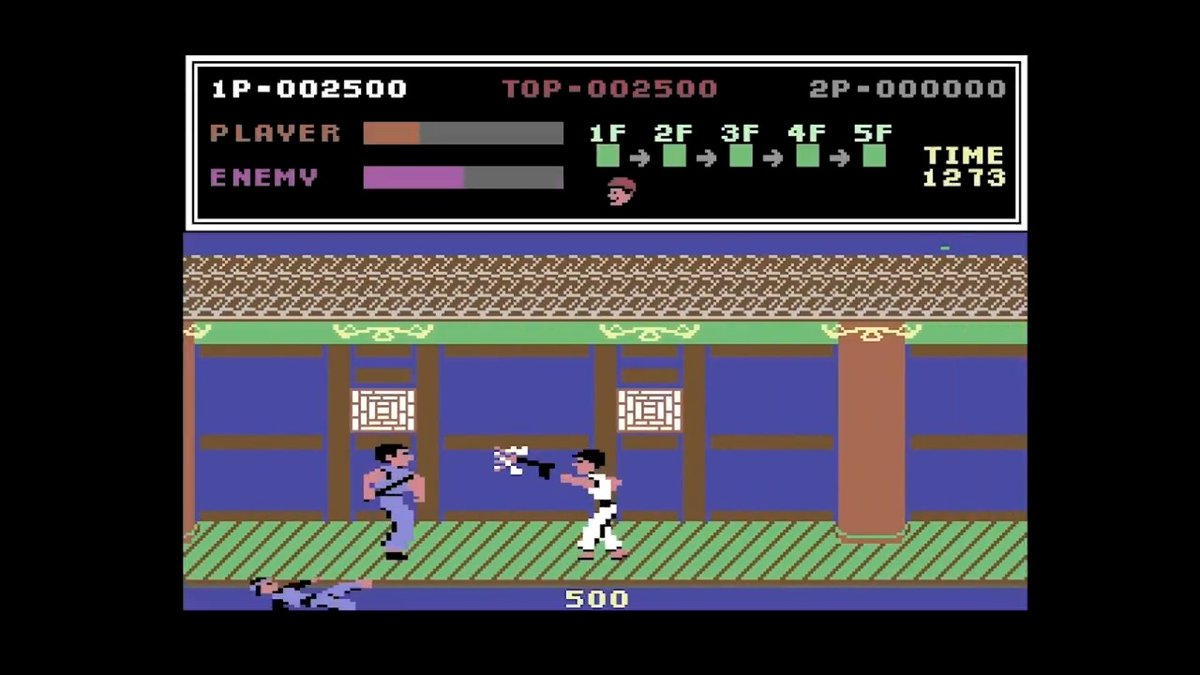
Karateka, released in 1984 for the Apple II by Jordan Mechner (while he was a Yale student!), stood out as a groundbreaking title for its era. My biggest achievement as a student was getting out of bed in time for the majority (not all) classes... The innovations included pioneering...

61,432 Aufrufe • vor 9 Monaten •via X (Twitter)

0 Kommentare

Keine Kommentare verfügbar

Kommentare vom Original-Post werden hier angezeigt

Ähnliche Videos

The apple scene in "Once Upon a Time in Anatolia" (2011) wasn't in the script. Nuri Bilge Ceylan got the idea when he was walking on a day off from the shoot. He saw the apple travelling around by chance. It was a scene where two people were talking and Ceylan felt it would be better if he could make it a bit more interesting. He used it as a metaphor for human life. Ceylan said, "That was not in the script—I found that idea when I was walking around on an off day during the shoot. I saw this apple traveling around, by chance. It was a suitable place—the two of them were talking, and showing them for a long time in a static frame, two people in the darkness, talking—you can inject something in that. For that scene, I wasn’t sure whether I should use that shot or not. But when I put the dialogue over it, I liked it. I wanted to show that the fate of the apple is not so different from our fate. Everything created in the world has the same destiny—animals, trees, humans all have the same kind of destiny. In some way, the apple represents human life, as it goes to rest with the other, rotting apples. Actually, in the rest of that shot, the apple moves back into the stream, but we didn’t use that." When asked the reason why he stopped the shot there, Ceylan replied, "Because to shoot the apple [as it keeps] moving creates more hope; it’s not realistic. Giving hope has become a cliché in cinema, and I don’t like that attitude." ("The Darkness: Once Upon a Time in Anatolia", Zachary Wigon, Tribeca, 2012)

DepressedBergman

11,243 Aufrufe • vor 1 Monat

The Royal Game of Ur .... For 4600 years, a mysterious game slept in the dust of southern Iraq, largely forgotten. The passion of a museum curator and the hunger of young Iraqis for their cultural history may bring it back.... The original name of this ancient game has been lost to time, but it was dubbed the Royal Game of Ur after a British archaeologist named Sir Leonard Woolley uncovered five worn playing boards in 1928 at the Royal Cemetery of the Sumerian city of Ur. Analysts estimated that the highly decorated boards, made of wood, inlaid shell and lapis lazuli, were made between 2600-2400 BC, making the Royal Game of Ur the oldest complete tabletop game ever discovered. Archaeological evidence suggests that the game (Game of 20 Squares) was immensely popular with people of all classes. The boards were carried all over the Middle East and sometimes scratched into clay or rock, if no board was available by soldiers, missionaries, explorers and traders, who introduced it to Iran, Syria, Egypt, Lebanon, Sri Lanka, Cyprus and Crete. Variations of the game have been found in King Tutankhamen’s tomb, and etched into pillars in the palace of the Assyrian king Sargon II. For at least 1000 years, the Royal Game of Ur was the national game of ancient Mesopotamia, but it waned in popularity as other games were developed, including those that most likely evolved from it, such as backgammon. Mentions of the game disappeared in the Middle Ages, but a variation, called Aasha, was played by the Jewish people of Kochi, in India. Jews of Kochi had migrated from ancient Babylonia and brought a version of the game with them. The 1928 discovery of the Royal Game of Ur gave scholars an important cultural glimpse into how the ancient Mesopotamians entertained themselves, but there was one problem: The boards did not come with an instruction manual, and that meant that modern-day scholars had no idea how the game worked. In 1980s, Dr. Irving Finkel (a curator and Assyriologist at British Museum), translated a cuneiform script on a crumbling clay tablet that had been brought to the museum by an antiquities dealer. The document sounded remarkably like the rules of an ancient game. The clay tablet written in 177-176 BC by a scribe named Itti-Marduk-balatu, tablet was discovered around 1880 in the ruins of Babylon, according to an academic paper written by Dr. Finkel. “The tablet included a grid on one side,” he wrote, “and two columns of closely written text on the other, adding his name and the date at the end of the inscription.” British Museum bought the relic shortly after it was found and cataloged it. Scholars tried to decipher the cuneiform over the years, but it was Dr. Finkel who was able to identify the text on the tablet as instructions on how to play the Royal Game of Ur after comparing it to the other game boards the museum had stored in its archives. Babylonian tablet revealed that the game is race between two players to get their markers around and off the board. Pyramid-shaped dice are used to indicate the number of squares a player can move, but strategy is involved as well: If a player lands on a square occupied by their opponent, they can knock that marker off, and the opponent must start over again with that piece. That can set a player back by quite a bit, and it is almost impossible to predict who will win, even near the end of the game. But there was another aspect of the game that attracted people: It was said to tell a player’s fortune. According to the cuneiform tablet, some of the marked squares on the board were assigned signs of the zodiac and, with them, predictions that a player would win a beer, make a friend, eat well, or perhaps become powerful and wealthy. #archaeohistories

Archaeo - Histories

17,784 Aufrufe • vor 3 Tagen

"Looks like it got a little hot out there, sir!" Wing Commander (1990) is often considered one of the earliest "AAA" games, even though the term itself didn’t exist yet. Chris Roberts’ game reportedly cost about five times more to develop than a typical hit title of its era, making it by far the most expensive game at the time, and raising eyebrows everywhere. It featured very advanced graphics, digitized speech, a cinematic story campaign with branching paths, countless cutscenes, and a “Star Wars in space” feel that made it stand out massively. At times, it genuinely felt like you were starring in an interactive movie rather than "just" playing a game. Its success raised the bar for the entire industry. Publishers were now forced to invest far more in production quality, bigger budgets, and marketing. Wing Commander sold millions of copies, and helped establish the space sim genre. The game not only paved the way for even larger budgets in its own sequels, but it also pressured other developers and publishers to keep up. Whether this was ultimately good for the industry could still debated today. On one hand, it started an era of cinematic, high-production games. On the other, it made it significantly harder for small teams and low-budget titles to compete, effectively throttling the kind of creativity that had been a hallmark of 1980s game development. With the birth of Wing Commander, the industry had entered a whole new territory.

exQUIZitely 🕹️

23,279 Aufrufe • vor 4 Monaten