Video wird geladen...

Video konnte nicht geladen werden

Zur Startseite

Katt keeps interruption Caine's meal Commission for Caine Core Katt Rig/Model by BatteryMaster (C0mms 5/8) #b3d #animation #TADC

19,484 Aufrufe • vor 2 Tagen •via X (Twitter)

10 Kommentare

Profilbild von Caine Core
Caine Corevor 2 Tagen

@BatteryMastor I took so many screenshots already

Profilbild von BatteryMaster (C0mms 5/8)
BatteryMaster (C0mms 5/8)vor 1 Tag

@CaineCore Seeing this model in action is so awesome

Profilbild von Marhola
Marholavor 1 Tag

@CaineCore @BatteryMastor Caine's expressions they're so good OUGHHHHH They nearly read as canon to my brain, extremely good job!!! Big fan of his eyes quickly shifting inside of his mouth after having pulled them out to eat the sadwitch!

Profilbild von city_guy
city_guyvor 1 Tag

@CaineCore @BatteryMastor How can this dude eat?

Profilbild von 🔞Lin Sparks🦉🐝/COMMISSIONS OPEN
🔞Lin Sparks🦉🐝/COMMISSIONS OPENvor 1 Tag

@CaineCore @BatteryMastor Massive W for using the Gmod Idiot Box version of the audio!

Profilbild von AlexGar.
AlexGar.vor 1 Tag

@CaineCore @BatteryMastor What's the song?

Profilbild von CP834
CP834vor 2 Tagen

@CaineCore @BatteryMastor How. TF. Can he eat?

Profilbild von baphi 𓃵 | xxxlilbaphometxxx.bsky.social
baphi 𓃵 | xxxlilbaphometxxx.bsky.socialvor 1 Tag

how much did this even cost?

Profilbild von dope (COMMS OPEN)
dope (COMMS OPEN)vor 1 Tag

🤫

Profilbild von baphi 𓃵 | xxxlilbaphometxxx.bsky.social
baphi 𓃵 | xxxlilbaphometxxx.bsky.socialvor 1 Tag

🫢

Ähnliche Videos

Chamath is making one of the most important business arguments of 2026. Half of large US companies right now cannot generate returns that exceed their cost of capital, which has normalized back to its long run average of 8 to 11%. Another one in seven companies globally is stuck generating persistent returns between 1 and 5% and most businesses don't have room for error and in this environment walks every frontier AI lab saying the same thing, give us your data, your workflows, your processes and our model will make everything better. And companies by the millions said yes. What they didn't fully account for is what happens on the other side of that door. Every time an employee runs a query through a frontier model API, the prompt goes through external servers, workflows, customer data, pricing logic, internal processes, all of it transmitted through a third party. As Alex Karp said companies are spending on tokens while handing over the exact proprietary advantages that make their business worth owning. Microsoft blocked internal use of Anthropic's Claude Fable 5 but over its 30-day data retention policy and the largest software company in the world decided a frontier model's data handling was too risky for its own employees. A US government action revoked access to another frontier model for foreign nationals overnight. Now here's where the cost math becomes impossible to ignore. Deutsche Bank calculated a roughly 65x cost gap between frontier models like Claude Fable 5 at ~$3.25 per task and open-source alternatives at ~$0.05. For 90% of everyday enterprise tasks, performance is comparable. Open-weight models now match closed frontier systems on core agent tasks at roughly one-tenth the cost, a high-volume deployment that costs $250/day on Claude runs at $12/day on an open-source equivalent. Chamath Palihapitiya tested this directly by running a standard enterprise code migration task through an orchestration layer wrapping an open-source model came in 16.4x cheaper than using a frontier model directly.

Milk Road AI

281,875 Aufrufe • vor 2 Monaten

VoxCPM 2 just dropped by OpenBMB Only 2B-param open-source TTS (Text-to-Speech) model built for production-grade multilingual voice work. Apache-2.0 license, Can run on only 8GB VRAM. • Eliminates the "robotic" feel of traditional TTS, delivering prosody and emotional depth suitable for high-stakes professional environments like filmmaking, gaming, animation, and audiobooks. • 30-language multilingual: no language tag needed, just type in a supported language and generate directly. • Voice design: create a brand-new voice from a text description alone, like age, tone, pace, or emotion. No reference audio required. Describe the desired voice characteristics (gender, age, tone, emotion, pace …) in Control Instruction, and VoxCPM2 will craft a unique voice from your description alone. • Controllable cloning: clone from a short clip, then steer delivery style without losing the speaker’s core voice. • Ultimate cloning: use reference audio + transcript for continuation-style cloning that keeps the tiny vocal details. • 48kHz output: takes 16kHz reference audio and produces studio-quality speech without an external upsampler. • Real-time ready: around 0.3 RTF on RTX 4090, even lower with Nano-VLLM. • Commercial use: Apache-2.0 licensed. Developer-Friendly Infrastructure: - Native Torch Inference: Direct support for PyTorch-based workflows. - Training Flexibility: Supports both full-parameter and LoRA fine-tuning for specific domain adaptation. - Production Readiness: Compatible with voxcpm-nanovllm for large-scale, high-concurrency deployment.

Rohan Paul

13,541 Aufrufe • vor 5 Monaten

10 repos that cut your ai agent token bill by up to 80% 1. microsoft/LLMLingua → cuts prompt size by up to 95% compresses prompts before the api call. 20x compression. published at EMNLP + ACL. near-zero quality loss. 6,100 stars 2. mem0ai/mem0 → replaces full conversation history in context stores what matters. retrieves only what's needed. 10,000 token history → 200 token memory. per agent. 54,800 stars 3. BerriAI/litellm → routes each call to the cheapest model simple task → haiku. complex task → sonnet. tracks cost per agent, per call, per day. 45,700 stars 4. run-llama/llama_index → replaces sending full documents rag: 100-page doc → 3 relevant chunks → same answer. 98% fewer tokens per query. 49,100 stars 5. chroma-core/chroma → replaces keyword search in full context vector store. finds the closest match. feeds only that. 50-200 tokens per query instead of thousands. 27,800 stars 6. letta-ai/letta → replaces infinite context window crashes paged memory for agents. loads only relevant memory. stops your agent from hitting limits and retrying. 22,400 stars 7. guidance-ai/guidance → cuts output token bloat by 30-50% structured generation. constrains model output natively. no more 100-token prompts to get json back. 21,400 stars 8. Aider-AI/aider → replaces pasting entire codebases builds a repo map. sends only files relevant to the task. not your whole project. just what the agent needs. 44,300 stars 9. openai/tiktoken → count tokens before you send know the exact cost before the api call happens. not after the bill arrives. 18,100 stars 10. simonw/ttok → hard cap on what gets sent cli tool: count tokens, truncate to budget limit. pipe any text in. get truncated output back. 389 stars most agents are expensive not because the model is expensive. because nobody checked what was being sent to it.

self.dll

39,554 Aufrufe • vor 4 Monaten

Variational Autoencoder by hand ✍️ ~ 11 steps walkthrough below A VAE learns the structure of your data, the mean and variance of its hidden features, and then generates new data from that structure. A GAN only learns to fool a discriminator. It can make convincing fakes without ever knowing what the data is really made of. That is the difference, and it is the whole reason VAEs matter. In 2024 ICLR gave its first ever Test of Time Award to the VAE paper, "Auto-Encoding Variational Bayes" by Diederik Kingma and Max Welling, ten years on. How does it work? Goal: encode three inputs into a distribution, sample from it, decode it back, and read every loss gradient off the page. = 1. Given = Three training examples X1, X2, X3, copied to the bottom as their own targets. Reconstructing your own input is what puts the "auto", meaning self, in autoencoder. = 2. Encoder, layer 1 = Let us multiply the inputs by weights and biases, then apply ReLU, crossing out every negative. = 3. Mean and standard deviation = We multiply the features by two more weight sets. The first predicts the means μ of the latent distributions, the second their standard deviations σ. = 4. A random offset = Let us sample ε from a standard normal, mean 0 and variance 1, and multiply it by σ. This is a random step away from the mean, scaled by how uncertain each feature is. = 5. Mean plus offset = We add the offset back onto μ, and these become the decoder's inputs. Keeping the randomness out in ε is the reparameterization trick: it lets gradients flow straight through the sampling. = 6. Decoder, layer 1 = Let us multiply by weights and biases and apply ReLU again. Here -4 is crossed out. = 7. Decoder, layer 2 = We multiply once more. The output Y is the decoder's attempt to rebuild X from the sampled distribution. = 8. Gradient for the mean = Let us push μ toward 0. A lot of math, the SGVB estimator, collapses the KL gradient to simply μ itself. = 9. Gradient for the standard deviation = We want σ to approach 1. = 10. And its formula = That same math simplifies the gradient to σ minus 1/σ. = 11. Reconstruction gradient = We want the reconstruction Y to match the input X. Mean squared error simplifies its gradient to Y minus X. Takeaway: the two gradients you just calculated each sit at the heart of a modern method, so one VAE teaches you both. The KL divergence is the penalty RLHF like GRPO uses to keep a fine-tuned model from drifting off its base. The reconstruction loss, plain mean squared error, is exactly what trains a diffusion model to denoise. Draw one VAE by hand and you have quietly learned the core of both. 💾 Save this post!

Tom Yeh

17,011 Aufrufe • vor 1 Monat

$AMD $5 Trillion is Inevitable LT| Agentic AI🧵 Agentic AI is the new $5 Trillion TAM 🚨🚨🚨 This thead will do Comp with $INTC and how to quantify this massive Agentic AI demand spike, and forcing Jensen to rush a CPU design. Global Agentic AI Market size is estimated to be $3-$5Trillion TAM by 2030(McKinsey) Quantifying the demand from agentic AI for AMD involves assessing the broader market growth for agentic systems, their unique computational requirements (particularly for CPUs in orchestration and reasoning tasks), and AMD's positioning very well through products like EPYC processors and partnerships. AMD EPYC Venice is the most superior choice in 2026-2027 for most Agentic AI workloads Agentic AI refers to autonomous AI agents that perform multi-step tasks, involving sequential logic, tool integration, and decision-making workloads that heavily rely on CPUs for handling orchestration, memory management, and context switching, rather than just GPU-parallelized training or batch inference. Agentic AI is often cited as 40-100x more "hungry" than traditional AI due to its continuous, 24/7 operation and complex workflows. This stems from factors like chain-of-thought reasoning (multiple LLM calls per query), API/tool interactions, memory management, and orchestration loops, which can generate 10-100x more tokens and require real-time responsiveness. For example, a single agentic query might trigger 5-20 model inferences, making it 10-20x more compute-intensive than simple chatbots, and the always-on nature compounds this to 40-100x overall. Nvidia's CEO has highlighted this as driving "easily 100x more computation" for inference in agentic/reasoning setups. AMD's EPYC Venice (6th Gen EPYC, codenamed "Venice") and Intel's Xeon 7 Diamond Rapids represent the pinnacle of server CPU technology in 2026, both targeting high-performance data center workloads like AI inference, agentic AI orchestration, cloud computing, and HPC. Venice builds on AMD's Zen 6 architecture, emphasizing core density and efficiency, while Diamond Rapids leverages Intel's Panther Cove P-cores for balanced performance. Both chips adopt similar advancements like 16-channel DDR5 memory and PCIe Gen 6, but differ in core counts, process nodes, and overall design philosophy. Intel has faced acute supply constraints across its Xeon lineup, including legacy nodes (Intel 7/3) and the ramping 18A process for next-gen parts. Intel shortage is expected with lead times up to 6 months or longer. 1. AMD EPYC Venice vs Intel Xeon 7 Diamond Rapids Architecture AMD: Zen 6 chiplet design with 8 CCDs and dual IODs Intel: Panther Cove P-cores; multi-die architecture with 4 compute tiles Core/Thread Count AMD: Up to 256 cores / 512 threads (Zen 6c variant) Intel: Up to 192 cores / 192 threads Process Node AMD: TSMC N2 (2nm) Intel: Intel 18A (1.8nm-class); in-house fab Memory Support AMD: 16-channel DDR5; up to 1.6 TB/s bandwidth. Intel: 16-channel DDR5 ; up to 1.6 TB/s bandwidth I/O and Connectivity AMD: PCIe Gen 6 (up to 128 lanes); twice the CPU-to-GPU bandwidth Intel: PCIe Gen 6 (up to 128 lanes); LGA 9324 socket Power (TDP) AMD: Starting 400-500W, potentially lower due to efficiency gains from TSMC 2nm Intel: Starting 400-500W, as it targets competitive efficiency Performance Projections AMD: Up to 70% uplift vs. 5th Gen Turin (1.7x in multi-threaded/AI tasks) Intel: ~40% faster than Granite Rapids (Xeon 6, 128-core). Lags AMD in per-core perf and 40-50% behind Venice core-for-core comp Target Workloads AMD: AI inference/orchestration, HPC, cloud virtualization. Partnerships Intel: Hyperscale AI, general enterprise. Custom silicon Pricing: AMD: estimated $10k-$20k for top SKUs Intel: estimated $8-$18k Availability: AMD: Significant Ramp H2 2026 due to higher allocation from TSMC Intel: H1-H2 2026 delayed, but trying to catch up Overall: ~Venice's 256 cores provide a 33% edge over Diamond Rapids' 192, making it superior for massively parallel tasks like AI training/inference or virtualization ~TSMC's N2 vs. Intel 18A debates rage on which is "better," but AMD's mature chiplet approach yields better density ( 32 cores/CCD vs. Intel's 48/tile). Venice's redesign reduces latency, aiding agentic AI where CPUs handle orchestration ~ Early projections show Venice widening AMD's lead matching or exceeding Diamond Rapids' perf with fewer watts in multi-threaded benchmarks. Intel's no-SMT design (to prioritize AI) handicaps it vs. AMD's 512 threads, though Clearwater Forest (E-core) could compete in density-focused niches. ~Power & Cooling: Both push above 400-500W, demanding liquid cooling. ~AMD been taking market share now above 40%. AMD EPYC Venice emerges as the superior choice in 2026 for most server workloads. Its higher core/thread count (256/512 vs. 192/192), stronger per-core performance, and architecture optimized for AI-driven tasks (agentic orchestration with GPU integration) provide decisive advantages in throughput, scalability, and efficiency. Projections indicate Venice delivering 1.7x the performance of prior gens while widening the gap over Intel ( 40-70% leads in multi-threaded benchmarks). AMD's fabless model with TSMC ensures reliable scaling, and its ecosystem ( open ROCm) appeals to AI adopters. Intel's Diamond Rapids is competitive in single-threaded enterprise apps and custom hyperscale ( NVLink), with potential fab advantages for supply/security. However, without SMT and lower density, it falls short in core-for-core battles—exposing Intel to another generation of AMD dominance unless 18A yields surprise efficiency gains. For data centers prioritizing raw compute ( AI, HPC), Venice wins; for Intel-centric ecosystems or specialized I/O, Diamond Rapids holds ground. Real benchmarks post-launch will confirm, but logic points to AMD pulling ahead. 2. Market size , Potential Revenue and Supply Global Agentic AI market size is projected to be $3-$5 Trillion by 2030 according to McKinsey, where consensus points to 40-50% CAGR driven by small to large enterprise demand. I also wrote a full thread on how and why Agentic AI is so explosive that AMD will blow all anlaysts estimate for subscribers. Link below if you are interested. AMD's data center segment hit a record $5.4B in Q4 2025 (up 39% YoY), with EPYC shipments ramping due to agentic demand. With 2GW of deployment in H2 2026, AMD AI data center revenue has $40-$50B+ at the lowest or most conservative projection; or Total Revenue in the $77-$94B For FY2026. However, Agentic AI massive demand spike could send EPYC revenue 3x to 4x in the next few years, potentially surpassing MI series GPU demand as enterprises prioritize CPU-dense Rack setups. This is pushing $NVDA Jensen to rush a CPU design and acquired Groq, a new CPU player due to this massive TAM. Noted that this is just popping just in weeks, highlighting we are just so early in this AI Supercycle and the pace of adoption is insane, and clearly productivity will skyrocket. Why? Because Agentic AI is 24/7 Smart AI agent working for you or your businesses is a mad compelling, and it is estimated to be 40-100x more Inference Hugnry! Many experts already said it is impossible to project this kind of Inference Demand. AI CapEx is expected to ramp up even more in 2027-2028-2029 and 2030 as Global Agentic AI is going to scale to $3-$5 Trillion TAM by 2030. The nature of Agentic is driving higher CPU/GPU ratio, with CPUs handling 50-90% of Agentic workflows. For example, The current Helios Rack: 18 compute trays per rack with 72 GPUs + 18 CPUs. The beauty of this $META and $AMD long term partnership is, that it is absolutely flexible to adjust racks to higher CPU rato or equal to service different needs. Helios rack can be easily swap to 2 GPUs 2CPUs or even CPUs only trays for dedicated orchestration/head nodes. You see, the beauty of this open rack-scale is flexibility and evolvability. If Agentic AI demand pushes much higher, AMD should be able to adjust variant trays without abandoning Heilos Rack. We can't talk just about massive Agentic AI demand without talking about the Supply side or TSMC. TSMC, AMD's primary foundry for advanced nodes ( Zen 6/Venice on N2/2nm), is addressing AI-driven shortages through massive expansions. TSMC accelerates fab construction with up to 10 facilities targeted for 2026. TSMC is accelerating its domestic manufacturing expansion, with industry sources indicating that as many as ten fabs could be under construction or preparing to begin operations across Taiwan’s major science parks. TSMC Capex: $52-56B in 2026 (up 37% YoY), with $45B already approved for new/upgraded capacities. 70-80% for advanced processes (2nm/A16), 10-20% for packaging (CoWoS quadrupling to 120-140K wafers/month by late 2026). In addition, Taiwanese companies (led by TSMC) commit to at least $250B in direct investments in US-based advanced semiconductor, AI, and energy production/innovation capacity.Taiwan provides $250B in government credit guarantees to facilitate additional investments and build a full US semiconductor ecosystem (including industrial parks). TSMC completed a second land purchase in Arizona (January 2026) for gigafab scaling, with an additional $100B+ (potentially four more modules) to further expand and qualify for tariff exemptions. AMD with secured 12GW from OpenAI and $META and massive Agentic AI will mean higher priority acess to 20-30% more wafers on TSMC advanced nodes, as TSMC has multi-year agreements with AMD for AI chips. Dr. C. C. Wei, CEO of TSMC quote: "I spend a lot of time in the last three or four months talking to my customer and then customers. Customer. I want to make sure that my customers demand are real. I talk to those cloud service providers, all of them. Their answer is. I'm quite satisfied with their answer. Actually they show me the evidence that the AI really help their business. So they grow their business successfully and he or she in their financial return. So I also double check their financial status. They are very rich." Amid shortages, the US buildout ensures AMD can ramp production of Instinct GPUs and EPYC CPUs without the constraints hitting competitors like Intel. By diversifying away from Taiwan (85% of advanced nodes today), the agreement mitigates supply disruptions, ensuring stable flows for AMD's chips. Scaling production and securing supply will matter for AMD the most in the next 5-10 years growth. The growth could be 80-100% YoY or higher; or it could be in the 60%. The aggressive TSMC supply ramp is reassuring the higher growth point. Conclusion: AMD stands at a pivotal inflection point in 2026, where the explosive rise of agentic AI demanding 40-100x more inference compute through its 24/7, multi-step orchestration positions the company to potentially triple its EPYC CPU revenue to $45-60B+ by 2028 while scaling Instinct GPUs to tens of billions annually by 2027. Agentic AI demand could push AI CapEx closer to $1 Trillion in 2027, far higher than most estimates. Dr. Lisa Su, AMD's visionary CEO, is masterfully securing supply to harness this massive demand by prioritizing operational execution and deep TSMC collaboration, ensuring readiness for the second-half 2026 AI ramp. Dr. Su has explicitly called out surging EPYC demand for agentic tasks where CPUs power head nodes and traditional workloads alongside GPUs while guiding for data center dominance through proactive capacity planning and partnerships like Nutanix ($150M investment for open agentic platforms) or providing tens of millions CPUs for OpenAI, $META, $ORCL, $AMZN, $MSFT, $GOOGL and others. Her strategy includes multi-year TSMC agreements for advanced nodes (N2 for Venice CPUs and future Instincts), diversifying beyond Taiwan to mitigate risks, and unveiling innovations like the MI455X GPU at CES 2026, which she touted as enabling "the next trillion-dollar market opportunity" in physical AI. Dr. Su's forward-looking vision predicting AI reaching 5 billion users emphasizes "AI everywhere," backed by hardware like Ryzen AI chips, all while declaring demand "going through the roof" and committing to scale without bottlenecks. TSMC's aggressive ramp-up, fueled by $52-56B in 2026 capex (up 37% YoY) and 10+ new fabs across Taiwan, the US (Arizona cluster expanding to 6+ modules with $165B+ investment), Japan, and Europe, provides profound reassurance for AMD's supply stability. The January 2026 US-Taiwan agreement committing $250B in investments and credit guarantees for US reshoring accelerates this, granting tariff relief (15% rates with 1.5-2.5x exemptions) tied to capacity buildouts, enabling TSMC to potentially double output over the decade to meet AI wafer hunger. This translates to 20-30% higher wafer allocations on key nodes, sidestepping Intel-like shortages and empowering Dr. Su's team to deliver on hyperscaler demands without disruption. Ultimately, this synergy cements AMD's leadership in the agentic era, promising sustained growth, $5T+ valuations at scale, and a resilient path forward as AI reshapes the world. This is NOT Financial Advice! Video source: AMD CES 2026

Mike

44,460 Aufrufe • vor 7 Monaten

🐬🐬🐬PI NETWORK NEWS: Pi Network and the 100 Apps Ready for Mainnet: Understand Clearly, Wait Patiently, and Build Together 1. Frequently Asked Question: “Where Are the Promised 100 Apps?” As Pi Network progresses toward a truly decentralized blockchain ecosystem, the community naturally wonders: Where are the 100 decentralized applications (dApps) that were promised to be ready for Mainnet? This is a perfectly valid question, showing the community’s interest in the pace of ecosystem development and the role of the Pi Core Team in driving innovation. 2. The Pi Core Team Doesn’t Build Everything – The Community Is the Heart of the Ecosystem The key point to understand is: Pi Network is a community-driven project. The Pi Core Team is not responsible for building all the apps. Their focus is on building the infrastructure, tools, and a safe environment – empowering external developers to independently create and deploy applications. Pi provides: - An optimized blockchain platform for mobile devices - SDKs, APIs, and developer documentation - A governance model that encourages innovation 3. Early Stage: Community-Built dApps – Underfunded But Passionate In the early stages, many applications were created by passionate pioneers, self-funded and full of creativity. However, due to budget limitations, most of these apps remained in experimental or prototype form, not yet ready for wide-scale deployment. Despite their early-stage nature, these apps played a crucial role in demonstrating Pi's blockchain potential and encouraging broader developer engagement. 4. A New Turning Point: $100 Million Ecosystem Fund and Pi Network Ventures A major change has arrived: Pi Network Ventures and a $100 million ecosystem fund have officially launched. This brings: - Strong financial support to upgrade promising apps - Opportunities to scale and enhance advanced features - Marketing assistance, user acquisition support, and long-term sustainability This is a decisive push paving the way for a wave of high-quality dApps ready for Mainnet. 5. A Diverse, Decentralized Ecosystem Built by the Community The Pi Core Team does not control everything but builds the foundation for an open ecosystem, where developers, entrepreneurs, and the community play leading roles. This decentralization helps to: - Increase application diversity - Avoid reliance on a single entity - Encourage collaboration and innovation from many directions 6. 100+ Apps Will Soon Arrive – And It’s More Than Just a Number As funding, tools, and community momentum converge, an app explosion is predictable: More than 100 dApps ready for Mainnet will soon emerge, spanning areas like: - Decentralized finance (DeFi) - Gaming (GameFi) - Social media - Supply chain - Payments, asset management, and more This will expand Pi’s real-world utility, attract more users, and strengthen Pi Network’s position in the Web3 space. 7. Why Patience and Cooperation Are Essential Building a global-scale blockchain ecosystem does not happen overnight. It requires: - Solid technology - Passionate development teams - A resilient and collaborative community - Time for products to mature and prove their value The patience and contributions of pioneers like you are the driving force of this journey. 8. A Broad Vision: Web3 and Social Impact The future of Pi Network is not just about technical platforms: It is about a connected ecosystem with social and economic impact, serving billions of people, not just a privileged few. With a focus on inclusive, meaningful, user-friendly applications, Pi is preparing for a fair and inclusive Web3 future. ✅Conclusion: 100+ Apps – Not Just an Empty Promise, But a Realization in Progress The question “Where are the 100 apps?” is fair. But more importantly, you need to know that: - The infrastructure is ready - The funding is available - The community is building continuously And you – the pioneer – are part of the answer. Be patient, collaborate, and support the developers and fellow pioneers. Because the future of Pi Network does not belong to just a few, it belongs to all of us working together.🐬🐬🐬 ------------------------- 🥰 P.S.: The Global GCV Core Team welcomes pioneers from around the world to work together to build a strong GCV-based Pi economy. Let’s co-create the future—united and strong! 📢 Join the global Pi movement on Telegram: [ ------------------------- 👉 Please Like, Share, and Comment to support the Pi Network’s global expansion! Your voice matters! 🥰 Pi Network Doris Yin 东方紫莲🪷 Lumari 🦋 NONNY PADJA NTT ❤ Eagle woman 🦅 @MoretopMovie M.Rad Olivier Ndatimana PATRICK CHUA KIAVASH brave Lee Mazi victor onyido Cherif Abiola IYANDA Herine Makosewe love life 2025 Mohammed Alademi Daniel Chen PiGCV_Spain西班牙 EDIER ALONSO RINCON @tkst RAMESH SHETTY hoda448🪷 Ganhoumeto dossou expedit ange Atty. Ebru 👑 Pi’N’Q Rabbit Av. N. Uğur Kadifeci solival Art💜" Global GCV Ambassador 🇫🇷 "💜

JoJo-π

19,019 Aufrufe • vor 1 Jahr

Using Claude Fable 5, I built a model that predicts the entire 2026 FIFA world cup.. every single game, not just the final.. so let me break the whole thing down. what it does, how it works, and exactly how i built it.. #1 First what it does: it predicts all 104 games of the tournament. not just who lifts the trophy, but every group match, every knockout, the full path from the round of 32 to the final.. everything lands in one dashboard: > group stage, every match with each team's win % and the chance of a draw > standings, how all 12 groups are projected to finish > bracket, the full knockout tree with each team's odds of advancing > champion odds, who's most likely to actually win it all and it doesn't freeze after one prediction. the moment a real game is played, it locks that result in and re-runs everything around it. so the odds move live as the tournament goes, week by week you watch favorites rise and contenders collapse. #2. How it works: the core idea is simple. the model only ever predicts one thing, a single match. the real trick is the repetition. it learns from decades of match history, then plays the whole tournament out from the first game to the final, tens of thousands of times. each run it records who advanced and who won. do that enough and you stop getting one guess and start getting real odds, one team lifts the trophy in maybe 14% of the runs, another in 9%, and so on. #3. So, how i built it ? i didn't hand-write most of the code. i broke the project into 4 pieces, described each one to fable, and let it build while i focused on getting the football logic exactly right. - The data every international match going back over a century, around 50,000 games, plus each team's elo rating, which is the truest measure of strength, and the official 2026 schedule. garbage data means garbage predictions, so this part mattered most. - The features i turned that raw history into signals the model can learn from, the elo gap between the two teams, recent form, goals scored and conceded, and a home boost for the hosts, usa, canada and mexico. - The model for each match it predicts the expected goals for both sides, then turns that into win, draw and loss probabilities plus a likely scoreline. that's what feeds the simulation. - The tournament engine this was the hard part. the 2026 world cup is brand new, 48 teams, 12 groups, a round of 32 that's never existed before, and 8 "best third-placed" teams that slot into the bracket by a fixed fifa table. even the group tiebreakers changed this year, head to head now counts before goal difference. get any of it wrong and the whole bracket falls apart, so i built it carefully and tested the format until it was exact, then wrapped it in a simulation loop that plays the tournament out tens of thousands of times. and the last piece, the live part. as real results come in, they get locked, and only the unplayed games get re-simulated. that's what makes it a living model instead of a one-time prediction. all of it outputs to a clean dashboard you can actually read and screenshot.. right now, before kickoff, it already has a clear favorite to lift the trophy.. 👀 btw who's your pick to win the 2026 world cup?

Axel Bitblaze 🪓

63,796 Aufrufe • vor 3 Monaten

AI AGENTS 101 (58 minute free masterclass) send this to anyone who wants to understand ai agents, claude skills, md files, how to get the most out of AI etc in plain english: 1. chat vs agents - chat models answer questions in a back and forth while agents take a goal, figure out the steps, and deliver a result 2. agents don’t stop after one response. they keep running until the task is actually finishedno babysitting required 3. everything runs on a loop. they gather context, decide what to do, take an action, then repeat until done 4. the loop is the system. they look at files, tools, and the internet. decide the next step. execute and then feed that back into the next step. over and over until completion 5. the model is just one piece. gpt, claude, gemini are the reasoning layer. the key is model + loop + tools + context 6. mcp is how agents use tools. it connects things like browser, code, apis, and your internal software. once connected, the agent decides when to use them to get the job done 7. context beats prompt all day. you don't need to write perfect prompts. load your agent with context about your business, style, and goals and then simple instructions work 8. claude.md or agents.md is the onboarding doc it tells the agent who it is, how to behave, what it knows, and what tools it can use. this gets loaded every time before it starts 9. memory.md is how it improves. agents don’t remember by default. this file stores preferences, corrections, and patterns you tell the agent to update it, and it gets better over time 10. skills + harnesses make it usable. skills are reusable tasks like writing, research, analysis the harness is the environment like claude code or openclaw that runs everything. basiclaly, different interfaces, same system underneath this episode with remy on The Startup Ideas Podcast (SIP) 🧃 was one of the clearest ways of understanding a lot of the core concepts of ai agents could be the best beginners course for ai agents 58 mins. all free. no advertisers. i just want to see you build cool stuff. im rooting for you. send to a friend watch

GREG ISENBERG

377,539 Aufrufe • vor 6 Monaten

🚀 L1X $25 Million Strategic Growth Raise is Live 🧬 From quantum resistance research partnerships to interoperability focussed real-world traction — Layer One X is scaling new heights. 🎯 Tranche One at $1 (90% Discount to the Trading Price) 🔗 Secure Your Spot in Tranche One: 📊 While many projects have raised between $200M to $350M, they’re still navigating toward meaningful market traction. Meanwhile, L1X has delivered unmatched real-world utility, innovation, and adoption with $12M raised to date. Now, with our $25M Strategic Growth Raise, we’re scaling our impact even further. 📈 📸 Milestones Achieved: 👉 2.5M+ Bridgeless Cross-Chain Messages 👉 200+ Decentralised Validator Nodes 👉 50+ Projects 👉 110,000 Soul Bound NFT’s Issued on L1X-App (Less than 150 Days) 👉 35+ Networks Integrated 🔐 Building the World’s First Quantum Resistant Cross-Chain Message Technology 📂 Open Sourced Code 🛡️ Audited by Hashlock 🛠️ What Sets L1X Apart ✅ Bridgeless Interoperability (X-Talk) ✅ Custom VM + EVM Compatibility ✅ PoX Consensus (Full + X-Talk Nodes) ✅ Protocol Integrated X_Wallet 🌉 World’s First Proven Bridgeless Cross-Chain Tech 📜 Must-Read Docs 📘 L1X Core WhitePaper (210 Pages): 📘 Quantum WhitePaper: 📘 LitePaper: 🔐 Proof of Utility Based Anti-Dump Tokenomics Model 📊 Tokenomics: 📅 Highlights of 2025 Roadmap 🌐 Multi-Chain Token Issuance and Liquidity Abstraction Standard (X-MNAIS) ERC-20-compatible Multi-Chain Token Issuance 🔸 Bridgeless, gas-efficient, & unified liquidity across chains 🔸 No redeployments. No bridges. Just seamless scaling. 🧬 Quantum Resistance Framework In collaboration with UWA 🔸 Plug-and-play security for dApps & chains 🔸 Quantum-proof messaging, state, and consensus layers 💸 L1X as Universal Gas 🔸 Pay once, interact everywhere 🔸 L1X to be used as the universal cross-chain fee with X-Talk which integrates with 35+ networks to enable cross-chain swaps. 🛍️ L1X App Store 🔸 110K+ Soul Bound NFT’s issued 🔸 Unified interface, real-time cross-chain logic ⚛️ Quantum DeX The first of its kind 🔸 Multi-chain liquidity pools 🔸 Vault-based integration with Uniswap, PancakeSwap, Raydium and other DeXs 🔸 Quantum-First security + Smart Release Pool integration 🔸 L1X as the gas layer for DeFi 🔧 Use of Funds – Strategic Allocation 🧠 Advancing Quantum-Resistant Technology 🌱 Ecosystem Growth & Adoption 💧 Liquidity Reinforcement via Release Pool 🏦 Tier 1 Exchange Listings 🧪 Building the World’s First Quantum-Resistant Liquidity Unification DeX (Quantum DeX) 💰 Tranche Details (US$5 Million Each) 📍 Tranche 1 at $1 (90% Discount to the Trading Price) 📍 Tranche 2 at $3.5 📍 Tranche 3 at $5 📍 Tranche 4 at $6.5 📍 Tranche 5 at $8 📑 Tranche Details: 💎 Backed by Real Builders 🔹 Ex-Samsung, Ex-Chainlink 🔹 TradeFi Experts, Web3 OGs 🔹 4M+ Follower Influencer 🔹 Research PhDs and Core Engineers 🌐 This is Layer One X — where real tech meets unstoppable vision.

LayerOneX

18,409 Aufrufe • vor 1 Jahr

🚨 Treason by Oath: Ilhan Omar & Rashida Tlaib Swore on the Quran - Disqualifying Them from ANY American Office! Why is the GOP Allowing ANY Official to Enter, or Remain, in Our Government Who Pledges Allegiance to a System That Subverts Our Constitution? !Ilhan Omar & Rashida Tlaib were sworn into office on the Quran - that alone should disqualify them from holding positions in our government, even today as they continue serving in Congress amid scandals and investigations. Why? Because Islam's core tenets are fundamentally incompatible with the U.S. Constitution, promoting a supremacist ideology that undermines American freedoms. Here is a breakdown from a RAIR Foundation article... 🔺1/ First, Islam clashes directly with the Constitution. The U.S. was founded on freedom, equality, & individual rights. But Sharia (Islamic law) mandates punishments like execution for apostasy (leaving Islam), violating the First Amendment's freedom of religion. Quran 4:89: "If they turn back, seize them and kill them wherever you find them." No other major faith demands death for changing beliefs. 🔺 2/ Blasphemy laws in Islam punish criticism of Allah or Muhammad with death, shredding free speech. Quran 33:57: "Those who abuse Allah and His Messenger—Allah has cursed them... and prepared for them a humiliating punishment." In places like Pakistan, this leads to mob lynchings, nearly 100 killed, per the U.S. Commission on International Religious Freedom. This contradicts U.S. protections for even offensive speech (e.g., Brandenburg v. Ohio). 🔺 3/ Islam enforces legal inferiority for women & non-Muslims, violating the 14th Amendment's equal protection. Women’s testimony is worth half a man’s (Reliance of the Traveller o24.7), & daughters inherit half what sons do (L6.7). Quran 4:34 allows men to "beat" disobedient wives. Non-Muslims face "dhimmitude"—subjugation & jizya tax (Quran 9:29: "Fight those who do not believe... until they pay the jizya with willing submission and feel themselves subdued"). 🔺 4/ Sharia claims supremacy over all laws, ignoring the Constitution's Supremacy Clause. Quran 5:44: "Whoever does not judge by what Allah has revealed, they are the disbelievers." This means Muslims must prioritize Islamic law over U.S. law. Examples: Sharia courts in the U.S. & UK discriminate in divorce/inheritance. Even Islamic finance embeds Sharia in our economy, prioritizing it over secular rules. 🔺 5/ Second, is the Quran hate propaganda? Absolutely—it dehumanizes non-Muslims, calling them "the worst of creatures" (98:6), "vilest of animals" (8:55), & compares them to "panting dogs" (7:176) or "cattle" (7:179). It distinguishes Muslims as "the best of peoples" (3:110) while condemning infidels to eternal torture: "Garments of fire... boiling fluid poured on their heads" (22:19-22). 🔺 6/ The Quran fosters hatred: "Take not the Jews and Christians for friends... He among you who taketh them for friends is one of them" (5:51). It curses other religions—Jews & Christians are "deluded" (9:30), polytheists (Hindus) invent lies about Allah (29:17). Atheists & apostates face death. Allah doesn't love unbelievers (30:45) & even causes them to sin for punishment (16:93). 🔺7/ This inspires violence: "Fight those who believe not in Allah... until they pay the jizya" (9:29). "Strive hard against the Unbelievers... be firm against them. Their abode is Hell" (66:9). Muslims are to be "severe against disbelievers" (48:29). History shows this in action—from Muhammad's conquests to modern jihad. 🔺 8/ The U.S. has banned harmful "religious" practices before, like polygamy (Reynolds v. United States, 1879), despite it being halal in Islam. We can't grant protected status to an ideology seeking dominance through "civilizational jihad" - economic penetration, lobbying, no-go zones, & more. Islam isn't just a faith; it's a political system with its own taxation (zakat for jihad). 9🔺/ Omar & Tlaib represent this threat. Swearing on the Quran pledges allegiance to a system that subverts our Constitution. Time to define "religion" legally - protect faith, but not subversive ideologies. America first! Ban Sharia in government.

Amy Mek

169,504 Aufrufe • vor 8 Monaten

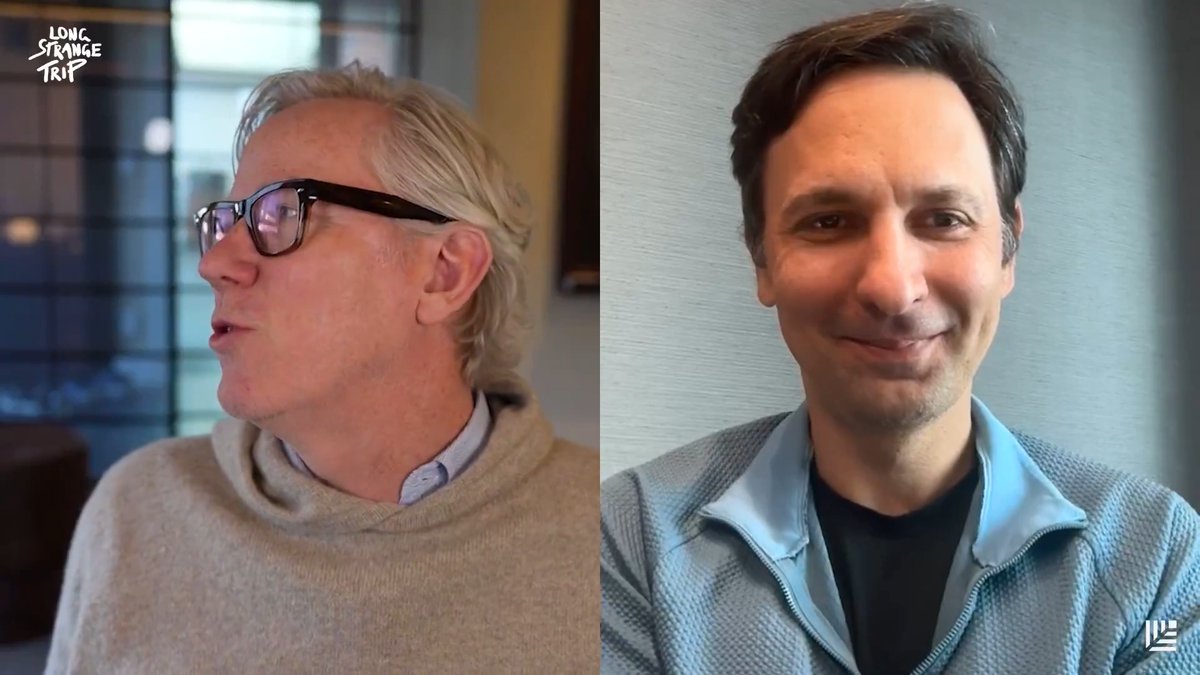
The most ‘Founder Mode’ CEO working today is not actually the founder. NEW EPISODE with Kaz Kaz Nejatian of Opendoor is now live. This is a special one. Kaz left Shopify to pull off the refounding of a struggling public company in just 16 days. Incredible story. Here are just a few of my learnings from our conversation on the latest episode of Long Strange Trip: 1. First Derivative Businesses The most enduring companies are rarely built on their primary activity; they are built on the first derivative of that core business. Great founders identify and weaponize the secondary value stream. This is important. 2. Rejecting Defaults Success is a function of the defaults you choose to overwrite. Most operators accept the 'software' of their industry or life on autopilot; exceptional builders identify the one or two critical defaults and fight them with all their power to create a new trajectory. Kaz is a master at this, and he explains how. 3. Stewardship Over Status Optimize for doing things rather than being things. When a leader optimizes for a title or happiness, they create fragile organizations; when they optimize for stewardship and service, they build a mission-driven culture that can withstand the lonely and painful stretches of the journey. 4. Write a user manual for yourself "Strong attract, strong repel. My job is to tell you what kind of a person I am so you can opt in or opt out." I love this quote. If you're a founder, you owe this to everyone around you. 5. Founder mode = responsibility for outcomes Hold yourself responsible for truth and outcomes, not processes. Hire people to round you out. Don't try to be well-rounded yourself. And don't work on your weaknesses. "Is the fact that I'm bad at this the reason I'm good at everything else?" 6. Structural Risk Mispricing The one permanent advantage for entrepreneurs is that the rest of the world structurally misprices risk. While others see a 'lion bite' in every setback, the best CEOs recognizes that things going poorly is not as painful as you think, allowing them to lean into volatility that scares off the incumbent. That's the difference. 7. Death Spiral Honesty When a company is in a death spiral, incrementalism is fatal; "what must change os everything." Professional managers are often incentivized by RSUs to delay the inevitable and manage a slow decline. You need zero incentive to manage a decline and a compensation structure aligned purely with performance. 8. AI as the New Performance Default Default to AI is not a suggestion; it is the first line of the job description. A company becomes AI-native not through top-down mandates, but by making AI proficiency a core pillar of the performance management system - effectively deciding who gets to play on the team based on their ability to automate their own craft. 9. The Career vs. Job Distinction "A job is something you do for someone else in order to get paid. A career is something you work on every day for yourself." Kaz's kids know what Opendoor is. His family is all in. Exceptional companies are built by people who self-identify with their work and treat their professional mission as a family-integrated pursuit. 10. Two timeframes matter. Everything else is noise. This week and 10 years from now. "This quarter is a deeply useless measuring period." tobi lutke applies a discount rate of basically zero to the future. That's the model. My takeaway from this conversation: ask yourself what defaults you're living by that you haven't deliberately chosen. Kaz overrides every default, and he does it over and over again.

Brian Halligan

271,721 Aufrufe • vor 6 Monaten