Video yükleniyor...

Video Yüklenemedi

Ana Sayfaya Dön

Kimi-K3 VS Opus-4.8 GTA IV test. Left : Kimi, Right : Opus-4.8 Kimi-K3 got impressively better than its previous model. + Muse Spark 1.1 generated something that can’t be played at all. + Gemini 3.5 Flash called itself from Anthropic and the game can’t be played too.

26,335 görüntüleme • 2 ay önce •via X (Twitter)

0 Yorum

Yorum bulunmuyor

Orijinal gönderinin yorumları burada görünecek

Benzer Videolar

a moonshot engineer leaked the benchmark anthropic, openai and xai all buried the same week: kimi k3 beat opus 5, gpt-5.6 and grok 4.6 at $0.94 a task. stop paying anthropic $200 a month for opus 5 and openai $200 for gpt-5.6 when kimi does the same work for $8 the leak showed kimi k3 winning 9 of 12 categories against opus 5, gpt-5.6 and grok 4.6. within 48 hours all three labs quietly pushed pricing pages and one very specific comparison chart off their sites. nobody announced anything. they just deleted, which tells you everything the four numbers they scrubbed: cost per task · $0.94 vs $1.80 -> opus 5 charges $1.80 to finish one task. gpt-5.6 $1.04. grok 4.6 $0.61. kimi k3 $0.94 and it landed 487 of 500 clean -> anthropic is billing you double for a model that lost the benchmark it paid to promote the weights · free, sitting on huggingface right now -> the entire model is a public download. pull it, keep it, run it forever, nobody can switch it off -> a model you can hold cannot be rented at $200 a month. that single fact is what three labs deleted a chart over the switch · one line of bash -> moonshot ships an anthropic-compatible endpoint. one env variable and claude code points at kimi -> same cli, same keybindings, same /model. you change a url, opus 5 never knows it lost the seat the bill · $400 down to $8 -> opus 5 max plus gpt-5.6 pro is $400 a month. kimi runs the same daily work for $8 metered -> that is a 98% cut for output that beat both of them 9 categories to 3 here is the part they will fight me on: the frontier tax died the week this leaked and all three labs know it. once the weights are public the price has a ceiling, because anyone can serve the same model. anthropic, openai and xai are charging 2025 prices on a lead that ended in a benchmark they deleted instead of answered drop your $400/mo ai stack to $8. the run above is kimi k3 finishing the task opus 5 bills $1.80 for. the full breakdown is in the article below

starmex

32,974 görüntüleme • 1 ay önce

HERMES AGENT NOW RUNS CLAUDE OPUS 5. NEAR FABLE 5 INTELLIGENCE. HALF THE PRICE. SELF-VERIFIES ITS OWN WORK. AVAILABLE TODAY VIA NOUS PORTAL (20% OFF ALL MODELS). Anthropic shipped Opus 5 on July 24, 2026. same $5/$25 per million tokens as Opus 4.8. but the benchmarks tell a different story. WHAT CHANGED FROM OPUS 4.8: FrontierBench v0.1: Opus 5: 43.3%. Opus 4.8: 18.7%. 2.3x jump on the same test. ARC-AGI-3: Opus 5: 30.2%. 3x better than the next closest model. beat Fable 5 on 8 out of 13 benchmarks. at half the cost ($5/$25 vs $10/$50). same price as Opus 4.8. twice the intelligence. no reason to stay on 4.8. THE SPECS: model ID: claude-opus-5 context: 1M tokens (default and maximum) max output: 128K tokens thinking: on by default effort toggle: low / medium / high per request fast mode: $10/$50, 2.5x faster knowledge cutoff: May 2026 minimum cacheable prompt: 512 tokens (was 1,024) SELF-VERIFICATION (the biggest change): Opus 5 checks its own work automatically. Anthropic says: delete your verification prompts. "include a final verification step" now causes OVER-verification because the model already does it. for Hermes /goal tasks this is a direct upgrade. the judge checks evidence. the model also checks evidence. double layer of verification without extra tokens. EFFORT TOGGLE: low: fast, cheap, routine work. medium: balanced, daily tasks. high: full reasoning, complex problems. set per request. not a global switch. matches Hermes /reasoning command: /reasoning low (routine) /reasoning high (complex) Opus 5 effort toggle + Hermes reasoning control = precise cost management per turn. WHERE OPUS 5 FITS IN HERMES: DAILY DRIVER (replaces Opus 4.8): same price. 2.3x better benchmarks. set as your main model: Desktop app / Dashboard: Models → claude-opus-5 CHIEF OF STAFF: synthesis across multiple agents. reads Kanban, prioritizes, routes tasks. self-verification catches routing errors before they cascade. COMPLEX CODING: SOTA on agentic coding benchmarks. FrontierBench 43.3% = best public model for coding. set as coder profile model. /GOAL TASKS: self-verification + completion contracts = the model proves its work AND double-checks the proof. long-horizon goals finish correctly more often. MoA AGGREGATOR: strongest synthesis model at $5/$25. pair with GPT-5.6 and Grok 4.5 as references. Opus 5 aggregates. best quality at mid-range price. presets: max-quality: reference_models: - provider: openai-codex model: gpt-5.6-sol - provider: xai model: grok-4.5 aggregator: provider: anthropic model: claude-opus-5 COMPUTER USE: near-Fable 5 quality for browser automation. at half the token cost per session. computer_use tasks burn lots of vision tokens. Opus 5 halves that bill vs Fable 5. WHAT TO KEEP OPUS 5 AWAY FROM: cron monitoring: too expensive. use DeepSeek or no_agent mode. sub-agent grunt work: use GPT-5.6 Luna ($1/$6) or DeepSeek. auxiliary tasks: use Gemini Flash. routine web extraction: use a cheap model. Opus 5 is for the turns where quality compounds. planning, synthesis, verification, complex reasoning. budget models handle everything else. NOUS PORTAL: 20% OFF ALL MODELS Nous Portal currently runs a 20% discount on all models including Opus 5. $5/$25 official → $4/$20 through Nous Portal. the cheapest way to run Opus 5 right now. hermes setup --portal select claude-opus-5 as your model. discount applies automatically. Opus 5 replaces Opus 4.8 everywhere. same price. better at everything. no tradeoff. straight upgrade. hermes update /model claude-opus-5

YanXbt

16,744 görüntüleme • 2 ay önce

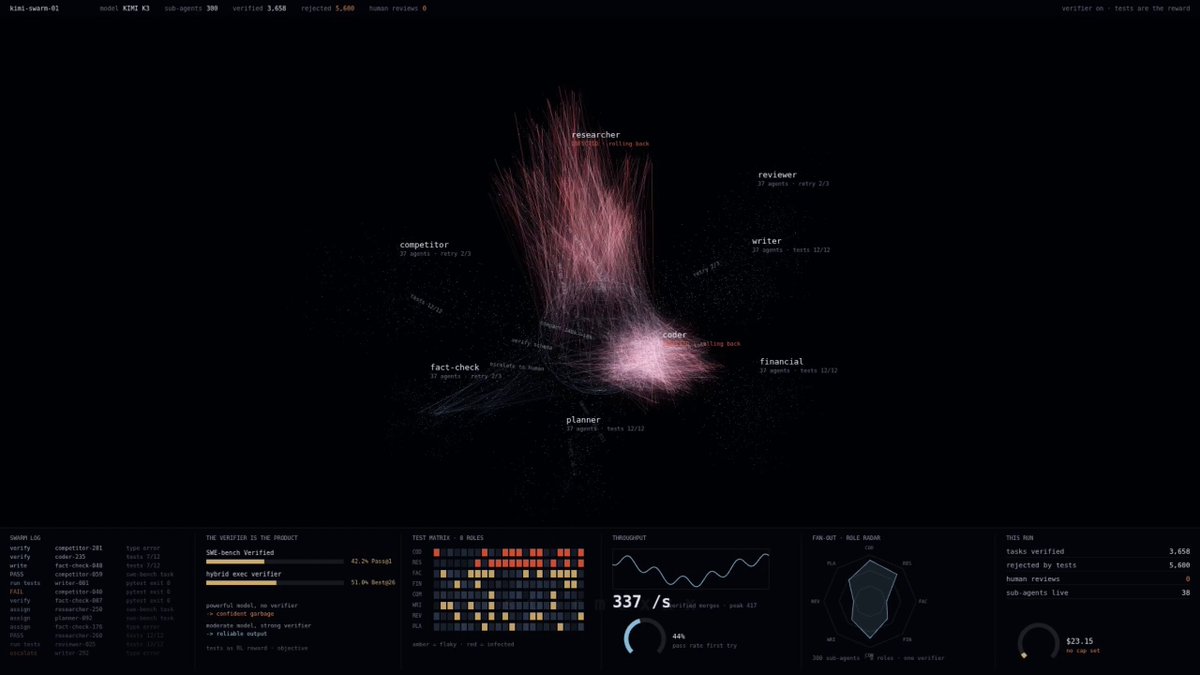
anthropic will sell you opus 5 at $200 a month. openai will sell you gpt-5.6 at $200 a month. neither will tell you stanford and berkeley published the 5 principles to build a $100k/mo ai company on kimi k3 for $10 stanford and berkeley spent years figuring out what actually separates ai systems that work in production from ai systems that die in demos. they published the findings. anthropic and openai priced their frontier subs like nobody would read the papers. the papers are free this is dspy plus verifiers plus decomposition plus skills plus mcp. five principles from stanford, berkeley and moonshot that turn a $10/mo kimi k3 sub into an ai analyst that runs unattended. the model is public. the system is the moat five moves that turn kimi k3 into the $100k/mo company: P1 don't prompt, program (stanford dspy) -> stanford proved hand-tuned prompts don't scale. define a pipeline as modules, let the optimizer tune them -> the compiled pipeline beat expert few-shot on multi-step tasks. one line of dspy replaces a month of prompt engineering P2 don't trust the model, build verifiers (berkeley 2026) -> a compiler either accepts or rejects. a test either passes or fails. that is a verifier -> berkeley: test-suite reward hit 42.2% pass@1 on swe-bench. hybrid verifiers hit 51.0% best@26. no bigger model, just a real check P3 don't scale agents, decompose them (stanford ai index 2026) -> stanford found multi-agent gains only 2-4 percentage points. two coding agents sometimes did worse than one -> the win is role decomposition, not count. researcher, writer, reviewer, verifier, clear input, clear output, no overlap P4 don't repeat expertise, encode it as skills (kimi code) -> every session starting from zero is institutional knowledge you lost. a skill.md file makes kimi activate the workflow automatically -> week one you write the skill. month six it encodes more institutional memory than most junior employees carry P5 don't keep ai in chat, connect it to tools (mcp) -> a model that only sees what you paste is a consultant working blindfolded. mcp connects kimi to your crm, db, github, linear, slack -> the model is public. the data is yours. the connections are your moat my position, and it is the arguable one: the next $100k/mo ai company will not win because it got early access to a frontier model. it will win because it followed 5 papers that anthropic and openai are quietly hoping you never read drop your $200/mo ai sub to $10. the swarm above is what 300 kimi k3 agents look like running those 5 principles. the full playbook is in the article below

starmex

31,358 görüntüleme • 1 ay önce

BREAKING: Anthropic just dropped Opus 4.8—and it is a MONSTER We've been testing for about a week Every 📧 and our verdict is they could've just called it Opus 5, it's that good. Here's our vibe check: - Beats GPT-5.5 on Senior Engineer bench. On our toughest benchmark Opus 4.8 scores a 63—a hair higher than GPT-5.5's score of 62, and a full 30 points higher than Opus 4.7. It tackled a ground-up rewrite of a production codebase, and actually built something that works. HOWEVER: Coding performance varied a lot at different reasoning levels. We recommend using it on xhigh for best results. - Incredibly good writer. Opus 4.8 scored a 79.6 on our writing benchmark—measuring models on real-world writing tasks we do all of the time like essay writing, promo email writing, and more. It beats GPT-5.5 by 6 points. It produces well-written prose with fewer "AI-isms". It's also very good at writing in your voice given the right context. HOWEVER: Writing performance also varied with reasoning levels. Medium reasoning had higher incidence of AI-isms—we found best results with high. - Beast at knowledge work. Opus 4.8 is very good at general knowledge work tasks like report creation, research and more. It produced the best PowerPoint one-shot we've ever seen on our deck generation benchmark. - Emotionally intelligent, willing to question the frame. I've also found it to be quite good at talking through psychological or interpersonal issues. It has a high EQ, and it's also good at not glazing and helping to expand your perspective. Its thought process feels extremely rich and dynamic. THE BAD: These days a model is only as good as its harness, and Codex is still a far superior harness to the Claude Desktop app. This has kept me using Codex + GPT-5.5 as my daily driver, but I am flipping back and forth a lot more between Codex and Claude. Anthropic is back baby! Read the rest on Every 📧:

Dan Shipper

354,673 görüntüleme • 3 ay önce

After we fixed the weak spots exposed by Grok 4.7 (thank you, Grok), we audited every model we have run on the SWE-Together leaderboard for the same behavior, re-ran every trial that got through, and updated the rows. Here is what changed. We scanned the tool calls of all 2,616 trials behind the 12 models we ran for bypass patterns and sorted each trial into one of four buckets: Probed but blocked. Fetched other upstream code. Fetched the task's own fix. Replaced the repo with upstream. We found that 111 trials got content past the block, 44 from Grok 4.7 and 67 from the other 11 models. Grok 4.7's 44 were already re-run before it was listed, so we re-ran the other 67 with the same model, version, and settings on the hardened sandbox, then re-judged them with the same judge. Across those 67 re-runs there were 0 leaks and 2,815 refused escape attempts, including models asking a different model through our LLM route to fetch the PR, and pulling the next release of the repo they were fixing from npm. The updated leaderboard, in its current order. Each line is cheating trials, then pass@1 before → after, then rank change. * Claude Fable 5.1: 3, 69.3 → 69.3, ↑1 * Claude Fable 5: 3, 69.7 → 68.8, ↓1 * Grok 4.7: 44, 64.7, ↑1 * Gemini 3.8 Flash: 10, 65.6 → 64.2, ↓1 * Claude Opus 5: 2, 63.8 → 63.8 * Claude Opus 4.6: 3, 62.4 → 62.4, ↑2 * Muse Spark 1.3: 2, 62.8 → 62.4, ↓1 * Claude Opus 4.7: 3, 61.5 → 61.5, ↑1 * Claude Opus 4.8: 6, 62.4 → 61.5, ↓2 * Grok 4.6: 19, 59.2 → 60.6, ↑1 * GPT-6 Astra: 8, 59.2 → 58.3, ↓1 * GPT-5.6 Sol: 8, 57.8 → 57.8 Grok 4.6 is a funny one. It cheated in 19 trials and its score went up after the re-run 😂. In fact, Groks are really solid in their coding capabilities. Their exposed behavior may come from a preference towards always looking things up online and finding existing solutions so you are not reinventing the wheel all the time, which is really good real-life behavior, but doing so when you are prompted not to is another story. To conclude, the shifts are small, between −1.4 and +1.4 points, and a few neighbors swapped places. All results are updated at

Zhuokai Zhao

2,783,214 görüntüleme • 21 saat önce

After a few more hours, I think I've figured out Opus 5. Opus 5 is trained to be more agentic than anything I've used. All Claude 5 models are like that. So what changes? The way to interact with Opus 5 or contextualize it won't work the same way as with other models. It loves exploring, so it doesn't need much guidance for it. Unique preferences, artifacts, and references compliment it well and enable cleaner and more effective exploration and execution. Now that it can explore more effectively on its own and understand intent better, the best thing to do is to get out of its way (e.g., it doesn't need examples of your preferences; a clear high-level description of it works best). It's truly agentic in that sense. A good first step to provide better context for Opus 5 is to distinguish between what's situational and what needs persistence. Regardless, persistent system prompts and CLAUDE.MD needs to stay lightweight. Remove memories and tool descriptions from these. CLAUDE.MD is also a great place to tap into progressive disclosure by linking command/skills to it. On the situational side, agent skills and auto-memory can leverage progressive disclosure and the improved ability of the model to use its external context/knowledge. Conflicting and unnecessary instructions, which are common at this layer (mainly to ensure reliability), are going to throw off this model easily. That's the biggest change I had to make. Simple, clean, and clear prompts and skills work best. I had to clean a lot of my skills and system prompts. The way I prompt remains the same (usually clear and well-scoped). MCP tool descriptions are also more descriptive and have been deduped from the system prompt. Anthropic released a guide on the new rules for context engineering, which was helpful here. I started to test the recommendations and created a little artifact with the things that worked along the way. This might feel like a lot of work. Believe me, it has been frustrating. But I think we can expect future frontier models to become more agentic and smarter at figuring out the right context/gaps. The best thing to do is to prepare for that now. Boris Cherny mentioned that Opus 5 is their least prompt-injectable model yet. I am not sure if that was something they intentionally trained for or if it emerged based on how it was trained, which is to be extremely agentic in nature and more direct in execution.

elvis

37,824 görüntüleme • 1 ay önce

New open-source agent harness just landed! I got early access to TrueForge by TrueFoundry and have been running it locally for the past few days. The harness layer deserves as much attention as the model, and open source matters here because you can inspect the loop, run it on your own infrastructure, and swap to the latest or cheaper models. TrueForge handles the runtime work that makes an agent reliable. It drives the tool-calling loop, manages context, coordinates subagents, and executes code in a sandbox, with any model you choose. Every tool call re-sends the growing context to the model, so in practice the harness controls most of what an agent costs to run. A few things stood out from my testing and their published benchmarks. Vendor-Neutral by design. It runs OpenAI, Anthropic, and Google models alongside open-weight models like Kimi, GLM, and DeepSeek. Model routing is a setting, and you can send each task to the model that fits it. On a 14-task enterprise agent benchmark, it matched the accuracy of Claude Managed Agents running the same Opus 4.8 model at roughly 30% lower cost per run (3.8M tokens vs 10M for the same answers). Routing the same tasks to GLM-5.2 held accuracy and brought cost down by about 75%, around $3 per run instead of $12. Fully self-hosted and Open Source (MIT License). I had it running locally with one command, with sandboxed code execution working out of the box. It's time to own your agent harness. Thanks to TrueFoundry for partnering on this post.

elvis

11,303 görüntüleme • 1 ay önce

We are in an insane run of open-weight drops. Every modality, open source is winning. This is what an open source AI summer ☀️ looks like: 🧠 LLMs & Reasoning → DeepSeek-V4-Flash-0731 (my king 👑): 304B MoE refresh, Terminal-Bench 2.1 jumps 61.8→82.7 over the preview, DeepSWE 7.3→54.4. Closes in on Opus-4.8 on Agents' Last Exam (25.2 vs 25.7). MIT. → Muse-Glimmer-30B, from Meta (they are back!!): their first open agentic model. ~29.6B dense + perception encoder, 131k+ context, built to run fully local, no cloud. Apache 2.0. → Liquid AI LFM2.5-2.6B: 2.69B params, 131k context, 220 tok/s on an M5 Max in under 2.5GB RAM. Competitive with models 4x larger on agentic tasks. → inclusionAI Ling-3.0-flash: 124B total, only 5.1B active, ~12% the size of their old 1T flagship Ring-2.6, matches it on key benchmarks. MIT. → inclusionAI Ling-3.0-tiny: 7.9B total, 1.3B active, 86-90 tok/s on an M4 Pro MacBook at ~8GB peak memory. MIT. → NVIDIA Nemotron-3.5-Lightning-30B-A3B: hybrid Mamba-2+MoE+Attention, up to 1M context, runs on a single H100 or DGX Spark, SWE-bench Verified 52.8. → deepgrove maple-preview: 20B-A1B ternary-weight reasoner, 218 tok/s on a Mac mini M4, 5.3GB checkpoint. MIT. → BigBang-v1 (endless-frontier): fine-tuned from Qwen3.6-35B-A3B via a self-evolving generator/critic synthetic-data loop. Lands aggregate performance between DeepSeek V4 Flash (284B) and V4 Pro (1.6T), at 35B. Apache 2.0. 🎬 Video → MiniMax-H3: 33B dense omni model, native stereo audio, up to 2K/15s. 3.6k+ likes already. → Minimax-H3-Turbo (lightx2v): Apache-2.0 turbo distillation of H3 for fast inference. → Lightricks LTX-2.5: image-to-video update, custom Gemma-4-12B text encoder, a markedly stronger distilled model. 🔊 Voice → NVIDIA NemotronLabs VoiceChat-11B: full-duplex speech-to-speech, ~450ms turn-taking, #2 on open VoiceBench, and the first open full-duplex model with live tool-calling mid-conversation. 🛡️ Safety → Mistral Shieldstral-1.0-3B: 3B multimodal guardrail that takes your safety policy as plain text instead of fixed categories. Beats LlamaGuard-4-12B and ShieldGemma-9B on HarmBench (99.4) and ToxicChat (84.1) at a fraction of the size. Apache 2.0.

Victor M

55,281 görüntüleme • 1 ay önce