Video yükleniyor...

Video Yüklenemedi

Ana Sayfaya Dön

Larry Ellison just explained why Tesla's AI has to work completely differently from every other AI system on earth: "If you're driving cars, things happen very fast. If something happens, you might be required to respond in a microsecond. You have to see it, understand what's going on, and...

49,275 görüntüleme • 3 ay önce •via X (Twitter)

0 Yorum

Yorum bulunmuyor

Orijinal gönderinin yorumları burada görünecek

Benzer Videolar

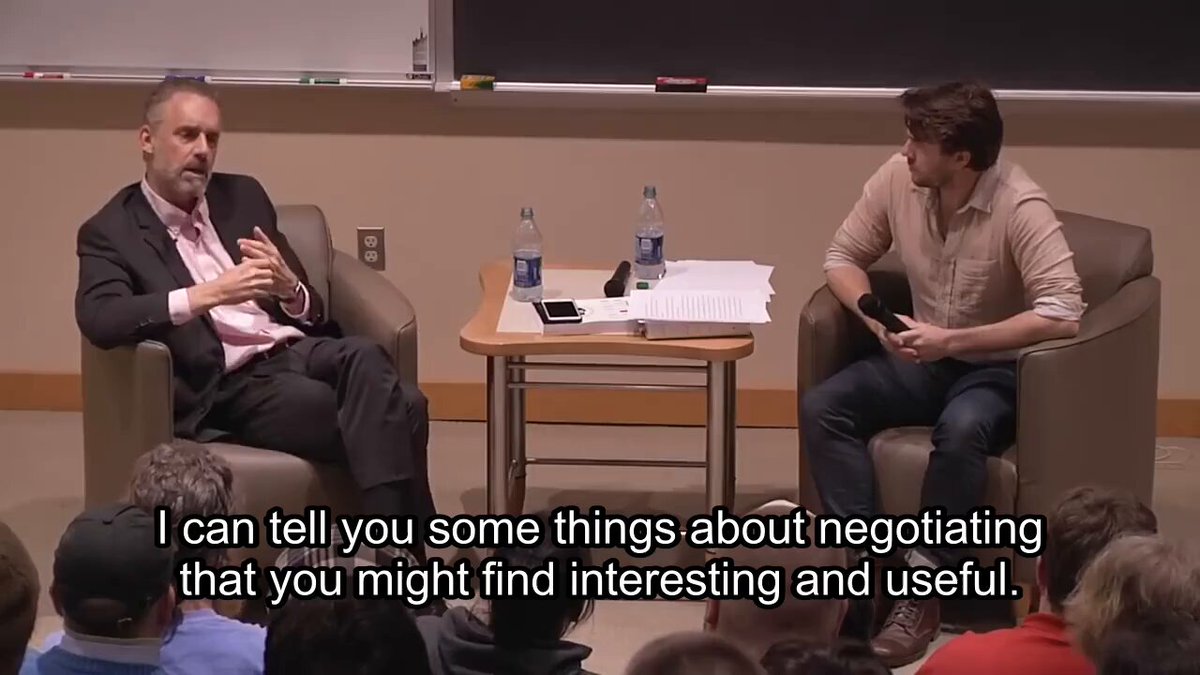
Jordan Peterson: "If you're competent and silent you will be ignored." "You might think well people should reward you because you're competent. And yes of course they should. But if you're competent and silent then you're just part of the background that's keeping everything functioning" On why you cannot negotiate from a position of weakness: "If you want to push your career forward you have to push it forward. You have to be competent and you have to be strategic" "To be strategic when you negotiate for a new position or a new salary you have to be able to say if you don't give me what I want then something you don't like will happen to you" "It's not a physical threat. It's that you have an option" "You have your CV in order. You're educated and competent and desirable to people outside of your immediate job. You're willing to instantly put yourself on the job market" "So that when you go talk to the person you're negotiating with you're credible" On the one thing most people completely miss about negotiation: "It's very seldom that you're talking to the person who's at the top of the pecking order. What you need to do is tell them a story that they can tell to their boss to make you not a problem" "A good story is look we really need this person because they're hyper competent and they have a better offer" "If you go in there with no power you're going to lose. Obviously" He concludes with the one thing every competent person needs to hear: "The first thing you need to know if you're going to negotiate is that you have to be able to say no. And what no means is that you're not going to do it"

Brad

35,334 görüntüleme • 1 ay önce

I got to ask Jensen a question today at CES 2026. Question: What advice would you give to a new robotics founder for them to choose the right application space or the right idea so that they can have the most impact and most differentiation? Jensen's answer (short summary): The real strategic choice is between a horizontal play and a vertical one. Horizontal competition comes from every direction, but focusing on a specific vertical allows you to solve the hardest problems for a specific industry. Whether it’s EMS manufacturing or surgical robotics, that deep domain expertise is very beneficial. Jensen's full answer: Well, first of all, let's take a step back. As you know, NVIDIA, here we were just talking about AI factories. And that AI factory—our contribution, our chips, systems, infrastructure, which is software, and model technology. Is that right? That's kind of the NVIDIA stack. And that's an AI factory. In order to build robotic systems, you really need three different computers. You need the training computer, which I just described. And then you need another computer for doing simulation, because the robot needs to learn how to practice and be evaluated inside a virtual world that's physically precise, so that it doesn't have to do crazy stuff in the physical world while it's still learning. And so we create a virtual world that obeys the laws of physics, and I've demonstrated it several times, and that virtual world is called Omniverse. And so that's a second computer. And that computer is much more like one of our gaming computers, and the GPU that we use for that is RTX Pro. Basically an RTX. And then the third computer is the computer that goes into the robot. It's the robot brain. And that robot computer we call Orin today, and then the next generation is called Thor. And it has its own stack. So Thor has a super-fast inference stack. It runs a safety operating system, like the safety operating system we have in the car, because you want the robot to stay in its guardrails and not do things that it's not confident in doing. And so, you have your stack, and then you have your model. And the model could be fine articulation, manipulation, and locomotion, and each one of those, it could be system one and system two thinking. The technology necessary to build a robot is incredible. And so I just described for you, in order to be a robotics company, you have to have three computers. You have to understand all three stacks, and you have to build this robotic system, not to mention all the electronics and the mechanicals necessary to do it. It's incredibly hard. However, as you know, these pieces of technology independently have been coming together. Isn't that right? Which is really what happens to a new industry, is when there's enabling technology necessary for the industry itself, but it rides on the contributions of the technology advances in other industry that it doesn't have to worry about. And so the humanoid industry is riding on the work of the AI factories we're building for other mainstream stuff and other AI stuff. And our Omniverse was designed for other applications and different other digital twin capabilities. And so all this stuff is now coming together. The question is for robotics, ultimately, it comes down to a couple of different questions. Do you want to be a horizontal company, or do you want to be a vertically domain-specific company? The benefit of a horizontal company, of course, is that you less worry about the application, you more worry about the technology, and if you succeed, your scale can be quite large. However, horizontal plays are incredibly hard. Your competition comes from every single direction. Now, on domain, if you want to be domain-specific, then you're going to have to understand the particular application quite deeply. So maybe it's something to do with EMS manufacturing, assembly of these AI supercomputers. Maybe it's related to building cars in factories. Whatever the reasons are, your domain expertise—could be surgical robots—domain expertise could really be a benefit. My preference usually—and you asked, so I'll offer—my preference tends to be to go find verticals, but that's kind of my preference. Some companies, some leaders just would prefer to build horizontal capability, and that's fine, too.

The Humanoid Hub

40,043 görüntüleme • 8 ay önce