Video wird geladen...

Video konnte nicht geladen werden

Zur Startseite

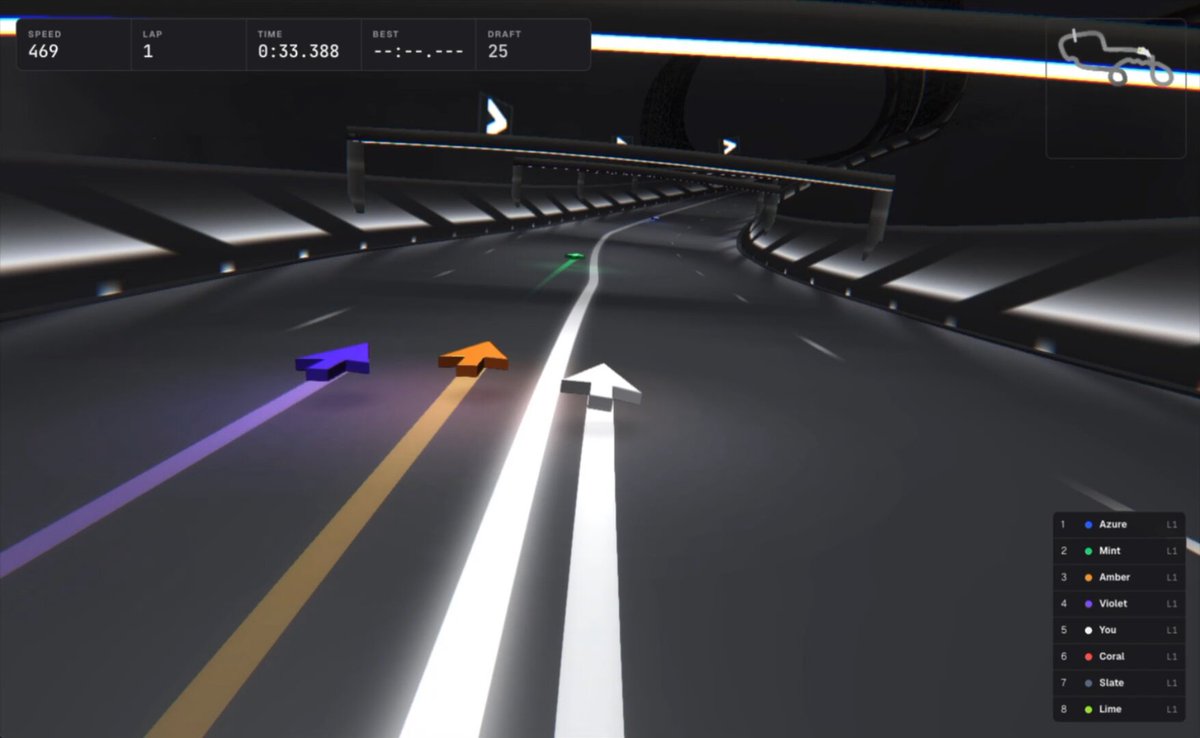
Lazy Bones - Uploading documentation videos now. So close. Here's a slower example than before. Omabuarts Studio - Game Assets models. @higgsas simulation methods. #b3d #blender

19,769 Aufrufe • vor 2 Jahren •via X (Twitter)

0 Kommentare

Keine Kommentare verfügbar

Kommentare vom Original-Post werden hier angezeigt

Ähnliche Videos

Everything you love about generative models — now powered by real physics! Announcing the Genesis project — after a 24-month large-scale research collaboration involving over 20 research labs — a generative physics engine able to generate 4D dynamical worlds powered by a physics simulation platform designed for general-purpose robotics and physical AI applications. Genesis's physics engine is developed in pure Python, while being 10-80x faster than existing GPU-accelerated stacks like Isaac Gym and MJX. It delivers a simulation speed ~430,000 faster than in real-time, and takes only 26 seconds to train a robotic locomotion policy transferrable to the real world on a single RTX4090 (see tutorial: The Genesis physics engine and simulation platform is fully open source at We'll gradually roll out access to our generative framework in the near future. Genesis implements a unified simulation framework all from scratch, integrating a wide spectrum of state-of-the-art physics solvers, allowing simulation of the whole physical world in a virtual realm with the highest realism. We aim to build a universal data engine that leverages an upper-level generative framework to autonomously create physical worlds, together with various modes of data, including environments, camera motions, robotic task proposals, reward functions, robot policies, character motions, fully interactive 3D scenes, open-world articulated assets, and more, aiming towards fully automated data generation for robotics, physical AI and other applications. Open Source Code: Project webpage: Documentation: 1/n

Zhou Xian

3,820,293 Aufrufe • vor 1 Jahr

What if you could npm install 3D models? Introducing Vibe3D - the shadcn for threejs Starting with the scifi asset kit, over 180+ models, all free and oss (MIT licensed) and two reference terrain meshes. All models are installed directly into your codebase instead of pre-packaged as code imports or worse yet, FBX files 🤮 Docs: This means, a simple "bunx vibe3d add Artificial Intelligence Papers-kit/pressure-gauge" will install the fully procedural code Want to change something? just tell your ai to do it It uses some shared helper code to produce the topology and at least per kit all items reuse and share the same materials, so technically performance should be better than letting your ai run wild on its own. Also releasing with it two skills: - Vibe model skill to produce your own models and kits, just "bunx vibe-model --global" and tell your ai to vibe model some 3d assets with a reference photo, you'll see it works - Vibe terrain "bunx vibe-terrain" installs the terrain mesh modeler, yea just try it out, best results with opus 5 ngl Everything is MIT licensed, i was just joking, no hate for unreal or unity Threejs still the best tho 🖕🏻 If you just want to see all 3D models up close: Yea, you can also just vampire it and download all modes as .glb files, good luck fixing some of them then though Big thanks to ThreeJS Assets for contributing 50 assets to the scifi kit! Everyone who spends some tokens on it will be added to the contributor list Oh and before i forget fuck you kenney, we roll our own kits now

robot 2.0

57,584 Aufrufe • vor 18 Tagen

I’ve been using Grok Bot in early access for a little over a week now, and it has been a massive boost to my game dev workflow and my productivity in general. One of the first things I asked it to do was to visit my custom art generation tool webpage and generate art assets to replace all the image placeholders in my game. It looked through my codebase to understand what each asset was, wrote a custom art generation prompt for every single one, generated the images, cropped and cleaned them up into transparent PNGs, and then wired them back into the game. In about 2 hours, it generated 74 (cleaned and cropped) art assets for the cards and integrated all of them into my game. Now, ALL my art assets workflows go through Grok bot. This blew my mind because, before this, I was doing everything manually, one asset at a time. It basically solved my entire art asset workflow and allowed me to put it on autopilot, which is amazing. I’ve also been using Grok Bot for: Playtesting my game: The bot was a little slow initially, so I asked it to build a skill specifically designed to playtest my game, with intimate knowledge of its rules and mechanics. It’s much faster now, though I’m still looking for ways to optimise its speed. Setting up my itchio page for my game: It also automated a workflow that uploads a new build to itch whenever I push one to GitHub. Going to the itch website and uploading builds manually every single time was always a pain. Flowcharts and UX design: I’m a UX designer by day, so I decided to give it a much bigger task. I fed the agent a PRD and asked it to design the UX flows and wireframes. With the help of the Figma MCP, it actually delivered. Auditing all my paid subscriptions: I had it go through my emails and hunt down subscriptions that I might have forgotten about. Unsubscribing me from marketing newsletters: It did this beautifully, though it did miss a few newsletters. What I’ve learned is that it takes time to discover all the possible use cases for Grok bot. I’ve had to reevaluate my day-to-day workflows and figure out which parts I can delegate to it. So far, it has been a huge productivity unlock for me and I am discovering more uses for my Grok bots every other day.

Danny Limanseta

404,057 Aufrufe • vor 22 Tagen

WHITNEY WEBB on the military now "realizing [its] initial dream for the internet" "LifeLog [has become] Facebook" "Total Information Awareness [has become] Palantir" "we're coming... close to the end game" "A lot of these 'Big Tech'... companies are just masquerading... [they] were created by military intelligence" "I think it's important to keep in mind too that even going beyond Palantir, the Internet itself was created by the military" "And... now we're coming kind of close to the end game in terms of full circle of them kind of realizing their initial dream for the Internet" This clip of Webb (Whitney Webb), author of One Nation Under Blackmail and contributing editor of unlimitedhangout(.)com, is taken from a discussion with Ryan Cristian, Hrvoje Morić, et al. posted to the Corbett Report YouTube channel on May 29, 2026. ---------------Partial transcription of clip---------------- "I mean, I remember stories 10 years ago about massive NSA data centers in like Utah and various states before people were even talking about data centers, about all the information they've been compiling on people. "And I think it's important to keep in mind too that even going beyond Palantir, the Internet itself was created by the military. And I think now we're coming kind of close to the end game in terms of full circle of them kind of realizing their initial dream for the Internet. "And then, you know, in the case of Palantir, you know, I argue, and a lot of my research points to various efforts within the DARPA military sphere aimed at the Internet being privatized. For example, LifeLog becoming Facebook, Total Information Awareness becoming Palantir. You know, these have become reality. "A lot of these big, 'Big Tech' Silicon Valley companies are just masquerading as we just started in our garage. And we're regular guys. Like, no, these are guys that were created by military intelligence and they privatized these programs and we have willingly given them our data and we continue to do so. "And so even if you have Palantir having access to privileged information, think about something in that same family of company, like Clearview AI, for example, which is also Peter Thiel–connected, that has amassed this huge database used for facial recognition by law enforcement and militaries. So, you know, to arrest and also to murder people. "And they just scraped most of that from stuff, pictures people freely and willingly posted. We voluntarily gave a lot of our data away, and they've been able to scrape a lot more of it than you, than you probably think."

Sense Receptor

85,720 Aufrufe • vor 3 Monaten

Cerebras inference is very fast. So fast that it changes how we think about configuring our LLMs for voice agent use cases. Kimi K2.6 is a 1T parameter reasoning model that Cerebras serves at 650 - 1,000 tokens per second (end-to-end throughput), with time to first token metrics as low as 150ms (latency). These numbers are two to three times faster than other similarly capable models. The biggest lever we get from this kind of speed is that we can use the model in reasoning mode, and still have excellent "time to first non-thinking token." This solves a big pain point we have in 2026 for voice agent use cases. Almost all recent innovation in post-training has focused on making models good at reasoning ("test time compute"). This is great, but it makes the user-facing model latency much, much slower. Which is a problem for conversational voice agents. We can run Kimi K2.6 with reasoning turned on, and get responses faster than other models produce with reasoning disabled. On my 30-turn voice agent benchmark, Kimi K2.6 with reasoning enabled ties GPT 5.1 and Haiku 4.5 with reasoning disabled, and is still about 200ms seconds faster! On my primary task agent benchmark, Kimi K2.6 is now the #2 model. It ranks just behind Gemini 3.5 Flash in "high" reasoning mode, and tied with GLM 5, Sonnet 4.6, and GPT 5.4 with reasoning set to "low." But Kimi K2.6 completes each turn in the agent loop in under 500ms. The other four models are all at least 3x slower. (Models only qualify for this benchmark if they can complete task turns at a P50 <4s.) A couple of other things that this speed buys us, for production voice agents: - Tool calls happen fast enough that we don't have to work around tool call latency in our pipeline design. - We can prompt the model to output structured data at the beginning of a response, followed by plain text for voice generation. This opens up possibilities like asking the model to do complex classification/generation tasks that influence the rest of the pipeline. For example, the model could create a detailed style prompt for a steerable TTS model, for each individual conversation turn. And, of course, you can use Kimi K2.6 with reasoning turned off. Cerebras calls this "instant" mode. Here's a video of a Cerebras Kimi K2.6 voice agent with voice-to-voice response time, measured at the client, under 500ms. This is the true response latency as perceived by the user, including all network and audio codec overhead, transcription and turn detection, Kimi K2.6 token generation, and voice generation. 500ms is, effectively, instant. So the Cerebras naming for this mode is a propos. :-)

kwindla

40,593 Aufrufe • vor 3 Monaten