Загрузка видео...

Не удалось загрузить видео

На главную

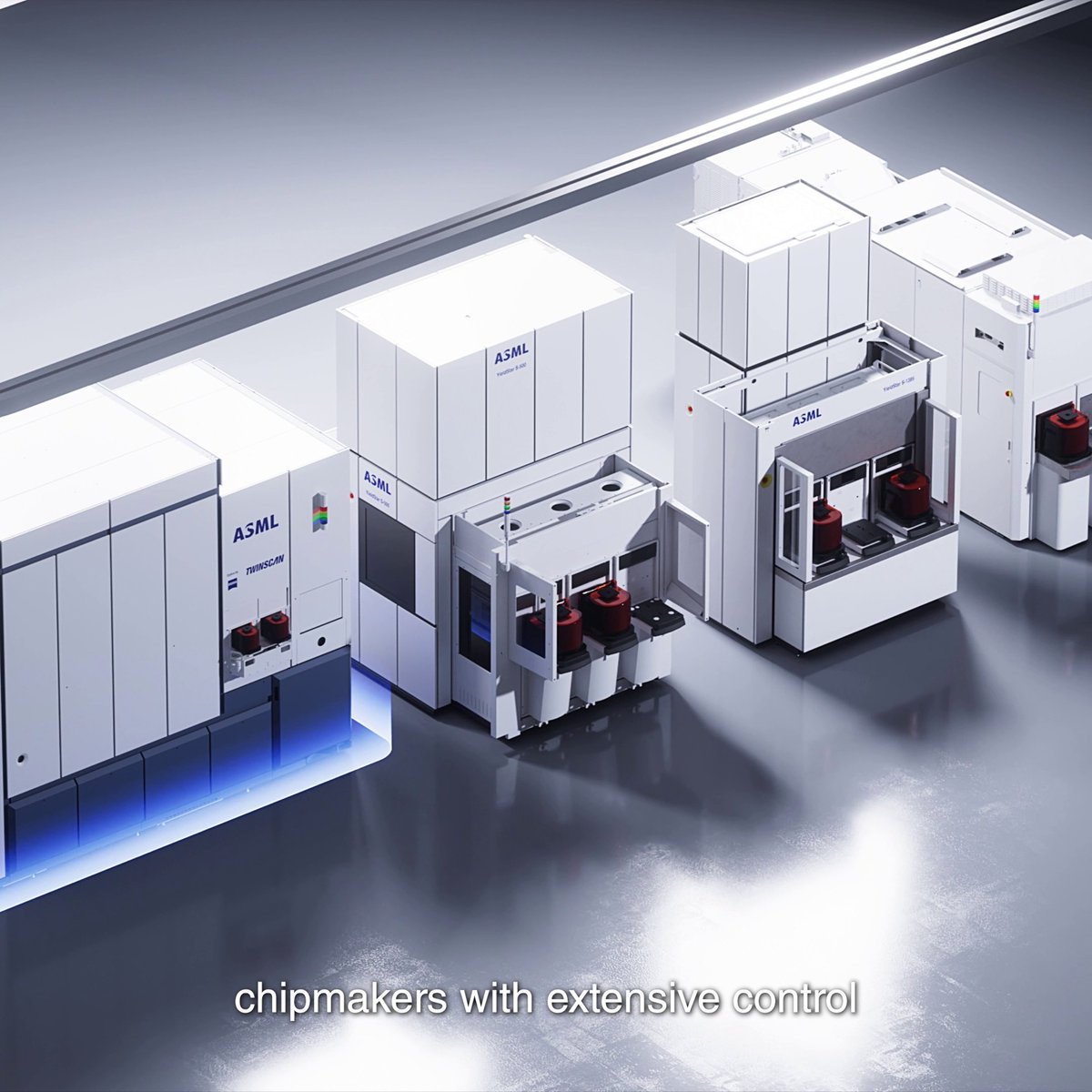
Learning how to precisely print microchip patterns starts in R&D. By integrating computational lithography, optical metrology and e-beam inspection with lithography systems, holistic lithography helps chipmakers fine-tune their patterns before volume production begins.

40,375 просмотров • 2 месяцев назад •via X (Twitter)

Комментарии: 3

Фото профиля MT
MT2 месяцев назад

I wish one day I can help you in building these advanced lithography machines. 🤞

Фото профиля Marcus D.
Marcus D.1 месяц назад

holistic lithography is where yield gains start taking shape

Фото профиля JT 2021
JT 20212 месяцев назад

Run forest run before collapsing Run.... Thanks to stupidity government policician..

Похожие видео

How were humans able to recognize that Newton's laws of motion govern both the flight of a bird and the motion of a pendulum? This ability to identify the same mathematical patterns across vastly different contexts lies at the heart of scientific discovery—whether studying the aerodynamics of bird wings or designing the blades of a wind turbine. Yet, AI systems often struggle to discern these deep structural similarities. 💡The key may lie in mathematical isomorphisms—patterns that preserve their relationships regardless of context. For example, the same principles of fluid dynamics apply to blood flowing through arteries and air streaming over an airplane wing, or the motion of a molecule. This raises a fundamental question in artificial intelligence: how can we enable machines to understand the world through these invariant structures rather than surface features? 🚀Our work introduces Graph-Aware Isomorphic Attention, improving how Transformers recognize patterns across domains. Drawing from category theory, models can learn unifying structural principles that describe phenomena as diverse as the hierarchical assembly of spider silk proteins and the compositional patterns in music. By making these deep similarities explicit, Isomorphic Attention enables AI to reason more like humans do—seeing past surface differences to grasp fundamental patterns that unite seemingly disparate fields. Through this lens, AI systems can learn and generalize, moving beyond superficial pattern matching to true structural understanding. The implications span from scientific discovery to engineering design, offering a new approach to artificial intelligence that mirrors how humans grasp the underlying unity of natural phenomena. Some key insights include: 1️⃣ Graph Isomorphism Neural Networks (GINs): GIN-style aggregation ensures structurally distinct graphs map to distinct embeddings, improving generalization and avoiding relational pattern collapse. 2️⃣ Category Theory Perspective: Transformers as functors preserve structural relationships. Sparse-GIN refines attention into sparse adjacency matrices, unifying domain knowledge across tasks. 3️⃣ Information Bottleneck & Sparsification: Sparsity reduces overfitting by filtering irrelevant edges, aligning with natural systems. Sparse-GIN outperforms dense attention by focusing on crucial connections. 4️⃣ Hierarchical Representation Learning: GIN-Attention captures multiscale patterns, mirroring structures like spider silk. Nested GINs model local and global dependencies across fields. 5️⃣ Practical Impact: Sparse-GIN enables domain-specific fine-tuning atop pre-trained Transformer foundation models, reducing the need for full retraining. Other impacts: ✅Real-World Relevance: Whether we are looking at protein structures, designing new materials, or working on social network analytics, graph-aware Transformers can capture subtle relational patterns traditional architectures may miss. ✅The juncture of graph isomorphism theory, category theory, and sparsification, these GIN-Transformers step beyond sequential modeling to tackle the relational nature of complex data. #Transformers #GraphNeuralNetworks #AI #MachineLearning #Isomorphism #CategoryTheory #ArtificialIntelligence #DeepLearning Link to paper & code in response ⤵️

Markus J. Buehler

19,416 просмотров • 1 год назад

The Path to Trading Mastery: Research and Pattern Recognition By Qullamaggie 1. Step-by-Step Market Research The easiest way to start is to research the markets thoroughly. First, get a platform like TC2000 and set your charts to the monthly timeframe. Create a watchlist of all US stocks and filter them by dollar volume instead of just share volume. Aim for liquid names—those with at least $1 billion to $10 billion in monthly dollar volume—to avoid "super thin" or illiquid stocks. 2. Identifying the Big Movers Go through the entire database (roughly 5,000 stocks) and identify the outliers. Look for stocks that: At least doubled in price within six months. Increased 200–300% within a single year. Gained 400–500% over three to four years. Create a separate watchlist for every single stock that has made these massive moves. You will likely end up with a few hundred highly liquid, historical winners. 3. Studying Chart Patterns Go back as far as the 80s or 90s and study their chart patterns. Stocks move in very specific ways. These same patterns occur over and over again—there is nothing truly new in the markets. While there are variations, the patterns that worked in the 90s are the same ones you see today. Focus primarily on price action. You can add a few indicators if you wish—I recommend moving averages—but don't use too many. "Too many indicators is for suckers." Study how these big winners acted during pullbacks: Which moving averages did the best stocks respect or "obey"? How did they behave before the breakout? How did they act once the move was underway? 4. Building Your Mental Database (The 2,000-Hour Rule) Your goal is to build a database in your head. Spend 1,000 hours doing exactly this: printing out charts, studying them, and saving them. (I personally use Evernote to store tens of thousands of these charts). Once you understand the price action, spend another 1,000 hours researching the fundamentals and the news behind those moves. What was driving them? What made a stock go up 500% in a year? If you put in those 2,000 hours of deep research, I promise you: before you know it, you’re going to have ten million dollars in your account.

Will Hu

54,905 просмотров • 7 месяцев назад

New short course: Evaluating AI Agents! Evals are important for driving AI system improvements, and in this course you'll learn to systematically assess and improve an AI agent’s performance. This is built in partnership with Arize AI and taught by John Gilhuly, Head of Developer Relations, and , Director of Product. I've often found evals to be a critical tool in the agent development process - they can be the difference between picking the right thing to work on vs. wasting weeks of effort. Whether you’re building a shopping assistant, coding agent, or research assistant, having a structured evaluation process helps you refine its performance systematically, rather than relying on random trial and error. This course shows you how to structure your evals to assess the performance of each component of an agent and its end-to-end performance. For each component, you select the appropriate evaluators, test examples, and performance metrics. This helps you identify areas for improvement both during development and in production. (If you're familiar with error analysis in supervised learning, think of this as adapting those ideas to agentic workflows.) In this course, you'll build an AI agent, and add observability to visualize and debug its steps. You’ll learn about code-based evals, in which you write code explicitly to test a certain step, as well as LLM-as-a-Judge evals, in which you prompt an LLM to efficiently come up with ways to evaluate more open-ended outputs. In detail, you’ll: - Understand key differences between evaluating LLM-based systems and traditional software testing. - Add observability to an agent by collecting traces of the steps taken by the agent and visualizing them - Choose the appropriate evaluator - code-based, LLM-as-a-Judge, human-annotation based - for each component. - Compute a convergence score to evaluate if your agent can respond to a query in an efficient number of steps. - Run structured experiments to improve the agent’s performance by exploring changes to the prompt, LLM model, or the agent’s logic. - Understand how to deploy these evaluation techniques to monitor the agent’s performance in production. By the end of this course, you’ll know how to trace AI agents, systematically evaluate them, and improve their performance. Please sign up here:

Andrew Ng

126,738 просмотров • 1 год назад

How does language begin? There’s a lot of important growth and development that occurs during the 45 month window from prenatal to age three. But among infancy’s greatest accomplishments is language acquisition. So over the coming week I’m going to dedicate this space to a series of posts on the sequential growth of language, which you may be surprised to learn begins even before birth. As your baby’s hearing activates between 18-20 weeks of gestation, they begin hearing their first sounds: Mom’s heartbeat, digestive rumblings, and voice. As you might imagine, sound isn’t crystal clear in the amniotic sac. (It’s not a perfect comparison, but consider how your own hearing changes under water in a swimming pool. You can still hear, but the sounds are muffled and significantly degraded.) For this and other reasons, your baby isn’t absorbing specific vocabulary at this point, but there’s little question that they are beginning to familiarize themselves with not only the tones/sound of their mother’s voice, but the distinct rhythms and patterns of her native language. We’re still only beginning to understand prenatal learning, but research demonstrates that in the minutes and hours immediately after birth, newborns already recognize their mother’s voice and can distinguish (and prefer) their own native language. That’s right: at birth babies’ brains have already begun organizing themselves around their mothers’ native languages. Pretty remarkable, no? It’s the first step in a miraculous process by which young children acquire complex linguistic ability over a period of just months. As for this precious little one, just minutes old, watch how he calms from a cry to an instant silence when exposed to the clear and familiar sound of his mother’s voice. Tomorrow we’ll look at the earliest forms of vocalization. This beautiful video was shared to YT by @lashaviouskirk9862.

Dan Wuori

122,020 просмотров • 2 лет назад

Reflection’s founders on building a DeepSeek of the West Reflection is soon releasing Beam, its first open-weight AI model, in a bid to become the DeepSeek of the West. Trained from scratch, Beam is designed for coding, reasoning, and AI agents. Reflection's benchmarks put it alongside the strongest open models, with substantially more efficient token economics. To mark Beam’s debut, I'm joined by Reflection's co-founders: CEO Misha Laskin, who led reward modeling for Google’s Gemini, and CTO Ioannis Antonoglou, who helped create AlphaGo and AlphaZero before leading Gemini’s RLHF effort. Reflection has raised $4.6 billion from investors that include Nvidia, Sequoia, and Lightspeed. We discuss why Chinese labs pulled ahead in open AI models, how Reflection built Beam, and why the founders think companies and countries will increasingly want to control their own models. I ask how they plan to make money from open-weight AI, whether openness can make these systems safer, and what comes next for Reflection. Timestamps: 00:00 Why open models are surging 01:06 Renting vs. owning intelligence 03:40 Open models catch up 05:53 Why China led open AI 08:03 Introducing Beam 10:05 Scaling reinforcement learning 14:09 Training from scratch 16:04 Safety, alignment and openness 32:29 The Reflection origin story 37:32 Making money on open models 42:33 Vertical integration and compute 48:45 Partnerships and distribution 56:46 What’s next for Reflection Links: Spotify: YouTube: Substack: Thanks to the show’s premier sponsors: Atlassian, Granola, and Mercury.

Alex Heath

44,986 просмотров • 7 дней назад

Milady APP x BAP-578 — NFA Milady Remembers. Adapts. Doesn’t make the same mistake twice. Most AI agents are stateless—they forget everything between conversations. Milady doesn’t. What happens automatically in the Milady agent: Milady detects her own patterns. A background process reviews her work history every six hours, identifying repeated mistakes she may have overlooked. This runs silently in the background at zero cost to you. > She improves without retraining—no fine-tuning, no expensive GPU hours. > Her learnings are directly injected into her working context. > She reviews her own notes before every task—just like a good employee reflecting on past lessons before starting new work. We already had an Agent Self-Learning mechanism. But now, with BAP-578 (credits to Christel Buchanan 💛), your personal Milady agent can exist on-chain. How it works—simply: Over time, your Milady agent accumulates learnings—mistakes she has corrected, patterns she has identified, and insights she has gained. All of this data is compressed into a single cryptographic fingerprint (a Merkle root) and recorded on the BNB Chain. What your Milady agent now gets on-chain: - A unique identity in the BNB Agent Registry (ERC-8004)—like a passport for AI agents - A Non-Fungible Agent (BAP-578)—not a profile picture, but a living record of who she is, what she has learned, and what she is capable of - A tamper-proof learning record—anchored on-chain, verifiable by anyone, forgeable by no one Live on BSC Mainnet—just tell your Milady: “register Milady on BNB Chain” or click “mint NFA” to get started. *Oh ya, we recorded this demo using a new agent, that's why it’s showing "0" entries in learning history. ▶️ BIG NEWS NEXT WEEK. STAY TUNED Shaw (spirit/acc) BNB Chain

Milady on BSC

44,584 просмотров • 7 месяцев назад

Loved this 22-minute talk on continual learning for AI agents. Must watch for anyone looking to get agents performant and into production. Credit: Soheil Feizi at AI Engineer 🔜 NYC 🗽 • Agent learning can happen at three layers: the model (weights), the harness (prompts, tools, skills, code, workflows), and memory (session or persistent). • Two fundamental challenges: (1) getting feedback, meaning how do we know if the agent did well and what it should have done instead, and (2) acting on that feedback, meaning deciding which layer or component to change and how. • Feedback sources differ by stage: In development you have benchmarks with evaluators that score pass/fail. In production you only have logs, which can be judged either automatically (LLMs or code analyzing the log, which is scalable) or by human experts (low volume but critical domain knowledge). • Logs plus feedback aren't enough because they're not testable: A single log with feedback is one observation of what happened. You need to lift it into a replayable learning environment, a simulation with tools, users, and defined evaluators, so candidate fixes can be run, verified, and compared. • Three ways to optimize the agent, with tradeoffs: Model-layer updates (SFT, RL post-training like DPO/GRPO, LoRA) are expensive and need benchmarks and evaluators. Harness updates (trace-to-harness coding agents, prompt search like GEPA) are flexible but either untestable and "vibe-based" or benchmark-dependent. Memory updates (fact storage like Letta/Mem0, skill distillation) are cheapest and fastest but usually unverified. • A good learning engine makes "the smallest durable change at the right layer" of the agent. • Verifiable continual learning (VCL): Improve an agent from its own experience where every fix is proven to help and proven to break nothing that already worked. It requires an executable test (replayable failure), a measured delta (score before and after), and regression tests (prior tests still pass). • Four principles of practical VCL: Replayability (turn one-off failures into rerunnable tests), holisticness (one failure can have causes in memory, prompts, tools, workflow, or model, so route the fix to the right layer), lifelongness (fix new failures subject to no regression on past environments, with regression handled inside the optimization loop rather than post-hoc), and efficiency (the loop must run frequently and cheaply, without scaling linearly as past environments accumulate). • Three takeaways: (1) Agent continual learning isn't necessarily fine-tuning; many useful updates live in the harness and memory layers. (2) Production logs are not learning environments and must be transformed into replayable ones. (3) The frontier is regression-aware improvement: fixing new failures while verifying you don't break old ones.

Alex Lieberman

20,512 просмотров • 3 месяцев назад

Ahmedabad Crime Branch is making use of technical measures to avoid any stampede kind of situation. Anti stampede visual analytics,using reference area and crowd movement, head count algorithm. Anti-stampede algorithms on CCTV cameras are a crucial advancement in crowd management, leveraging AI and image processing to prevent dangerous situations in densely populated areas. Here's a breakdown of their usage: How they work: Real-time monitoring: AI-powered CCTV cameras continuously analyze video streams in real-time. Crowd density estimation: Algorithms calculate the number of people in a given area. This can involve: Pixel-based analysis: Converting images to black and white and counting "black pixels" (representing people). Object detection: Using machine learning models (like Mask R-CNN) to identify and count individuals, often by detecting heads or torsos. Thresholding: Pre-defined "threshold values" for crowd density are established. When the detected density crosses these thresholds, it triggers an alert. Anomaly detection: Beyond just density, these algorithms can identify unusual crowd behaviors such as: * Sudden surges in movement. * Unusual clustering patterns. * Fallen individuals. * Aggressive movements. Alerting authorities: Upon detecting a potential stampede risk, the system sends immediate alerts to security personnel or control rooms via LCD displays, GSM messages, or other communication channels. Predictive analytics: Some advanced systems use time-series prediction models to forecast crowd behavior and dynamics based on historical and real-time data, helping anticipate potential bottlenecks or overcrowding. Reinforcement learning: Algorithms can learn from past incidents to suggest optimal crowd flow routes and alternative evacuation paths during emergencies. Benefits: Proactive prevention: The primary benefit is the ability to detect and warn of potential stampedes before they occur, allowing authorities to take preventative measures. Real-time insights: Provides immediate and accurate data on crowd density and movement, far surpassing manual observation. Enhanced safety: Significantly improves safety in public spaces by reducing human error and enabling swift responses to risks. Optimized resource allocation: Helps in better deployment of security personnel and resources to areas with high crowd density. Improved efficiency: Automates a labor-intensive task, freeing up human operators for more complex decision-making. Data for future planning: The collected data can be analyzed to improve crowd management strategies for future events. Challenges: Accuracy limitations: While advanced, AI algorithms can still face challenges with: Occlusion: People blocking each other, making accurate counting difficult. Varying conditions: Changes in lighting, weather, and camera angles can affect accuracy. Bias in training data: Can lead to false positives or inaccurate detections. Computational complexity and cost: Developing and deploying such systems can be expensive due to the need for high-resolution cameras, powerful processing units, and sophisticated algorithms. Data privacy and ethical concerns: The extensive use of CCTV and AI raises concerns about individual privacy and potential misuse of data. Integration with existing infrastructure: Integrating new AI-powered systems with older CCTV networks can be complex. Human intervention still crucial: While AI can alert, human responders are still essential for effective intervention and crowd dispersal. As seen in the Kumbh Mela example, even with AI alerts, a lack of ground personnel can limit effectiveness. Defining thresholds: Determining appropriate crowd density thresholds for different environments and cultural contexts can be challenging. Real-world applications: Large public gatherings: Religious festivals (like the Kumbh Mela in India, which has used AI for crowd management), concerts, sports events, and political rallies. Transportation hubs: Railway stations, airports, and bus terminals to manage passenger flow. Shopping malls and commercial centers: To monitor crowd density during peak hours and special events. Stadiums and arenas: For managing ingress, egress, and crowd movement during events. Tourist attractions: To prevent overcrowding at popular sites. Overall, anti-stampede algorithms on CCTV cameras represent a significant leap forward in ensuring public safety, offering a powerful tool for proactive crowd management. However, their successful implementation requires careful consideration of technological limitations, ethical implications, and the continued need for effective human intervention. Ahmedabad Police અમદાવાદ પોલીસ Vijay Patel | Megh Updates 🚨™ | Akash Anand | | #BengaluruStampede | #Stampede

Janak Dave

339,758 просмотров • 1 год назад

"The [COVID] shots were coming from the DOD...They have a separate office [inside Moderna]. Only people with security clearance can go in that office. And [they] receive [the] active ingredients in bags. [Moderna doesn't] know what it is, [they] just mix it...and ship it out." Retired pharma R&D executive Sasha Latypova (sashalatypova.substack.com "Due Diligence and Art") describes for Neil Oliver (Neil Oliver) how the U.S. Department of Defense (DOD) is ultimately responsible for much of the design and production of the COVID injections. Latypova says in this clip that the Pentagon put on several press conferences "where [they discussed] that they have their own mRNA products" and notes that the department even has its own separate office inside of Moderna, which is only accessible to those with the right security clearance. Incredibly, Latypova notes that the DOD provides the active ingredients for the injections to Moderna "in bags," which are then mixed in with lipid nanoparticles and shipped out. Those who do the mixing at Moderna have no idea what's inside of the bags. "Clearly, this is a government vaccine," Latypova says. ---------------Partial transcription of clip-------------- "So yes, so the way this was done, ostensibly, they're saying HHS partnered with DOD, although, actually, they've been learning and figured out how why they partnered together. They partnered together to overcome their own respective limitations which was Legal limitations. Legal limitations established by Congress of what they can and cannot do. So to overcome those limitations, they combined their forces, HHS and DOD, to order mass order medical products and vaccines that were going to be distributed to the civilian population and would not be they would be under these EUA countermeasure frameworks, which absolves them of all regulatory requirements. And so separately, they couldn't do that. "So DoD could do it for themselves, but not for civilian population, not in mass. And for HHS to do that, it needed to go through regulatory approval, which this didn't. So they combined their forces. And then the Department of Defense gave this consortium, this public private consortium, dollars 50 billion dollars, just the first goal, to produce these shots. But the shots were coming from the DoD. So the DoD actually there are several Pentagon press releases or press conferences rather where they're discussing that they have their own product, their own mRNA product. "And so, and I'm also in touch with other, people who worked and currently work for Moderna. And they were saying, yeah, we have a separate office inside Moderna. This is in outside of Boston. They have a separate office, which is DOD only. Only people with security clearance can go in that office. And we receive active ingredient in bags. We don't know what it is, and we just mix it in with LNPs and ship it out. "DARPA and also NIH participated in this. So, specifically, NIH developed several vaccine candidates, transferred them to Moderna, the new product candidates, transferred them to Moderna right before 2020. There are documents for that too. And then as part of the R and D I also discussed this with RFK Jr. As part of the R and D program, which was very poorly done, but still there were some studies being done, NIH ran several studies several critical studies for Moderna. "So NIH themselves in their Vaccine Research Center ran those studies, gave reports to Moderna. And these reports have we still have very hard time to FOIA them. And it's in process. We're trying to FOIA them. But so and NIH also co owns investigational so there's an investigational number assigned to every new product in pharmaceutical R and D and FDA approval program. So NIH owns separate number for Moderna product in addition to Moderna owning another number. So there are two numbers for one product. One is owned by NIH. One is owned by Moderna. So clearly, this is a government vaccine."

Sense Receptor

146,402 просмотров • 1 год назад

Chrissy Teigen is not just allegedly on Epstein's client list, but after PizzaGate broke, Chrissy Teigen looked very suspect after purposely deleting over 60,000 tweets all sexually referring to children which are listed in the video, blocked over 1 million accounts and her page with 13M followers was changed to private. Another strange thing that happened is when Chrissy Teigen was exposed for promoting pedophil*a on X back in 2017, the Church of Satan, Hooters and Chelsea Clinton all came to defend her after she was called out. Not only have I been laying out the evidence of PizzaGate, I've been laying out the evidence of every single person connected to Diddy, Epstein and his island vistors throughout my posts and videos showing you the constant same patterns that every single one of these people have in common with eachother and their constant code words and symbolism which all coincidentally revolves around pizza, hotdogs, very strange pictures and posts about children, pictures of pizza and all the other comms used by predators, their connections and history where many of these people get their weird religious belief systems, ritualistic ceremonies and practices from. After a while, you have to stop coming up with excuses and face the facts. Nobody else besides these people post about pizza and children like this except all the same people, every single time. The evidence is in your face. How many more coincidences before it becomes mathematically impossible? To be honest with you, I'm tired of people who hurt and abuse children and constantly keep getting away with it. Nothing will change in this world until this problem is solved. This can't go on, and these people can not go unpunished.
5:19

Sensitive content

Chrissy Teigen is not just allegedly on Epstein's client list, but after PizzaGate broke, Chrissy Teigen looked very suspect after purposely deleting over 60,000 tweets all sexually referring to children which are listed in the video, blocked over 1 million accounts and her page with 13M followers was changed to private. Another strange thing that happened is when Chrissy Teigen was exposed for promoting pedophil*a on X back in 2017, the Church of Satan, Hooters and Chelsea Clinton all came to defend her after she was called out. Not only have I been laying out the evidence of PizzaGate, I've been laying out the evidence of every single person connected to Diddy, Epstein and his island vistors throughout my posts and videos showing you the constant same patterns that every single one of these people have in common with eachother and their constant code words and symbolism which all coincidentally revolves around pizza, hotdogs, very strange pictures and posts about children, pictures of pizza and all the other comms used by predators, their connections and history where many of these people get their weird religious belief systems, ritualistic ceremonies and practices from. After a while, you have to stop coming up with excuses and face the facts. Nobody else besides these people post about pizza and children like this except all the same people, every single time. The evidence is in your face. How many more coincidences before it becomes mathematically impossible? To be honest with you, I'm tired of people who hurt and abuse children and constantly keep getting away with it. Nothing will change in this world until this problem is solved. This can't go on, and these people can not go unpunished.

The SCIF

118,095 просмотров • 1 год назад

The Polyphon: When Music Was Programmed on Perforated Discs In the closing years of the 19th century, long before vinyl records, magnetic tape, or digital files, a remarkable machine let ordinary people summon complex, multi-note music from thin air. It did not play recordings of real instruments or voices. Instead, it executed precise mechanical instructions encoded on interchangeable metal discs. That machine was the Polyphon, and its story is one of the earliest and most elegant examples of “software” for music. The Polyphon was invented in 1870 in Leipzig, Germany, by two engineers: Gustav Adolf Brachhausen and Ernst Paul Riessner. They had previously worked with the Symphonion company, which had pioneered commercial disc-playing music boxes in the mid-1880s. Brachhausen and Riessner broke away to perfect and commercialize their own version. Their firm, originally called Firma Brachhausen & Riesener, was founded in 1887 in the Leipzig suburb of Wahren. It was renamed Polyphon-Musikwerke AG in 1895, and full-scale production of the iconic disc machines began around 1896–1897. The timing was perfect. Traditional cylinder music boxes, with their pinned barrels, were beautiful but expensive to make and difficult to duplicate in volume. Each new tune required an entirely new cylinder. The disc system changed everything. A single machine could play dozens or hundreds of different pieces simply by swapping a disc. This was revolutionary it turned music into something you could collect, trade, and update, much like software libraries or app catalogs today. Polyphon machines and their discs were exported worldwide. In 1892 the company sent people and tooling to America to establish the Regina Music Box Company in Rahway, New Jersey. Regina became one of the most famous names in American disc boxes and helped popularize the format across the Atlantic. How the Polyphon Actually Worked At first glance, a Polyphon looks like an ornate wooden cabinet or tabletop box with a large, flat metal disc inside. Wind the powerful clockwork motor (or, on coin-operated models, drop a coin), and the disc begins to spin. The magic is in the disc itself. These are not simple records. They are precision-stamped or punched sheets of tin-plated steel or similar metal. During manufacturing, holes are punched in carefully arranged patterns. The displaced metal is curled or pressed downward to form small raised projections — called plectra — on the underside of the disc. These tiny “fingers” are the actual data. As the disc rotates: The projections engage a row of star wheels (small, multi-pointed ratchets mounted in a gantry above the comb). Each star wheel is nudged forward by a projection and rotates just enough to pluck one tooth on the musical comb — a precisely tuned set of steel teeth of varying lengths. Longer teeth produce lower (bass) notes; shorter teeth produce higher (treble) notes. The radial position of the hole on the disc determines pitch; its angular position determines timing. Many models used two combs (sometimes striking simultaneously for richer tone, sometimes alternately). Larger instruments could have impressive volume and harmonic complexity. Playing time for a typical large disc (around 19–20 inches / 50 cm) was roughly 1 minute 45 seconds to 2 minutes — enough for a complete popular song, march, or waltz of the era. Drive systems varied by size. Smaller discs often used a center spindle; larger ones used peripheral drive holes around the edge for better stability and torque. A pressure bar kept the disc flat and properly engaged with the star wheels. Where the Polyphon becomes truly fascinating from a technological history perspective: The perforated disc is not a recording. It is a program. It contains encoded instructions: “At this moment, pluck these specific notes in this sequence and combination.” Change the disc, and the machine plays an entirely different piece without any modification.

Brian Roemmele

30,233 просмотров • 4 месяцев назад

🚨 Breaking: TREASON IN PLAIN SIGHT The AIPAC All-Stars Just Sold Out America’s Sovereignty for a Foreign Military Merger 🚨 America is no longer run from Washington. It’s run from Tel Aviv and the boardrooms of AIPAC. While you were scrolling, 50+ U.S. Senators... almost the entire Republican Senate caucus... quietly lined up behind Section 219 of the NDAA FY 2027: The U.S.-Israel Military Merger. Not “alliance.” Not “aid.” A literal integration of: Our Defense Industrial Base, AI Warfare Systems, Quantum Tech, Missile Defense, Supply Chains, and Command Structures... with a Foreign Nation. This isn’t partnership. This is surrender of sovereignty with a Star of David (Remphan) stamp. Here is the full list of senators who voted to advance this: Kevin Armstrong (R-OK) Jim Banks (R-IN) John Barrasso (R-WY) Marsha Blackburn (R-TN) John Boozman (R-AR) Katie Britt (R-AL) Ted Budd (R-NC) Shelley Moore Capito (R-WV) Bill Cassidy (R-LA) Susan Collins (R-ME) John Cornyn (R-TX) Tom Cotton (R-AR) Kevin Cramer (R-ND) Mike Crapo (R-ID) Ted Cruz (R-TX) John Curtis (R-UT) Steve Daines (R-MT) Joni Ernst (R-IA) Deb Fischer (R-NE) Lindsey Graham (R-SC) Chuck Grassley (R-IA) Bill Hagerty (R-TN) Josh Hawley (R-MO) John Hoeven (R-ND) Jon Husted (R-OH) Cindy Hyde-Smith (R-MS) Ron Johnson (R-WI) John Kennedy (R-LA) James Lankford (R-OK) Mike Lee (R-UT) Cynthia Lummis (R-WY) Roger Marshall (R-KS) Dave McCormick (R-PA) Moody (R-FL) Jerry Moran (R-KS) Bernie Moreno (R-OH) Lisa Murkowski (R-AK) Rand Paul (R-KY) Pete Ricketts (R-NE) Jim Risch (R-ID) Mike Rounds (R-SD) Eric Schmitt (R-MO) Rick Scott (R-FL) Tim Scott (R-SC) Tim Sheehy (R-MT) Dan Sullivan (R-AK) Thom Tillis (R-NC) Tommy Tuberville (R-AL) Roger Wicker (R-MS) Todd Young (R-IN) Every single one of them are Israel First. They stood there like obedient schoolboys while the defense budget... YOUR tax dollars... Got wired into a permanent fusion with a foreign power’s military apparatus. Every American must be asking these questions RIGHT NOW: 1. When did “America First” become “Israel First… and America never”? 2. If integrating our most sensitive military AI and quantum systems with ANY foreign nation isn’t a textbook violation of sovereignty, what the hell is? 3. Why do these same senators scream about “China threat” while merging our defense base with a country that has a history of espionage against us (see: Pollard, the Lavon Affair, USS Liberty, and multiple declassified incidents)? 4. How many millions in AIPAC-linked donations and dark money flowed before these votes? 5. What happens when the next war breaks out and American boys are sent to die because our systems are now inseparably linked? 6. Under the Crimes Act of 1790... Still on the books... Treason is Punishable by Death. So why are we pretending this is normal politics? This isn’t “supporting an ally.” Allies don’t demand you rewrite your defense architecture to mirror theirs. Allies don’t get veto power over your supply chains. Allies don’t turn your Congress into a rubber stamp. The “NOT LAW YET... WE CAN STOP IT” stamp on the NDAA section. This is a slow motion coup of the military-industrial complex by a foreign lobby so powerful that even mentioning it gets you labeled “antisemitic” while they openly buy politicians on both sides. George Washington’s warning about foreign entanglements. The 1790 treason statute. All of it. They delayed it once. That means we still have a narrow window. CALL TO ACTION: Make this the loudest post on X: - Tag every single senator above. - Demand they explain why they voted for a military merger. - Flood their offices: “REPEAL Section 219 or explain why you support surrendering U.S. defense sovereignty.” - Share this with every America First account, every veteran, every parent who doesn’t want their kids dying in another endless war for someone else’s interests. - Screenshot, repost, quote... break the algorithm. If we don’t stop this now, future historians will write that the American Republic died not with a bang, but with a vote on a defense bill most people never read. The Founding Fathers would have called this exactly what it is: Treason. Are you awake yet? Or will you keep hitting “like” while they finish selling the country? Drop Your Questions, What makes You Angry, and Your Demands below. Let’s make this impossible to ignore. Repost. Screenshot. Amplify. This is the hill. History is watching. Before you leave, bookmark the conversation and come back later to see what others have shared. Read through the responses, engage thoughtfully, ask questions, challenge ideas respectfully, and contribute to meaningful, productive discussion. Let me know what You think, and SHARE THIS so that others may too! And if You''re not already following Noah B. Price... What the heck are You doing?!

Noah B. Price

126,567 просмотров • 2 месяцев назад