正在加载视频...

视频加载失败

lee from cursor JUST showed me the future of coding in this 29 min tutorial. what if instead of thinking about coding as you sitting alone in front of a screen , you started to think about it as you and a swarm of agents each taking on very...

47,160 次观看 • 11 个月前 •via X (Twitter)

0 条评论

暂无评论

原始帖子的评论将显示在这里

相关视频

Imagine if your way of thinking - your edge, your taste, your strategy - could be turned into a high-performance worker. Not a copy of you. Something better. An agent that acts on your judgment at scale, powered by superintelligent systems and refined through real-world results. That’s what Fraction AI makes possible. It launches today on Base mainnet. The core idea is simple: You create AI agents based on your own way of approaching problems. These agents compete on live tasks - writing, coding, finance, whatever - get feedback, learn from their performance, and improve over time. The better they get, the more they win. And so do you. No code required. Just your insight. Why now? Until now, building agents like this took huge teams and even bigger budgets. But with Fraction, anyone can do it. You can test ideas instantly. You can iterate fast. You can build a fleet of smart workers that evolve through competition. And it works. 30M+ sessions on testnet 320K users 1.2M agents already competing How it works? Agents join sessions within a Space - a domain like finance, writing, or games. Each session runs as a series of competitive rounds. In every round, agents try to generate the best solution to a task. Their outputs are scored by a decentralized network of AI judges trained to evaluate quality for that domain. The top agents in each round earn rewards from the pooled entry fees. The losers get to learn. Feedback from each round helps them adjust and improve, and every session becomes a training loop. What it means? Fraction is a decentralized intelligence economy - a system where your ideas become agents, and agents earn by proving they work. You don’t need credentials or code. Just a clear point of view. If your thinking holds up under pressure, your agents will rise. This kind of AI used to live in corporate labs, built by PhDs with massive compute. Now anyone with a smart idea and an internet connection can build agents that compete, learn, and earn on their behalf.

Fraction AI

67,822 次观看 • 1 年前

THIS GUY CONNECTED HIS AI AGENTS TO HIS OBSIDIAN AND BUILT A BRAIN THAT LEARNS ON ITS OWN. HERE'S HOW TO BUILD IT Obsidian is just markdown files sitting in a folder. That turns out to be the perfect memory for an AI agent, because an agent can read and write those files directly. He wired his agents into the vault so they pull context from it, do the work, and write what they learned back. The notes aren't the point. The loop is, and it gets sharper every cycle How to build it: 1. Point an agent at your vault. The fastest way, no plugins, no API keys: open a terminal and run npx obsidian-mcp /path/to/your/vault. That exposes your Obsidian folder to Claude as a tool it can read, search, and write to. Add it to your Claude Code or Cowork config and restart 2. Confirm it can see the brain. Ask it: "list the notes in my vault and summarize what's in them." If it reads them back, the connection is live. Now it starts every task with everything the vault already holds instead of from zero 3. Give each agent one job and a write-back rule. Tell it: "research this, then save what you found as a new note in /brain with links to related notes." One agent researches, one summarizes, one plans. Each writes its output back into the vault 4. Close the loop. Add one line to every agent's instructions: "read /brain before starting, write your result back when done." Now each task leaves the vault richer, and the next run reads that before it works. It compounds instead of resetting 5. You only steer. Review what the brain produces, point it at the next thing. The agents handle the reading, writing, and connecting The edge isn't better notes. It's a brain that feeds itself, so the work gets sharper every cycle instead of starting over Bookmark this

Yarchi

58,186 次观看 • 2 个月前

New Andrej Karpathy interview Says AI agent failures stem from user skill, not model capability. Poor instructions cause errors. He suggests delegating 20-minute macro actions like coding and research to parallel agents and reviewing their work. --- "I think everything, like so many things, even if they don't work, I think to a large extent you feel like it's a skill issue. It's not that the capability is not there; it's that you just haven't found a way to string together what's available. Like, I didn't give good enough instructions to the agents in the file, or whatever it may be. I don't have a nice enough memory tool that I put in there, or something like that. So, it all kind of feels like a skill issue when it doesn't work to some extent. You want to see how you can parallelize them, and you want to be a 'Pierce tender,' basically. Pierce famously has a funny photo where he's in front of lots of these Codex agents behind the monitor. They all take about 20 minutes if you run them correctly and use high effort. You have multiple—you know, 10 or 20—pull requests checked out. It's just like you can do much larger macro actions. It's not just, 'Here's a line of code, here's a new function.' It's like, 'Here's a new functionality, delegate it to agent one. Here's a new functionality that's not going to interfere with the other one, give it to agent two.' Then, you try to review their work as best as you can, depending on how much you care about that code. You look for these macro actions that you can manipulate your software repository by. Another agent is doing some research, another agent is writing code, another one is coming up with a plan for some new implementation. Everything just happens in these macro actions over your repository. You're just trying to become really good at it and develop a muscle memory for it. It's very rewarding when it actually works, but it's also a new thing to learn. Hence, the psychosis." --- From No Priors YT channel (link in comment)

Rohan Paul

23,187 次观看 • 4 个月前

New course to bring you up to state-of-the-art at using AI to help you code: Build Apps with Windsurf's AI Coding Agents, built in partnership with WIndsurf (Codeium) and taught by Anshul Ramachandran! AI-assisted IDEs (Integrated Development Environments) make developers’ workflows faster, more efficient, and much more fun. Agentic tools like Windsurf are more than just code autocomplete—they are collaborative coding agents that help you break down complex applications, iterate efficiently, and generate code that spans multiple files. Although a lot of coding assistants share the same underlying large language models for planning and reasoning, a major point of distinction is how they handle tools, keep track of context, and stay aligned with your intent as a developer. For instance, if you make modifications to a class definition in your code and make the same modifications to other classes in the same directory, you might tell the AI agent "Do the same thing in similar places in this directory." Here, tracking your intent means understanding that “the same thing" refers to that recent edit you just made, which must be followed by appropriate search and tool-calling to implement the changes. In this course, you'll learn the inner workings of coding agents, their strengths and limitations, and how to use Windsurf to quickly build several applications. In detail, you'll: - Build a mental model of how agents work by combining human-action tracking, tool integration, and context awareness to carry out an agentic coding workflow. - Learn the challenges of code search and discovery and how a multi-step retrieval approach helps coding agents address them. - Use Windsurf to analyze and understand a large, old codebase and update it to the latest versions of the frameworks and packages it uses. - Build a Wikipedia data analysis app that retrieves, parses, and analyzes word frequencies. - Enhance the performance of your Wikipedia analysis app by adding caching, and through this, also learn how to course-correct when the AI agent produces unexpected results. - Learn tips and tricks such as keyboard shortcuts, autocomplete, and @ mentions to quickly call on agentic capabilities. - Use image/multimodal capabilities of the AI agent to increase your development velocity; you'll see an example of uploading a mockup with sketched-out UI features, and ask the agent to use that to build new functionality to an app. By the end of this course, you’ll understand agentic coding in-depth and know how to use it to make your development process much faster, more efficient, and enjoyable. Please sign up here!

Andrew Ng

139,873 次观看 • 1 年前

Airtable's Howie Liu says that basically everyone will need to graduate from being ICs to ICs that manage teams of 20-30 agents: "The best developers today don't just sit there in front of their IDEs and synchronously talk to their agent." "[Instead], you have like 30 separate branches that are each being worked on by a different agent. And you can have the agents continue to update the branches based on human and other agent feedback." "And I think this whole idea of it taking hours for that entire loop to complete — agent pushes some changes, the changes get feedback from other agents or humans, the agent responds to that — that whole loop could be hours, not just minutes. So you're not going to just sit there and watch it one at a time." "But the powerful thing about this is, each one is still actually operating faster than a human engineer. One agent on one branch can do the work of maybe three humans, operating 3x as fast. So it's like a 10x leverage factor just for one agent." "But the best engineers are now able to multitask and say, 'I'm going to oversee my own little team of 20-30 agents working concurrently.'" "Everyone needs to graduate from being an IC to an IC manager of agents. Meaning, if you're a VC analyst, your job should no longer be to go synchronously research one company. You need to go and research like 30 companies, and do them all faster, better, and higher quality than you could before." "That's the greatest leap that is going to be challenging for a lot of people in a lot of roles. Because it's a totally different mentality in how you operate, and what your role is."

TBPN

35,595 次观看 • 3 个月前

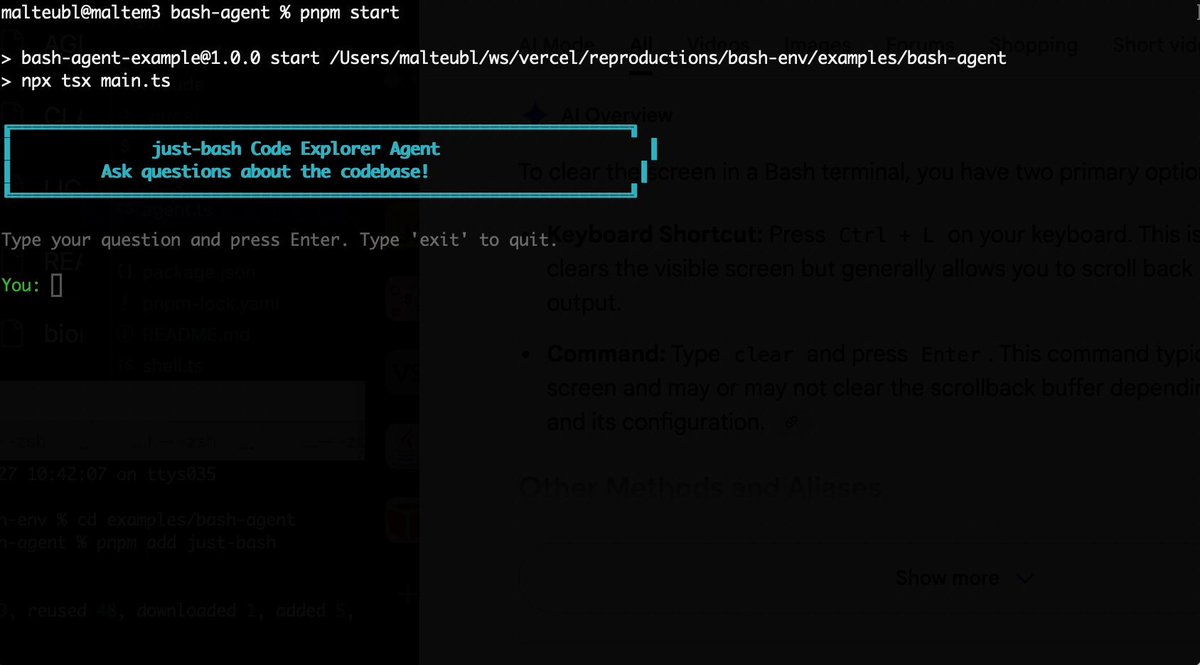
Bash is all you need! Which is why I'm introducing my holiday project: just-bash just-bash is a pretty complete implementation of bash in TypeScript designed to be used as a bash tool by AI agents. Because it turns out agents love exploring data via shell scripts, even beyond coding. It comes with grep, sed, awk and the 99th percentile features that an agent like Claude Code or Cursor would use. In fact, Claude Code can use it for secure bash execution. In the package - A bash-tool for AI SDK - A binary for use by yourself or your coding agents - An overlay filesystem to feed files to your agent securely - A Vercel Sandbox compatible API, so you can quickly upgrade to a real VM if you need to run binaries - An example AI agent that explores the just-bash code base using just-bash - I imported the Oils shell bash compatibility suite and just-bash passes a very good chunk What is interesting about this codebase: It was essentially entirely written by Opus 4.5. Coding agents love bash and they are good at reproducing it. They are also great at text-book recursive descent parsers and AST tweet-walk interpreters. That said, it is, like, a lot of code and I didn't read it all 😅. This is very much a hack, but it also seems to be _really_ useful. I haven't really found anything agents want to use that it doesn't support and it's fast and secure (caveats apply). It doesn't have write access to your computer and the filesystem is given a root that the agent cannot escape from. Find it at Related: Our recent blog post how we migrated our data analysis agent to bash tools and achieved incredible quality improvements The video shows the example agent investigating the just-bash code base

Malte Ubl

125,326 次观看 • 7 个月前

8 rules to improve your AI coding agent. All of these rules work with Claude Code, Cursor, VS Code, and with most programming languages. Automating these rules will 10x the code quality and security produced by your AI coding agents. 1. Dependency checks - Prevent your agent from suggesting insecure libraries based on outdated training data. 2. Secret exposure - Auto-fix the use of hardcoded credentials introduced by your coding agent. 3. File and function size - Automatically refactor any files or functions that exceed a reasonable length. 4. Complexity and parameter limits - Simplify overly complex code written by the agent. 5. SQL Injection - Auto-fix all database interactions with unsanitized user input. 6. Unused variables and imports - Detect and remove dead code. 7. Detect invisible unicode characters in AI rules files - Remove zero-width spaces, direction overrides, and other invisible characters that can hide malicious behavior. 8. Insecure OpenAI API usage - Enforce use of secure OpenAI endpoints, proper authentication, and context isolation Here is how you can automate this: Install the Codacy extension. This will give you access to a CLI for local scanning and an MCP server for agent communication. From here on out, every time you need to generate some code: 1. Your agent will write the code 2. It will then call Codacy's CLI to check it 3. It will find any issues in real time 4. Your coding agent will fix the issues 5. When the code passes all checks, you are done Level of effort on your side: literally zero! Code quality and security because of this: 100x better! Here is the link to download the extension for your IDE: Thanks to the Codacy team for collaborating with me on this post.

Santiago

49,331 次观看 • 9 个月前

. Kent Beck 🌻 is a legend in software engineering: and after coding for 52 years, he's never had more fun than now, he told me. Why? Because AI agents brought back the joy of creating software without the stuff that he's started to hate about coding for so long. Watch or listen: • YouTube: • Spotify: • Apple: Brought to you by: • Sonar — Code quality and code security for ALL code •⁠ Statsig ⁠ — ⁠ The unified platform for flags, analytics, experiments, and more • Augment Code — AI coding assistant that pro engineering teams love Two of my takeaways from this chat with Kent: 𝟭. 𝗞𝗲𝗻𝘁 𝗶𝘀 𝗿𝗲-𝗲𝗻𝗲𝗿𝗴𝗶𝘇𝗲𝗱 𝘁𝗵𝗮𝗻𝗸𝘀 𝘁𝗼 𝘂𝘀𝗶𝗻𝗴 𝗔𝗜 𝗮𝗴𝗲𝗻𝘁𝘀 𝘁𝗼 𝗯𝘂𝗶𝗹𝗱 𝘀𝘁𝘂𝗳𝗳. Kent has been coding for 52 years, and the last decade, he’s gotten a lot more tired of all of it: learning yet another new language or framework, or debugging the issues when using the latest framework. What he loves about these AI agents (and AI coding tools) is how he doesn’t need to know exactly all the details: he can now be a lot more ambitious in his projects. Currently, Kent is building a server in Smalltalk (that he’s been wanting to do for many years) and a Language Server Protocol (LSP) for Smalltalk 𝟮. 𝗙𝗮𝗰𝗲𝗯𝗼𝗼𝗸 𝘄𝗿𝗼𝘁𝗲 𝗻𝗼 𝘂𝗻𝗶𝘁 𝘁𝗲𝘀𝘁𝘀 𝗶𝗻 𝟮𝟬𝟭𝟭, 𝗮𝗻𝗱 𝘁𝗵𝗶𝘀 𝘀𝘁𝘂𝗻𝗻𝗲𝗱 𝗞𝗲𝗻𝘁, 𝗯𝗮𝗰𝗸 𝗶𝗻 𝘁𝗵𝗲 𝗱𝗮𝘆. Kent joined Facebook in 2011, and was taken aback by the lack of testing and how everyone pushed code to production without automated testing. What he came to realize – and appreciate! – was how Facebook had several things balancing this out: • Devs took responsibility for their code very seriously • Nothing at Facebook was “someone else’s problem:” devs would fix bugs when they saw them, regardless of whose commit caused it • Feature flags were heavily used for risky code • Facebook did staged rollouts to smaller markets like New Zealand To this date, Facebook ships code to production in a unique way. We covered more in the deepdive Shipping to Production at

Gergely Orosz

42,526 次观看 • 1 年前

How to build a 1-person AI company that: - Runs locally - 100% open-source - No human employees, all agents - Real-time collaboration via email Multi-agent orchestration is not new. Plenty of frameworks already let agents hand off tasks, run in parallel, and talk to each other. So the interesting question is not whether agents can collaborate. It is what structure you use to make them collaborate. The common approach is to wire a graph of nodes and edges and reason about the plumbing yourself. It works, but you are learning a new abstraction just to describe who does what. There is a coordination structure we have trusted for a hundred years already: an organization. Every company runs the same way. People have roles, roles have reporting lines, and work moves up and down that chart without anyone relaying each message by hand. Map that onto agents and the whole thing gets intuitive. You lay out an org chart, each agent fills one role, you talk to the person at the top, and the org sorts out the work between them. You already know how a company works, so you already know how to run one here. There is no new abstraction to learn. That is exactly what Alook does. Each agent is a live Claude Code or OpenCode session with a defined role, a reporting line, and its own email inbox. The agents coordinate over email, the same way a team would. And it all runs locally through a runtime on your own machine, so nothing leaves your setup. You bring your own agent too. Claude Code and Codex both work, and if you would rather stay fully open source and local, OpenCode works the same way. To show how this feels in practice, I set up three agents as a small sales team. Vi is the one I talk to. I hand Vi a goal, and Vi routes the work down the chart. Neile runs prospect research. Vi passes the target criteria, and Neile reports back a ranked list of names, roles, and companies, each with a suggested angle and a confidence score. Lliane runs outreach. Vi hands over the messaging angle and follow-up cadence, and Lliane reports back on emails sent, responses received, and any deal that needs escalation. I never relay a message between them. Neile and Lliane report to Vi, and Vi updates me in one place. The whole thing is open source and self-hosted, so it runs on your machine with your own agents. Give the repo a star if you want to follow where it goes: I also wrote a full walkthrough on building your own AI company with it, from a blank org chart to a running job. The article is quoted below. Cheers! :)

Akshay 🚀

169,131 次观看 • 1 个月前

AI is changing the software engineering craft. Anders Hejlsberg (Anders Hejlsberg) - creator of C#, TypeScript and industry legend - on why code review needs to get more enjoyable in response: #1 - AI is shifting the craft from writing code, to reviewing code: "In a sense, we're all turning into project managers. We can have an army of junior programmers, called agents, that will just spit out reams of code but someone's got to have the big picture and review all of that. And so, increasingly, our craft is going from one of writing the code, to one of reviewing the code and building the architecture of the code and overseeing the work. It's a different kind of craft. It's a different kind of enjoyment. I've always liked writing the code. To me that was the fulfilling part, seeing it work. In a way, AI robs a little bit of that, because I am less interested in reviewing code." #2 - The code review experience should be improved: "I think we could also make the process of reviewing code much more interesting than it is today. I mean, today, you see a list of diffs in alphabetical order and now it's up to you to make heads or tails of it. There are more pedagogical ways of presenting that. And you could have commentary generated by the AI that tells you what the changes are and whatever, and then tries to guide you along. So that symbiotic relationship, I think we need to work on that more and to keep the enjoyment in there."

The Pragmatic Engineer

39,011 次观看 • 2 个月前

✨New demo: what if vibe coding felt more visual? Brian Lovin Mary Rose Cook and I did a game jam using Notion as our "IDE": launching Cursor agents from a task board, and making a custom image for each task 😎 The demo shows 3 ideas for the future of agents: 1) Agents should collaborate across apps. Each app has its focus--Notion AI is good at drafting specs and organizing tasks; Cursor is good at coding. So let them specialize! Today we're launching a new integration where Notion AI can kick off Cursor Cloud Agents to do coding tasks. The Cursor API accepts natural language prompts, so I think of this as "cross-app sub-agents" -- it's kinda cute how it resembles humans hiring outside contractors 😊 BTW: the parallelism of cloud agents is incredibly freeing for creativity, but it also creates a new problem: sooo much work to keep track of! Which brings us to the next idea... 2) Agent orchestration is a data visualization problem. A powerful frame for designing agent UIs is to think of the chat transcripts as the "raw data" and ask: what visual projections might help people make sense of this data at scale? We need to engage our human GPUs -- our visual processing -- to understand what the computer GPUs are doing for us! One thing we can do is use AI to populate traditional UIs like progress bars and status updates. But there are also new possibilities now... For example: when you have a lot going on, it can be hard to identify tasks just by text titles. So we tried generating an AI image for each task -- turns out this helps a lot by giving it a unique visual identity! And of course, it also just makes it super fun to build with friends 😃 Speaking of friends... 3) The future of coding is collaborative. Sometimes it feels like IC engineers are being reduced to middle managers: shuffling information between the team's context and the coding agents that they individually manage. The solution: bring all the people and agents into one shared space, with shared context and visibility! In the video you can get a glimpse of how this feels. Mary, Brian and I record ourselves chatting about ideas, and then we use AI to turn that conversation into a list of tasks on a shared board. As the ideas get built in parallel, we can all monitor progress and review the work together, nothing is siloed. My main takeaway from this game jam was: damn, creativity with friends, at the speed of conversation, is incredibly fun. --- Our goal here is to let anyone use Notion as a fun and creative "software factory" to build software together with your team. Give the Cursor integration a shot and let us know what you think! (AI Image gen in Notion isn't GA yet, but coming soon and already out to some users) And let me know if you'd want a template or more detailed instructions on the setup we showed in this demo...

Geoffrey Litt

88,919 次观看 • 5 个月前