Video wird geladen...

Video konnte nicht geladen werden

Zur Startseite

Live monocular 3D reconstruction from camera feed, with multi-frame stitching and relative positioning (frame buffer of 4)... running on M3 mac cpu at 24fps... visualised using Rerun next up... realtime semantic navigation in 3d space...

22,080 Aufrufe • vor 6 Monaten •via X (Twitter)

0 Kommentare

Keine Kommentare verfügbar

Kommentare vom Original-Post werden hier angezeigt

Ähnliche Videos

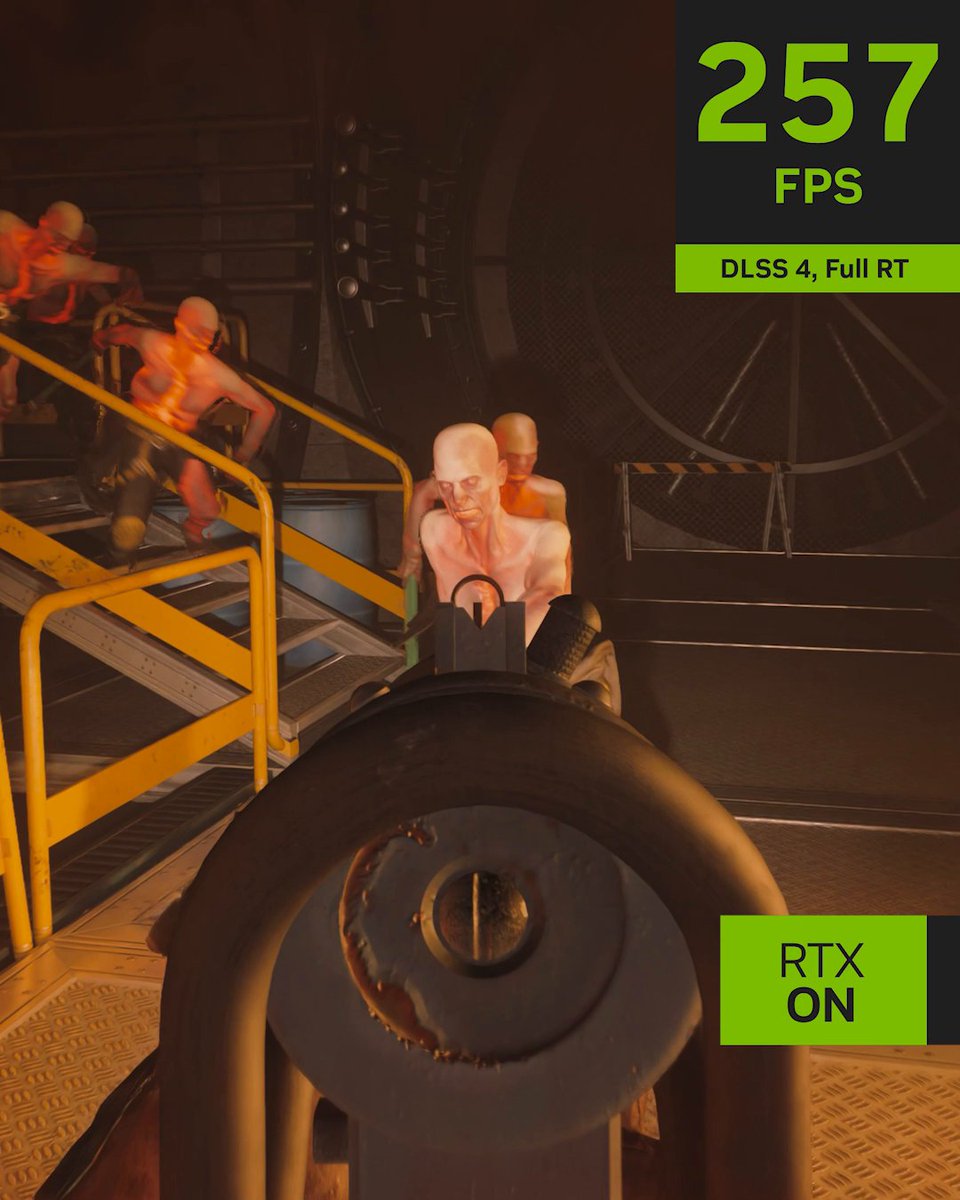
#Battlefield6 NVIDIA DLSS 4 Reveal Trailer 📽️ The game includes support for DLSS 4 with Multi Frame Generation, DLSS Frame Generation, DLSS Super Resolution, DLAA, and NVIDIA Reflex. Desktop GPUs Performance At 4K, Ultra settings, DLSS 4 with Multi Frame Generation and DLSS Super Resolution multiply Battlefield 6's GeForce RTX 50 Series frame rates by an average of 3.8X. ▪️ GeForce RTX 5090 performance rockets to over 470 FPS. ▪️ GeForce RTX 5080 exceeds 330 FPS. ▪️ GeForce RTX 5070 Ti is in touching distance of 300 FPS. ▪️ GeForce RTX 5070 surpasses 230 FPS. At 2560x1440, Ultra settings, DLSS 4 with Multi Frame Generation and DLSS Super Resolution increase Battlefield 6 frame rates by an average of 3X. ▪️ GeForce RTX 5090 runs at almost 600 FPS. ▪️ GeForce RTX 5060 Ti over 240 FPS. At 1920x1080, Ultra settings, the combination of DLSS 4 with Multi Frame Generation and DLSS Super Resolution boost Battlefield 6’s GeForce RTX 50 Series frame rates by an average of 2.9X. ▪️ Allowing every GPU in NVIDIA's line-up to play at over 230 FPS, maxing out at over 740 FPS on the GeForce RTX 5090. Laptop GPUs Performance GeForce RTX 50 Series Laptop GPUs benefit similarly from DLSS 4 with Multi Frame Generation and DLSS Super Resolution, with Battlefield 6 frame rates multiplied by 3X on average at 2560x1600, with Ultra settings, enabling performance of up to 360 FPS. At 1920x1080, Ultra settings, GeForce RTX 50 Series Laptop GPU performance increases by 2.8X on average, enabling Battlefield 6 frame rates to surpass 480 FPS, and the range to run at over 200 frames per second.

Battlefield Bulletin

30,559 Aufrufe • vor 9 Monaten

MAGS-SLAM: Monocular Multi-Agent Gaussian Splatting SLAM for Geometrically and Photometrically Consistent Reconstruction TL;DR: The first RGB-only multi-agent 3D Gaussian Splatting SLAM for collaborative photorealistic scene reconstruction. Contributions: (1) We propose the first monocular RGB-only multi-agent 3D Gaussian Splatting SLAM system. It integrates Gaussian front-ends, compact submap summaries, inter-agent verification, Sim(3) submap pose graph, and occupancy-aware fusion into a unified framework, achieving accurate tracking and photorealistic reconstruction without depth sensors. (2) We propose a Pose-Graph Bundle Adjustment (PGBA)-consistent Sim(3) loop closure mechanism for multi-agent systems, which jointly resolves intra- and inter-agent scale drift through a submap-level Sim(3) pose graph coupling geometric and photometric residuals. Robustness is ensured by a spatial-extent gate that rejects degenerate loops and an adaptive edge invalidation scheme consistent with evolving PGBA corrections. (3) We propose an occupancy-aware fusion framework for coherent multi-agent Gaussian maps. It combines occupancy-grid deduplication, decoupled coordinator, and joint pose-Gaussian photometric refinement to eliminate duplicated Gaussians, residual misalignment, and photometric seams across agents. (4) We introduce ReplicaMultiagent Plus dataset. While existing multi-agent datasets are typically limited to 2-3 agents with short trajectories, our dataset scales to 4 agents with long-horizon trajectories. In addition, we provide ground-truth geometry and semantic annotations, supporting the evaluation of monocular, RGB-D, and semantic multi-agent SLAM for collaborative dense reconstruction.

MrNeRF

19,357 Aufrufe • vor 2 Monaten

MVP of Multiview Video → Camera parameters + 3D keypoints. Visualized with Rerun The basic pipeline as of right now looks like this: 1. Capture 🔴 – Using 4 iPhones and an Insta360 Go. iPhone videos are captured via Final Cut Pro Multicam for easy sync and the exocentric view; the Insta360 Go is used for the egocentric view. 2. Sync 🕒 – Custom Gradio app using two Rerun viewers and callbacks for easily aligning frame timestamps so the ego and exo views are aligned. 3. Calibrate 🎯 – Use VGGT from Jianyuan and AI at Meta to get intrinsics/extrinsics for sparse cameras. 4. Estimate 3D 🕺 – Use RTMLib whole‑body keypoint estimator on each frame, then triangulate in 3D. What's missing? 1. No temporal coherence: I’m estimating keypoints one frame at a time and one camera at a time. This leads to a lot of jittering. For now, I plan on adding a One Euro Filter to help with jittering. Long term, I'd want to train a multiview keypoint estimator 2. Kinematic fitting is still missing; this is my next goal. The output will be joint angles, as explored in my previous posts. 3. Missing dense point cloud: VGGT seems to fail for me here. I’m looking to explore using MP‑SFM as a method for generating dense multiview depth maps + normals (plus it has a friendlier license compared to VGGT). 4. Eventually, creation of 4D Gaussian splatting using something akin to DN‑splatter—my long‑term goal is a data engine that provides poses/depths/splats/keypoints/etc.

Pablo Vela

42,785 Aufrufe • vor 1 Jahr