Loading video...

Video Failed to Load

Go Home

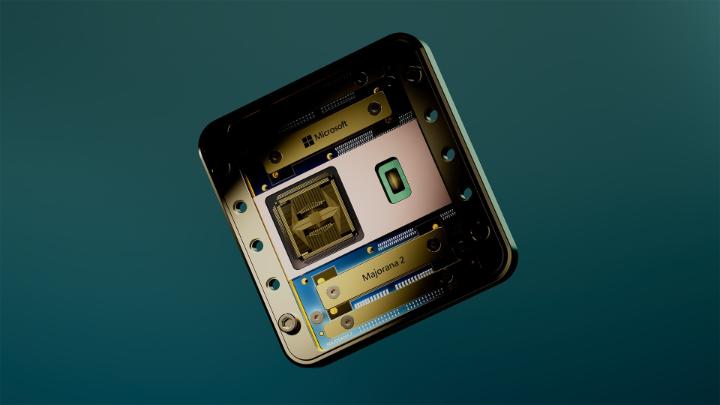
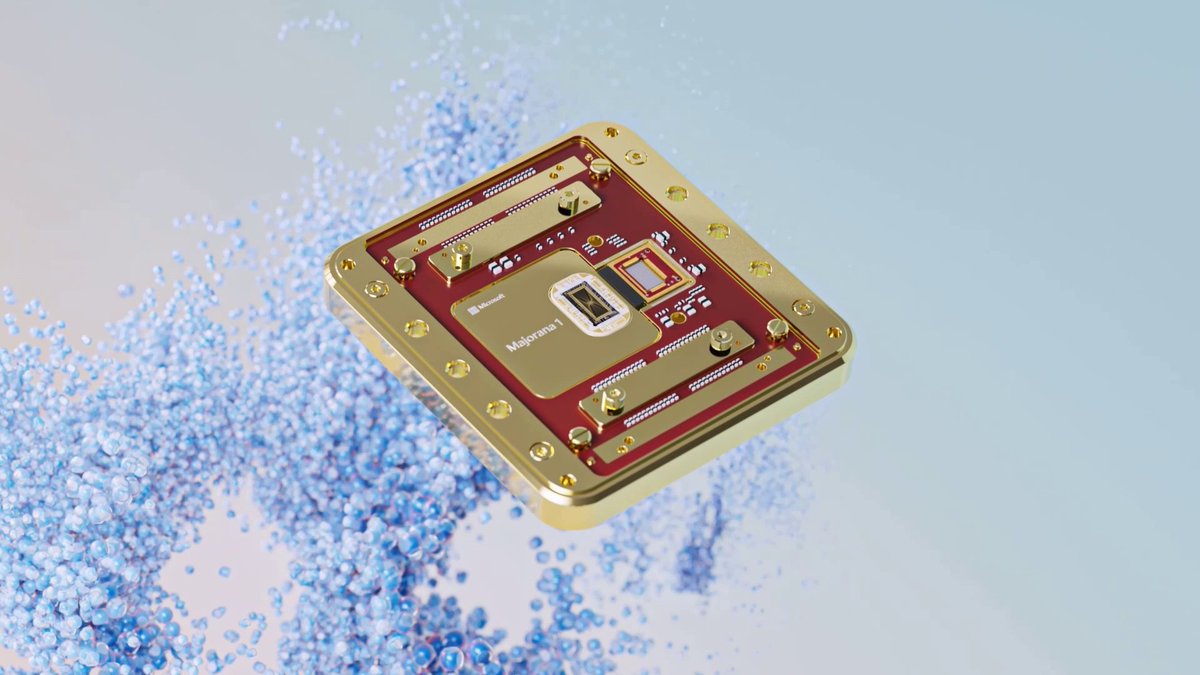
Majorana 1 is a groundbreaking quantum chip powered by a Topological Core. This innovation is built on a new class of materials called topoconductors. Topoconductors enable stable and scalable qubits—the fundamental units of quantum computing.

282,190 views • 1 year ago •via X (Twitter)

13 Comments

Mr_Fireside's profile picture
Mr_Fireside1 year ago

While everyone’s focused on Trump, Microsoft created a new state of matter. It's going to change everything. Here's what you need to know about Microsoft's Majorana 1 Quantum Chip:🧵

Mr_Fireside's profile picture
Mr_Fireside1 year ago

A topoconductor is a newly engineered material that behaves like a superconductor but with quantum stability. They allow Majorana particle creation, which is crucial for building topological qubits. Topoconductors = Superconductors 2.0

Mr_Fireside's profile picture
Mr_Fireside1 year ago

What is a Majorana particle? It's a special type of quasiparticle that was first theorized by Ettore Majorana in 1937 and is unique because it is its-own antiparticle. Both matter and antimatter. It exists only in special quantum states and has “non-abelian” properties.

Mr_Fireside's profile picture
Mr_Fireside1 year ago

If you swap two Majorana particles around, the system “remembers” the swap and can be used for fault-tolerant quantum computing.

Mr_Fireside's profile picture
Mr_Fireside1 year ago

A new state of matter? Traditional matter exists in solid, liquid, and gas forms (plasma, BEC, and others exist too). Microsoft's new state allows for the creation and control of Majorana particles. These particles are key to producing reliable qubits.

Mr_Fireside's profile picture
Mr_Fireside1 year ago

How does Majorana 1 differ from other quantum chips? Most quantum computers today use superconducting qubits (like those from Google and IBM). The problem? They’re fragile. Qubits need to stay in a superposition state to work.

Mr_Fireside's profile picture
Mr_Fireside1 year ago

But even the tiniest disturbance—heat, radiation, or noise—can cause errors. This leads to "quantum decoherence," meaning information is lost before calculations are complete. Microsoft’s Majorana 1 chip solves this using topological qubits.

Mr_Fireside's profile picture
Mr_Fireside1 year ago

What makes topological qubits unique? Instead of storing information in a single point, topological qubits spread information across a quantum system. This makes them far more resistant to errors because even if part of the system is disturbed, the entire qubit doesn’t collapse.

Mr_Fireside's profile picture
Mr_Fireside1 year ago

The key breakthrough here is Majorana particles. Their exotic quantum states naturally protect qubits from interference. Think of it like a braided rope: If you only have a single thread and it breaks, it's useless. A braided rope is far stronger and more resistant to damage.

Mr_Fireside's profile picture
Mr_Fireside1 year ago

Potential applications? With the ability to fit up to a million qubits on a single chip, we might soon see: ✅ Drug discovery and personalized treatments ✅ Cryptography, security protocols, and new encryption methods ✅Designing super materials with unprecedented properties

Mr_Fireside's profile picture
Mr_Fireside1 year ago

When can we expect to see real-world impact? Microsoft suggests that practical quantum computing applications are "years, not decades" away. Challenges remain, such as testing, scaling production, and reducing costs. But with Majorana 1, we are now jumping decades ahead.

Mr_Fireside's profile picture
Mr_Fireside1 year ago

That's it! Follow me for more like this: @Mr_Fireside If you enjoyed this thread, please give it a like and repost it so others can see it, too.

SecBriefs | Making Cybersecurity Simple's profile picture
SecBriefs | Making Cybersecurity Simple1 year ago

Quantum computers can break today’s encryption in seconds.🔑 Quantum tech will reshape our digital lives. Governments & hackers are preparing for the quantum era. How about you?🛡️ Don’t get left behind!🧠 Cybersecurity Dictionary for Everyone can help:

Related Videos

6,100-Qubit Processor Shatters Quantum Computing Record | David Nield, ScienceAlert Another major quantum computing record has been broken, and by a considerable margin: physicists have now built an array containing 6,100 qubits, the largest of its type and way above the thousand or so qubits previous systems contained. It's the work of scientists from the California Institute of Technology, who used cesium atoms as their qubits, trapping them in place with a complex system of lasers that acted as tweezers to keep the atoms as stable as possible. Qubits differ from the classical bits of traditional computers by exploiting what's known as a superposition: not just binary states of 1 or 0, but a spread of probabilities that allows for algorithms that can solve problems considered out of reach of conventional computing methods. Related: Quantum Advantage: A Physicist Explains The Future of Computers A lot of qubits will be needed to make quantum algorithms practical, however. One reason for these large arrays is error correction, which helps overcome the inherent fragility of the qubit by providing a surplus to double-check the machine's operation. "This is an exciting moment for neutral-atom quantum computing," says physicist Manuel Endres. "We can now see a pathway to large error-corrected quantum computers. The building blocks are in place." There was no single breakthrough that enabled this jump in qubit numbers, but rather a series of engineering advancements in many key areas – from the laser tweezers to the ultra-high (very low pressure) vacuum chamber. Stability has also been a problem for quantum computing systems. The innovations in this latest array kept qubits in a superposition state for almost 13 seconds – almost ten times longer than previous configurations had managed. What's more, individual qubits could be manipulated with 99.98 percent accuracy, establishing a significant benchmark in the programmability of quantum technology. "Large scale, with more atoms, is often thought to come at the expense of accuracy, but our results show that we can do both," says physicist Gyohei Nomura. "Qubits aren't useful without quality. Now we have quantity and quality." To make quantum computers a practical alternative to modern supercomputers, more qubits and even greater levels of stability will be required. Experts are tackling the problem from several different angles, which is why records for some types of quantum computer don't necessarily apply to others. Next, the researchers need to work on exploiting entanglement, which will enable the system to make the leap from storing information to actually processing it. Not too far in the future, we could be using these computers to discover new materials, matter, and fundamental laws of physics. "It's exciting that we are creating machines to help us learn about the Universe in ways that only quantum mechanics can teach us," says physicist Hannah Manetsch. Read more:

Owen Gregorian

43,078 views • 8 months ago