Загрузка видео...

Не удалось загрузить видео

На главную

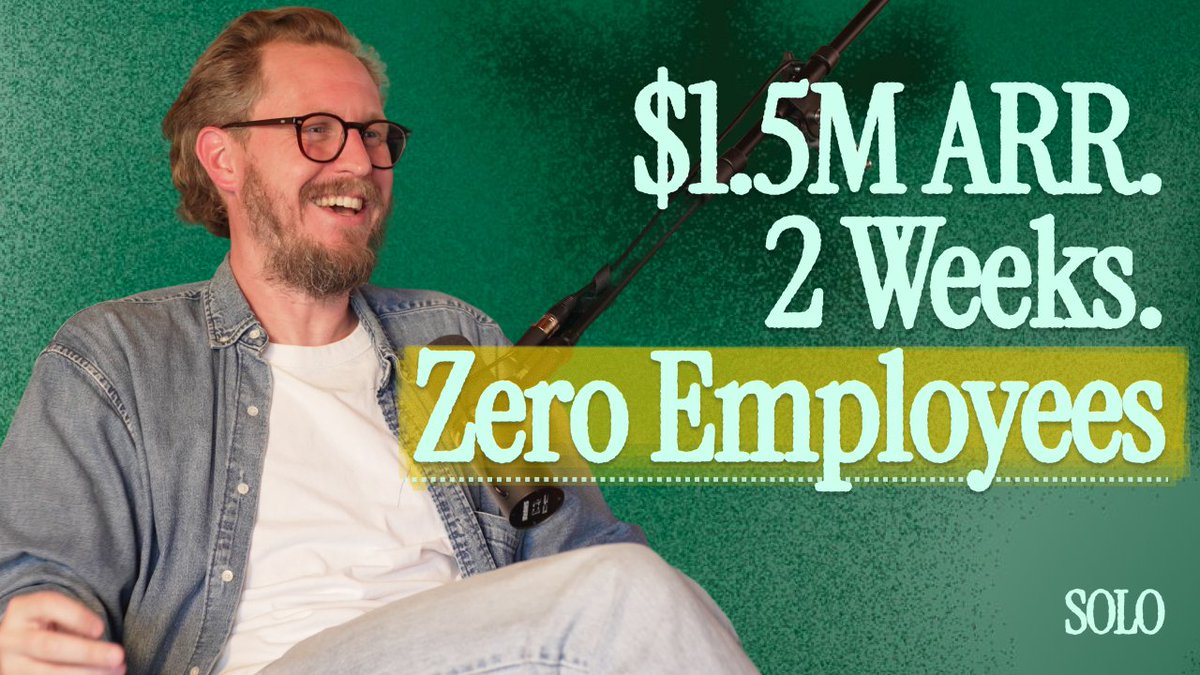
Many founders start their customer search with cold email, LinkedIn, and prospecting tools. But the first 10 customers rarely come from a tool. It starts somewhere else: your network, showing up in person, and a willingness to do things that don't scale. In this episode of Startup School, YC...

221,705 просмотров • 24 дней назад •via X (Twitter)

Комментарии: 0

Нет доступных комментариев

Здесь появятся комментарии из оригинального поста

Похожие видео

Scott Belsky on the most common mistake founders make when building a product “Every product has what we call a ‘first-mile experience’, which is the part of your product that the most customers will see. And it’s all drop-off from there. What gets people through the first-mile experience? First, you have to empathize with where that customer is at — whether they’re a consumer or an enterprise customer, in the first 30 seconds of that first mile of your product, I guarantee you, they’re lazy, vain, and selfish. They want to get through it fast. They want to look good to their boss or their friends or feel good about themselves. There needs to be some quick hit of feeling successful in that first mile for them to engage further.” Ironically, the first-mile experience is the last thing many companies and product people will focus on. “Typically it’s the final mile before you launch where you’re like, ‘Oh wait, what should the onboarding be?’ or ‘What should the defaults be?’ That’s like a happenstance conversation towards the end of shipping when in fact that’s the only thing that every customer will ever see. So why not nail that?” Scott takes this point even further: “If you can really just nail the first-mile experience of your product — even if after that it’s all kind of crappy — you’re probably in the top 1% of products out there.” Another interesting point Scott makes here is that optimizing the first-mile experience is something that you’ll have to continually work on because your customers change over time. “Your first cohort of customers that used your product, those were early adopters — and your first-mile experience was nailed for them. But [as you’ve grown] this new cohort of customers that started using your product are no longer early adopters. They’re pragmatists. They’re not coming because they like to test and try new products. They’re coming because their boss told them they had to or they read some blog that said this was the best product in the space, and the first-mile needs to be different for them.” Scott sums his point up as follows: “Spend consistent time, forever on that first-mile experience of your product.” Video source: South Park Commons (2025)

Startup Archive

32,450 просмотров • 1 год назад

Michael Seibel on how to get and test startup ideas As the former CEO of Y Combinator puts it in the clip below: “There’s a common misconception that your idea has to be great to start a company, and the first thing I want to do is destroy that misconception.” Michael was one of the cofounders of JustinTV, which later become Twitch and sold to Amazon for almost $1B. Their original idea was to create an online reality TV show—very different from where Twitch eventually ended up. Rather than falling for the trap of thinking that your initial startup idea has to be great, Michael advises founders to start with a problem: “Starting with ideas is tricky because people immediately want to grade your idea. It’s a lot easier to start with a problem and think about how you grade a problem.” Ideally the problem you set out to solve is one you've experienced personally or have some sort of connection to. You should ask yourself: “why am I uniquely qualified to work on this problem?” Is there some unique angle or approach you're taking to the problem that you understand but you don't believe others understand? Peter Thiel argues that “great companies have secrets: specific reasons for success that other people don’t see." After identifying a problem, you’ll want to start thinking about your MVP. What's the first solution you're going to build and release to see if you can help your initial users solve this problem? But don’t fall in love with your MVP. As Michael puts it: “A lot of people fall in love with their product and are not in love with their problem or their customer. I advise the opposite. Be in love with your problem. Be in love with your customer. And treat your product in a way that can change, develop, and improve.” And once you have an MVP, you should have a strong opinion about who your initial customer is and handpick all of your initial users. The goal with an MVP is not to see how many people want to use your product. It's to see if your solution actually solves the problem for your initial target customers. “The best startups very heavily filter the people who are able to use the initial product and make sure that they’re the right type of initial customer.”

Startup Archive

101,023 просмотров • 2 лет назад

The cost to go from idea to first customer used to be $3 million and 12 months. Now you can get there in a weekend. On a TWiST devoted to your questions, Jason and Lon reflect on how getting early-stage companies launched and funded has changed, how to compete with major players like OpenAI and Anthropic, and who Jason dislikes the most in Silicon Valley. 0:00 Inside the TWiST private group chat 3:25 How to react when an investor says your "too early." 6:50 The ultimate seed round funnel 8:48 Jason's new Associate in Training program 10:09 Grasshopper Bank - Time is money. Don't waste either. Go to and get an exclusive $500 cash bonus just for opening an account. 18:28 How have the metrics for early-stage companies changed? 20:20 LinkedIn Jobs - Hire right, the first time. Post your first job and get $100 off towards your job post at 22:34 TWiST Bounties update 23:43 Competing against frontier labs 30:03 What signals real investor-founder alignment? 30:14 Northwest Registered Agent - Get more when you start your business with Northwest. In 10 clicks and 10 minutes, you can form your company and walk away with a real business identity — Learn more at 36:07 A crash course in Bay Area startup culture 40:15 Automatons-as-a-Service (AaaS) 42:29 Who in Silicon Valley does Jason really not like? 49:59 Museum Etiquette with Lon Harris cc: @jason, Lon Harris, JS, sergedawg, Peridot: Curated matchmaking, Shawn Sully 🎥 Watch the full episode here 👇

This Week in Startups

45,672 просмотров • 1 месяц назад

Chamath: “Facebook, Tesla, Google… they almost had an allergic reaction to the traditional software stack. They refused to use it.” Find out why he raised a $135M Series A to redefine development, giving every enterprise the opportunity to build and maintain their own software without the $4T in consultants and middleware that usually comes with it… in the debut episode of TWiST All Star Summer 2026. 0:00 It's TWiST All-Star Summer! 0:44 Plaud: If your work depends on conversations — interviews, meetings, calls — you need a Plaud NotePin. You can check it out at and use code TWIST for 10% off! 3:21 Chamath's origin story 7:54 Tom Sawyer entrepreneurship 11:29 Shopify - Turn those What If's into sales with the ecommerce platform powering millions of businesses. Sign up for your $1-per-month trial today at 16:25 The $5 trillion software market 21:06 LinkedIn Jobs - Hire right, the first time. Post your first job and get $100 off towards your job post at 25:00 Building "a co-founder for every human" 31:51 Northwest Registered Agent - Get more when you start your business with Northwest. In 10 clicks and 10 minutes, you can form your company and walk away with a real business identity — Learn more at 35:00 How product development lost its way 45:00 Regulated industries are the beachhead 50:00 Raising the $135M Series A 55:00 8090's "System on a Chip" model 1:04:44 What to tell your kids about AI cc: Chamath Palihapitiya, @jason, 8090 🎥 Watch the full episode here 👇

This Week in Startups

109,738 просмотров • 17 дней назад

If you are a SaaS Founder and you want to increase your Domain Authority. To get customers from Google and AI on Autopilot. Let me introduce you to Distribb backlink exchange. We don't just swap links randomly like every other network. Which, by the way, doesn't bring you much power to your website. We built a system that: 1. Connects to your Google Search Console 2. Finds your top 5 direct competitors 3. Calculates your backlink gap 4. Matches you with real websites in your niche 5. Writes articles and listicles that link to you (optimized for Google AND AI answers) 6. Distributes links across your homepage, money pages, and blog with natural anchor diversity 7. Publishes them across the network automatically 8. Spreads everything over months so it looks 100% organic 9. Uses A-B-C linking: no direct swaps, no footprints Bonus: The longer you stay, the more links you get. Month 1: 5 backlinks/mo Month 3: 8 backlinks/mo Month 6: 12 backlinks/mo Month 12: 20 backlinks/mo Month 18: 25 backlinks/mo Month 24: 50 backlinks/mo You start at your current DR level. As your authority grows, you unlock links from stronger sites. You focus on building your product. We handle the SEO. There are already hundreds of websites in the network waiting for you. This is not a marketplace where you pay $500 per link. This is not a PBN that gets you penalized. This is a real network of real SaaS websites exchanging real editorial backlinks. Your first month starts at $9 👇

Florian Darroman

26,669 просмотров • 3 месяцев назад