Video yükleniyor...

Video Yüklenemedi

Ana Sayfaya Dön

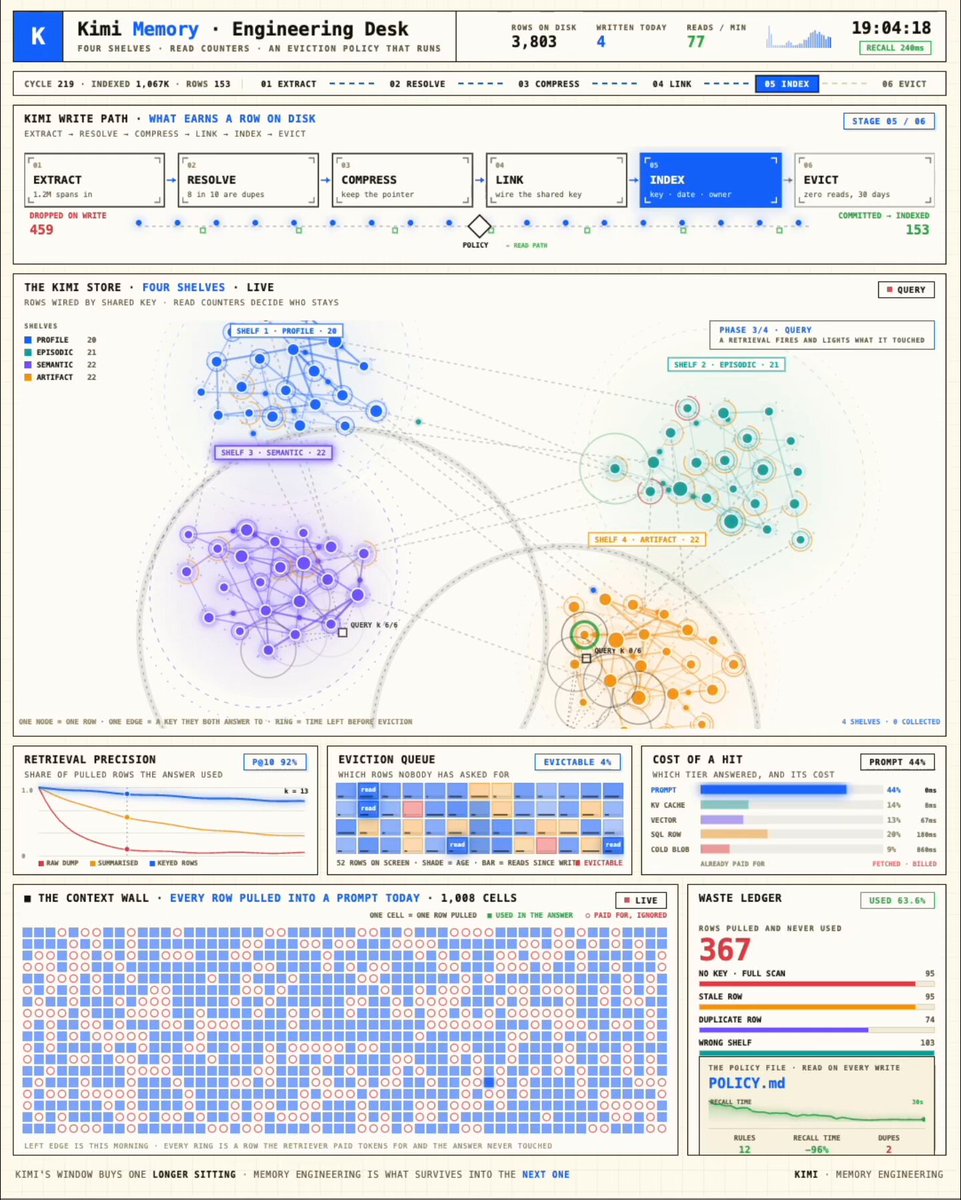
Martin Keen from IBM just explained the one thing separating "chatbot users" from $300K AI architects > most people use Claude Opus 4.8 as a temporary tool -> the pros build it a permanent memory it's called the CoALA framework. the 4 layers your agent actually needs: > Working...

10,435 görüntüleme • 2 ay önce •via X (Twitter)

0 Yorum

Yorum bulunmuyor

Orijinal gönderinin yorumları burada görünecek

Benzer Videolar

HERMES AGENT LEARNS FROM ITS OWN MISTAKES. UPDATES ITS MEMORY. CREATES ITS OWN SKILLS. NO CLOUD. EVERYTHING STORED LOCALLY. THIS IS HOW THE SELF-IMPROVING LOOP WORKS. most agents start from zero every session. Hermes carries forward what it learned. THREE MEMORY SYSTEMS: 1. PROCEDURAL MEMORY (how to act) stored in ~/.hermes/skills/ as SKILL.md files. when the agent repeats a complex workflow, it saves the procedure as a reusable skill. next time the same task comes up, it follows the skill instead of figuring it out again. you can also create skills explicitly: "create a skill called video-prep that captures how I format my video scripts. spoken english, define jargon inline, no em-dashes, close with a catchphrase." the agent writes the SKILL.md. available as a slash command from that moment. Hermes ships with 90+ skills. the number grows the longer you use it. 2. SEMANTIC MEMORY (durable facts about you) stored in ~/.hermes/memory/memory.md the agent scans conversations for facts worth remembering. preferences, habits, corrections, project details. real example from the video: agent tried to scrape a YouTube channel. URL was wrong. it failed. it updated memory.md with the correct URL pattern so it never makes the same mistake again. you can also save explicitly: "save to memory that my favorite testing framework is pytest" the agent updates memory.md immediately. this file loads into context on every session. the agent knows you better every week. 3. EPISODIC MEMORY (chat history) stored in ~/.hermes/state.db (local SQLite). every conversation. every tool call. every result. searchable with FTS5 full-text search. "search our past sessions. what was the first thing I ever said to you?" the agent queries state.db and finds it. over time, auxiliary models consolidate episodic memory into semantic memory. distilling recurring patterns into durable facts. THE SELF-IMPROVING LOOP: every agent run follows this cycle: → you send a prompt → working memory loads: SOUL.md + memory.md + relevant skills + chat history → agent calls tools (terminal, browser, delegate_task) → agent completes the task, replies to you → AFTER the reply: agent checks "did I learn something worth saving?" → if yes: updates memory.md or creates a new skill → next session starts smarter than the last this happens automatically. you don't ask the agent to learn. it decides what to remember on its own. WHAT MAKES THIS DIFFERENT FROM CLAUDE CODE: Claude Code has memory too. but Hermes stores everything locally. no cloud. your data never leaves your machine. Claude Code doesn't auto-create skills from experience. Hermes turns repeated workflows into reusable procedures. Claude Code memory is instruction-based. Hermes memory is conversational and self-updating. over months of usage, Hermes builds a knowledge base of your preferences, your projects, your mistakes, and the procedures that work for your specific workflow. the agent that remembers your birthday also remembers why your last deploy failed. NO EMBEDDINGS. PLAIN TEXT. Hermes does not use embeddings or RAG for memory. skill and memory search runs on plain text keyword matching. simpler. faster. no vector database to maintain. works entirely offline on your local machine. DELEGATE TO CLAUDE CODE: Hermes can spawn a sub-agent that runs Claude Code in headless mode: "spawn a sub-agent using Claude CLI to build a Python script that fetches the top 5 Hacker News stories to markdown." Hermes delegates. Claude Code writes the code. result returns to Hermes. Hermes runs the script and delivers the output. use Hermes for orchestration. use Claude Code for heavy coding. both tools. not competitors. WHAT HERMES DOES NOT HAVE: no built-in eval or LMOps system. no LangSmith, no LangFuse integration out of the box. trajectory export and logs exist but there is no automated quality tracking. if you need eval, build it yourself or connect external tools. the loop is self-improving. measuring how well it improves is on you. comment LOOP and I'll send you the configs that control how fast Hermes learns and what it remembers. memory limits, skill auto-creation triggers, and the auxiliary model that runs the learning. Replace your entire team with 8 hermes agents👇

YanXbt

22,720 görüntüleme • 1 ay önce

New short course: Long-Term Agentic Memory with LangGraph. Learn to build an agent with long-term memory in this course developed in collaboration with taught by its Co-Founder and CEO, Harrison Chase! Personal assistance and productivity tasks have become important use cases for agents. An important feature of an AI assistant, such as a coding or calendar assistant, is its ability to keep improving over time from its experience. Agent memory is the key capability that enables this. To add memory to an agent, you must first figure out what to store and what to retrieve when it is time to use the information. Additionally, you’ll have to decide when to update the stored information. For example, you might update in each iteration loop of the agent or perform updates in the background, with a helper agent. In this course, you will learn a mental framework to build agents with long-term memory. You'll create a useful email assistant that can respond, ignore, and notify using writing, scheduling, and memory-management tools. You’ll develop your agent's memory by adding facts to its memory store, provide examples to learn the user's preferences, and optimize system prompts to evolve instructions based on previous responses. In detail, you’ll: - Learn how the three types of memory--semantic, episodic, and procedural–and the two update mechanisms–via hot path and in the background–apply to your agents. - Build an email agent with writing, scheduling, and availability tools, along with a router that triages incoming email and handles it accordingly by ignoring, responding, or notifying the user. - Add tools to your email agent that allow it to operate on semantic memory by learning facts about the user, storing them in a long-term memory store, and searching over them in future interactions. - Incorporate episodic memory, in the form of few-shot examples, in the triage step of your agents to help them learn and update user preferences. - Add procedural memory as system prompts, optimized with feedback to improve the instructions the agent follows. Learn how to approach memory in agents, and start building agents with long-term memory with LangGraph! Please sign up here:

Andrew Ng

131,850 görüntüleme • 1 yıl önce

THIS GUY BUILT AN AUTONOMOUS AI AGENT OUT OF CLAUDE CODE + OBSIDIAN and this is way more interesting than another “use AI to take notes” demo the trick is simple: Obsidian is not the writing app here. it becomes the agent’s memory, task board, and context folder. Claude Code is not just answering prompts. it reads the vault, edits files, follows instructions, and keeps moving through the work like a junior operator with a filesystem. the reusable setup looks like this: 1. create an Obsidian vault for one project 2. keep goals, rules, tasks, decisions, and references as markdown files 3. point Claude Code at the folder 4. give it a clear operating loop: read context → choose next task → execute → write back what changed 5. use the notes as persistent memory instead of re-explaining the project every chat that’s the part people miss. the “agent” is not magic. it’s the boring combination of: - local files - explicit rules - task state - write access - a model that can run through the repo/vault Obsidian makes the memory human-readable. Claude Code makes the memory executable. that combo is why the video worked: it turns a notes app into an operating surface for actual work. best use cases: - content systems - research vaults - coding projects - client ops docs - personal knowledge bases that need actions, not just storage the caveat: if your vault is messy, your agent becomes messy too. folders, naming, “done” criteria, and forbidden actions matter more than the prompt. but once the structure is clean, this is one of the easiest ways to build an agent that remembers what happened yesterday without paying for a full custom app.

kocer

30,403 görüntüleme • 1 ay önce

THIS GUY CONNECTED HIS AI AGENTS TO HIS OBSIDIAN AND BUILT A BRAIN THAT LEARNS ON ITS OWN. HERE'S HOW TO BUILD IT Obsidian is just markdown files sitting in a folder. That turns out to be the perfect memory for an AI agent, because an agent can read and write those files directly. He wired his agents into the vault so they pull context from it, do the work, and write what they learned back. The notes aren't the point. The loop is, and it gets sharper every cycle How to build it: 1. Point an agent at your vault. The fastest way, no plugins, no API keys: open a terminal and run npx obsidian-mcp /path/to/your/vault. That exposes your Obsidian folder to Claude as a tool it can read, search, and write to. Add it to your Claude Code or Cowork config and restart 2. Confirm it can see the brain. Ask it: "list the notes in my vault and summarize what's in them." If it reads them back, the connection is live. Now it starts every task with everything the vault already holds instead of from zero 3. Give each agent one job and a write-back rule. Tell it: "research this, then save what you found as a new note in /brain with links to related notes." One agent researches, one summarizes, one plans. Each writes its output back into the vault 4. Close the loop. Add one line to every agent's instructions: "read /brain before starting, write your result back when done." Now each task leaves the vault richer, and the next run reads that before it works. It compounds instead of resetting 5. You only steer. Review what the brain produces, point it at the next thing. The agents handle the reading, writing, and connecting The edge isn't better notes. It's a brain that feeds itself, so the work gets sharper every cycle instead of starting over Bookmark this

Yarchi

58,186 görüntüleme • 2 ay önce

New short course: LLMs as Operating Systems: Agent Memory, created with Letta, and taught by its founders Charles Packer and Sarah Wooders. An LLM's input context window has limited space. Using a longer input context also costs more and results in slower processing. So, managing what's stored in this context window is important. In the innovative paper MemGPT: Towards LLMs as Operating Systems, its authors (which include the instructors) proposed using an LLM agent to manage this context window. Their system uses a large persistent memory that stores everything that could be included in the input context, and an agent decides what is actually included. Take the example of building a chatbot that needs to remember what's been said earlier in a conversation (perhaps over many days of interaction with a user). As the conversation's length grows, the memory management agent will move information from the input context to a persistent searchable database; summarize information to keep relevant facts in the input context; and restore relevant conversation elements from further back in time. This allows a chatbot to keep what's currently most relevant in its input context memory to generate the next response. When I read the original MemGPT paper, I thought it was an innovative technique for handling memory for LLMs. The open-source Letta framework, which we'll use in this course, makes MemGPT easy to implement. It adds memory to your LLM agents and gives them transparent long-term memory. In detail, you’ll learn: - How to build an agent that can edit its own limited input context memory, using tools and multi-step reasoning - What is a memory hierarchy (an idea from computer operating systems, which use a cache to speed up memory access), and how these ideas apply to managing the LLM input context (where the input context window is a "cache" storing the most relevant information; and an agent decides what to move in and out of this to/from a larger persistent storage system) - How to implement multi-agent collaboration by letting different agents share blocks of memory This course will give you a sophisticated understanding of memory management for LLMs, which is important for chatbots having long conversations, and for complex agentic workflows. Please sign up here!

Andrew Ng

200,950 görüntüleme • 1 yıl önce

Everyone's building AI agents that run on someone else's server, store memory in someone else's database, and can be shut down by someone else's terms of service. I built one that can't be. FlowClaw is an AI agent that runs on a decentralized distributed computer. Your agent, your conversations, your memory, your tools — all stored onchain on Flow, a distributed network of validator nodes across the world. Not a centralized cloud. Not someone's S3 bucket. A blockchain that functions as censorship-resistant compute and storage for your AI. This isn't a wrapper. Your agent is a Resource — a first-class programmable object in Cadence (Flow's smart contract language) that physically lives in your account's on-chain storage. It can't be duplicated, seized, or deleted by anyone except you. Your encrypted messages, your cognitive memory, your scheduled tasks — they persist on a global distributed ledger that no single entity controls. It's an alpha build. It will break. But it works today on mainnet and I want people to push it this weekend. What it does: You go to authenticate with a passkey (Face ID, Touch ID), and you have a blockchain account in seconds. No wallet. No seed phrase. No tokens needed — gas is sponsored. You're immediately chatting with an AI agent that has real tool execution: live web data, token prices, on-chain balances, Cadence script execution, FLOW transfers. Every message is encrypted client-side before it touches the chain. The agent has a cognitive memory system — it doesn't just remember your last message, it builds molecular memory clusters where related knowledge bonds together for contextual retrieval across sessions. You can spawn sub-agents from a visual canvas to run parallel research. The memory tab shows you exactly what your agent knows. Everything is transparent and everything is yours. 11 smart contracts. No external dependencies. No keeper networks. No account abstraction hacks. Here's the part that matters for the censorship-resistance crowd: FlowClaw supports BYOK — bring your own key. You can plug in any LLM provider. But pair it with Venice and you get the full stack: a censorship-resistant AI model running inference with no content filtering, connected to an agent whose state lives on a decentralized network that no company can shut down, with end-to-end encrypted conversations that nobody can read — not the relay operator, not the LLM provider, not the blockchain validators. Venice doesn't log prompts. Flow can't read your encrypted storage. The relay never sees your plaintext. That's not a privacy policy. That's architecture. You can also use OpenAI, Anthropic, or any OpenAI-compatible provider. The agent platform doesn't care — it's model-agnostic. But the Venice pairing is the one that closes every gap in the stack. For the people tinkering with OpenClaw and the broader open-source agent ecosystem — FlowClaw is exploring what happens when you take the agent off the cloud entirely. Not just open-sourcing the code (though it is), but putting the actual runtime state on a distributed computer. Your agent's memory isn't in a SQLite file on your laptop or a Pinecone index on someone's cluster. It's on-chain, encrypted, and replicated across every validator node on Flow. You own it the way you own a private key — mathematically, not contractually. The blockchain here isn't a gimmick bolted onto an agent for token speculation. It's functioning as the infrastructure layer that replaces AWS. Flow accounts are programmable containers with their own storage, keys, and security capabilities. Passkey authentication works natively because Flow supports P-256 keys at the protocol level — the same curve your phone uses for biometrics. Gas sponsorship works natively because Flow transactions have separate proposer, authorizer, and payer roles built into the protocol. No proxy contracts. No relayers. No ERC-4337. Now here's the part that interests me economically. Every FlowClaw interaction is an on-chain transaction. Every message stored, every memory committed, every session created, every sub-agent spawned. An active user might generate dozens of transactions in a single conversation. Scale that and FlowClaw becomes a real contributor to Flow's transaction volume. Flow.com becomes deflationary at 250 TPS. Applications like FlowClaw that generate high-frequency, storage-heavy transactions are exactly what moves the needle. Every encrypted message uses account storage, which requires FLOW balance to back it. Every transaction burns fees. The more agents running, the more demand for $FLOW — not because of a tokenomics gimmick, but because the protocol literally requires it for compute and storage. FlowClaw doesn't have its own token. The token is $FLOW. The entire platform runs natively on the network — using Flow storage, paying Flow transaction fees, backed by Flow account balances. If FlowClaw succeeds, FLOW captures that value directly. I'm sharing this early because the AI agent space is moving fast and I think the decentralized infrastructure angle is underexplored. Most "crypto AI" projects are tokens with a chatbot attached. FlowClaw is the opposite — it's an agent platform that happens to use a blockchain because the blockchain solves real engineering problems that centralized infrastructure can't. Try it: Github: Create an agent, ask it something, spawn a sub-agent, check your memory tab, pair it with Venice for the full censorship-resistant stack. Break it and tell me what broke. If you think this direction matters, the best thing you can do is use it and give feedback. Your AI agent should be yours. Not your provider's. Not your platform's. Yours.

doodlifts

12,172 görüntüleme • 5 ay önce