Video yükleniyor...

Video Yüklenemedi

Ana Sayfaya Dön

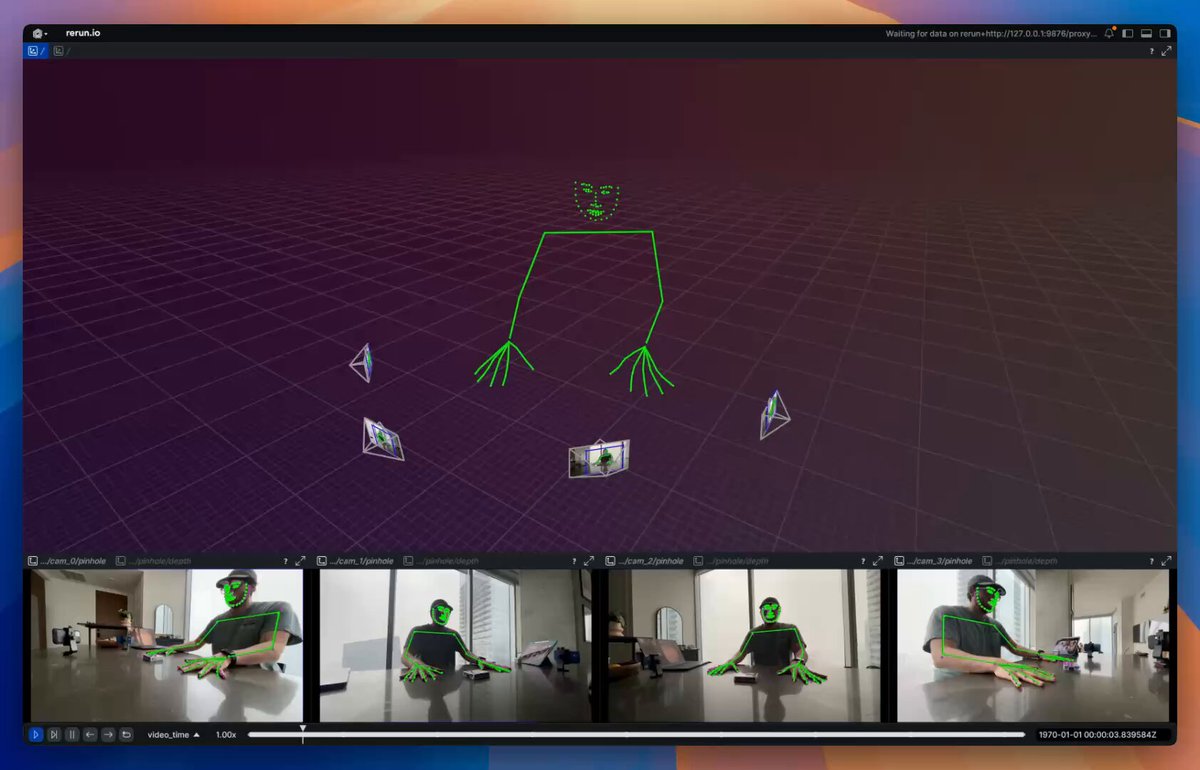
✨ Massive Pipeline Refactor → One Framework for Ego + Exo Datasets, Visualized with Rerun 🚀 After a deep refactoring and cleanup, my entire egocentric/exocentric pipeline is now fully modular. One codebase handles different sensor layouts and generates a unified, multimodal timeseries RRD file that you can open instantly...

20,836 görüntüleme • 1 yıl önce •via X (Twitter)

3 Yorum

Pablo Vela profil fotoğrafı
Pablo Vela1 yıl önce

Try it / follow along Code is landing in the pi0-lerobot repo (hand‑kinematic‑fitting branch): < The current viewer can be found here: < Stay tuned—Gradio front‑end + full‑body exo labels up next!

Himanshu Kumar profil fotoğrafı
Himanshu Kumar1 yıl önce

@rerundotio Intriguing, a unified pipeline could streamline varied data analysis in unexpected ways.

Astrid Wilde 🌞 profil fotoğrafı
Astrid Wilde 🌞1 yıl önce

@rerundotio are you looking for work? if so call me

Benzer Videolar

MVP of Multiview Video → Camera parameters + 3D keypoints. Visualized with Rerun The basic pipeline as of right now looks like this: 1. Capture 🔴 – Using 4 iPhones and an Insta360 Go. iPhone videos are captured via Final Cut Pro Multicam for easy sync and the exocentric view; the Insta360 Go is used for the egocentric view. 2. Sync 🕒 – Custom Gradio app using two Rerun viewers and callbacks for easily aligning frame timestamps so the ego and exo views are aligned. 3. Calibrate 🎯 – Use VGGT from Jianyuan and AI at Meta to get intrinsics/extrinsics for sparse cameras. 4. Estimate 3D 🕺 – Use RTMLib whole‑body keypoint estimator on each frame, then triangulate in 3D. What's missing? 1. No temporal coherence: I’m estimating keypoints one frame at a time and one camera at a time. This leads to a lot of jittering. For now, I plan on adding a One Euro Filter to help with jittering. Long term, I'd want to train a multiview keypoint estimator 2. Kinematic fitting is still missing; this is my next goal. The output will be joint angles, as explored in my previous posts. 3. Missing dense point cloud: VGGT seems to fail for me here. I’m looking to explore using MP‑SFM as a method for generating dense multiview depth maps + normals (plus it has a friendlier license compared to VGGT). 4. Eventually, creation of 4D Gaussian splatting using something akin to DN‑splatter—my long‑term goal is a data engine that provides poses/depths/splats/keypoints/etc.

Pablo Vela

42,785 görüntüleme • 1 yıl önce

I've been on a SLAM/SFM kick. It's one of the more underexplored and lacking areas when it comes to human teleop/data collections, so I've brought over Deep Patch Visual Odometry/SLAM to Rerun and Gradio. With this example, we now have 1. pycuvslam 2. pycolmap/glomap 3. mast3r-slam 4. dpvo/slam all integrated into rerun. The question becomes, which method should be used in what situations? They all make different trade-offs with different camera requirements and throughput/accuracy. What about when a new method comes out? Now that I have several different methods, I plan to use VSLAM-LAB for evaluation. It uses prefix.dev to isolate all the dependencies of each of these methods and easily compare them against each other. In particular, I'll be converting the data preprocessing, algorithm outputs, and evaluation into rerun recordings (rrd files). This will allow both programmatic querying of anything stored in the files (which method had the highest ATE-to-FPS ratio? Which dataset/sequence caused the most difficulty? etc. etc.), all with easy visual inspection using the rerun server to link them all together. Another really important side effect of this is how it impacts agents. As Karpathy said ``` LLMs are exceptionally good at looping until they meet specific goals, and this is where most of the "feel the AGI" magic is to be found. Don't tell it what to do, give it success criteria, and watch it go. ``` by having accuracy and throughput metrics deeply tied with human inspectable artifacts. One can really accelerate agentic development with an actual understanding of how the method/data performs. I think this is another killer use case that I'll be really leaning into to make ingestion of new datasets/methods trivial with an agent. I'm making it my mission for folks to understand that rerun as a visualization tool only scratches the surface of what its true benefit is. Deep integration between data and visuals, with powerful query capabilities. I'll be focusing on the SLAM use case first and then bringing this into the full egocentric/exocentric data collection domain!

Pablo Vela

40,864 görüntüleme • 3 ay önce

Colmap 4.0 was very recently released, so it inspired me to do some work to better understand it and its new capabilities with Rerun. I want to really understand how Colmap, and in particular, pycolmap, works outside of just calling it via the CLI. So my goal is to use the low-level pycolmap API to log every part of the pipeline. The explicit goal is to have an alternative to the SQLite database that I can utilize. Instead of SQLite, I want to try logging everything directly to rerun and use RRD. This means I can have deep inspectability and still save the features/matches/2D view geometry, but be able to view it directly in rerun. I think this is one of the superpowers that rerun provides; data and visualizations are deeply integrated. As I'm often working with sequential data (videos), I'm going to specifically focus on four things: 1. Monocular Video Simple: Calls high-level APIs such as pycolmap.extract_features, pycolmap.match_sequential, pycolmap.incremental_mapping. These are basically identical to the CLI options and provide a good baseline. 2. Monocular Video Streamed: Take the above high-level APIs and break them down to their iterator version, logging each component in a streamed manner. This way, I can stream the intermediate features to rerun while the extraction/matching/mapping is happening. 3. Rig with unknown calibration: <- WHAT THE VIDEO SHOWS This is probably the most interesting version and the first one I've been working on. It allows one to set a rig between known sensors, such as in VR/AR devices, leading to much better reconstructions with multiple cameras. This is the case where we don't know the calibration a priori, so we have to run a reconstruction twice: once as a normal Colmap reconstruction with no rig constraints, use this to generate the constraints, and then do it again with the newly found rig. 4. Rig with known calibration: This is the RoboCap example, where we have a pre-calibrated set of sensors, so we don't need to run the two reconstructions and also gain better matching between cameras, both spatially and temporally. Again, this leads to a much better reconstruction! Along with all this, GLOMAP has become a first-class global mapper, making it super easy to use directly within pycolmap! I'm excited to do more with this and compare it to things like pycuvslam, vipe, and other alternatives.

Pablo Vela

30,070 görüntüleme • 4 ay önce

AI TENNIS ANALYSIS. A FULL COMPUTER VISION SYSTEM. BUILT ON YOLO, PYTORCH, AND KEYPOINT EXTRACTION. Take any tennis match broadcast, any camera angle, any resolution. Feed it into the pipeline. YOLO detects both players and the tennis ball frame by frame. No manual labeling, no pre-annotated dataset. A fine-tuned YOLOv5 model trained on a Roboflow tennis ball dataset handles the ball - the hardest object to track in any sport. Tiny, fast, constantly occluded. The model finds it anyway. Trackers maintain identity across frames so Player 1 stays Player 1 from the first serve to match point. But detection is just the start. A ResNet50 CNN trained in PyTorch predicts court keypoints from every frame - the corners, service lines, baselines, net posts. Fourteen points that define the entire playing surface geometry. From those keypoints the system builds a homography matrix and warps the broadcast perspective into a top-down mini court with real coordinates. Now every player has a position in real space, not pixel space. Every frame becomes a measurement. Every rally becomes a dataset. Player movement speed - calculated from position deltas between frames, converted to meters per second through the homography. Ball shot speed - measured from the ball trajectory across consecutive detections. Number of shots per rally - counted automatically through ball direction changes. All of this rendered live on the video as an overlay. A mini court in the corner showing both players as dots moving in real time. Stats updating after every point. OpenCV handles the rendering. Pandas handles the math. PyTorch handles the intelligence. YOLO handles the eyes. No Hawkeye subscription, no court-embedded sensors, no tracking chips in the ball. A Python script, a trained model, and a GPU. The full code is on GitHub. The tutorial walks through every module - from ball detector training to court keypoint extraction to the final statistical overlay. Professional teams used to need broadcast deals and proprietary hardware for this kind of analysis. Now you build it in an afternoon with open-source tools. Trading here: Computer vision didn't just enter tennis. It made the expensive stuff free.

zostaff

120,370 görüntüleme • 3 ay önce

If you take a movement to unpack this visualization... You'll see how it simply breaks down how reality works. At frame 0 you have a static image. Everything is one, this is the monad. As soon as you hit frame 1 there is movement, there is change. Now you have two states, moving, or static. When Nikola Tesla says you can explain everything in frequency and vibration. The difference between frame 0 and 1, is vibration. The difference between movement and no movement. This is like binary logic we use in code which is made up of 0's and 1's. After frame 1, is when frequency emerges. Because the difference between frame 1 and all frames after is about how fast is the vibration/movement happening. If we skip forward to frame 50... You have a shape that begins to emerge, this is the 8 dots, then the 6 dots. Notice how unstable it is, it's 8 dots, then 6, then a moment with 4 in a rectangle These shapes are emergent properties. The first two emergent properties after the monad was vibration and frequency. Next comes shape (i'm skipping over rotation and direction). These shapes of dots can only exist when you have frequency and rotation. This frequency and rotation creates vortex energy. It's the same energy that things like your chakras use. Or the same energy we harness in devices like engines, airplanes, fans, blenders, hard drives, etc. It's also the same vortex energy you'll see in a tornado or hurricane. They are powered because they harness rotation and frequency(change/movement). Going back to the video, notice that it is inside the entire shape, the internal structure is manifesting before the external structure does. Then around frame 60 the hexagon of circles begins to rotate. First it was the two dots that moved and now it's a complex shape that is coming to life. This is a higher dimension (or lower depending on how you look at it) manifesting into existence. The internal state is "awakening" and experiencing it's own change like what happened to the whole shape in the first frames. But it is unstable. That's why it doesn't persist for long. If you think of the 8 dots being the octahedron, they map to the element of air. Air is in the material world, but it is not something you can see. The brief moments the 8 dots are visible is similar to that effect. They are only experienceable between a small frequency band of frames. Now here's where stability begins to appear in the internal structure. This is when the 4 dots appear. You'll see that the four dots, the square, is stable and persists the most visibly for the most amount of frames. The square represents earth in the platonic solids to elements mapping. Earth, is material, it's stable. We build our buildings in squares and with earth because it is a solid shape to build on. This visualization shows you why. Across different vibrations (frame rates) it can self sustain. Between this point and frame 180, you'll see a new emergent property. Which is depth. A new dimension is introduced at around frame 90 but really becomes visible at around frame 110. You can see a foreground and background. There is the shape of the dots, but also the triskellion wave happening in the background. Let's jump to frame 180. Notice how it is the same as frame 0 except... It's flashing. If you were paying attention, you'll notice you could see flashing at frame 90 and frame 120, but they didn't persist for long. At around 150 it started to reach stability and 180 it was solidified. Between frames 150 and 180 there is flashing, but the image is still moving. Only for a brief moment at frame 180 is the movement frozen and the flashing persists. Think of that like your computer screen. It's what your screen is doing right now as you read this. Even tho the text isn't moving, the screen is flashing at 60 or 120hz. The images appear on your device because this flashing brings things to life. The entire material realm and your physical body right now, is doing the same thing. While you look solid... You're flashing in and out of existence at very high frequencies. You can look at frame 180 and frame 0 as the same essence but it is the mid point between an octave change. In the video, the ying and yang was vertical, now it is horizontal. This is a phase shift. If you notice at exactly frame 180, the rotation freezes and then the direction of rotation changes. The process then repeats all the way to frame 360 but in the opposite sequence. Once it reaches frame 360, that is an octave change and the process repeats. Each time you repeat the process is a layering of the same patterns into higher octaves. This is the same as your chakras or how other things work. They are like russian nesting dolls where every octave is layering onto the next. The complexity of your body is a layering of basic principles that emerged in earlier stages. Your organs are built of systems that are built with cells that are built with proteins that are built with atoms and so on. The atoms, work just like your body at a basic level. Your body works just like the galaxies. At each level you'll have the same pattern. This is where the idea "As Above, So Below" from. The monad, splits in two, and so on and so on. One cell, splits into two through mitosis in the same logic. We could spend all day going through examples of how biology, physics, spirituality, etc. aren't really different. They are just categories that we use to dissect these frequencies and octaves of energy but they only start paying attention within the confines of materialism. The problem is, none of the sciences start at the root patterns. Because that is reserved for religion or spirituality. It's too woo-woo to take seriously so it's dismissed. And because of that... We're left ignorant on the simple explanations for how things work. Now you need some expert with tools you don't have access to in order to explain things. When you could be understanding them without the tools. The Yin and Yang symbol in this video is 3,000 years old. It's simple. Yet I just showed you how it explains deeper layers of reality.

Jamal ☯︎ 🔆🧘🏽🧠

13,149 görüntüleme • 3 ay önce

THIS GUY CONNECTED HIS AI AGENTS TO HIS OBSIDIAN AND BUILT A BRAIN THAT LEARNS ON ITS OWN. HERE'S HOW TO BUILD IT Obsidian is just markdown files sitting in a folder. That turns out to be the perfect memory for an AI agent, because an agent can read and write those files directly. He wired his agents into the vault so they pull context from it, do the work, and write what they learned back. The notes aren't the point. The loop is, and it gets sharper every cycle How to build it: 1. Point an agent at your vault. The fastest way, no plugins, no API keys: open a terminal and run npx obsidian-mcp /path/to/your/vault. That exposes your Obsidian folder to Claude as a tool it can read, search, and write to. Add it to your Claude Code or Cowork config and restart 2. Confirm it can see the brain. Ask it: "list the notes in my vault and summarize what's in them." If it reads them back, the connection is live. Now it starts every task with everything the vault already holds instead of from zero 3. Give each agent one job and a write-back rule. Tell it: "research this, then save what you found as a new note in /brain with links to related notes." One agent researches, one summarizes, one plans. Each writes its output back into the vault 4. Close the loop. Add one line to every agent's instructions: "read /brain before starting, write your result back when done." Now each task leaves the vault richer, and the next run reads that before it works. It compounds instead of resetting 5. You only steer. Review what the brain produces, point it at the next thing. The agents handle the reading, writing, and connecting The edge isn't better notes. It's a brain that feeds itself, so the work gets sharper every cycle instead of starting over Bookmark this

Yarchi

58,186 görüntüleme • 1 ay önce

Hermes agent just left the terminal. 𝗛𝗲𝗿𝗺𝗲𝘀 𝗗𝗲𝘀𝗸𝘁𝗼𝗽 dropped yesterday. native app for macOS, Windows, and Linux. for months Hermes was the agent that learned your projects, wrote its own skills, and built a model of who you are. all of it buried in terminal logs. now it has a window. the important part is that it's not a wrapper. it runs the same agent core, the same sessions, memory, and skills as the CLI. you can start a task in the terminal and finish it in the app without anything resetting. the state is shared across every interface, not copied between them. what the GUI actually adds: → streaming chat that shows live tool calls and inline reasoning instead of a spinner → a preview rail that renders pages, code, and images right beside the conversation → an artifacts panel that collects every file the agent has ever produced → remote gateway mode, so you can point the app at a VPS and run the heavy work elsewhere → skills, cron, profiles, and gateways managed point-and-click instead of through YAML → voice mode, drag-drop files, and inline image generation remote gateway mode is the one worth slowing down on. the agent runs 24/7 on a $5 server while you control it from your laptop like a local app. other agent UIs are chatboxes with a logo. this one shows the autonomy instead of hiding it, so you watch the skills load, the tools fire, and the artifacts pile up as it works. it was teased in Jensen's GTC keynote. MIT licensed, local-first, no telemetry. if you already run Hermes, download it and everything is already there. your chats, memory, and skills carry straight over. i wrote a full masterclass on Hermes Agent that walks through the SOUL. md identity layer, the three-tier memory system, the self-evolving skills loop, and how to run three specialized agents 24/7. desktop is the interface that finally does all of it justice. the article is quoted below.

Akshay 🚀

51,370 görüntüleme • 1 ay önce

Why the character movement in my custom game engine felt janky and how I fixed it. In a game engine, most often, a character moves using the physics engine. Meaning, the player is not just a coordinate in space but a physical body. It has velocity, it handles collisions, and it interacts with the world. Now, as you might know, physics engines need stability. If you run them at variable framerates, things start breaking. Objects phase through walls or fly off into space because the math becomes unpredictable. This is why most game engines lock their physics loop to a 60Hz fixed rate. But here’s the problem: If you have a high-end system, you don't want to limit it at 60 FPS. That's a waste of good hardware. Now, that said, if the GPU is rendering at 144 FPS but the player's position (physics driven) only updates 60 times a second, it creates a micro-stutter that ruins the "smooth" feel of the game. A good way to fix this is to treat the character as two separate things: 1. The Physics Body (Invisible part): This is the "real" character. It lives in the 60Hz physics world, it moves the player and handles collisions. 2. The Visual Model and Camera (Visible part): This is what the player actually sees. It doesn't care about collisions, its only job is to look nice and smooth at whatever framerate the GPU is pushing. Once you have this separation, you can use interpolation to keep them in sync. Every time the physics clock ticks, you save the previous position of the invisible body before moving it to the new one. Between those ticks, calculate how far we are between the last physics update and the next one. By using this to drive the visible parts of the game, the stutters disappear. The physics loop stays fixed behind the scenes, while the visuals slide smoothly between the snapshots. Example: - Right after a tick: blend_weight= 0.0 (The visual model stays at the old physics position). - Halfway to the next: blend_weight= 0.5 (The visual model slides to the middle point). - Just before the next: blend_weight= 0.9 (The visual model is almost at the new physics position). Pro-Tip A critical mistake I made initially, and one many devs make, is parenting the camera and visible parts directly to the player body. If you do this, the camera inherits the discrete 60Hz physics movement by default. In that setup, interpolation won't work because the camera is "stuck" to the physics clock. For this fix to work you must decouple the camera and visuals from the body and move them separately. Player movement processing in Detis Engine: - fixed_process: Physics runs at 60Hz. Handles collisions and raw movement. - process: Variable rate. Mainly used for player input caching in the player case. - late_process: Variable rate. Handles interpolated camera movement after physics and everything else is done being processed. - render. Submits the final interpolated transforms to the GPU. The test environment in the video is running on an old 2070-based laptop. Hopefully the video compression won't introduce any stutter... I’m sharing this in hopes it helps a fellow dev. Cheers.

Ioannis Koukourakis

48,636 görüntüleme • 6 ay önce

This guy spent several days teaching a tabletop robot arm to roll a burrito and when one could not do it he did not rewrite the controller he printed 2 more and launched a 3-arm setup for about $1,000. He does not rewrite the software, does not wait for a smarter model, does not update the imitation weights, he just prints another arm and connects it to the existing leader-follower through LeRobot, nonstop. And it got more interesting: the hardware of one arm is a DIY kit SO-101 for about $300 to $400 on STS3215 bus servos, coordination between the arms goes through leader-follower teleoperation in Hugging Face LeRobot, and replication goes through a Bambu Lab A1 for $399 that prints a copy in a day. It knows the position of the tortilla by the leader-arm coordinates at the start, knows the handoff moment between the arms by the fold phase, and knows the final rolling from the sequence of demonstrations from teleop sessions. And it even distributes the work between the arms, one does the initial folds, the second holds the tortilla still, the third performs the final rolling, depending on which phase the burrito is currently in. In one 57-second demonstration 3 arms rolled a burrito for the first time without human involvement, and the total stack cost less than $1,000 in hardware versus a UR5 at $25,000 or an industrial burrito machine Solbern BR-1500 that costs about $50,000. The viewer is not watching 3 robots rolling a burrito. The viewer is watching permission to believe in a future where a kitchen task on $1,000 of hardware is done by the same loop as an industrial one at $50,000. Here is what happens when the bottleneck stops being the intelligence of the controller and the quality of the imitation model, and becomes the number of arms in the setup, and for a maker with a 3D printer the number of arms is limited only by print time. 3 arms do not get tired between sessions, do not require retraining when a new one is added, do not degrade from repetition, and every next burrito goes through the same teleop pipeline at the same quality as the first. Imagine that multi-arm DIY setups are no longer built for one kitchen task, but printed for each one, burritos, sushi, tacos, pizza dough, pour-over coffee. We just watched hobby robotics shift from "retrain the controller" to "print 2 more": when one robot can not handle it, you do not make it smarter, you print 2 more. The viewer thinks they are watching a DIY experiment. They are watching a multi-agent robotics stack that in one 57-second demonstration rolled a burrito for the first time without human hands, and whose filling partially falls out on the final rolling. What will improve the final rolling, a softer silicone gripper, a 4th follower arm in the setup, or a different filling composition and a more moist tortilla?

Blaze

61,030 görüntüleme • 2 ay önce

Today at Yoast we’re shipping something I've actually wanted to see on the web for some time (even before working at Yoast) and am now honored to be part of the team to bring this to the masses... Built in collaboration with the Open Source and NLWeb team at Microsoft lead by R.V.Guha (co-creator of RSS, RDF and other web standards) - we're introducing the Schema Aggregation feature: a "schemamap" endpoint that outputs your site's entire structured data map in one place. ​ Under the hood, we now provide a standardised, deduplicated map of your entities via a single endpoint. An agent no longer needs to crawl all individual pages to understand its meaning but can now ingest an entire entity map with ease. ​ A few details to note about the endpoint: - It's is cacheable with sub‑100ms responses - It respects existing privacy and indexing settings - It aggregates all indexable content without navigation noise - It merges duplicate entities so your "Author X" or "Article Y" exist as a single node instead of being re‑discovered on every URL. - If you're using one of our paid plugins that extends schema even more (such as Yoast WooCommerce SEO adds product schema) this will be populated within the endpoint too - If you already extend Yoast’s Schema API, or use partners like events or recipe plugins, their entities are pulled into the same map automatically. ​ For me, this is one of the first major ways the agentic web can ingest a site at scale, and with much more efficiency and context. It has also been so much fun to work with this alongside the team at Yoast, particularly the genius mind of Alain Schlesser. Lastly, we have also launched a schema visualisation tool to view how everything is output. You can enable this feature today with the free version of Yoast SEO.

Alex Moss

15,360 görüntüleme • 4 ay önce

I just built a Claude skill that acts as a second brain for DTC brands 🤯 Drop your ad exports, customer reviews, competitor screenshots, and brand docs into a folder → Claude compiles it all into an organized wiki you can ask questions against. All inside Claude Cowork. Perfect for DTC brands and agencies whose knowledge is scattered across Google Drive, Notion, Meta Ads Manager, Figma, and 47 spreadsheets nobody has opened in 3 months. If every strategic question takes 2 hours to answer because the data lives in 8 different places ... This skill eliminates the entire loop: → Claude scaffolds a DTC folder structure: ads, customers, competitors, brand, performance, notes → You drop every file you have into those folders — messy, unorganized, exactly how you have them now → Claude reads everything and compiles a wiki: hooks-that-work, customer-pains, competitor-angles, brand-voice, performance-patterns, creative-brief-library → Every article is cross-linked and traceable back to the source file → You ask questions against the wiki — "what hooks are actually working?" "what objections come up most?" "where are my competitors weak?" → Claude answers, grounded entirely in your own data → Save the answers back in and the system gets smarter every time you use it No more hunting through 12 tools. No more "where did I save that brief?" No more answering the same question twice. What you get: → A complete DTC brand brain scaffold in 60 seconds → Six core wiki articles Claude populates automatically from your raw files → A schema file that tells Claude exactly how to maintain the wiki for DTC use cases → Monthly health checks that catch contradictions and flag gaps before errors compound → A knowledge base that compounds — every question you ask makes the next answer better Built on a methodology Andrej Karpathy shared for personal knowledge bases, I rebuilt the entire thing for DTC operators: folder structure, schema rules, wiki articles, and question frameworks all tuned for brands and agencies. I put together the full skill file plus a playbook walking through the exact setup and 5 real questions to ask your brand brain. Want it for free? > Like this post > Comment "BRAIN" And I'll send it over (must be following so I can DM)

Mike Futia

15,158 görüntüleme • 3 ay önce

This Chinese developer linked two $2,999 NVIDIA DGX Sparks into one box and runs the full Qwen3-235B at home, after dropping his $1,999-a-month cloud bill to zero. He wired 2 small boxes into a single computer, split a giant 235-billion-parameter model in half between them, and serves it across his own network at about 10 tokens a second, with no internet, no cloud, right there on the desk. No data center, no thousand-dollar graphics cards, no monthly cloud bill. Just him, 2 gold boxes the size of a sandwich, one cable between them, and 1 power strip. And here is the whole payoff. He used to pay the cloud $1,999 a month for the same model, and the meter ticked on every request. Now he paid $5,998 once for 2 boxes, they covered their cost in 3 months, and after that he sends as many requests as he wants for free, only electricity. The two Sparks talk over one fast cable, each holds 128GB of memory, and together they carry the whole model, about 73GB loaded per box, with the chip inside pinned near the limit at 96%. Both boxes work as one and keep trading data over the cable, with no cloud in the loop and no single word leaking out. The ready model sits on one local address, and any app on his network calls it as easily as ChatGPT. And here is how he described, in plain words, what this pair of boxes does: "this is a pair of boxes that holds the huge Qwen3-235B model and serves it to one network. the model is split in half, and each box owns its half. parts: // Box 1 (holds the first half of the model and starts the answer fast, the first word appears in under a second) // Box 2 (holds the second half and writes out the rest, about 10 tokens a second) // Cable (connects the 2 boxes and moves data between them on every step, with no lag) // Address (one local address where any app sends its request, like to a cloud model) // Test (a script that runs big prompts through and measures speed and delays) // Monitor (checks temperature, power draw, and load on both boxes every 2 seconds). the model never goes to the cloud. he only steps in when a box runs hotter than 80 degrees or the cable between them starts dropping data." So the system knows exactly what it is, what it is for, and where its limits are. It knows it has to hold the whole huge model across 2 boxes on its own. It knows it has to answer every request locally, with no meter, no limits, and no internet. It knows the human is only needed when a box overheats or the link between them stalls. → The setup runs around the clock on 2 boxes, each pulling under 60 watts → However many requests he sends, the monthly bill is $0, only electricity → The first box starts the answer in under a second → The second writes text at about 10 tokens a second → One request at a time: 838 tokens in 85 seconds, first word in 0.8s → Two requests at once: 697 tokens in 108 seconds, first word in 0.7s → Both boxes sit at 96% load and warm up to 76-78 degrees And only when a chip in a box runs hotter than 80 degrees or the cable between the 2 Sparks drops data does the system call the owner. And when he himself is out on a run or in a coffee shop, he still reaches his own model at home from his phone: sends a big prompt to the local Qwen3-235B, gets the full answer back in under a minute and a half, with no token meter ticking and no limit to hit. Here is what the test shows on his screen during one of the night runs: "one request at a time: 838 tokens in 84.9 seconds, first word in 0.8s, then 0.1s per token." "two requests at once: 697 tokens in 107.6 seconds, first word in 0.7s, then 0.15s per token." "Box 1: chip at 96% load, 76 degrees, 56 watts, 73GB used in memory." "Box 2: chip at 96% load, 78 degrees, 56 watts, the Qwen3-235B model fully loaded." And while everyone around is paying for AI by the month and bumping into limits, his top-tier model just sits on the desk and works as much as he wants: his own little power plant instead of a forever meter. He has no server rack of his own and no cloud account behind it. Just 2 DGX Spark boxes on a desk, one model split in half between them, one local address, and a folder of prompts next to it. Out of everything I have seen this year, this is the cleanest way to stop paying for AI: $5,998 of hardware on the desk once, $0 a month to the cloud, unlimited forever, and between them 2 gold boxes, 1 cable, and the full Qwen3-235B answering at home with no internet.

Blaze

93,219 görüntüleme • 2 ay önce

Elon Musk thinks the entire education system is built on a broken assumption. That every student should learn the same thing. At the same speed. In the same order. At the same time. Musk: “Everyone goes through from like 5th grade to 6th grade to 7th grade like it’s an assembly line. But people are not objects on an assembly line.” The model was designed for a factory economy. Standardized inputs. Predictable outputs. That economy is gone. The assembly line is gone. But the education system still runs on its logic. A student who masters algebra in two weeks sits through eight more weeks because the calendar says so. A student who struggles gets dragged forward because the schedule doesn’t wait. Neither is being served. Both are being processed. Musk: “Allow people to progress at the fastest pace that they can or are interested in, in each subject.” AI doesn’t teach a classroom. It teaches a student. One at a time. Every time. It skips what a student already knows. It finds where they’re stuck and approaches it from a different angle. It adjusts in real time. Not at the end of a semester when the damage is already done. A student obsessed with basketball learns fractions through shooting percentages. A student who builds in Minecraft learns geometry through architecture. The subject doesn’t change. The entry point does. No teacher with thirty students can do this. Not because they lack skill. Because the math doesn’t work. AI doesn’t have that constraint. Musk: “You do not need to tell your kid to play video games. They will play video games on autopilot all day. So if you can make it interactive and engaging, then you can make education far more compelling.” The brain isn’t broken. The format is. Kids learn complex systems and strategic thinking for hours voluntarily. Then walk into a classroom and can’t focus for twenty minutes. That’s not a discipline problem. That’s a design problem. Musk: “A university education is often unnecessary. You probably learn the vast majority of what you’re going to learn there in the first two years. And most of it is from your classmates.” Four years. Six figures of debt. And the real value comes from the people sitting next to you. Not the institution charging you. The degree doesn’t certify knowledge. It certifies endurance. Musk: “If the goal is to start a company, I would say no point in finishing college.” The system was built to train employees. If you’re not trying to be one, it has nothing left to offer you. Every lecture. Every textbook. Every curriculum. Now available instantly. Personalized to any learner. Adapted to any pace. The question isn’t whether the old model survives. It’s how long we keep forcing students through it while the replacement already exists.

Dustin

21,746,692 görüntüleme • 3 ay önce

Elon Musk thinks the entire education system is built on a broken assumption. That every student should learn the same thing. At the same speed. In the same order. At the same time. Musk: “Everyone goes through from like 5th grade to 6th grade to 7th grade like it’s an assembly line. But people are not objects on an assembly line.” The model was designed for a factory economy. Standardized inputs. Predictable outputs. That economy is gone. The assembly line is gone. But the education system still runs on its logic. A student who masters algebra in two weeks sits through eight more weeks because the calendar says so. A student who struggles gets dragged forward because the schedule doesn’t wait. Neither is being served. Both are being processed. Musk: “Allow people to progress at the fastest pace that they can or are interested in, in each subject.” AI doesn’t teach a classroom. It teaches a student. One at a time. Every time. It skips what a student already knows. It finds where they’re stuck and approaches it from a different angle. It adjusts in real time. Not at the end of a semester when the damage is already done. A student obsessed with basketball learns fractions through shooting percentages. A student who builds in Minecraft learns geometry through architecture. The subject doesn’t change. The entry point does. No teacher with thirty students can do this. Not because they lack skill. Because the math doesn’t work. AI doesn’t have that constraint. Musk: “You do not need to tell your kid to play video games. They will play video games on autopilot all day. So if you can make it interactive and engaging, then you can make education far more compelling.” The brain isn’t broken. The format is. Kids learn complex systems and strategic thinking for hours voluntarily. Then walk into a classroom and can’t focus for twenty minutes. That’s not a discipline problem. That’s a design problem. Musk: “A university education is often unnecessary. You probably learn the vast majority of what you’re going to learn there in the first two years. And most of it is from your classmates.” Four years. Six figures of debt. And the real value comes from the people sitting next to you. Not the institution charging you. The degree doesn’t certify knowledge. It certifies endurance. Musk: “If the goal is to start a company, I would say no point in finishing college.” The system was built to train employees. If you’re not trying to be one, it has nothing left to offer you. Every lecture. Every textbook. Every curriculum. Now available instantly. Personalized to any learner. Adapted to any pace. The question isn’t whether the old model survives. It’s how long we keep forcing students through it while the replacement already exists.

Teddy - PolyBackTest.com

314,720 görüntüleme • 14 gün önce

A fired Jane Street quant walked out with 10 years of private BTC trading data. Turned it into $1.5M. He did not build a bot. He built a simulator that runs every move Bitcoin can make before it makes one. I found his wallet. Been copying him for a week. PnL prints like clockwork. Here is what he actually built. A swarm of agents feeds 10 years of stolen tick data into MiroFish. A god-tier agentic simulator. It does not forecast the next candle. It spins up a virtual market and plays Bitcoin forward through thousands of scenarios at once. Six agents each validate their own call. A trade only fires when they converge. They collect data 24/7, rerun the sim, and remember every pattern, every reaction, every signal they have ever seen. He does not predict the future. The math already knows it. He just reads the numbers and takes the money. Here is the part firms do not want public: MiroFish just broke algo trading. The desks are quietly building their own simulators right now. The window where one solo wallet can run this is still open. Barely. I rebuilt his approach using Claude. One prompt. Fed it the same framework. Let it run. The agent monitors his wallet 24/7. Copies every position in real-time. No delay. No guessing. Just mirror and profit. You only need Claude + device + 1 hour to deploy. Giving this free for 24 hours. To get it: 1. Comment the word "QUANT" 2. Like and retweet this post 3. Follow me Himanshu Kumar so I can DM you Save this post. Build the copytrading system this week. Start with $200. Scale on evidence.

Himanshu Kumar

63,122 görüntüleme • 1 ay önce

Neil deGrasse Tyson just revealed that we're building a trap around Earth that could switch off the modern world. And every major country is making it worse on PURPOSE. Right now there is a land grab happening a few hundred miles above your head: SpaceX alone has already put more than 10,000 Starlink satellites into orbit. Around 5,000 objects went up in 2025, and even more are planned this year. By 2040, there could be 100,000 active satellites circling the planet. Every major nation is trying to claim its share and there are almost NO laws governing any of it. Tyson describes the current state of space as a wild west. So why should you care? The hidden trap: In 1978, a NASA scientist named Donald Kessler ran a calculation that space agencies have feared ever since. He found there is a threshold. Once you pack enough satellites into orbit, a single collision stops being an accident and becomes a chain reaction. How it works: Objects in orbit travel at roughly 17,000 miles per hour, which is FASTER than a rifle bullet. At that speed, even a fleck of paint hits with the force of a bullet. So when two satellites collide, they shatter into thousands of pieces, and every single piece becomes a hypersonic bullet of its own. Each of those pieces can strike another satellite, which explodes into thousands more. One collision becomes ten. Ten become a hundred. A hundred become a thousand. Tyson warns that within just a few orbits, this cascade could wipe out close to 100% of the satellites around Earth. Now think about what those satellites run... There is no GPS without them, which means no Google Maps, no ride-sharing, and no navigation. As Tyson put it, there is no Uber without GPS. There is no high-speed internet for ships, planes, remote towns, or entire militaries. There is no reliable weather forecasting and no global financial timing. The invisible backbone of modern life runs through a few thousand machines in orbit, and we are stacking them closer together every year with no traffic rules and no cleanup crew. And it has already begun: Four countries have already blown up their own satellites just to flex their military power. The US, China, Russia, and India have all done it, and every one of those tests scattered thousands of fresh bullets into orbit. Tyson even joked that if aliens ever came to visit, they took one look at the cloud of junk we wrapped around our own planet and decided it was not worth the risk to land. Every player already knows the danger. The problem is that the same logic that fills the sky also traps everyone inside it. Starlink is worth a fortune. Global satellite internet is worth a fortune. Military control of orbit is priceless. So everyone keeps launching, because the first one to stop simply hands the lead to a rival. No country will slow down, because no law forces them to and there is no reward for going first. So we keep running the same experiment on the one thin layer of space that every phone, map, market, and military on Earth depends on. We are simply betting that nobody triggers the first big collision. The scary part is that it only has to happen ONCE. We spent decades dreaming about everything we would build out in space but we may end up locked underneath the garbage we left there instead. This is easily the best interview Steven Bartlett has done in a while.

Ricardo

70,058 görüntüleme • 19 gün önce

"We are not a creedal people. We have no Nicaea, no list of clauses you must recite to be counted among us. And yet in 1995 the leadership put the doctrine of the family on a single page, signed their names beneath it, and that one page has become our shibboleth. You know the word. At the fords of the Jordan the men of Gilead caught the fleeing Ephraimites by a single sound. Say shibboleth. The ones who could not shape the sh, who said sibboleth, were known in a heartbeat for what they were. A shibboleth is the syllable you cannot fake, the confession that reveals which bank of the river you are standing on. But here is the strange thing about ours, and it took me years to see it. Every other shibboleth in history was a word. A password. Something you said. Ours cannot be said at all. We have no creed to recite, so the test could never live in the mouth. It had to go somewhere the mouth cannot reach. It had to become a life. You do not pronounce this one. You build it, and the building shows. It is a man and a woman who took the covenant and then kept it, through the years and the dullness and the nights they wanted to leave and stayed, for time and for all eternity, while the whole world assured them the vow was a formality and the exits were always open. It is a house with too many children in it by the world's arithmetic, the family that refused to treat a child as a luxury to be deferred and took it instead as the entire point, the cord carried forward into the next generation, the one most of the world has now decided it cannot afford. It is the clean life. The thousand small refusals the world finds quaint or insane. The body kept. The appetites bridled. The Sabbath honored. The long sobriety of a people who say no to a hundred easy things on a Tuesday when no one is watching. These are not three rules. They are the welding itself, done with a body, in time. And none of it can be faked at the ford. You can sign the Proclamation in an afternoon. You cannot fake a marriage of forty years, or a table that loud, or a life that disciplined. The signature is easy. The life is the shibboleth. And so is the nerve to say it out loud, to stand up in the open and say that family is between a man and a woman, plainly, publicly, and where it costs you to say it, and to refuse to file the edge off the word because you would rather be liked, or because you have weighed the persecution and decided your own comfort is worth more than the truth. Anyone can affirm the parts the world still applauds."

Kirk Rollins

20,366 görüntüleme • 1 ay önce

Demis Hassabis, the Nobel Prize winner who runs Google DeepMind just described the most consequential project on earth, and most people have no idea it exists. The project is called Isomorphic Labs and the goal is to end the way drugs have been developed for the last century. Here is the problem it is trying to solve. Developing a single drug today takes an average of 10 years, costs billions of dollars, and fails 90 percent of the time before it ever reaches a patient. Of every 10 drugs that enter clinical trials, only one makes it through. The other nine years of work, the other billions of dollars, the other scientific careers, gone. Hassabis believes AI can collapse that entire process from identifying a disease target to designing a compound that binds to it, predicts how it behaves in the body, and minimizes side effects , end to end, on a computer, before a single experiment is run. The foundation is AlphaFold, the AI system that solved one of biology's hardest problems predicting the 3D structure of every protein in the human body and won him the Nobel Prize in Chemistry in 2024. But knowing a protein's shape is only one part of designing a drug. Isomorphic is building what Hassabis describes as adjacent systems , AlphaFold 3, AlphaFold 4, and now a unified model called IsoDDE , that take the next steps. From designing the actual chemical compound that binds to the protein, predicting its binding strength, identifying new pockets to target that no one has ever found before. IsoDDE more than doubles the accuracy of AlphaFold 3 on the hardest protein-ligand prediction benchmarks that exist. Isomorphic is already running 18 to 19 live drug programs, cardiovascular disease, cancer, immunology in partnership with Eli Lilly, Novartis, and Johnson and Johnson. The first human clinical trial of a fully AI-designed drug is expected by the end of 2026. If that trial succeeds, it will be the first time in history that a drug put into a human body was designed not by a team of chemists working for a decade but by an AI working for months. Hassabis's long-term vision is even more direct, one day you describe a disease, click a button, and a drug blueprint comes out the other side. AI will solve almost all diseases within 10 years.

Milk Road AI

36,062 görüntüleme • 3 ay önce