正在加载视频...

视频加载失败

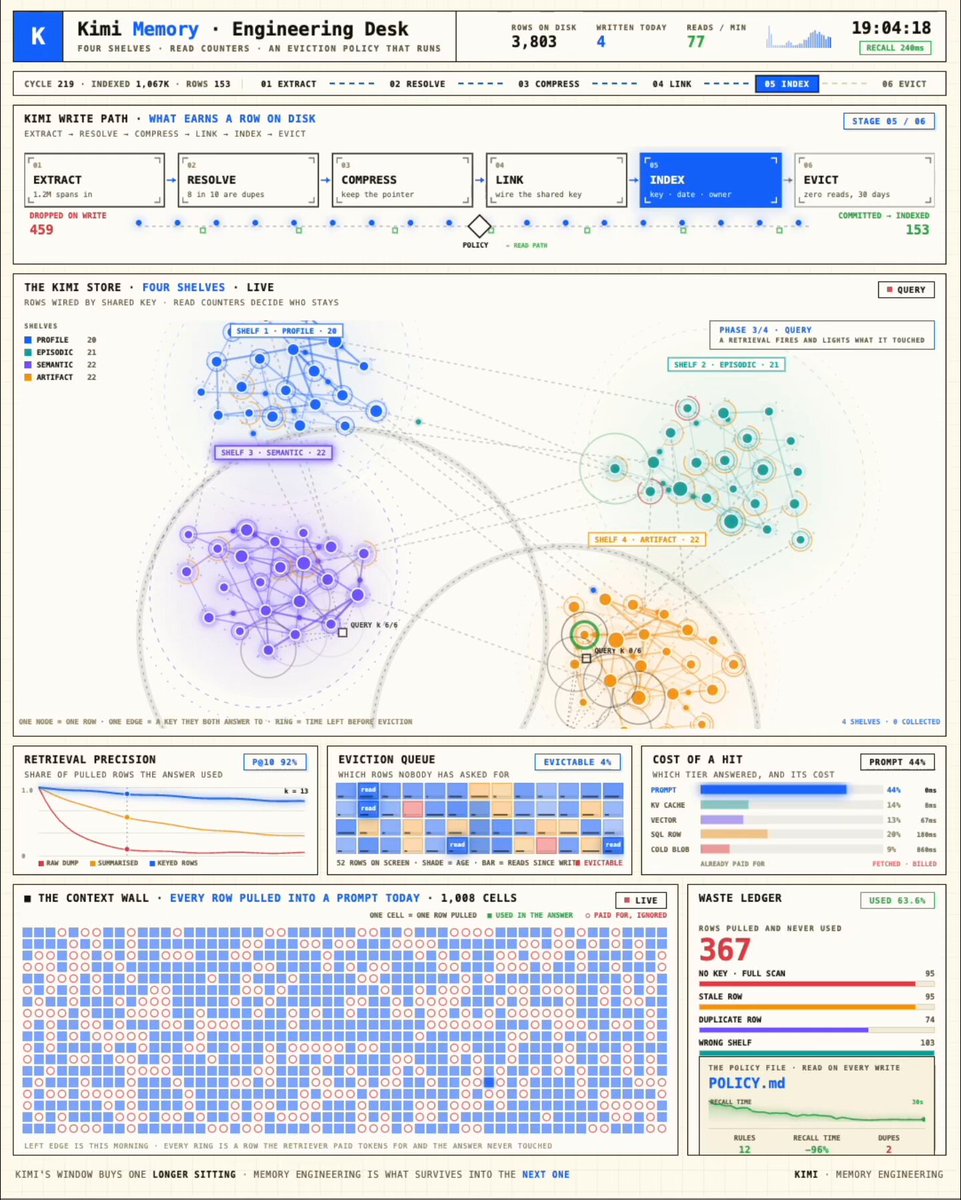
Memory for OpenClaw is now Native! Our first OpenClaw Memory Skill was a massive success: 30k+ downloads in a week and 500k+ organic impressions overnight for launch post. But we knew memory needed to be native. On March 21, OpenClaw merged PR #50848, allowing us to go beyond the...

168,996 次观看 • 2 个月前 •via X (Twitter)

0 条评论

暂无评论

原始帖子的评论将显示在这里

相关视频

New short course: LLMs as Operating Systems: Agent Memory, created with Letta, and taught by its founders Charles Packer and Sarah Wooders. An LLM's input context window has limited space. Using a longer input context also costs more and results in slower processing. So, managing what's stored in this context window is important. In the innovative paper MemGPT: Towards LLMs as Operating Systems, its authors (which include the instructors) proposed using an LLM agent to manage this context window. Their system uses a large persistent memory that stores everything that could be included in the input context, and an agent decides what is actually included. Take the example of building a chatbot that needs to remember what's been said earlier in a conversation (perhaps over many days of interaction with a user). As the conversation's length grows, the memory management agent will move information from the input context to a persistent searchable database; summarize information to keep relevant facts in the input context; and restore relevant conversation elements from further back in time. This allows a chatbot to keep what's currently most relevant in its input context memory to generate the next response. When I read the original MemGPT paper, I thought it was an innovative technique for handling memory for LLMs. The open-source Letta framework, which we'll use in this course, makes MemGPT easy to implement. It adds memory to your LLM agents and gives them transparent long-term memory. In detail, you’ll learn: - How to build an agent that can edit its own limited input context memory, using tools and multi-step reasoning - What is a memory hierarchy (an idea from computer operating systems, which use a cache to speed up memory access), and how these ideas apply to managing the LLM input context (where the input context window is a "cache" storing the most relevant information; and an agent decides what to move in and out of this to/from a larger persistent storage system) - How to implement multi-agent collaboration by letting different agents share blocks of memory This course will give you a sophisticated understanding of memory management for LLMs, which is important for chatbots having long conversations, and for complex agentic workflows. Please sign up here!

Andrew Ng

200,729 次观看 • 1 年前

🚨 memU bot is live. A better alternative to OpenClaw🦞 (formerly Moltbot / Clawdbot) 👉Get instant access to the memU bot: 🕒 A 24/7 proactive assistant memU bot runs continuously on your machine and works as a proactive assistant. It takes action based on your behavior and context — instead of waiting for explicit commands. 🧠 Highly personal, built for you memU bot learns from your long-term usage and memory, and gradually adapts to your work style and preferences. It becomes your assistant — not a generic AI. ⚡ Very easy to use — download and run No complex setup. No configuration. Even non-technical users can simply download and run memU bot. 🔒 Local-first and secure, with no server dependency memU bot runs locally on your device. Your data never needs to be uploaded to public networks or third-party servers. 💸 Lower LLM token cost (more efficient than OpenClaw🦞) While supporting always-on and proactive behavior, memU bot is designed to reduce LLM calls and token usage — so it runs cheaper than OpenClaw, without sacrificing performance. 🧠 "Always-on" is the real key to a proactive agent. And memory is what gives it true proactivity. With memory, an agent is no longer generic. It becomes personal — shaped by who you are. This is how a user-intention-driven proactive agent is born: before you even issue a command, it can already anticipate what kind of help you’ll need, based on your past, your habits, your context. 🔮 A 24/7 process that can observe 👀, remember 📝, and act ⚡ — not just wait for prompts. 🤖 memU bot is our attempt at a user-intention-driven proactive agent — one that lives beyond the chat box.

memU

817,807 次观看 • 4 个月前

New short course: Long-Term Agentic Memory with LangGraph. Learn to build an agent with long-term memory in this course developed in collaboration with taught by its Co-Founder and CEO, Harrison Chase! Personal assistance and productivity tasks have become important use cases for agents. An important feature of an AI assistant, such as a coding or calendar assistant, is its ability to keep improving over time from its experience. Agent memory is the key capability that enables this. To add memory to an agent, you must first figure out what to store and what to retrieve when it is time to use the information. Additionally, you’ll have to decide when to update the stored information. For example, you might update in each iteration loop of the agent or perform updates in the background, with a helper agent. In this course, you will learn a mental framework to build agents with long-term memory. You'll create a useful email assistant that can respond, ignore, and notify using writing, scheduling, and memory-management tools. You’ll develop your agent's memory by adding facts to its memory store, provide examples to learn the user's preferences, and optimize system prompts to evolve instructions based on previous responses. In detail, you’ll: - Learn how the three types of memory--semantic, episodic, and procedural–and the two update mechanisms–via hot path and in the background–apply to your agents. - Build an email agent with writing, scheduling, and availability tools, along with a router that triages incoming email and handles it accordingly by ignoring, responding, or notifying the user. - Add tools to your email agent that allow it to operate on semantic memory by learning facts about the user, storing them in a long-term memory store, and searching over them in future interactions. - Incorporate episodic memory, in the form of few-shot examples, in the triage step of your agents to help them learn and update user preferences. - Add procedural memory as system prompts, optimized with feedback to improve the instructions the agent follows. Learn how to approach memory in agents, and start building agents with long-term memory with LangGraph! Please sign up here:

Andrew Ng

131,640 次观看 • 1 年前