Video wird geladen...

Video konnte nicht geladen werden

Zur Startseite

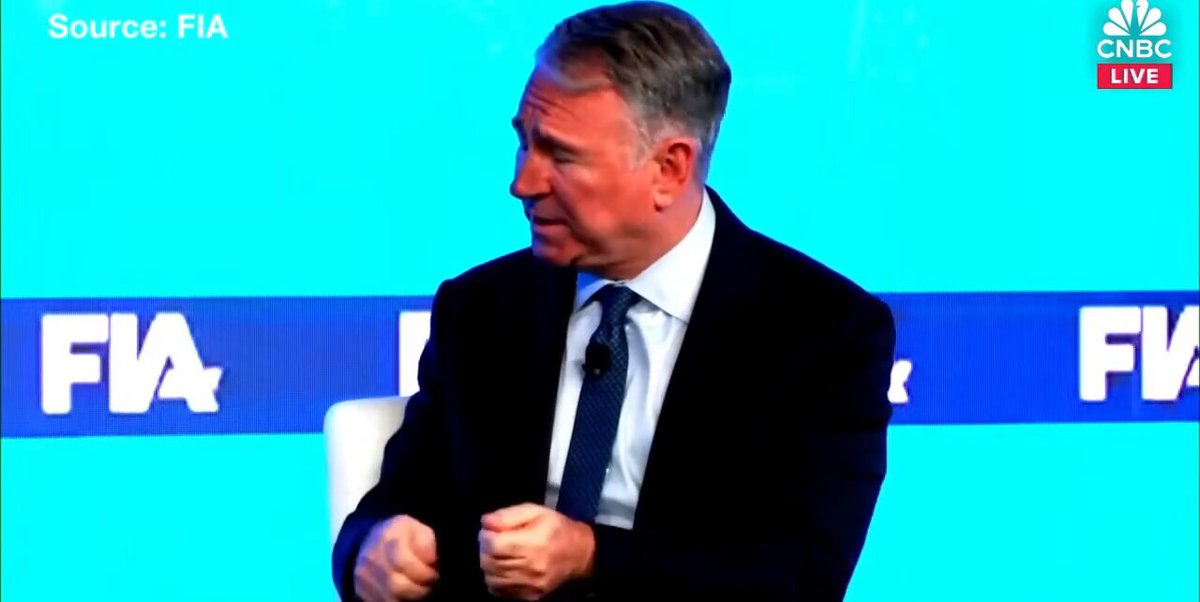
Michael Saylor gave me a two-word model for Bitcoin that explains this entire year: "Risk capital squared." Whatever is good for risk assets is really good for #Bitcoin. Whatever is bad for risk is really bad for it. Simple. But then he walked me through what's actually happening inside...

32,100 Aufrufe • vor 2 Tagen •via X (Twitter)

0 Kommentare

Keine Kommentare verfügbar

Kommentare vom Original-Post werden hier angezeigt

Ähnliche Videos

Ben Thompson says Nvidia has already cut prices, they just show up as backstops and neocloud equity instead of margins "They're actually not maintaining their margins, because who is buying?" "This whole question of circular financing, people talk about Lucent and things like that. This whole deal and Nvidia's providing 25% backstop." "But if you actually ascribe a value to Nvidia's taking equity in the Neoclouds or whatever, they guarantee they're going to buy all their compute to 2030. And why do they do that? So that the entity in question can get a lower cost of capital, so they can buy more GPUs." "But implicit in that, why do they get a lower cost of capital? They get a lower cost of capital because Nvidia assumed risk." "This is my point before. Risk never disappears. It just appears somewhere else. Taking on risk has a price." "Now there is a world where AI takes off, it never stops, and everything is fine, and Nvidia captured all the upside of their risk." "But there's also a world where, say, this Neocloud they backed, a ton of compute comes to market, the hyperscalers have plenty of compute, they don't have enough demand, Nvidia is paying for a computer that no one wants. They just lost a bunch of money." "So if you think about it, there's an expected value of that investment. It's not zero. It's not 100%. It's somewhere in the middle." "But that is a diminution of Nvidia's profitability. If you actually look at their business holistically, what that is is a price cut."

Fireside Alpha

56,613 Aufrufe • vor 5 Tagen

🚨 THIS IS NOT NORMAL Look at the chart. Gold dumping. Silver dumping. Both rolling over at the exact same moment - **2026**, the year a 150-year-old cycle map marked as *"high prices, time to sell."* Everyone's screaming "collapse." They're wrong. This isn't the system dying it's capital *moving,* right on schedule. Here's what most people miss: in a liquidity crunch, the *safe* stuff sells first. Not because it failed because it's what funds *can* sell to cover margin calls. Gold and silver get used as ATMs. Dumped at any price. We've seen this movie: → 2008 - silver cut nearly in half mid-crisis… then gold ran to records. → 2020 - everything red in one week, metals included… then they exploded to new highs. The pattern never changes: **first liquidation, then rotation.** Capital doesn't vanish - it moves to wherever the rules change next. And the same chart points the arrow down to **2032–2039**: the cycle's "time to *buy*" window. So ask the real question - when trust in banks fades and currencies get diluted to save the system, where does the money go? Not into paper. Not into anything that can be frozen, seized, or printed. Gold *used* to be the only exit. But gold is heavy, centralized, sitting in vaults run by the same institutions now under stress. **Bitcoin isn't.** No issuer. No counterparty. No permission. That's why it gets sold hardest in the panic - and bought hardest once liquidity stabilizes. The crash of old finance isn't bearish for the exit asset. It's the entire reason it exists. The rotation won't be gradual. It never is. One moment it's "just another risk asset." The next, it's the only neutral one left standing - and by then the move is already done. Don't follow narratives. Follow liquidity. I've called every major top and bottom for 10+ years. When I make my next move, it goes here first. Follow and turn notifications on. A lot of people are going to wish they'd listened sooner.

Shelpid.WI3M

136,775 Aufrufe • vor 2 Monaten

The $250,000 ETH Productive Money Price Target Explained "You just have to look at the monetary premium that currently exists in gold and Bitcoin. If ETH is better money than gold and Bitcoin, it should capture the monetary premium of those two assets. Today gold has a market cap of ~$30 trillion and Bitcoin has a market cap of ~$1.5 trillion. If you divide that by 121 million ETH, you get a price somewhere between $250,000 and $300,000." Michael McGuiness continues: "I view Bitcoin and gold as the rough TAMs for scarce assets without counterparty risk. That's what gold is and that's what Bitcoin is... and I actually think that could end up being low because it doesn't include other TAMs like the broader money supply -- M2 is ~$22 trillion. There's a monetary premium in asset classes like luxury real estate -- you're not buying an apartment in NYC for the cap rate; it's more of a store of value. If the world converged on ETH as its store of value, it might win that monetary premium as well." Vivek Raman adds: "It sounds audacious but Ethereum is audacious. It's a new technology and people need to start thinking in exponentials... Institutional investors are starting to realize too that it's not just a discounted cash flow model -- Ethereum is not a software company. It's going for money. The repricing from an asset that's not well-understood yet to a productive money that's the global reserve asset is not something that's going to stop at a 10x... And that's what the opportunity is. There aren't many assets out there that have an intrinsic value floor with actual fundamental value plus a monetary premium -- and you have the ability to capture the growth of an entire network that's kind of like owning a piece of the Internet early on. That's what ETH is. It's one of the greatest assets I've ever seen." Mike adds: "I know the number can sound crazy on the surface, but one sanity check I like to do is: there's ~60 million millionaires and there's ~121 million ETH. If every millionaire globally tried to buy some ETH, they'd each be able to own ~2. Obviously there are people out there who own a lot more than 2 ETH, so it'd be less than that. So that's another way of thinking about these few-hundred-thousand-dollar price targets. I used to think about Bitcoin the same way. It's just a nice sanity check: If this is the global reserve asset and the world converges on it, and everyone tries to buy it, how much is left to go around?" Read the full report and watch the full The Edge Podcast interview with Vivek Raman and Michael McGuiness in the links below.

Etherealize

171,344 Aufrufe • vor 4 Monaten

🚨 WARNING: TOMORROW WILL BE THE WORST DAY OF 2026!! JPMorgan will dump $165 BILLION in U.S. stocks right after the market opens. If you think this is a "drop in the ocean" and it won’t affect the markets... YOU ARE COMPLETELY WRONG. Every time JP Morgan sells stocks, the S&P 500 drops 10–20%. And this isn't just about the stock market. It's about liquidity. It's about investor sentiment. And it's about a market that isn't prepared for what's coming. Let me explain: JPMorgan isn't some retail trader taking profits. It's one of the largest and most influential financial institutions on the planet. When they move capital at scale, markets pay attention. And history shows that large institutional selling rarely happens in a vacuum. It usually signals something bigger. A shift in risk appetite. A change in liquidity conditions. Or growing concerns beneath the surface that most investors haven't recognized yet. Now here's the part almost nobody talks about. The direct impact isn't limited to the stocks being sold. Because when a major institution dumps billions of dollars worth of equities, it affects sentiment across the entire market. Selling creates more selling. Liquidity gets thinner. Volatility increases. And risk assets everywhere start to feel the pressure. That's why this isn't just an S&P 500 story. The S&P 500 is the first domino. But the effects will spread into AI stocks. International equities. Commodities. Credit markets. And even digital assets. Today, people are positioned for stability. They're positioned for higher prices. They're positioned for the rally to continue. Which means they're vulnerable if liquidity suddenly moves in the opposite direction. THIS IS THE WARNING. Not because one institution is selling. But because markets often underestimate what large-scale institutional selling can trigger. The risk isn't the transaction itself. The risk is how everyone else reacts to it. Markets aren't pricing that possibility today. But eventually, they will. I've spent more than a decade studying macro and market cycles. I've called some of the biggest market tops and bottoms of the past 10+ years. And I'll call the next market crash in 2026 before the crowd sees it coming. Follow and turn notifications on. I'll post my next market call here first.

0xNobler

375,857 Aufrufe • vor 2 Monaten

🚨 WARNING: THE WORST DAY OF 2026 IS TOMORROW. JPMorgan is preparing to dump $165,000,000,000 into the market right at open. Thinking this won’t move the market? You’re in for the rudest awakening of your life. Every time JP Morgan sells stocks, the S&P 500 drops 10–20%. And this isn't just about the stock market. It's about liquidity. It's about investor sentiment. And it's about a market that isn't prepared for what's coming. Let me explain: JPMorgan isn't some retail trader taking profits. It's one of the largest and most influential financial institutions on the planet. When they move capital at scale, markets pay attention. And history shows that large institutional selling rarely happens in a vacuum. It usually signals something bigger. A shift in risk appetite. A change in liquidity conditions. Or growing concerns beneath the surface that most investors haven't recognized yet. Now here's the part almost nobody talks about. The direct impact isn't limited to the stocks being sold. Because when a major institution dumps billions of dollars worth of equities, it affects sentiment across the entire market. Selling creates more selling. Liquidity gets thinner. Volatility increases. And risk assets everywhere start to feel the pressure. That's why this isn't just an S&P 500 story. The S&P 500 is the first domino. But the effects will spread into AI stocks. International equities. Commodities. Credit markets. And even digital assets. Today, people are positioned for stability. They're positioned for higher prices. They're positioned for the rally to continue. Which means they're vulnerable if liquidity suddenly moves in the opposite direction. THIS IS THE WARNING. Not because one institution is selling. But because markets often underestimate what large-scale institutional selling can trigger. The risk isn't the transaction itself. The risk is how everyone else reacts to it. Markets aren't pricing that possibility today. But eventually, they will. I've spent more than a decade studying macro and market cycles. I've called some of the biggest market tops and bottoms of the past 10+ years. And I'll call the next market crash in 2026 before the crowd sees it coming. Follow and turn notifications on. I'll post my next market call here first.

WhaleTwits

340,786 Aufrufe • vor 2 Monaten

Silver's squeeze is being driven by gold which in turn is being driven by the dollar. No, not "debasement" or "inflation." Eurodollar deflation. People make the critical mistake believing gold is a substitute for the dollar when it's not even in the same arena. Precious metals instead compete with stocks and other risky financial assets as the safe haven alternative to them. Ledger money separated medium of exchange from store of value 150 years ago (not that you've heard anything about it, but you live it every day each time you use your credit card - medium - and check your 401k - store). Gold is not a medium, but it is superior form of value. Gold's behavior therefore has nothing to do with "the dollar" except when eurodollar conditions drive the exchange value and signal conditions relative to stores of value alternatives. This is why gold has behaved like it has and why all the gold "experts" get it wrong. When the dollar is rising, that's a deflation signal which means increasing chance conditions will be bad for risky stores of value. Gold shines. And that is exactly how it has traded recently, too, from late last year through April, the middle of the year when gold backed off because risk-taking was back at the forefront, and now with flat Beveridge everywhere and credit cockroaches showing up every other minute gold is utterly flying. That deflation would be really bad for risky assets that gold competes with. IT IS NOT DEBASEMENT OR ANYTHING LIKE IT. All the evidence is here: Everything you get from the mainstream is either wrong or backward. Oftentimes on purpose. Misdirection and misinformation is actually the trade of "central banks." Start unlearning the garbage and start learning the truth which has been hiding in plain sight all this time.

Jeffrey P. Snider

26,897 Aufrufe • vor 10 Monaten