Загрузка видео...

Не удалось загрузить видео

На главную

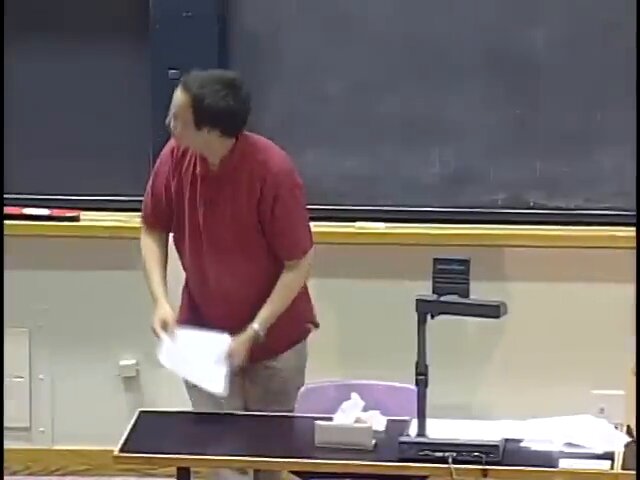
MIT FILMED A PROFESSOR WHOSE EXPLANATIONS ARE SO CLEAR AND INTUITIVE THAT THE MOST COMPLEX CALCULUS ON WALL STREET BECOMES OBVIOUS - AND IT PROVES WHY NEWTON'S VERSION GIVES THE WRONG ANSWER FOR EVERY OPTION PRICE This is an MIT lecture on Itô calculus, course 18.S096. The professor opens...

47,157 просмотров • 1 месяц назад •via X (Twitter)

Комментарии: 5

Фото профиля No Fear T-Shirts Emporium
No Fear T-Shirts Emporium1 месяц назад

Judge Ito sentenced OJ for murder.

Фото профиля Teofilo Colon Jr 💰 🇺🇲 📈 🚀
Teofilo Colon Jr 💰 🇺🇲 📈 🚀1 месяц назад

😮

Фото профиля Shiban Lal Pandita
Shiban Lal Pandita1 месяц назад

It's difficult to cancel Newton now Generations got brainwashed with F = m g^2 which is wrong.

Фото профиля helix
helix1 месяц назад

This is pure gold. The way he derives Itô’s lemma in like 10 lines finally made it click for me.

Фото профиля TTD 🇮🇩
TTD 🇮🇩1 месяц назад

Agreed

Похожие видео

A Japanese mathematician published a result in 1944 that nobody understood for twenty years. Today it runs inside every options desk on Wall Street. Goldman pays $400K to quants who can derive it from scratch and explain why classical calculus gives the wrong answer without it. His name is Choongbum Lee. MIT, 18.S096, Topics in Mathematics with Applications in Finance. The course that Wall Street watches. This is lecture 17. It derives Ito's Lemma from scratch. He opens with the problem nobody in classical calculus can solve. Then the foundation. Brownian motion is the limit of a random walk taken to infinity. Each trade pushes a price up or down by a tiny amount. A million trades a day. The limit of that process is Brownian motion. Einstein proved this for pollen particles in 1905. The finance world borrowed the math fifty years later. Then three properties that make no sense until you see them derived. Brownian motion crosses zero infinitely often. It never escapes to infinity. And it is nowhere differentiable - with probability one, every path is continuous but has no slope at any point. That last property is why classical calculus breaks completely. Then quadratic variation. For any smooth function, chop an interval into n pieces, square the increments, sum them - the result goes to zero. For Brownian motion it goes to T. The increments are too wild to vanish. That single fact is why Ito's Lemma has a second term that classical calculus does not. Watch the moment he derives it. Taylor expansion applied to a function of Brownian motion. The first term is what you expect. The second term appears precisely because the squared increment does not vanish. Without it, options pricing gives wrong answers. With it, you have Black-Scholes. A quant I know sends this lecture to junior analysts who cannot explain why their pricing model drifts. Says it fixes in ninety minutes what two years of finance courses left open. Free on YouTube, MIT OpenCourseWare, 18.S096. bookmark this and watch later - the math behind every options desk on Wall Street fits on one blackboard, and this is the lecture that shows you why

Lupen

66,176 просмотров • 1 месяц назад

This man teaches at a community college in California. His salary: around $800,000 a year. The engineers who passed calculus because of him: $1,800,000 to start. He has more calculus students than Harvard, MIT, and Stanford combined. This is Professor Leonard's Calculus 2, Lecture 6.2. Free on YouTube. Professor Leonard has taught calculus on YouTube for over a decade. His channel has millions of subscribers across 150 countries. Every major university has students who watch him the night before their exam. Then the concept. An inverse function is a machine that undoes another machine. If a function takes 2 and gives you 8, the inverse takes 8 and gives you back 2. Finding an inverse means switching every x and y in the equation and solving for y again. The graph flips across the line y = x like a mirror. Then the problem. Sometimes it is easy to find the inverse. Sometimes it is impossible to write it explicitly. A function like 3π sin x + sin x cannot be solved for x with algebra. You have to think. What angle makes the whole thing equal to 1? You work backwards through the unit circle until the answer appears. Then the shortcut. If you want the derivative of an inverse at a point, you do not need the inverse itself. You only need the derivative of the original function. The formula: the derivative of the inverse at a point equals 1 divided by the derivative of the original function evaluated at the switched point. The inverse flips the coordinates, so you flip where you plug in. Watch the moment he shows why G prime of 8 equals 1/12 without ever writing the inverse function. Every engineering student memorizes the derivative rules. Professor Leonard's lecture is the one that shows why the inverse derivative formula is just those same rules run backwards. A software engineer at a semiconductor company in Austin said Professor Leonard's channel is the reason she passed Calculus 2 on her second attempt. She graduated, joined the company, and now makes $165,000 a year. Bookmark this and watch later - after this lecture every inverse problem on your exam will feel like a question you already answered.

Lupen

734,174 просмотров • 27 дней назад

MIT filmed a mathematician proving the theorem behind every equation Maxwell ever wrote. Most engineers use it daily without understanding why any surface gives the same answer - and the ones who can explain it earn $350K at aerospace firms. Stokes' theorem is the reason Maxwell could write four equations instead of forty. Every result in electromagnetism, fluid mechanics, and differential geometry sits on top of it. Understanding it changes how you see every circulation and flux problem in physics. This is Denis Auroux. MIT, 18.02, Multivariable Calculus, Fall 2007. Lecture 31. It covers Stokes' theorem - the result that unifies line integrals, surface integrals, and curl into one statement. He opens with one confession. Then the statement. The work done by a vector field along any closed curve equals the flux of its curl through any surface bounded by that curve. Not a specific surface. Any surface you want. You pick whichever one makes the calculation easier. Then Green's theorem disappears. The result from the plane that converts line integrals to double integrals turns out to be Stokes' theorem in disguise. Same formula, restricted to a flat surface in the xy-plane. What looked like two separate theorems is one. Then orientation. Walk along the curve with the surface to your left and the normal vector points up. This rule is not chosen for elegance. It is the price of having a consistent coordinate system in three dimensions. Then the proof. Cut your surface into tiny flat tiles. Apply Green's theorem to each one. Sum everything up. All interior boundary edges cancel. Only the outer edge survives. The sum of tiny Green's theorems gives you Stokes' theorem for any surface. Watch the moment he computes the same line integral two ways. First directly - answer is pi. Then through a paraboloid instead of the obvious flat disk. Longer calculation, stranger setup, same answer. The theorem is not an abstraction. You can watch it work. A fluid dynamics engineer I know kept this lecture open during their first week modeling atmospheric circulation. Said it was the first time Stokes felt like a tool rather than a formula to verify on exams. Free on YouTube, MIT OpenCourseWare, 18.02. bookmark this and watch later - after this lecture every circulation, every flux, and every curl you encounter will feel like three views of the same object

Zyphor

11,286 просмотров • 1 месяц назад

The Fourier transform runs inside every MRI machine, every audio compressor, every signal processor on earth. JPMorgan pays $350K to engineers who can derive it from scratch. There is one professor alive who explains it the way nobody else can. His name is Gilbert Strang. MIT. The most brilliant mathematical mind of his generation. His textbook sits in over 10 million homes. No other person on earth holds this combination of depth and clarity in one head. He opens with one confession. The Fourier transform is unreasonably effective. It solves problems it was never designed for. The goal is not to compute it. The goal is to understand why it works at all. Then the core idea. A periodic signal breaks into pure sine waves. Each with a frequency, amplitude, and phase. The transform finds all three simultaneously. A complicated signal in time becomes a simple picture in frequency. Then 1807. Fourier invented the transform not for sound but for heat. How does warmth spread through a metal rod? In time the equation is a partial differential equation - hard. In frequency space it becomes ordinary - easy. Transform in, solve it, transform back. Then convolution. Convolution in time equals multiplication in frequency. Filtering a signal, removing noise, compressing audio - all multiplication in frequency space. Without the transform: thousands of computations. With it: a few multiplications. Then the delta function. Zero everywhere except one point where it is infinite. Integral equals one. Every mathematician in 1900 said it was not a function. Dirac used it anyway. It took 40 years to justify what engineers had been doing the whole time. Watch the moment Strang shows that the Fourier transform of a delta function is a constant - every frequency in equal measure. The more concentrated in time, the more spread in frequency. This is the uncertainty principle. Not quantum physics. A theorem about any signal at all. A signal processing engineer I know rewatched this before their first project at Apple. Said it was the first time the Fourier transform felt like a change of coordinates rather than a formula to memorize. Free on YouTube, MIT OpenCourseWare. bookmark this and watch later - after this lecture every sound, every image, and every signal will feel like a sum of sine waves waiting to be separated

Zyphor

123,256 просмотров • 1 месяц назад

Gilbert Strang taught linear algebra at MIT for fifty years. His last lecture is on YouTube. It has fewer views than his worst lecture. Nobody told students it was the last one. He just walked in, said "the final class in linear algebra at MIT," and started reviewing old exams. Google built a $2,000,000,000,000 company on one concept from this course. He is 88 years old. He still answers emails. This is MIT 18.06. Linear Algebra. The most watched mathematics course in history. Then the Markov matrix. Strang writes a transition matrix on the board. Three states. People moving between them every step. After enough steps - the system locks into a steady state that never changes. That steady state is an eigenvector. Google's PageRank works the same way. Websites are states. Clicks are transitions. The importance of every page on the internet is one eigenvector of one enormous matrix. Then least squares. Three data points. No line passes through all three. So you find the line that minimizes total error. That is how every AI model on earth is trained - including the ones running inside Goldman Sachs trading desks. Then the projection. The closest point on a plane to a vector outside it. Strang draws it in 30 seconds. That same operation is how Netflix decides what to recommend to 280,000,000 subscribers. Watch the moment he gives back the final exam answer and asks students to work backwards to the question - the room solves it in silence faster than any other lecture all semester. A software engineer told me 18.06 was the course that got her from $90,000 to $200,000 in two years. Same company. Different title. Bookmark this and watch later - after this lecture every dataset you touch will feel like a geometry problem waiting to be solved. MIT 18.06 Lecture 34 | Linear Algebra Final Review | Gilbert Strang

Zyphor

56,603 просмотров • 27 дней назад

Millions have watched an MIT professor accidentally destroy the American sports betting industry in a free 12-lecture undergraduate poker course. MIT charges $85,000 a year to sit in that classroom. He posted every lecture on OpenCourseWare for nothing. Almost no one who has ever placed a DraftKings same-game parlay has finished all twelve. His name is Kevin Desmond. He is an MIT alum, a professional poker player, and the instructor of 15.S50 Poker Theory and Analytics, which MIT gave undergraduates college credit for taking during January of 2015. The 43-minute clip in this video is one lecture from that course, filmed at MIT that same month. The chart on the screen behind him looks like a poker graph. It is the exact math that decides whether a Wall Street quant clears $500,000 a year, whether a FanDuel bettor loses their rent money on a Sunday afternoon, and whether a Silicon Valley founder can walk into a term sheet negotiation without being taken apart in the room. Desmond compresses the mathematical foundation of every adversarial decision on earth into five ideas. Ranges. You never know your opponent's exact hand. You know a distribution of hands weighted by probability. Every FanDuel bettor picking a parlay on a hunch is playing without a range. Every retail trader guessing a competitor's next move is guessing blind. Pot odds. The equation that tells you when a call has positive expected value. Every VC term sheet and every insurance premium reduces to it. Every same-game parlay on DraftKings violates it in ways the app is legally allowed to hide from you. Expected value. Sum every outcome weighted by probability. Casinos are built on it. Poker pros live on it. Sports bettors violate it every time they chase a loss hoping for a hot Sunday. Game theory optimal. The Nash equilibrium of poker. The strategy no opponent can exploit no matter how well they read you. Quant funds pay $500,000 bonuses for one senior who can solve for it under pressure. Exploitative play. When to deviate from GTO to punish a specific mistake. What every senior desk on Wall Street does against retail order flow, every trading session, every day. Every quant fund on Wall Street runs a hiring pipeline that starts with this material. Every prop trading desk drills it into juniors before their first live session. The MIT professor who filmed the whole course posted it on OpenCourseWare for the price of an internet connection. "Every time you play a hand differently from the way you would have played it if you could see all your opponent's cards, they gain." That is David Sklansky's Fundamental Theorem of Poker. Desmond opens the course with it. It is also the exact statement of information asymmetry that every trading floor, casino, and DraftKings promo card on earth is built to exploit. The lectures are free on MIT OpenCourseWare. The problem sets are online. Every equation Desmond derives fits on one page. The math is free. The willingness to spend 43 minutes on one lecture before opening a sportsbook app, placing a parlay, or entering a negotiation is a much rarer commodity than the confidence to walk in without it.

Lumen

58,397 просмотров • 1 месяц назад

Today we introduce Stochastic Differential Equations (SDEs). I find that the best way to introduce these complex concepts is to look at an application. This is part I of the lecture🙂 We look at the theory behind electromagnetic scattering/radar clutter which leads to anomaly detection on scattering statistics. When a narrowband wave scatters off a messy cloud of particles, the complex field at your receiver is a random phasor sum...at time t you can write the electric field as E_N(t) = Σⱼ₌₁ᴺ e^{iθⱼ(t)}, each term a unit arrow in the complex plane from scatterer j. This is exactly where the magic of Brownian motion appears naturally and in the most reasonable way. Think of all the microscopic chaos...tiny motions, index fluctuations, path jitters, Doppler shifts that shows up as small random kicks to the phases θⱼ(t) over very short times. If you just made θⱼ(t) random in an ad-hoc way (say, resampling independent angles at each time), the field would jump around unrealistically with no temporal structure. Brownian motion is what you get when you let each phase take the continuous-time limit of many tiny, independent kicks...it’s continuous in t, it has the right cumulative variance growth, and it remembers just enough of its past to look physical. So we model each phase as a Brownian walk, θⱼ(t) = θⱼ⁰ + σ_θ Bⱼ(t), with independent Brownian motions Bⱼ(t) and a phase-diffusion rate σ_θ. Brownian motion here isn’t window dressing...it’s the clean way to compress all the small random stuff into a single process that actually matches how the phases wander in time. #StochasticProcesses #BrownianMotion #ItoCalculus #RadarClutter #RayleighScattering #SignalProcessing

Mathelirium

55,319 просмотров • 9 месяцев назад

An MIT mathematician spent the last decade building one equation that assigns every chart pattern on Wall Street a precise probability of having been drawn by pure random noise. She filmed the entire framework in a 110-minute lecture and put it on YouTube for nothing. Millions of traders draw trendlines every day. Almost none have watched it. Her name is Yilin Wang. She is a mathematician at MIT, previously at ETH Zurich, and winner of the 2023 Salem Prize, the highest recognition for a young mathematician working in analysis. The 110-minute video in this post is one of her seminars on Schramm-Loewner Evolution and Loewner energy, filmed at a chalkboard in a small university lecture hall. MIT charges $85,000 a year to sit in a room like that. She posted the entire talk to YouTube for free. Wang covers the mathematical foundation of "how random is this pattern" in one afternoon. Schramm-Loewner Evolution. A family of random curves that turned out to be the scaling limit of almost every 2D random system physicists ever studied: percolation, the Ising model, self-avoiding walks. Driving function. Every SLE curve is encoded by one 1D signal, a Brownian motion that steers it. Extract that signal from a price chart and you can measure exactly how far the chart is from pure noise. Loewner energy. The number Wang built her career on. It assigns to every smooth curve on the plane a single real value between zero and infinity. A perfect circle gets zero. Every other shape costs energy. Large deviation principle. The probability that a random SLE curve looks approximately like a given shape decays like exp of minus its Loewner energy divided by kappa. Low energy shapes are almost indistinguishable from noise. High energy shapes noise would essentially never draw. Every quant fund on Wall Street pays PhD statisticians $500,000 a year to formalize exactly this question: is the pattern on the screen a signal, or is it something pure randomness would have drawn anyway. Wang wrote the closed-form answer at a chalkboard, in one lecture, for nothing. "The most surprising fact about a random curve is not how random it looks. It is how much of what humans call a pattern is exactly what pure randomness would have drawn." That is a paraphrase of the framing she returns to across the seminar. The lecture is free on YouTube. The paper introducing Loewner energy is free on arXiv. The full framework fits in under forty pages. The formula is free. The willingness to measure the energy of a chart before betting a mortgage on the pattern is a much rarer commodity than the confidence to draw the trendline without it.

Lumen

11,992 просмотров • 18 дней назад