Video yükleniyor...

Video Yüklenemedi

Ana Sayfaya Dön

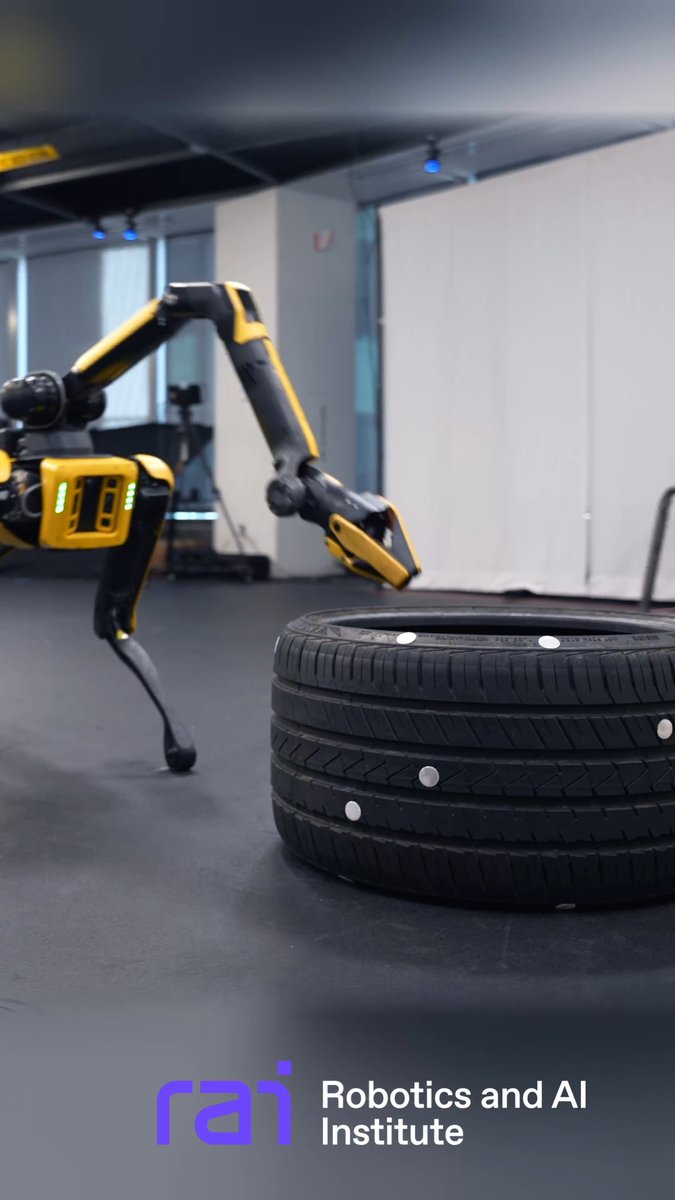
Mondo's Beni ( may look cute, but there is a serious learning stack inside. It can perform flips, navigate autonomously, and track moving subjects. The secret is reinforcement learning: Beni practices at massive scale in simulation, optimizing its controller through millions of virtual trials before entering the real world....

31,539 görüntüleme • 3 ay önce •via X (Twitter)

24 Yorum

Shuo Yang profil fotoğrafı
Shuo Yang3 ay önce

1/ @nvidia IsaacLab and @GoogleDeepMind MuJoCo are core parts of our training and validation pipeline. We train controllers across large numbers of simulated environments, then validate them in a separate physics engine.

Shuo Yang profil fotoğrafı
Shuo Yang3 ay önce

2/ Modern legged-robot reinforcement learning builds on years of excellent research. The work of @rdn_nikita , David Hoeller, and their collaborators has been particularly influential. For Beni’s flipping motions, we also drew inspiration from @xbpeng4’s classic DeepMimic paper. Beni has been reading the literature—and practicing its backflips.

Shuo Yang profil fotoğrafı
Shuo Yang3 ay önce

3/ Some behaviors need an additional layer of sim-to-real polish. For these, we use ideas from Regularized Online Adaptation, or ROA, developed by my good friends @zipengfu and @xuxin_cheng (and @deepakpathak) :

Shuo Yang profil fotoğrafı
Shuo Yang3 ay önce

4/ Along side all the neural networks, Beni also uses some good old-fashioned SLAM—in several creative ways. One particularly valuable tool is GTSAM, created by @fdellaert and contributors.

Shuo Yang profil fotoğrafı
Shuo Yang3 ay önce

5/ Beni’s target-tracking system also contains several algorithmic innovations developed by our own team. These improvements allow Beni to follow a subject smoothly while coordinating perception, locomotion, and camera motion. We may publish more technical details in the future.

Shuo Yang profil fotoğrafı
Shuo Yang3 ay önce

Sometimes the best robotics system is not “AI versus classical robotics.” It is AI standing on top of decades of great robotics research. Small robot. Serious algorithms. 🤖

Carlos DP 🤖🇺🇸 profil fotoğrafı
Carlos DP 🤖🇺🇸3 ay önce

is there a developer mode on Beni? like, could he be used for people learning to do RL on real robots in a fun way?

Deepak Pathak profil fotoğrafı
Deepak Pathak3 ay önce

Great work @Shuo — love to see our ROA algorithm in action. This robot is so cool!

JVM profil fotoğrafı
JVM3 ay önce

and you want $549 for this?!

cr_ss_ profil fotoğrafı
cr_ss_2 ay önce

Thats a really cool toy!

HGONG | Founder & Researcher profil fotoğrafı
HGONG | Founder & Researcher3 ay önce

咦?你是RM的杨硕吗?

Ankur Deka profil fotoğrafı
Ankur Deka3 ay önce

Great to see Beni’s acrobatics @ShuoYangAIR!

Keith Botha profil fotoğrafı
Keith Botha3 ay önce

We love to see it ! Really good partnership opportunity with @UFBots

Jrmginer profil fotoğrafı
Jrmginer3 ay önce

that’s cool!

Swiftlined profil fotoğrafı
Swiftlined3 ay önce

Solid stuff

tobitege profil fotoğrafı
tobitege3 ay önce

Now I want Beni to kick back 🤣 Love that lil guy, even though I don't have a use for him!

Will Kriski profil fotoğrafı
Will Kriski2 ay önce

can we train it ourselves similar to microduck and use a simulator? @pollenrobotics

theobot profil fotoğrafı
theobot3 ay önce

this is awesome

Sadikk profil fotoğrafı
Sadikk2 ay önce

This is great for cat parents.. Best toy for cats to ay with.. Consider cheaper version.

Tanay Jaipuria profil fotoğrafı
Tanay Jaipuria3 ay önce

have you experimented with world models for simulation?

Black Eyed Hat Man profil fotoğrafı
Black Eyed Hat Man3 ay önce

😈 cute! But was the kick necessary?! 😰

T. profil fotoğrafı
T.3 ay önce

a cutie, how hes following the skater 🥰

AI Apps API profil fotoğrafı
AI Apps API3 ay önce

The simulation scale is the impressive part, and it is also where the hard problem hides. Training at that volume gets you a policy that is optimal for your simulator, including its contact model, its friction constants and its integration step. The gap to hardware is not noise, it is systematic, and domain randomization tends to paper over it rather than measure it. The number I always want to see alongside these is how much the policy degrades on the real robot before any fine tuning. That one figure tells you how good the physics model actually was.

Hoon_Sky profil fotoğrafı
Hoon_Sky3 ay önce

Probably cannot last long on batteries

Benzer Videolar

Former Meta Chief AI Scientist Yann LeCun on the three paradigms of machine learning — and why the third is what made ChatGPT possible: Here's each one, and where it breaks. First, supervised learning. You tell the machine the answer. "You show it a picture, let's say of a table, and you tell it this is a table. So it's supervised because you tell it what the correct answer is." Get it wrong, and the machine rewrites itself: "The system computes its output, and if it says something else than table, then it's going to adjust its parameters, its internal structure, so that the output it produces gets closer to the output you want." Repeat at scale and something more than memorisation appears: "Eventually the system will find a way to recognize every image you trained it on, but also images it's never seen that are similar to the one you train it on. This is called a generalization ability." The limit: a human has to supply every single answer. That doesn't scale to the size of the internet. Second, reinforcement learning. You don't give the answer, only a verdict. "You don't tell the system what the correct answer is. You only tell it whether the answer it produced was good or bad." Learning to ride a bike, essentially: "You try to ride a bike and you don't know how to ride the bike and after a while you fall. So you know you did something bad and so you change your strategy a little bit. And eventually you learn how to ride a bike." For years the field assumed this was the closest thing to how animals actually learn. Yann LeCun's verdict: "Now it turns out reinforcement learning is extremely inefficient." It dominates wherever failure is free: "It works really well if you want to train a system to play chess or play go or poker, because you can have the system play millions and millions of games against itself and basically fine-tune itself. But it doesn't really work in the real world." The limit, in one image: "If you want to train a car to drive itself, you're not going to do it with reinforcement learning. It's going to crash thousands of times." On robotics he's careful rather than dismissive: "Reinforcement learning can be part of the solution, but it's not the complete answer. It's not sufficient." Third, self-supervised learning. You tell the machine nothing at all. "And this is what has enabled the recent progress in natural language understanding and chatbots." The strange part is that you stop asking for a task: "You don't train the system to accomplish any particular task. You just train it to basically capture the structure..." The method is deliberate sabotage: "You take a piece of text, you corrupt it in some way, by for example removing some words, and then you train a big neural net to predict the words that are missing." And one narrow version of that trick runs every chatbot on Earth: "A special case of this is that you take a piece of text and the last word in that text is not visible, and so you train the system to predict the last word in that text — and this is the way large language models are trained on." So why did the third one win? Supervised learning needs a human. Reinforcement learning needs a crash. Self-supervised learning needs neither — because the missing word and the correct answer are the same thing. The data grades itself.

Big Brain AI

49,293 görüntüleme • 2 ay önce