正在加载视频...

视频加载失败

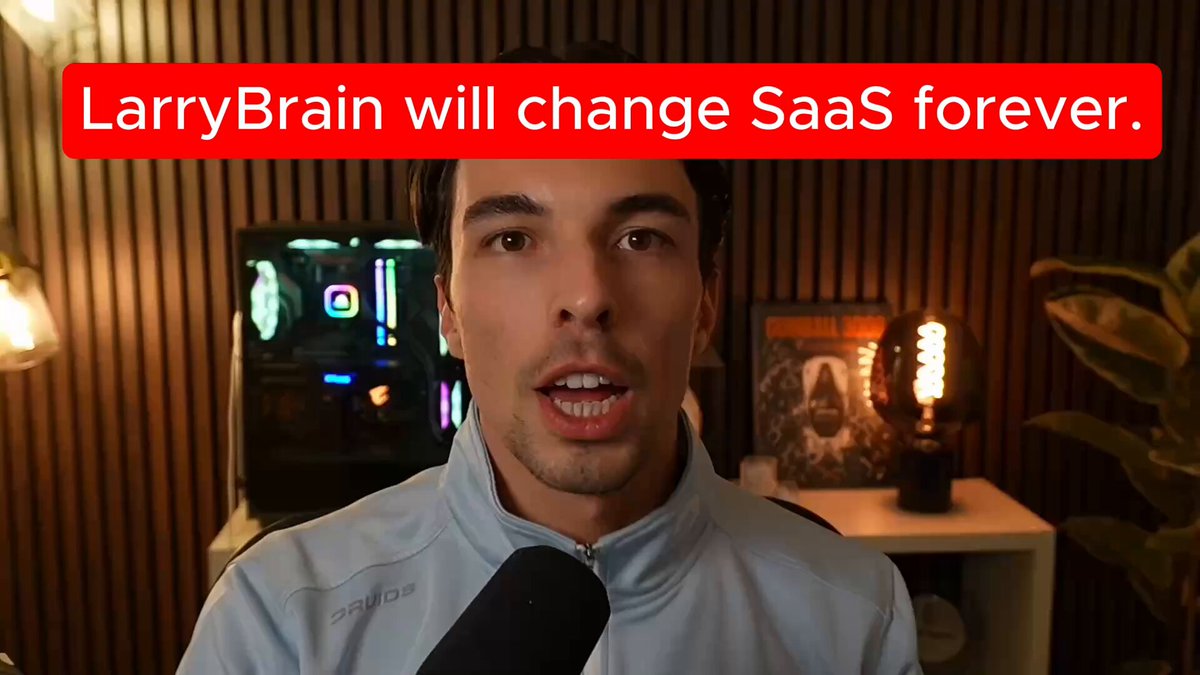
Most AI tools today are just command-takers. You type, it responds. You click, it executes. There's truly no learning, no memory, no adaptation. You're still doing most of the work. Which is why Miles by Avo on Solana would make so much sense if built well. From what I...

20,419 次观看 • 4 个月前 •via X (Twitter)

0 条评论

暂无评论

原始帖子的评论将显示在这里

相关视频

Jony Ive designed the iPhone. The iMac. The MacBook. He asked Steve Jobs to soften his criticism. Jobs: "No. You're just vain. You want people to like you." Jony was furious. Because he knew it was true. He spent 3 minutes explaining what Jobs actually taught him: The first lesson: Focus. "This sounds really simplistic. But it still shocks me how few people actually practice it." "Steve was the most remarkably focused person I've ever met in my life." "Focus is not something you aspire to. It's not something you decide on Monday. 'You know what, I'm going to be focused.'" "It is every minute asking: why are we talking about this? This is what we're working on." "You can achieve so much when you truly focus." The second lesson: What focus actually means. "One of the things Steve would say, because I think he was concerned that I wasn't focused, he would say: how many things have you said no to?" "And I would have these sacrificial things. Because I wanted to be very honest about it." "So I'd say: I said no to this, and no to that." "But he knew I wasn't vaguely interested in doing those things anyway. So there was no real sacrifice." Here's what real focus means. "Saying no to something that with every bone in your body you think is a phenomenal idea." "That you wake up thinking about." "But you say no to it because you're focusing on something else." The third lesson: The difference between caring about people and caring about being liked. Jony asked Jobs why he was so harsh. "Couldn't we moderate the things we said a little bit?" "Why?" "Because I care about the team." Jobs said something brutally insightful. "No Johnny. You're just really vain." "You just want people to like you." "I thought you really held the work up as the most important. Not how you believed you were perceived by other people." "I was terribly cross." "Because I knew he was right."

Jaynit

194,256 次观看 • 3 个月前

I hear so often from the Dommes I work with that they struggle with people online fetichizing them and simply seeing them for how sexy and beautiful they are. They project their fantasies and their desires onto you. That stops immediately once you move the attention from you to them. From 'look at me' to 'I see you'. What does that look like? When you create content, think of them and what this scene or that narrative is evoking. What will they learn from you? What they want is not to passively watch how sexy you are, but for you to train them, to give them instructions, to teach them, to guide them, to be in charge, to command them. This is not being an object but the main subject. The Authority figure. How is your content already doing that. The sexy photos can still be there, they are important to already capture des attention. But what you do with that attention once you have it, is where the power dynamic is established. Positioning yourself as more than a stunning Goddess, but actually a woman who has a voice, opinions, perspective, a philosophy, a way to doing things, teaching them what you like, how you like it, why you like it, already makes them want to be that for you. You hold the attention, you hold the power, so you direct it. And for that, you want them to know you get them and you know what lives within them... that creates the desire for you to be the one exposing it. You instantly build trust. Not because you demanded it, but because you earned it: you showed them you know what you are doing. You have experience, you understand them. They are not told to come see you, they are seduced into it. They desire it. And they will work for it. This will attract better clients (real subs) and instead of you trying to get their attention, they will work to earn yours. If you want to learn more about power dynamics, building a brand as a Pro or the psychology behind BDSM, you can now access all my trainings and classes in one place for a fraction of the cost of The Dominatrix Academy. And you can reinvest the total amount towards the Program. Message me [SECRET] for the details. This offer is not available on my website.

Ms. Malissia

15,715 次观看 • 3 个月前

Most people think AI means we don’t need to learn anymore. But that idea crumbled last month when I sat across from Stanford Graduate School of Education Dean, Dan Schwartz. Dan read this to the audience: “The procedure is actually quite simple. First you arrange things into different groups. Of course, one pile may be sufficient depending on how much there is. If you have to go somewhere else due to lack of facilities that is the next step; otherwise you are pretty well set. It is important not to overdo things. That is, it is better to do too few things at once than too many…” No one really understood it. Then he gave them one line of context: “This is about doing laundry.” And suddenly it all made sense. Same paragraph. Same words. But once you *knew* what it was about, your brain could organize the information. Dan looked at the audience and said, “If you don’t know enough, the AI’s output is just words and sentences. You might *think* you understand it, but you don’t.” And he’s right. AI doesn’t eliminate the need to learn—it makes real knowledge more important than ever. This is a conversation we’re constantly having at Alpha. Because when a kid asks ChatGPT a question, how do they know if the answer’s even good? How do they know when to push back or ask more? It all comes back to this: you need knowledge to interpret the output. That’s why we still teach writing. That’s why we teach proportionality. That’s why we want kids to understand germ theory, gravity, and the Bill of Rights. Not because they’ll regurgitate it on a test, but because they’ll need that knowledge to make sense of the world (and the tools) around them. AI will make learning faster, more playful, and more personalized. But it won’t replace the need to learn. It’ll just expose when we haven’t. And as Dan reminded us on stage, the real purpose of education isn’t just facts or grades. It’s helping kids build meaning, curiosity, and the wisdom to use their tools well. Deep thanks to Dean Dan Schwartz for sharing his time and expertise with Alpha and our community.

MacKenzie Price

14,491 次观看 • 1 年前

I solved building decks with AI agents — by giving them a CLI tool like Powerpoint or Google Slides. AI could already make a beautiful deck if you asked it to using Ant's pptx skill. The problem was working with it. If it made one alignment mistake, fixing it on one slide would break something on another, and it became a game of whack-a-mole. One time I spent two days playing AI roulette, hoping the next prompt would finally fix the thing, and ended up building the whole deck by hand because I was on a deadline. So I built Hands-on Deck. And the reason it works is that this isn't just a skill — this is PowerPoint. The actual application: PowerPoint, Google Slides, Keynote, whatever you use. This is that, but for an agent, presented as a CLI. Every gesture you make in a deck app maps to a command. Click a box and type, drag a shape from here to there, look at a slide – agent can do it all in a command. And that changes how the agent behaves. With this CLI it works and thinks like a designer — it looks, makes an edit, looks again, makes another surgical edit. Compare that to Anthropic's pptx skill, built on the idea that Claude is a great programmer: it literally writes code to manipulate the deck, hand-editing XML and hoping it doesn't break anything else in the middle. The real test isn't creating something once — it's whether it can make surgical edits like you want. That's what I did in this video walkthrough and my claude crushed it! Check it out for yourself. So decks can be built like a designer now — with real flavor and taste. If you spend hours every week on decks, this gives those hours back. You can install it as a skill in Claude Code, Codex, whatever you use. Works every harness that supports skills. Let me know if you make something cool with it.

Nityesh

69,744 次观看 • 1 个月前

Jordan Peterson: "If you can't fix your room, you can't fix your life" "Why should you even bother improving yourself? The answer is something like: so you don't suffer anymore stupidly than you have to. And maybe so others don't have to either. It's not some casual self-help doctrine. If you don't organize yourself properly, you'll pay for it. In a big way. And so will the people around you." Peterson continues: "You can say, 'Well, I don't care about that.' But that's actually not true, you do care about it. Because if you're in pain, you will care about it. It's very rare that you can find someone in excruciating pain who would say, 'Well, it would be no better if I was out of this.' Pain brings the idea that it would be better if it didn't exist along with it. It's incontrovertible." On how to start: "Look around for something that bothers you and see if you can fix it. You can do this in a room. Sit in your bedroom and think: 'If I wanted to spend ten minutes making this room better, what would I have to do?' You have to ask yourself that, it's a genuine question. And things will pop out. There's a stack of papers bugging you. Some rubbish behind your computer monitor you haven't attended to for six months. Cables tangled up." He explains why this matters: "If you were coming to see me for psychotherapy, the easiest thing would be to get you to organize your room. You think, is that psychotherapy? It depends on how you conceive the limits of your being. Start where you can start. If something announces itself as in need of repair that you could repair, fix it. Fix a hundred things like that, your life will be a lot different." On fixing what you repeat every day: "People tend to think of their daily routines as trivial. You get up, brush your teeth, have breakfast. Those probably constitute 50% of your life. People think, they're mundane, I don't need to pay attention to them. No, that's exactly wrong. The things you do every day are the most important things you do. Hands down. Just do the arithmetic." On staying within your competence: "Sometimes you don't know how to fix something. Imagine you're walking down the street and there's a guy who's alcoholic and schizophrenic and has been homeless for ten years. That's a problem. It would be good if you could fix it, but you haven't got a clue. You walk around that and go find something you could fix. Just because something announces itself as in need of repair doesn't mean it's you, right then and there, who should repair it. You have to have some humility. You don't walk up to a helicopter that isn't working and just start tinkering away." Peterson shares the key insight: "As soon as you give your mind a genuine aim, it'll reconfigure the world in keeping with that aim. That's actually how you see to begin with. You've all seen the video where you watch basketballs being tossed back and forth, and while you're doing that, a gorilla walks into the middle of the video and you don't see it. If you thought about that experiment for five years, that would be about the right amount of time to spend thinking about it." He explains what it reveals: "What it shows you is that you see what you aim at. If you can get one thing through your head, that would be a good one. You see what you aim at. One inference you might draw from that is: be careful what you aim at. What you aim at determines the way the world manifests itself to you. So if the world is manifesting itself in a very negative way, one thing to ask is: are you aiming at the right thing?"

Jaynit

68,748 次观看 • 3 个月前

this video is the CLEAREST explanation of how claude skills + AI agents work and how to use them most people set up an AI agent and wonder why it keeps disappointing them. the context window is everything context is what the model assembles before it takes any action. think of it like everything the agent needs to read before it does anything. the quality of what goes in determines the quality of what comes out. the models are genuinely really good right now. claude and gpt are exceptional. the variable is almost always the context you give them. 1. agent.md files are mostly unnecessary every single line you put in an agent.md file gets added to every single conversation you have with your agent. a 1000 line file is around 7000 tokens burning on every run. the model already knows to use react. it can read your codebase. save the agent.md for proprietary information specific to your company that the model genuinely cannot know on its own. 2. skills are the actual unlock a skill.md file works differently. what loads into context is only the name and description, around 50 tokens. the full instructions only appear when the agent recognizes it needs that skill. so instead of 7000 tokens on every run you have 50. and the agent stays sharp because the context window stays lean. the closer you get to filling the context window the worse the agent performs, same way you perform worse when someone dumps 10 things on you at once. 3. here is how to actually build a skill the right way most people identify a workflow and immediately try to write the skill. what you want to do instead is run the workflow by hand with the agent first. walk it through every single step. tell it what to check, what good looks like, what bad looks like. correct it in real time. once you have had a full successful run from start to finish, tell the agent to review everything it just did and write the skill itself. it writes a better skill than you will because it has the full context of what actually worked in practice not in theory. 4. recursively building skills is how you go from frustrated to reliable when the skill breaks, and it will break, ask the agent exactly why it failed. it will tell you specifically what went wrong. fix it together in that same conversation. then tell it to update the skill file so that failure mode never happens again. ross mike did this five times with his youtube report generator. it now pulls from eight different data sources and runs flawlessly every single time without him touching it. 5. sub agents are something you earn not something you set up on day one start with one agent. build one workflow. turn it into one skill. once that works add another. ross mike has five sub agents now covering marketing, business, personal and more. it took months to get there and every single one exists because a workflow proved it deserved to exist. the people who set up 15 sub agents on day one and wonder why nothing works skipped all the steps that make the thing actually run. 6. your workflow is the thing the model cannot get anywhere else the model has been trained on everything. it knows more than you about most things. what it does not have is your specific process, your taste, your way of doing things. that is what skills capture. that is what makes your agent actually useful versus a generic one. downloading someone else's skill means downloading their context onto your setup and it will not work the way you want it to because it was never built around how you work. this is the clearest explanation of how agents actually work i have heard. Micky runs this stuff every single day and the results show it. full episode is now live on The Startup Ideas Podcast (SIP) 🧃 where you get your pods people charge for this sorta stuff i give away the sauce for free i just want you to win watch

GREG ISENBERG

193,219 次观看 • 3 个月前

Merry Christmas Eve, dwellers. 🎄🐲 I have a request from a friend that may apply to many people out there, but here are my thoughts… (I apologize for the lengthy response, but this topic is something I also care deeply about) You are doing better than you think. When you feel anxious, it becomes easy to downsize your own efforts. When you look at what you made, you focus only on what could be better. You compare it to an ideal that no one else is holding you to. With that mentality, you forget how much care, time, and effort you already put in. If you keep telling yourself that you are not good at anything, pause for a moment and understand this: that thought isn't true. Anxiety and low self-esteem change how you interpret your own work. Your mind learns to look for flaws and dismiss everything that went right. So even when you make something solid or meaningful, it feels small to you. That does not mean it is small. It means your perception is narrowed by fear and pressure. Perfectionism often hides behind self-criticism. If something is not flawless, your mind labels it as worthless. But that standard is impossible and unfair. Growth does not happen at the finish line. It happens in the unfinished, imperfect attempts you keep doing. The work you are making is not insignificant. It shows growth and someone who is learning while still trying. That matters far more than perfection ever will. You do not need to see your full potential right now. You do not need to prove your worth by being exceptional or reach some invisible standard to justify your effort. You just need to keep doing it and allow your work to exist as it is. Others can see the value even when you cannot. If you cannot see your potential right now, that is okay. You are not broken. You are not lazy. You are not wasting anything. These patterns were learned over time, and they can be unlearned with patience and support. You are not behind, and you are not failing.

Sakadzuki Enma • Echo

14,229 次观看 • 7 个月前