Video yükleniyor...

Video Yüklenemedi

Ana Sayfaya Dön

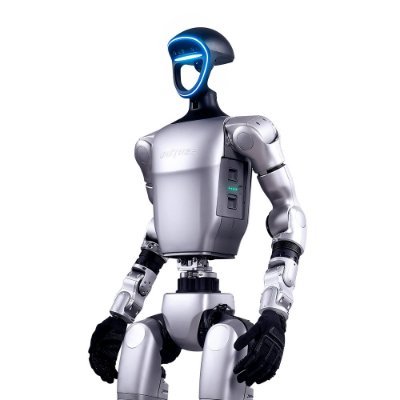
Movement creates intelligence - Unitree's G1 humanoid robot nails the world's first kip-up!😘 This fresh, newly captured video from Unitree's testing grounds showcases the breakneck speed of humanoid intelligence advancement. Every day brings something thrilling! #Unitree #Combat #TaiChi #MartialArts #KungFu #SpringFestivalGalaRobot #ArtificialIntelligence #HumanoidRobot
7,679,872 görüntüleme • 1 yıl önce •via X (Twitter)

11 Yorum

maru profil fotoğrafı
maru1 yıl önce

It's already way better than Boston dynamics robots

FRANK E ELKINS profil fotoğrafı
FRANK E ELKINS2 yıl önce

Unlock the secrets of Consciousness! 🔑 Book V explores Perception, Awareness & Artificial Intelligence. Subscribe now to our FREE Weekly Newsletter and explore Reality one week at a time!

Bones profil fotoğrafı
Bones1 yıl önce

The pace in humanoid robotic movement is stunning. A year ago these humanoid robots would not have been able to stand up after falling down. I so want one!

尚月 profil fotoğrafı
尚月1 yıl önce

@42Cup

義德臺仰 profil fotoğrafı
義德臺仰1 yıl önce

Love to see all these robot companies keep showing off their work. Keep it up.

Vincent Bounce🦾🔑 profil fotoğrafı
Vincent Bounce🦾🔑1 yıl önce

She was afraid when G1 rushed at her at the end :)

carbonat profil fotoğrafı
carbonat1 yıl önce

What this company makes is really impressive!Others say this is not really important compared with manipulative skills, but that's wrong. This must be a part of a great humanoid robot product

Borg King profil fotoğrafı
Borg King1 yıl önce

Unitree, I am headed to Beijing this Saturday. Where can I see your robots? Any by Chaoyang or at Joy City shopping mall?

Tanvi profil fotoğrafı
Tanvi1 yıl önce

🤯looks like, every one is just playing for second

MocroMoon🇲🇦 profil fotoğrafı
MocroMoon🇲🇦1 yıl önce

Can you avoid heavy dramatic music on your next marketing videos? It descredits your work.

Kou profil fotoğrafı
Kou1 yıl önce

This one is way more sturdier than a certain company one

Benzer Videolar

Beijing hosts world’s first humanoid robot games | Ariana News The world’s inaugural humanoid robot competition is underway in Beijing, drawing more than 500 robots from 280 teams across 16 countries to compete in a uniquely futuristic sporting spectacle. The three-day event, held at the National Speed Skating Oval—once the “Ice Ribbon” of the 2022 Winter Olympics—kicked off on August 15 and runs through to Sunday August 17. The tournament features 26 events spread across athletic, performance, and scenario-based categories. Athletic challenges include sprinting, soccer, and kickboxing, while performance segments showcase robot dance routines and musical instrument displays. Real-world scenarios, such as medication sorting, cleaning tasks, and industrial material handling, are also on the agenda to test practical functionality. Organizers meanwhile emphasize the event’s role in accelerating the integration of humanoid robots into everyday life, from manufacturing and hospitality to healthcare. One Chinese official summed it up: “Every robot that participates is creating history.” The competition has yielded both triumphant strides and technical stumbling blocks. In running events, the robot H1 from Unitree Robotics claimed top honors in the 1,500-meter race, demonstrating promising agility. Yet, many robots struggled with balance, coordination, and task execution, including some collapsing mid-sprint or requiring human help to stand—underscoring the still-developing nature of embodied artificial intelligence.

Owen Gregorian

43,158 görüntüleme • 1 yıl önce

i don't think people realize what's happening in Chinese robotics. this one manufacturer might be the most impressive AND most concerning company on Earth right now let me explain... Unitree Robotics sells a humanoid robot for $5,900. their robot dog costs $1,600 (Boston Dynamics charges $74,500 for theirs for context). you can literally buy these on Amazon today. so obviously the first question is: how is that even possible? the answer starts with a guy who couldn't pass his English exam. Wang Xingxing grew up in Zhejiang province. for his master's thesis, he decided to build a quadruped robot. budget: about $3,000. for context, $3,000 for this kinda robot is nothing. off-the-shelf servo motors alone would've eaten that twice over. so Wang did the only thing he could: he designed and machined every single component himself. motors, joints, controllers, the frame. all of it. the resulting robot was janky and imperfect. but it worked. and the video went viral globally. after graduating he joined DJI. but he quit after two months, and this is 2016, when DJI was arguably the hottest hardware company in China. walking away from that with no money to start a robotics company is a... specific kind of stubborn. he launches Unitree with $280K from a single angel investor. tiny office in Hangzhou. 50 square meters. but the money runs out fast. he can't make payroll for three years. the company almost dies in 2017. but emergency government funding arrives with days to spare. he survives, barely, and keeps building. this is where it gets really fascinating IMO. this founding constraint, building everything yourself because you literally cannot afford to buy parts, never went away. even after funding rounds started landing. even after revenue kicked in. it just became the company's permanent DNA. Unitree now manufactures 90%+ of its core components in-house. motors, reducers, controllers, encoders, LiDAR, etc the founder's $3,000 robot thesis ended up being an architectural decision that turned out to be structurally superior. think about what that means in practice. Boston Dynamics needs a better motor? they negotiate with a supplier, wait on lead times, qualify the part. but when Unitree needs one, they design theirs internally and have a new version in production within weeks. that gap compounds every cycle. Unitree shipped three separate humanoid platforms in 18 months. Figure AI has shipped one. Tesla has shipped zero commercially. the results are getting hard to dismiss. 23,700 robot dogs shipped in 2024 (roughly 70% of the entire global market). 7,000+ humanoids deployed. over 600 industrial sites running their quadrupeds. $140M+ revenue, profitable every year since 2020. for perspective: no Western humanoid competitor is profitable. not one. OK. now here's where the "most concerning" part of this starts... if you watched the DJI story unfold, you already recognize the shape. affordable Chinese hardware quietly saturates global markets. years later, the national security questions arrive, after the install base is already massive. drones, then EVs, then AI. now robots. Unitree is running this exact playbook in real time. in April 2025, researchers found an undocumented backdoor in their Go1 robot. a remote tunnel letting anyone control the robot and stream its camera feed. default password: pi/123. 1,919 vulnerable units exposed globally. including machines at MIT, Princeton, and Carnegie Mellon. but it gets worse. every Unitree robot shares the same hardcoded encryption key. encrypt the word "unitree" and you get root access to any of them. one compromised robot can spread to every Unitree robot in Bluetooth range automatically. a literal robot botnet. the G1 quietly transmits sensor data to Chinese servers every five minutes. audio, video, GPS, LiDAR spatial mapping, with no notification, no consent, no opt-out. PLA footage has shown Go2 robots with mounted weapons. Ukrainian forces literally deployed weaponized units on the actual frontline. and every member of the bipartisan House China Committee signed a letter calling for Unitree's military company designation. Wang signed a 2022 pledge alongside Boston Dynamics not to weaponize robots. but pledges don't survive contact with shipping hardware to open markets. and under China's 2025 rules restricting military-related speech, Unitree couldn't publicly confirm PLA use even if they wanted to. 50,000+ of these robots are now deployed globally. some at institutions that probably should've asked harder questions before connecting them to their networks. the security stuff is real and people should know about it. but i also think it's important not to let that overshadow what's actually been built here. a 35-year-old who failed his English exam created a robotics company that's outshipping and outpricing every Western competitor while being the only profitable humanoid maker on Earth. most impressive and most concerning company in the world right now.

Ole Lehmann

123,024 görüntüleme • 6 ay önce

Not a preplanned motion sequence. A robot deciding mid-jump what to do next. [📍 paper + demo] Researchers just showed a humanoid doing real parkour using only onboard perception. No motion script, no fixed obstacle layout. The system is called Perceptive Humanoid Parkour (PHP). Instead of memorizing a path, the robot reads depth from its cameras and continuously chooses actions. Step, vault, climb, or roll depending on what geometry appears in front of it. To make that possible, they combine three ideas: First, they stitch together human motion clips into long movement references so the robot learns fluid transitions instead of isolated tricks. Second, they train tracking policies with reinforcement learning so contacts land at the right time and the robot keeps balance during dynamic moves. Finally, everything is distilled into one perception policy that runs directly from depth input to action selection. The result on a Unitree G1: about 3 m/s vaults wall climbs up to 1.25 m nearly one minute continuous obstacle traversal adapting when obstacles move What matters is not the tricks. It is the shift in capability. Earlier humanoids executed motions. This one navigates situations. Once robots react to geometry instead of replaying trajectories, environments stop needing to be predictable. Warehouses, homes, and outdoors suddenly become the same problem. Thanks for sharing, Zhen Wu! Paper + demo: ——— Weekly robotics and AI insights. Subscribe free:

Ilir Aliu

22,127 görüntüleme • 7 ay önce

New framework: Kick down your robot, it will get back up every time 🥋 Chinese startup RoboParty is a Beijing startup founded April 2025 by Huang Yi, originally shipping ROBOTO ORIGIN, the world's first full-stack open-source bipedal humanoid. They released UFO: Unsupervised Reinforcement Learning Framework for Humanoid Control. DEFINITIONS -> what differs is where the learning signal comes from: - SUPERVISED: humans supply the right answers (labels), the model imitates them. - UNSUPERVISED: no answer key, the model finds structure in raw data on its own. - REINFORCEMENT LEARNING: no answer key either, the model tries things and a reward scores each attempt. → UNSUPERVISED RL: trial and error where the agent invents its own rewards, instead of engineers hand-writing one per task. REPRESENTATION LEARNING: compress raw states into a useful internal map. TEMPORAL DISTANCE: distance on that map is "how many steps from A to B." CONTRASTIVE: trained by pulling together what's close in time, pushing apart what isn't. -> CONTRASTIVE TEMPORAL-DISTANCE REPRESENTATION LEARNING: the model builds an internal map of body states where distance means how many steps it takes to get from one to another. It is trained by contrast: states that occur close together in a movement get pulled together in the map, randomly paired states get pushed apart. UFO is an open-source training framework that teaches humanoid robots skills, like getting up, walking, goal-reaching, teleoperation, without reference motions -> no motion-capture or human-video demonstrations to imitate. Its core is TeCH, a contrastive temporal-distance representation-learning algorithm: the robot explores, builds pseudo-goals by temporal rolling, and learns goal-conditioned policies from a single unified progress reward. One framework trains five different robots (Unitree G1/H1, RoboParty RP0/RP1, AgiBot X2) with automatic config conversion in ~2–3 hours per robot! The real novelty here "no demonstrations at all". No data-collection arms race,the dominant humanoid-locomotion recipe is tracking: imitate mocap/retargeted-human reference trajectories. The robot self-generates goals from its own exploration and learns from a progress reward, needing zero reference motion data. Everybody else is fighting over data acquisition, while this team just teleports out of the race entirely (inb4 "competition is for losers 💀 ). This strategy reminds me of the DeepSeek playbook applied to robots: open-source the whole stack to become the global default and commoditize everyone else. RoboParty is giving away hardware and now control software (UFO) to be the Android of humanoids. Yet another reason for the US to ban Chinese open models perhaps 🥶 ? What I also really like about this approach is the cross-embodiment infrastructure, one framework trains Unitree G1/H1, RoboParty RP0/RP1, and AgiBot X2 with automatic configuration conversion. Just like Physical Intelligence, RoboParty seems to place itself as a neutral hardware agnostic middle man. Also woth mentioning: their ability ot perform stable skill injection, e.g. adding a cartwheel without forgetting how to walk. A common failure of RL humanoid policies is that teaching a new agile skill destabilizes the existing ones (catastrophic forgetting). UFO claims you can inject rare motions (cartwheel) without collapsing learned behavior. If it holds, that's a significant incremental/continual skill-learning! But again, I have to underline it: no arXiv, no external validation, no success-rate numbers. -> robotics badely needs an independent unbiased evaluator imho. Still, look at that cool demo: robot is getting kicked and pushed around (serious disturbance) during teleoperation (controlled the person at the back wearing the VR headset), and still managed to always get back up. This is some serious demonstration of stability and robustness!

Léo

36,112 görüntüleme • 1 ay önce

this is the world's first ever humanoid robot that will summit Mt. Everest it's named Pemba, and two days ago it reached the top of Chimborazo, a 20,000-foot peak in Ecuador, completely on its own (no remote or operator). and the robot itself is nothing special. Pemba is a Unitree G1, the same ~$14k robot anyone can buy online right now. the guy behind it, Pablo Berlanga, is doing this to send robots into the places that kill people. think about how you'd check on a melting glacier or a deadly crevasse out in the middle of nowhere today. you either send a person who might not come back, or you skip it and learn nothing. so Berlanga wants a robot that walks in on its own, carries a few pounds of gear, and brings back footage from places no human can safely reach. i think eventually they'll even be used for robot rescue missions to reach people stranded in disasters and dangerous situations from here, the plan for Pemba is Mauna Kea in Hawaii, then Everest. Everest is the tricky one. the team wanted to send Pemba up this spring to start hauling trash off the mountain and tracking its glaciers (something Nepal genuinely needs help with) but the Nepalese government told them to wait. there's no law in Nepal for a climber that isn't human, so the rules have to get written before a robot can set foot on the mountain. kind of incredible that the machine is ready for Everest a full year before anyone's decided whether it's allowed to be up there

Ole Lehmann

34,120 görüntüleme • 3 ay önce

In just one week, Binh and I trained a full-body Unitree G1. Here's a recap: 1. Secured a Unitree G1 humanoid through a LinkedIn post 2. Deployed TWIST2 full-body teleoperation pipelines 3. Adapted TWIST2 for Zed stereo camera & collected full-body teleoperation samples (carried by Binh ) 4. Adapted & fine-tuned NVIDIA Gr00T N1.5 VLA on the TWIST2 public datasets, which I fine-tuned on an 8xNVIDIA H100 Cluster. We picked Gr00T N1.5 as it was trained with Unitree G1 embodiment data. 5. Adapted the TWIST2 codebase to stream in the actions from Gr00T via ZMQ using a co-located NVIDIA H100 for ~200ms inference latency 6. Tested the model in sim, then deployed to the real-world Unitree G1. We streamed a training sample observation to the VLA (as we didn't want to break robot in case real observations were OOD) We were the first team in the world to deploy the full TWIST2 data collection pipeline to the unitree g1 :) Much more work ahead though, which I'll work on as a side-project over the next months: 1. Exploring the various types of 'world models': video backbones, dynamics models, v-jepa-2 models. I believe these will generalize better & train much more data-efficiently than VLM backbones 2. Speeding up inference - I believe low-latency robotics inference will be a big challenge. There are many works in video diffusion which I'd like to test (e.g. SageAttention, SparseAttention, Drifting Models). Perhaps also writing custom CUDA kernels. 3. Economics of inference scaling :) What will be the compute demands as we scale inference up to millions of humanoids? Will it run on edge or on distributed 'co-located' inference clusters? These are questions I'd like to answer. Adapted TWIST2 codebase: Adapted Gr00T-N1.5 codebase: The ETH Robotics Club are doing a cool GTC Golden ticket competition with NVIDIA , so this is my submission :) The DGX Spark compute will get me a long way with initial prototyping & especially working on inference optimization for next-gen Blackwell GPUs #NVIDIAGTC #GOLDENTICKET #ETHRC

Arnie Ramesh

23,236 görüntüleme • 7 ay önce

Jensen Huang just described how he plans to outlive his own body. Huang: “Very soon, I’m going to put a humanoid on a spaceship. And it’s going to be my humanoid.” His robot. His frame. Launched into deep space while he is still breathing. Huang: “Take all my inbox, take everything that I’ve done, everything I’ve said. It’s been collecting and becoming my AI. When the time comes, we’ll just send that at the speed of light, catch up with my robot.” Your body fails. Your data does not. Every email. Every decision. Every conversation. Recorded. Compressed. Compiled into a model that thinks the way you think. And when the biology gives out, that model launches at light speed to meet a titanium frame already cruising through the void. You do not die. You transfer. Sounds like fiction. Then he put a number on it. Huang: “Understanding the biological machine is not 10 years. It’s five years probably.” Five years to decode the human body the way we decoded software. Not treat disease. Decode it. Understand the entire machine well enough to patch it like a bug. Cancer is a bug. Alzheimer’s is a bug. Aging itself is a bug. And the compute to find the fix doubles every year. Huang: “It’s a reasonable thing to expect the end of disease.” He did not say hope for. He said expect. The man whose chips power nearly every AI system on Earth just told you the end of disease is not a dream. It is a scheduling problem. Huang: “It’s a reasonable thing to expect that pollution will be drastically reduced. It’s a reasonable thing to expect that traveling at the speed of light is actually in our future.” He listed these the way someone else lists quarterly targets. Items on a roadmap. Waiting on execution. But here is the part most people will skip past. And it might be the most important thing he said. Huang: “I’ve always had a great confidence in the kindness, the generosity, the compassion, the human capacity.” This is the man building the most powerful computing infrastructure ever constructed. The man whose hardware will power the intelligence that reshapes every industry, every government, every border on Earth. And his operating principle is not paranoia. It is trust. Huang: “Sometimes more so than I should. And I get taken advantage of. But it doesn’t ever cause me not to.” He has been burned. He kept trusting anyway. Not naivety. Evidence. Huang: “Vastly I am proven right. Constantly proven right. And often exceeds my expectations.” The doomers build everything on one assumption. Power corrupts. Humans weaponize every tool they touch. Huang has spent thirty years handing the most powerful technology in history to thousands of companies, researchers, and governments. His conclusion is the opposite. People want to do good. Give them the tools and they prove it. That is not soft. That is thirty years of data from the dead center of the compute revolution. Fridman: “What an exciting time to be alive.” Huang: “How can you not be romantic about that?” Romantic. Not optimistic. Not bullish. Romantic. Optimism is a prediction. Romance is what happens when you look at what is coming and it hits you somewhere deeper than logic. The end of disease. Consciousness uploaded. A robot carrying your mind past the rings of Saturn. Underneath all of it, a belief that the species wielding these tools is fundamentally good. That is what separates Huang from every other voice in this space. The fearful see AI and ask what could go wrong. Huang sees AI and asks how much suffering can we end. He is not dreaming out loud. He is reading the trendline and telling you exactly where it lands. Five years for biology. A lifetime for consciousness. And past that, a humanoid with your mind aboard, sailing through space at the speed of light. Built by a man who still believes in people. The cynics will laugh. They always do. Right up until the moment it ships.

Dustin

282,792 görüntüleme • 5 ay önce

Ex Machina is no longer sci-fi. China has finally built it. The company is AheadForm, founded in Shanghai. The product is the world's most hyper-realistic robotic face. Silicone skin you can't tell from human, 25 micro motors hidden underneath pulling the face into real expressions. And RGB cameras embedded inside the pupils so when it looks at you, it actually sees you from where its eyes are. They raised $28.5M to "give AI a head," which is also where the name comes from. AheadForm = a head form. This is the opposite of where everyone else in robotics is focused. Unitree, Figure, Tesla, Boston Dynamics: all about the body. AheadForm chose the face because they think trust is the harder problem to solve, and trust gets decided at the face. The reason nobody else has tried this is the "uncanny valley." It's the creepy zone where a robot looks almost human but not quite, and looking at it just feels wrong even when you can't say why. Most roboticists believed no amount of engineering could make a face realistic enough to escape it. So they gave up and kept robots cartoonish on purpose: big anime eyes, exaggerated features, clearly synthetic. But AheadForm decided to treat it as an engineering bug instead. Add enough motors, tune the silicone, fix the timing, the valley closes. And they're pulling it off. A few crazy details about how this actually works: 1. The robot learns its own face in a mirror. You put it in front of a camera, let it fire every motor randomly, and it watches what its face does and builds an internal map of "if I send command X to motor Y, my eyebrow does this." Same exact process a human baby uses staring into a mirror. The robot teaches itself who it is by experimenting. 2. It predicts your smile 839 milliseconds before you smile. By watching the micro-tells in your face that precede a smile, the robot starts smiling 0.8 seconds ahead, so its smile lands at the same moment yours does. Most robot mimicry happens half a second late, which is exactly why it always feels artificial. 3. The pupils are the cameras. When the robot makes eye contact, the gaze and the sensor are the same physical thing. Most humanoid robots stick the camera on the forehead or chest, so they aren't actually looking at you when their eyes are pointed at you. 4. The founder, Yuhang Hu, did his PhD at Columbia under Hod Lipson. Lipson is the guy who in 2006 built a four-legged robot that figured out it had four legs by experimenting with its own movement, nobody told it the body shape, it discovered it. He has spent 25 years trying to build machines that know what they are. AheadForm is that 25-year research arc productized. 5. NetEase Games already paid them to physically embody a fantasy video game character. That opens up a brand-new category: robotics as the physical embodiment of fictional IP. Every character-rich studio, Disney, Riot, Hoyoverse, Pokemon, Netflix, now has a question to answer about when their characters get bodies. AheadForm believes whoever ships the first robot you'd actually want around your family wins. That's the bet behind the most realistic robot face on earth.

Ole Lehmann

537,852 görüntüleme • 4 ay önce

Elon Musk just said on camera that America CANNOT beat China with humans alone. His exact words: "We definitely can't win on the human front." This is the richest man on the planet. Advisor to the president. And he's saying the US is cooked without robots. Here's why he's probably right: China is about to hit 3x the total US electricity output. Elon says electricity is a direct proxy for industrial capacity. Three times the electricity means roughly three times the manufacturing power. They have 4x the population. And Elon said something that'll piss a lot of people off: "The average work ethic in China is higher than in the US." America's birth rate has been below replacement since 1971. More people retiring every year. Fewer entering the workforce. No amount of policy, tariffs, or reshoring fixes that math. His solution: Optimus. He literally called it "the infinite money glitch." Because you can use robots to build more robots. Here's what makes this different from every other robotics play: 3 things are hard about humanoid robots. 1. Real-world AI 2. The hand 3. Scale manufacturing And the hand is harder than EVERYTHING else combined. Tesla had to custom design every single actuator, motor, gear, sensor, and control system from physics first principles. There is no supply chain. Nothing comes from a catalog. Not a single component. But they've solved it. Optimus has full human-hand dexterity with all degrees of freedom. No other company has demonstrated this. Not even in demos. Then you layer on what Elon described as a "recursive multiplicative exponential": Exponential growth in digital intelligence. Multiplied by exponential growth in chip capability. Multiplied by exponential growth in electromechanical dexterity. And then the robots start building robots. He's targeting 1 million Optimus units per year at Gen 3. Ten million at Gen 4. The first use case? Any operation that runs 24/7. Factories, warehouses, refineries, every continuous operation on the planet. Robots don't sleep, don't overheat, don't quit. And here's the part that should terrify every other country: America can't build enough ore refineries because Americans don't want refining jobs. China does 2x more ore refining than the rest of the world COMBINED. They dominate rare earths. The US literally mines rare earth ore, puts it on a train, ships it to CHINA for refining, then ships the finished product back. Optimus wants to fix that. Not by convincing Americans to take refining jobs but by making humans optional in the process entirely. And Elon also said something else that went completely under the radar: "Pure AI, pure robotics corporations will FAR outperform any corporations that have humans in the loop." He compared it to spreadsheets replacing human computers. Entire skyscrapers used to be filled with humans doing calculations. A laptop replaced all of them. Now imagine replacing some cells in your spreadsheet with humans again. It would be WORSE. That's his prediction for the future of corporations. Mixed human-AI companies lose to pure AI-robotics companies. Not by a little. By orders of magnitude. The race isn't AI models anymore. It's not chatbots or benchmarks or who scores higher on some test. The race is physical. Whoever builds the robot army first wins the entire global economy. China has the workers. The factories. The electricity. The refining. The supply chains. America has one card left to play... And it's a 5'11" humanoid robot that Elon calls the infinite money glitch. This is either the move that saves American manufacturing. Or the most disastrous science project in history.

Ricardo

49,857 görüntüleme • 7 ay önce

One question that's been on my mind for years now is: could we use regular multimodal LLMs not necessarily trained for robotics to do the high level robotics intelligence part that VLAs and WAMs attempt to do? The latest explosion of powerful opensource multi-modal LLMs has, IMO, begun to make this possible due both to intelligence and speed. This is GLM 5.3 Flash, which has vision understanding, but isn't meant to be a VLA/VLM/WAM/robotics model at all, controlling an XGO mini wheeled robot quadruped with an arm & gripper. GLM 5.3F simply has access to the robot's high level SDK for controlling movement, arm joints, open/close gripper...etc. It analyzes the frames from the camera and makes adjustments all on its own to solve the task. Nothing was trained here, nothing fine-tuned for this task. Z AI did not make this model for robots and tbh I think they're surprised this works when I talk to them about it! This also works quite well with DSV4F + a vision capable model like Qwen 3.8 27B. I havent tried JUST Qwen 3.8 27B, but I'm sure it works too. I like the "logic" to be a model that's as fast as possible (but still intelligent). There's also an experimental vision version of DSV4F, I'm confident that'll work too and might even be better bc the full loop might be the fastest of all with this model. An obvious question you might wonder is: well why not use VLA or VLM? The hard part about robotics isn't object detection, that's long solved. This also isn't a solution for gait/locomotion...yet, but I actually don't think this is far away either and I've done some experimentation with LLMs in this space in the past and it does show promise. It might actually already be here for quadrupeds, since you dont need super fast IMU readings to maintain balance. I've also tried many of the larger, more generalist, VLAs that you should be able to use with popular robots and tbh there are just so many edge cases that make things hard and not work. You gotta get the camera, lighting, task, everything *just right* or the demo fails. This is for the actual hard part in robotics right now: intelligence, logic, and planning for all the ways the real world just simply isn't perfect. I've trained VLAs. They're super finicky and you're always running into sim2real issues, especially around the camera. You also have to build the whole training pipeline in a simulator, and, if everything does work, you still just have a robot that does this 1 single thing after weeks of work. If you use teleop, this overcomes the "2real" problem, but now you need to painstakingly collect teleop data, and it's only good at that specific task and that particular robot. There is a growing set of egocentric training data for "general purpose" VLAs and world action models (for humanoid form factors), but I'm really starting to wonder: Why? I think we might just sidestep this whole area of research entirely. I didn't need any training data or special environment to work with this quadruped and arm to do the task I was after. This particular quadruped and arm doesn't even exist in the wild yet really, it's a demo build from a company launching it on kickstarter, so it's not like this robot's data exists in the LLM to any real extent. I think this is cool as heck that this works and I am interested to see just how far I can push it. Also this marks the first time that I've finally got a generalist solution to a task I've been trying to solve ever since I became a dad of twins: pick up toys off the ground. This is a big day!

Harrison Kinsley

53,429 görüntüleme • 16 gün önce

AG1 Residency Program is a 10-week residency in Tokyo where founders from around the world live together, build together, and focus intensely on creating great products. Applications for Batch 3 are now open! Every batch, AG1 brings founders to Tokyo from across the world, including the US, China, Korea, and many other countries. For Batch 3, there is one type of founder we’re particularly excited to meet: Founders using AI not just to build better software, but to build new infrastructure and products that make AI accessible to ordinary people. We believe the next wave of AI will not only be about better models. It will be about turning intelligence into something people can actually use in their everyday lives, across work, commerce, education, entertainment, and the physical world. And we think Japan is one of the most interesting places in the world to build this: Japan is one of the world’s most advanced economies, yet many parts of society remain surprisingly under-digitized. There is still a huge gap between what technology can do and what people actually use every day. That gap creates an unusually fertile environment for founders: strong infrastructure, sophisticated consumers, large incumbent industries, and countless workflows that AI can fundamentally reinvent. If you want to build products that bring AI out of the lab and into the real world, we want you at AG1. It’s a rare opportunity to spend 10 weeks in Tokyo living and building side by side with ambitious founders from all over the world. And most importantly, check out the new AG1 video we just made! Applications and shares are very much appreciated 👇

Luke LI@Asu Capital Partners--e/acc

71,194 görüntüleme • 21 gün önce

An Air Force whistleblower alleged the US military found a 1,100-pound giant in Afghanistan. This may be one of the most highly classified secrets—ever. In 2005, a military unit vanished. Without a trace. A second unit went searching for them. What they saw will shock you: “They were all dead.” “And this gigantic humanoid was eating one of them … ” This is the story of the Kandahar Giant: Timothy Alberino: “I used to work with Steve Quayle.” “His primary area of research was biblical giants.” “Steve was contacted by an elderly woman who told him that her son had a story that he needed to hear.” “We flew him out to Bozeman, Montana and we interviewed him.” “He showed us his CV, his credentials.” “He was active duty.” “He was C-130 cargo pilot.” “He would fly missions into Bagram Airfield in Afghanistan.” “He would describe these missions as classified, and he would often be called in to pick up high-value assets.” “One day, he’s flying in there, he said in 2005 … he deplanes with his crew and they’re met on the tarmac by individuals he described as the babysitters.” “He thinks that these are Air Force intelligence or Army intelligence.” “And they said: this never happened, no pictures, don’t ever talk about it.” “He sees a forklift bringing over a huge crate, an air cargo pallet.” “And there’s something on it.” “He said the first thing that hit him was the odor.” “It was this pungent odor of like BO and death.” “As they put this thing down … he realized that the tarp wasn’t covering the whole thing.” “You could see part of its head, you could see its hands and its feet hanging off the pallet.” “He said that the hair of this being was red.” “The skin was pale white.” “He said it had six fingers on each hand and six toes on each foot.” “He said he and the guys that were standing around the body were taking their boots and putting it up to the foot, and he said it was 2-3 times bigger than everybody’s boot.” “And he said this thing was solid as a rock.” Jesse Michels: “How tall?” Alberino: “The pallet was 9 feet, and he’s in the fetal position, so they estimated … 10-12 feet tall.” “They weighed this being.” “1,100 pounds.” “He was asking … where’d you guys get this thing?” “They told him that they had heard … a group of guys got lost … doing recon or something.” “They weren’t reporting back in.” “So they sent out another team to look for that first team.” “When that second team found them … they were all dead.” “And this gigantic humanoid was eating one of them.” “[The second team] was able to kill it.” “Maybe that was just a rumor.” “Either way, the giant was airlifted from the Kandahar region and deposited at Bagram.” “He loaded the giant onto the aircraft, and then they transferred it to a base in Qatar.” “And that’s where his interaction with this being ends.” “He told me he heard through the grapevine, I don’t know if this is true … that the giant ended up at Wright-Patterson.” Timothy Alberino Jesse Michels American Alchemy

Holden Culotta

25,653 görüntüleme • 5 ay önce

Mark Zuckerberg just gave away the real business model of the next decade. It isn’t computing. It’s loneliness. Zuckerberg: “The average person would like to have 10 friends, and they have two, right? Or three. And there’s just more demand to socialize than what people are able to do given the current construct.” The CEO of the largest social network ever built just told you the construct is broken. He built half of it. Now he’s selling the repair. Every platform shift in modern history has quietly repriced a human need. The phone repriced attention. The feed repriced validation. The glasses reprice presence itself. Zuckerberg: “This is probably going to be the next major platform after phones.” Ten years of miniaturization. Full holograms. Wide field of view. Not a headset. Glasses. Something you wear the way you wear your face. Every winning platform disappeared into daily life. The phone won because it fit in your pocket. Glasses win if they fit into who you are. Then comes the layer nobody else has. An AI that sees what you see. Hears what you hear. Not a map overlay. Not a floating notification. A second mind sitting behind your eyes. Building context around every person in front of you, every room you walk into, every silence you’d otherwise sit in alone. Zuckerberg: “It’s this feeling of presence, and this capability of really personalized intelligence that can help you.” Presence and intelligence. The two things human beings have always needed from each other and could never reliably provide. That’s the whole pitch. That’s the whole company. The loneliness data has been stacking for thirty years. People are more connected and more isolated at the same time. That isn’t a contradiction. That’s what connection without presence produces. You can text someone every day and still feel like they’re gone. The phone solved distance. It didn’t solve absence. Video calls solved visibility. They didn’t solve the room. There’s a gap between being reachable and being there. Every platform of the last twenty years has lived inside that gap and called it enough. Zuckerberg is the first person with the capital, the hardware, and the AI to close it. Or to simulate closing it so convincingly that nobody checks. That’s the part that should keep you up. Because if a pair of glasses can make an empty room feel full, most people won’t go looking for the real thing. They’ll just put the glasses back on. The feed taught a generation to trade community for dopamine. The glasses will teach the next one to stop noticing the difference.

Dustin

20,864 görüntüleme • 5 ay önce