Loading video...

Video Failed to Load

Go Home

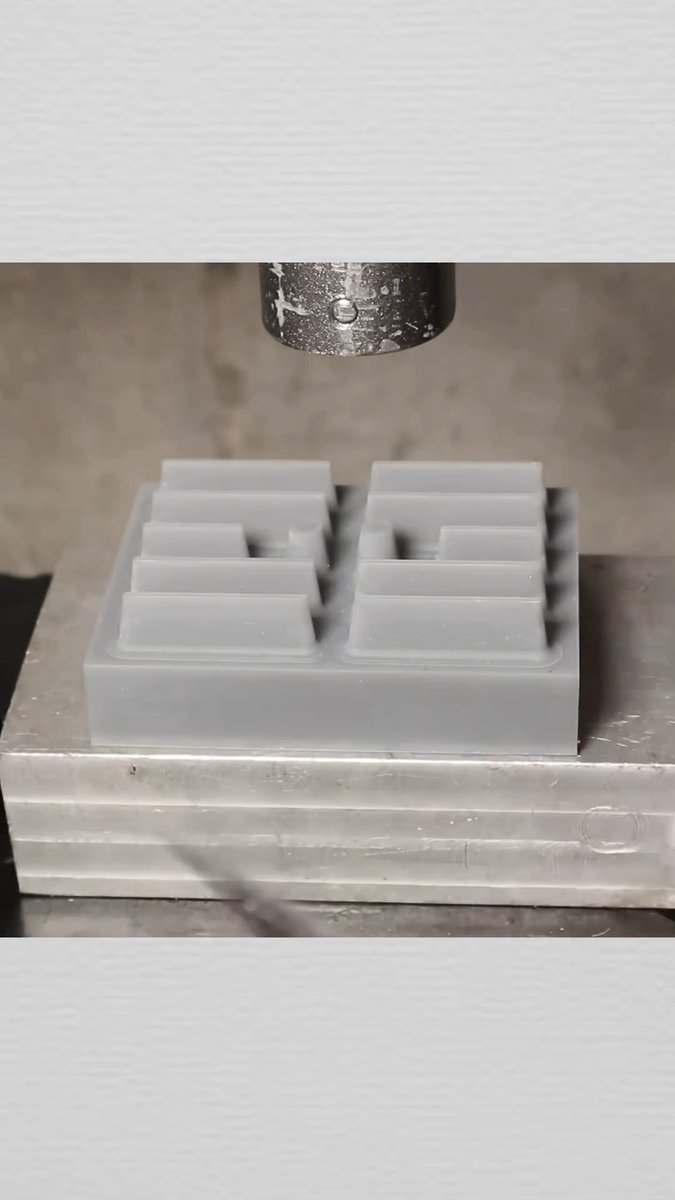
Multimaterial metal Additive Manufacturing will unlock entirely new designs for electromagnetic systems. Here’s another Noyron-engineered example. We produced this motor with the Fraunhofer-Gesellschaft IGCV process. It needs a third, insulating material to be functional.

92,903 views • 1 month ago •via X (Twitter)

0 Comments

No comments available

Comments from the original post will appear here

Related Videos

NordSpace is pleased to announce a groundbreaking Canada-Germany R&D collaboration and funding towards medium-lift rocket engine development with Fraunhofer ILT, receiving advisory services and up to $335,000 from the National Research Council of Canada Industrial Research Assistance Program (NRC IRAP). This collaboration will support a research and development project that will advance our large format multi-material additive manufacturing capabilities for medium-lift rocket engines. This collaboration between NordSpace, the Fraunhofer Institute for Laser Technology, and SWMS (Systemtechnik Ingenieurgesellschaft mbH) builds upon the recent launch of our Advanced Manufacturing for Aerospace Lab (AMA Lab), and marks an important step toward our ongoing efforts to advance orbital launch vehicles that are fully scalable from light to medium-lift payload capacities. NordSpace's Tundra and Tundra+ light lift vehicles, capable of 500 kg and 1,100 kg to LEO respectively, are being designed specifically to scale to the medium-lift Titan vehicle (5,000 kg+ to LEO) by the early 2030s. This advanced manufacturing project for space propulsion harnesses breakthrough methods such as large volume, high-speed, high-resolution, multi-metal deposition to optimize rocket engine design, fabrication, and testing. NordSpace will partner with Fraunhofer ILT – the German research institute that has developed the world-leading EHLA laser-based high-speed additive manufacturing capability, and SWMS – the German company that has developed the CAESA software for AI-powered advanced manufacturing path planning optimization. This collaborative project will support NordSpace in developing next-generation, large-scale, regeneratively cooled liquid engines, validated through rigorous hot-fire test campaigns and positioned for flight qualification and commercial scale-up.​​ This announcement builds on NordSpace’s AMA Lab launched earlier this year with Ontario Centre of Innovation support and another advanced manufacturing project that received funding from the Canadian Space Agency. The AMA Lab has already accelerated the design of our 3D-printed Hadfield engines and enhanced development cycles through AI-driven design methodologies and direct validation at our test range. Now, this new Canada-Germany collaborative R&D project will go further into efficient production methods for these advanced rocket engines. We will also present updates on this initiative at the Canadian Space Launch Conference on May 5, 2026 in Ottawa. NRC Canada Canadian Space Agency National Defence Defence Research and Development Canada Transport Canada Ontario Centre of Innovation (OCI) Fraunhofer-Gesellschaft Fraunhofer-Gesellschaft

NordSpace 🇨🇦

26,703 views • 7 months ago

Shane Wighton, from the YouTube channel Stuff Made Here, used 3D-printed tooling to form a sheet metal component as part of a concept validation process. Metal manufacturing is essential for all areas of the economy. Because of their strength, stiffness, and long-term durability, metal components are used in applications from appliances to construction parts and car body panels. Traditional metal manufacturing techniques include forming, casting, molding, joining, and machining. Sheet metal forming involves various processes where force is applied to a piece of sheet metal to plastically deform the material into the desired shape, modifying its geometry rather than removing any material. Sheet metals can be bent or stretched into a variety of complex shapes, permitting the creation of complex structures with great strength and a minimum amount of material. Sheet metal forming is the most cost-effective forming procedure today for manufacturing parts in large quantities. It can be highly automated in factories or, at the other end of the spectrum, manually operated in metal workshops for small series parts. It is a versatile, consistent, and high-quality procedure to create accurate metal parts with limited material waste. From metal cans to protective housing for hardware, parts created by sheet metal forming are found everywhere in our daily lives. In this article, learn the basics of sheet metals, the various sheet metal forming processes, and how to reduce the cost of sheet metal forming with rapid tooling and 3D printed dies. For a detailed overview and the step-by-step method, watch our webinar or download our white paper: Research conducted by Shane Wighton. Check out the fantastic 15-minute video on his YouTube channel 'Stuff Made Here'! its top-notch engineering content.:

Formlabs

39,948 views • 1 year ago

I want to hear all the competing theses for how manufacturing happens in space. My current view: The first thing we'll manufacture in space won't be spacecraft. It'll be hydrocarbons. We need fuel and food. Survival before sophistication. For a long time, most hardware will still be shipped from Earth. Manufacturing will mostly mean repair, maintenance, and replacement of spare parts by astronauts maybe robots. 1000s of Starships leaving with lots of spare parts every 18 month. So the real challenge isn't producing known parts. It's dealing with the unexpected. Every settlement, station, ship, or habitat will eventually break in ways nobody predicted. New missions will create needs nobody anticipated. Waiting months for a launch window is not a viable supply chain. That implies, space manufacturing cannot begin with giant, specialized factories. It starts with highly versatile systems capable of making many different things from limited feedstocks. Multi-purpose robots. Flexible. General-purpose manufacturing cells. In other words, the opposite of most factories today. My bet is that space manufacturing evolves as a network of distributed robotic job shops and microfactories, not monolithic production plants. The manufacturing systems that win early because they can repair the unexpected will become the industrial legacy of space. When demand eventually grows large enough for mass production, those flexible systems will already be everywhere so that is the paradigm that will scale to large volumes. What's the strongest argument against this?

Edward Mehr

16,926 views • 2 months ago