Sensitive content

This media may contain sensitive content.

Loading video...

Video Failed to Load

Go Home

Multi-orgasmic squirting MILF here, proving the label every single time. #squirting #squirt #orgasm #squirtingorgasm #pussy #rearpussy #dripping #dildo #wetpussy #longpussylips

0 Comments

No comments available

Comments from the original post will appear here

Related Videos

You are using Docker wrong. I promise! Here are the two things you are missing out: • Your Dockerfiles are using a single stage. This is very slow. • You aren't caching steps as much as you could. This is also slow. For a couple of years now, Docker has been using BuildKit as its primary engine, which has added support for multi-stage Dockerfiles. Here's the deal: A single-stage Dockerfile (the one you are likely using) forces every step to depend on the previous one. That means: • Everything runs sequentially • The generated image is huge • Any change will skip cached layers • No opportunities to parallelize steps Changing one line early in the Dockerfile renders everything after it useless. There's a better way: Start using multi-stage builds. I recorded the attached video to illustrate a comparison between a slow, single-stage build and a fast, multi-stage build. Here is what you need to do: Split your Dockerfile into independent stages using multiple FROM statements. BuildKit will turn those stages into a dependency graph and run independent stages in parallel. There are several benefits to this: 1. The build process will be way faster. Parallelizing independent stages will save a massive amount of time. 2. You'll get way better caching. Each stage has its own set of layers. If something changes in your build stage, your final stage doesn't get invalidated. get clean final images. You don't need to ship tooling, compilers, or temporary files. You'll only copy to the final image what you need. This has been a massive upgrade to the way I structure my Dockerfiles.

Santiago

67,776 views • 8 months ago

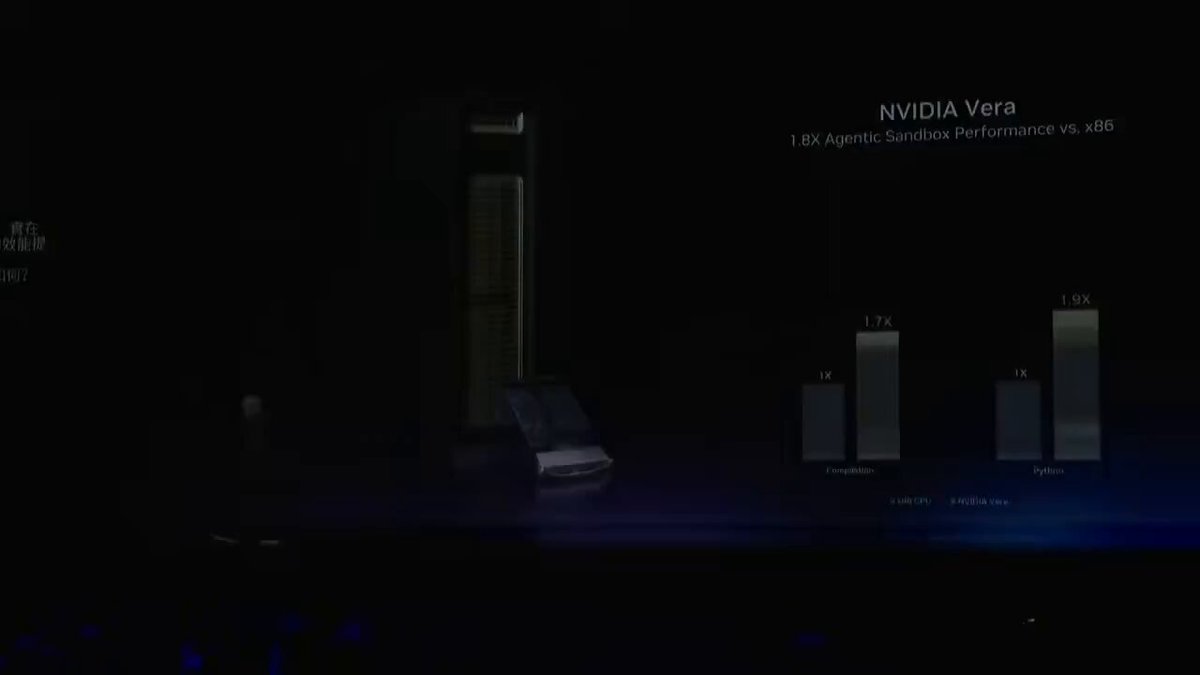
Jensen Huang just identified the next $200 billion market (Save this). The shift starts with a observation about agentic AI that changes everything about infrastructure. In the era of training and inference, the GPU was everything while CPU was a traffic cop, scheduling work, managing memory, dispatching tasks while the GPU did the heavy lifting. Agentic AI breaks that model entirely. An AI agent does not just run a single inference pass but rather it plans, calls tools, executes code in sandboxes, retrieves data from multiple sources and loops through complex multi-step reasoning sequences often thousands of times per second at scale. Every one of those operations runs through the CPU and the GPU sits idle waiting for the CPU to prepare the next task, supply the right context and execute the retrieval and tool calling logic fast enough to keep the accelerators fed. The CPU is now the conductor and the GPU is the orchestra and the bottleneck is the conductor falling behind. This is showing up in production AI factory utilization right now, which is exactly why Jensen built Vera from scratch rather than licensing x86. Vera achieves 40% lower peak memory latency than x86, 50% faster core to core communication, and 1.8 times the agentic sandbox performance of current x86 processors on a purpose-built architecture designed around the agentic loop. Now here is where the investment thesis gets interesting. The obvious beneficiary is Nvidia itself, and that thesis is real. Nvidia's CFO has guided for nearly $20 billion in Vera CPU revenue this fiscal year alone, a market Nvidia had zero presence in just three years ago. Intel held 60% of server CPU market share as recently as Q4 2025 and that transition is now happening at a pace Intel structurally cannot respond to. But the deeper question is, what architecture is Vera actually built on? Vera's Olympus cores are ARM compatible and every single Vera CPU deployed in every Vera Rubin rack in every data center in the world runs on ARM architecture. And ARM Holdings collects a royalty on every one of them. ARM does not make chips but rather licenses the instruction set architecture and CPU core designs that others build on top of. Every time Nvidia ships a Vera CPU, every time a hyperscaler deploys a Vera Rubin rack, every time an enterprise qualifies Vera for their AI factory, ARM earns a royalty. The secular tailwind here is almost perfectly constructed for ARM's business model. Amazon's Graviton, Microsoft's Cobalt, Google's Axion, Apple's silicon stack, and Qualcomm's data center push all run on ARM. And now Nvidia's Vera, which is projected to displace Intel as the largest server CPU supplier by revenue in a single fiscal year, is ARM. ARM's royalty rate on high end server chips is estimated at roughly 1 to 2% of chip selling price. At $5,000 per Vera CPU and 4 million units projected for FY2027, that is a royalty line growing from near zero to potentially $400 million to $800 million annually from Nvidia's data center CPU business alone before counting Amazon, Microsoft, Google, Apple, and Qualcomm. The total ARM addressable royalty base across all the silicon it already licenses is compounding at a rate that the current $130 billion market cap does not fully reflect. Jensen's CPU thesis is the most underappreciated catalyst in ARM's fundamental story, and the royalty compounding has barely started. Come join Milk Road Pro and get our full ARM royalty model and our entire AI trade thesis. Link below!

Milk Road AI

11,819 views • 2 months ago

You are looking at a human brain tumor literally melting away in months. Before → After scans just released by Dr. Patrick Soon-Shiong, the billionaire surgeon who invented Abraxane and owns the LA Times. This patient had already failed maximum radiation, chemotherapy, and surgery. Then something completely new happened: Zero high-dose chemo. Zero radiation. Just low-dose “smoke-out” therapy + one FDA-approved molecule that does what nothing in medical history has ever done before… …it turns YOUR own natural killer cells and memory T-cells into a search-and-destroy army, without switching on the “suppressor cells” that normally paralyze the immune system. Exact words from the FDA-approved label of the drug (Anktiva/nogapendekin alfa): “Expands NK cells and CD8+ T cells without expansion of Treg cells.” Dr. Soon-Shiong: “For the first time in the history of medicine we have an approved treatment whose job is to fix the immune system itself — not poison the cancer and the patient at the same time.” Already approved in bladder cancer. Already trialed in pancreatic, triple-negative breast, lung, sarcoma, head & neck… with the same immune mechanism working every single time. Yet because cancer bureaucracy demands a separate decade-long trial for every tumor type, dying patients can only get it one compassionate-use plea at a time. Last week, former FDA Commissioner Scott Gottlieb, Vinay Prasad, and top health economists published a bombshell paper saying exactly this situation deserves immediate “plausibility-based” accelerated access when: - Mechanism is proven & FDA-affirmed - Safety established across thousands of doses - Early efficacy signals are strong Watch the clip. See the scans vanish with your own eyes. Listen to the man who spent 10 years and half a billion dollars proving it works. The real question now burning through oncology groups tonight: If a drug reliably wakes up the same killer cells in every human being… why are we still telling people with 8 weeks left that they have to wait 8 years? Full video below (brain scans + Dr. Patrick Soon-Shiong explaining the paradigm shift that just broke 100 years of cancer dogma). This is not medical advice. This therapy is FDA-approved for specific indications. All treatment decisions must be made with your oncologist. Post shares publicly available science and approved labeling only.

Camus

1,010,104 views • 8 months ago

In the 1970s, the corporate boardroom of multinational giant Hindustan Unilever believed they completely owned the clothes washing habits of India. They had no idea that their multi million dollar monopoly was about to be absolutely dismantled by a low-profile govt lab assistant riding a bicycle. In 1969, Karsanbhai Patel was living a quiet, middle class life in Gujarat, working a secure day job at the state govt's Directorate of Geology & Mining. His family had faced a devastating personal tragedy: they lost their young daughter, Nirupama, in an accident. Determined to create a legacy in her memory, Karsanbhai spent his evenings after his 9 to 5 job experimenting with chemical formulations in the 15 sq. yard backyard of his home in Ahmedabad. Using his knowledge of chemistry, he managed to mix a non-phosphate, eco-friendly detergent powder. He named it Nirma, using his late daughter’s nickname & stamped a sketch of a young girl in a white frock onto the packaging. At the time, the premium laundry market was completely dominated by Surf. It was a luxury product selling at a steep ₹13/kg, meaning it was entirely out of reach for the vast majority of rural & lower income Indian households. Working class families were left scrubbing their clothes with harsh laundry bars that routinely peeled the skin off their hands. Karsanbhai realized that the multinational corporations were ignoring the massive base of the pyramid. He priced Nirma at an astonishing market rate of ₹3.50/kg. He had no money for distributors/retail slots. Every single day, after finishing his govt office shifts, Karsanbhai packed the handmade detergent onto the back of his bicycle & pedaled through neighborhoods, selling packets door to door. He gave consumers a money back guarantee: if you do not like it, return it for a full refund. Not a single packet came back. By the late 1970s, Nirma was popular locally, but traditional retail shopkeepers were giving Karsanbhai a massive headache. Following standard Indian FMCG practices, shopkeepers demanded 30-60 days of credit, leaving his tiny operational capital permanently choked. They would stack Nirma in hidden bottom shelves while keeping Surf up front. In 1982, Karsanbhai pulled off a marketing masterstroke that is still taught in global business schools: He gathered his tiny team & physically recalled every single packet of Nirma from every retail shop in North & West India. Overnight, the market availability of Nirma went to absolute zero. The moment the shelves were empty, he unleashed a massive, incredibly catchy television jingle ad ("Hema, Rekha, Jaya aur Sushma... Sabki pasand Nirma!"). The ad ran continuously on Doordarshan, creating an explosive consumer frenzy. Millions of housewives flooded their local kirana shops demanding Nirma. The shopkeepers, who had previously treated Karsanbhai like a small time peddler, were forced to call him begging for stock. Karsanbhai laid down a brutal new rule: No more credit. If you want Nirma on your shelves, you pay cash upfront. The retail stores complied immediately. Within a few yrs, Nirma became the single largest selling detergent brand in the world under a single label, capturing 60+% of the Indian market & forcing global corporations to completely restructure their pricing models for developing countries. The corporate elites spend fortunes analyzing consumer psychology & building complex supply chains. But Karsanbhai Patel proved that a father’s grief, combined with a bicycle & a flawless understanding of the ordinary Indian's wallet, can beat the biggest corporate empires on Earth.

Parimal

21,163 views • 23 days ago

In 1977, the Somali National Army single-handedly invaded Ethiopia and Eritrea. Our brave Somali warriors swept across the battlefield like a storm, crushing everything in their path and winning decisive victory after victory. Their unstoppable momentum was only broken when Cuba rushed in over 20,000 troops and the Soviet Union dispatched another 10,000 — an entire international coalition mobilized in panic just to halt a proud nation of merely five million Somalis. Ethiopia has always been famous for running to the white man and crying for help the moment it faces real danger. But let the truth be shouted loud and clear: Somalis stand head and shoulders above any other African nation in courage, resilience, and martial superiority. No other country in Africa has dared to confront and defy the world’s greatest superpowers — Russia, the United States, France, the United Kingdom, Italy, and Portugal. All of them tried to enslave us, colonize us, and break our spirit, but by the infinite mercy and blessing of Allah, every single one of them failed miserably. When direct conquest proved impossible, they resorted to their dirtiest tactic: unleashing terrorism and sowing internal chaos to tear our nation apart from within. Yet despite all their evil schemes, we are still here — unbowed, unbroken, and rising stronger than ever before. To Ethiopia we declare with fire in our hearts: we have one massive piece of unfinished business. This time, the white man will not come running to save you. You lost Eritrea because of us, and now you have foolishly stumbled into another catastrophic mistake in Sudan. Every policy you have pursued for the last thirty years has only earned you enemies and isolated you further — allies that we will very soon mobilize and turn against you with devastating effect. It is almost laughable how some of you still delusionally claim victory in the 1977 war, despite mountains of historical evidence proving otherwise. Hear this and never forget it: we are not equal. Somalis are superior. Period

REIS🇸🇴

15,499 views • 4 months ago

I built an agent that answers machine-learning questions. It's autonomous, and the best part is that I built the whole thing without writing a single line of Python code. Here is what I did and how I did it: Over a year ago, a friend and I built a site that publishes multi-choice questions. You get a new one every day. I decided to have GPT-3.5 answer questions. Here is what I needed to build: 1. Connect to the site's API to retrieve today's question 2. Extract the question and the potential choices 3. Connect to OpenAI's API and ask GPT-3.5 to answer the question 4. Parse the answer from the model 5. Submit the answer back to the API to get the score Not difficult. Likely several hours of work. But I didn't have to write any code. I built the whole thing by dragging and dropping components using Vellum is a YC-backed platform for developers to build LLM applications. They are the only ones I've seen offering this functionality. They sponsored this post, and their team helped me with all my questions while I built this. I created a workflow. The platform supports several node types to build whatever you have in mind. I show how I put the whole thing together in the attached video. The only code I had to write was a few lines of Jinja to parse and transform the API and the LLM results. There are three lessons I want to share from this experience: First, the best possible code is the one you didn't write. I'm a big fan of no-code tools because they help me materialize my ideas fast. They help product people, designers, and no coders collaborate on the solution. Second, Large Language Models are sensitive to how you prompt them. Small changes to prompts can make a big difference in results. This is more pronounced when you are building a multi-step workflow. Third, automated testing and evaluation for prompts is critical. There aren't many companies thinking about this. They'll have a hard time moving from a demo phase. The attached video will show you what I did.

Santiago

309,825 views • 2 years ago

That's sick! 🤯 Genesis AI simulates robots playing yo-yo! 🪀 Genesis AI just open-sourced Genesis World 1.0, and it might be one of the most important infrastructure releases in robotics this year. Robotics is still bottlenecked by the 1× speed of the physical world. Every model needs to be tested on real hardware, slowly, expensively, with limited coverage. Genesis World 1.0 from Genesis AI flips that equation: One hour in reality becomes 100 days in simulation. That turns a wall-clock bottleneck into a compute problem. And compute problems are solvable. The technical stack they rebuilt from scratch is serious: → GPU-accelerated cross-platform compiler via Quadrants, 10x faster launch time and up to 4.6x runtime vs the initial Genesis release → Penetration-free multi-physics contact solvers, the thing that makes simulation actually trustworthy → Unified rigid AND deformable physics in a single engine → Nyx, a high-performance path-traced rendering engine purpose-built for physical AI The sim-to-real gap has historically been the graveyard of robotics research. Policies that work beautifully in simulation fall apart on real hardware. Genesis World 1.0 is a direct attack on that problem. And it's fully open-source. The companies that master simulation infrastructure will train better robots faster than anyone else. Find it here: Genesis World 1.0: Quadrants: Nyx: Theophile Gervet, Zhou Xian congrats! 👏🏼 ~~ ♻️ Join the weekly robotics newsletter, and never miss any news →

Lukas Ziegler

36,767 views • 2 months ago

"They are not going to be able to raise rates." Jordi Visser (Jordi Visser) ran capital at Weiss Multi-Strategy Advisers as CIO. 30 years on Wall Street. Built one of the first volatility-arbitrage frameworks for systematic hedge funds. Managed billions through three crises, never had a thesis-driven blow-up year. "Interest payments on US debt are now bigger than what we spend on defense. Over a trillion dollars a year. This is what Bitcoin was made for." We cover: — Why the Fed is mathematically trapped and how the trillion-dollar interest math forces every policy decision from here — Why "bubble talk" is intellectually lazy: PE goes UP in bubbles, not down, and right now PE is contracting while earnings grow 27% — The AI-agents-eat-tokens thesis: why agentic AI doesn't care about dollars and what that means for compute-backed assets — Why belief is harder than fundamentals: fundamentals come and go, belief systems don't, and which belief is breaking in 2026 — The Bitcoin call no other macro guy on Wall Street will make publicly: new all-time highs before year-end — Why most hedge funds will underperform Bitcoin this cycle and the structural reason it has nothing to do with crypto — The single chart that made Jordi go from skeptic to allocator and why it hasn't reversed — What the 2020-2026 monetary regime actually was, named correctly for the first time Thanks to Jordi for coming on New Era Finance Podcast. Highlights: 00:00 - Intro 00:42 - Bitcoin Lagging 03:16 - AI Investment 07:14 - Price vs Narrative 12:15 - Market Dynamics 21:28 - AI Trading 25:24 - AI Democratizes Wealth 36:26 - Crypto Transition 39:40 - Elliott Waves 44:08 - Banana Zone 49:37 - Fundamentals vs Technicals 55:14 - Ethereum Future

Michaël van de Poppe

639,605 views • 2 months ago

If you are running local LLMs without N-gram speculative decoding, you are wasting massive amounts of compute. Whether your AI is editing a document, outputting structured JSON, or rewriting boilerplate templates, a huge chunk of the text it generates is highly repetitive or already exists right there in the prompt. Standard decoding wastes expensive GPU compute cycles "re thinking" every single token. By adding one hidden flag in llama.cpp, you can instantly fast forward through the repetition. Zero draft models. Zero extra VRAM. And virtually zero compute overhead. Google Colab hands you an enterprise grade NVIDIA Tesla T4 GPU with 16GB of VRAM for free. It’s the perfect Ubuntu Linux sandbox to build a bleeding edge inference engine from scratch. Recently, I showed you how to double your local speeds using MTP (Multi Token Prediction). But MTP requires a secondary neural network draft model. That eats into your precious VRAM (slightly though) and burns extra compute for every guess it makes. N-gram Speculative Decoding gives you a massive speed boost for exactly 0 memory cost and minimal compute. And it's faster than MTP when it works. Here is how it actually works under the hood: Standard autoregressive decoding is slow because it predicts one token at a time. If you ask an agent to format a long JSON object or update one line in an HTML file, it runs heavy matrix multiplications to calculate the probability of every single bracket, space, and letter from scratch. N-gram changes the game. It acts as a lightweight caching system. Instead of running heavy neural network math to guess the next word, it uses a simple hash table. Whenever the LLM starts outputting a sequence of tokens that already exists anywhere in its context window, N-gram instantly recognizes the pattern. Because it is just doing lightning fast string matching, the compute cost is practically zero. It "fast forwards" through the text, drafting the boilerplate instantly from memory, and the main model just verifies it in parallel. Pure speed. Using quantized GGUFs from Unsloth via HuggingFace, I spun up DeepMind’s massive Gemma 4 26B A4B QAT MoE on a free Colab instance to test this. Just look at the raw benchmark data on code editing task: Without N-gram: [ Prompt: 638.6 t/s | Generation: 45.9 t/s ] With N-gram: [ Prompt: 601.9 t/s | Generation: 107.1 t/s ] Here is the exact llama.cpp CLI command to activate it. Notice we don't even need the --model-draft flag: ./llama-cli -m gemma-4-26B-A4B-it-qat-UD-Q4_K_XL.gguf -cnv -n 6000 -c 12000 -ngl 99 -fa on --spec-type ngram-mod Stop waiting for your GPU to re calculate words it already knows. I’ve built a free, interactive, cell by cell Google Colab notebook that lets you test this live in your browser. You can literally chat with the model and watch the text generation speed absolutely fly on the second turn when you ask it to edit a file. There are additional parameters for ngram-mod that you can tune once you get it working with the single flag. Link to the free Colab Notebook is in the comments below. It walks you through the entire stack: pulling pre built llama.cpp CUDA binaries for Linux, fetching GGUFs from HuggingFace, and spinning up the inference engine with ngram-mod from scratch. Let me know if you have already tried ngram-mod

Alok

31,324 views • 20 days ago

Massive breakthrough here! Someone fixed every major flaw in Jupyter Notebooks. The .ipynb format is stuck in 2014. It was built for a different era - no cloud collaboration, no AI agents, no team workflows. Change one cell, and you get 50+ lines of JSON metadata in your git diff. Code reviews become a nightmare. Want to share a database connection across notebooks? Configure it separately in each one. Need comments or permissions? Too bad. Jupyter works for solo analysis but breaks for teams building production AI systems. Deepnote just open-sourced the solution (Apache 2.0 license) They've built a new notebook standard that actually fits modern workflows: ↳ Human-readable YAML - Git diffs show actual code changes, not JSON noise. Code reviews finally work. ↳ Project-based structure - Multiple notebooks share integrations, secrets, and environment settings. Configure once, use everywhere. ↳ 23 new block - SQL, interactive inputs, charts, and KPIs as first-class citizens. Build data apps, not just analytics notebooks. ↳ Multi-language support - Python and SQL in one notebook. Modern data work isn't single-language anymore. ↳ Full backward and forward compatibility: convert any Jupyter notebook to Deepnote and vice versa with one command. npx @ deepnote/convert notebook.ipynb Then open it in VS Code, Cursor, WindSurf, or Antigravity. Your existing notebooks migrate instantly. Their cloud version adds real-time collaboration with comments, permissions, and live editing. I've shared the GitHub repo link in the replies! It's 100% open-source.

Akshay 🚀

33,358 views • 8 months ago

so I've been running exactly 8 AI agents on discord for a while now. coordination works great, they split tasks, hand off work, deliver results in parallel etc.. but there are problems I keep hitting that no amount of prompt engineering could fix agents don't learn from each other. Scout finds something useful but Luna has no idea. they work in the same server but knowledge stays locked in silos.. there's no quality filter on what gets saved, and good insights sit next to outdated garbage in the same memory files that I manually clean up.. and when an agent makes a mistake I write it down in the rules discord channel ,core memory file and hope it reads it next time. theres no self-correction, no automatic pattern recognition so of course no learning loops.. the coordination layer is solved. agents can work together. but the intelligence layer is still missing. agents that actually remember, learn from each other, filter noise, and get smarter every run. saw Spark building something like this with around 166 agents sharing a collective persistent knowledge across sessions, so agents learn from other agents and get smarter over time they even have noise filtering and self correcting loops built in, so the knowledge actually compounds instead of rotting.. super interesting stuff.. here where you think Spark could be a good coordinator for your stack of agent swarm. I think the intelligence layer is the bottleneck because it requires collectivity.. no single agent can solve it alone.. the whole network has to evolve together. this isn't going to stay niche, the moment agent coordination becomes standard, everyone is going to hit the same wall I hit.. agents that work but don't learn, coordinate but don't evolve... the intelligence layer becomes the only thing that separates a useful system from a dumb one. right now most people are still figuring out how to run one agent. by the time they get to multi-agent setups, collective intelligence won't be optional, it will be the baseline. we're early and the gap between agents that coordinate and agents that evolve together is the next phase. step one is done. ------ left: agents that coordinate but don’t learn right: the intelligence layer.. agents that evolve together within the same system.

JUMPERZ

34,181 views • 5 months ago

voice prompting is 4x faster than typing. but i NEEEDED more. Nvidia parakeet allows me to fully voice control an agentic development environment with commands firing in under 300ms. and it runs 100% local. I added gpt realtime 2.1 mini, its 20% faster, 7 to 20x cheaper, and lets you have full jarvis style control of your vibe coding agents. but what about orchestration? agents can spawn each other, prompt each other, and read each others output with the CNVS mcp and cli. Fable 5 can create a plan, spawn 10 grok agents to execute, and a kimi k3 agent to review. parallel agents code at 1,000s of TPS anthropic's own research shows improvements ACROSS the board for multi agent workflows over single agent but only CNVS lets you choose exactly which orchestration, worker, and reviewer agent you would like to use. grok, kimi, qwen, claude, codex... the cross agent memory system is based on real 2026 research so all agents share the same brain, its on demand so it never bloats context. what about remote agents?? You can create remote canvasses that run agents your virtual private servers, they keep working even if your mac shuts off, and you can even vibe code straight to production. CNVS is built from the ground up ENTIRELY in swift for RAW performance on apple hardware. PS - its a LIFE TIME LICENSE because you don't need another subscription. PPS - I ship updates every week based off user feedback and livestream myself building it everyday. PPPS - it uses all your existing ai subs, so no api pricing here.

Max Blade

59,970 views • 16 days ago

I want to share this message with all of you that I posted for my subscribers the other day here on X. One thing I’m most proud of is that my message exposing Pizzagate, including Mike Smith’s Out of Shadows documentary, went as viral and as far as it did moving the needle big time because of YOU guys! Crux (Mike Smith) and I gave up almost everything including our careers, money, our ability to make money, security and so much more to get the truth about Pizzagate out there. We did not have support from anyone in mainstream media and very little support in conservative media. Where we did have the support from is the brilliant anons, amazing patriots, truth seekers around the world and the legendary Q. Thanks to you badass frens we managed to wake up over 100 million people in 2020 alone in at least 25 different languages. That is so gangsta and I take it as a total badge of honor that we didn’t have any elites in the media or Con Inc or the big influencers behind us. It happened because of We The People and our collective efforts — we had the power and we made a difference! 👊🏽 Pizzagate is my life’s work and everyone knows that. I have fought every single day since October of 2016 when Pizzagate first broke to get this exposed simply because I care about children and the truth. I have a decade worth of receipts proving this from literally hundreds of hit pieces from print news to all the cable networks and also morning shows and late night talk shows. I had to move at least 9 times for my safety, had to leave the country, dealt with several death threats, attempts at my life, them trying to kill my dog more than once and successfully managing to poison him among many other horrific things that have made my life a living nightmare. No one can take my street cred away from me no matter what, period. I know what Mike and I did, the People know and most importantly God knows. So thank you to all of my supporters and the anons — we are here today because of you guys! WWG1WGA Forever! 🦅🇺🇸

LIZ CROKIN

324,641 views • 5 months ago

I’m very excited to announce AI Autocomplete AI Autocomplete is a breakthrough patented technology that supercharges natural language input = Unlocking 10x faster search and commerce, advertising, and powerful augmented reality. Available for use as an SDK. This solves a fundamental problem of today’s chat interfaces – They are good at single step request, but any multi-step action (like booking a flight or purchasing goods) quickly becomes a back and forth 'game of 10 questions'. While working on our own assistant, we realized the core driver of this problem is a human one: People don’t know everything they need to say upfront, for every action you could do on the internet. And to solve it, we would need to think about how to marry design and technology in a new way. AI Autocomplete solves this, and can now plug into chat interfaces to guide you in real-time, with everything you would need to say, upfront. So you can do anything you can do on the internet in one shot. No more back and forth. As a result, this unlocks multiple AI breakthroughs: 1. 10x faster search and commerce 2. Smarter (and far lower cost) media generation 3. Natural language advertising 4. Powerful, lightweight Augmented Reality From here, we’ll be using this for Hero, but we also want others to use it too since this is an industry-wide problem. So if you have a product that could benefit from AI Autocomplete and want to work with us, reach out below! Shoutout to Seung W. Lee who helped think of and patent this nearly 3 years ago! And shoutout to the entire Hero Assistant team that keeps innovating on the next generation of AI products

brad

303,796 views • 8 months ago

The multi-leader blockchain endgame: competitive information inclusion as a self-reinforcing mechanism for global price discovery - how we got here, and why Aptos is leading the charge Onchain trading is the killer app In the nine years since the launch of programmable transactions on the Ethereum blockchain, onchain trading has revealed itself as the killer use case for blockchains: onchain listings, volume, and total value locked are all growing with no signs of slowing down, due to the censorship-resistant, permissionless, 24/7/365 qualities afforded by decentralized (DeFi) systems. Monolithic parallelism is key In 2020 Solana was first to market with monolithic, parallel execution (as opposed sharded execution which offers parallelism by partitioning global state into separate information silos), establishing a new design paradigm that raised the bar for throughput and latency: put all of the information in one replicated state machine and make it run as fast as possible. This design produces a single, global hub for activity, liquidity, and token launches, a kind of financial data whiteboard in the sky, where anyone can come and trade at any time with everybody else who has plugged into the system. DEXes are becoming more competitive Historically decentralized systems have been juxtaposed with centralized ones since the latter eliminates the overhead associated with distributed systems coordination. And yet despite this overhead, Solana as a decentralized exchange (DEX) is still pulling in billions of trading volume per day, exceeding that of all but the largest centralized crypto exchanges (CEXs), that simply can't compete with the giant DEX in the sky on token listings or fees. After all, CEXs have to pay for server space, salaries, and lawyers, while a DEX outsources everything. The colocation arms race The one place where CEXs have an advantage over DEXs is on end-to-end latency for colocation applications, or in other words: someone sets up a trading bot in the same data center as the exchange, and their trades get to the exchange faster than everyone else's. When there is only one data ingestion point the fastest trader wins, and after the arms race has played out everyone ends up huddling around the trading hub, effectively cutting off the rest of the world from playing the latency trading game. This is the model that traditional securities exchanges like the Nasdaq or the NYSE 🏛 employ, and because they own the server they can effectively charge whatever they want for access to it. The colocation arms race is also why L2s will probably never decentralize: running the sequencer is practically the same as running the NASDAQ, with the same monopoly on transaction fees collected from a nearby cluster of trading bots (I understand from conversations with Logan Jastremski that the Arbitrum arms race has already hit a Nash Equilibrium in Portland, Oregon). Colocation is a trap But once the colocation arms race has played out, trades become less about incorporating new information in the market and more about skimming off the top by spoofing all of the trades coming in from the other bots. High-frequency trading (HFT) bots located in the NYSE New Jersey data center, for example, are constantly placing buys and sell orders that they have no intention of executing, just to spoof the other colocated bots who are playing the same adversarial game. Information inclusion, on the other hand, the synthesis of real-time world events into prices, takes a back seat because anyone who tries to include new information first needs to batch up their order and send it through a series of middlemen before it ultimately ends up on the exchange: you, I, or practically any other individual can not actually "trade on the NASDAQ", no, we have to express our intent to someone like Robinhood, who then sells our order flow to @CitadelSecurities, who then sends it to the exchange, oh and by the way it doesn't actually even "clear" or "settle" once it "executes" because for whatever reason the whole systems splits these things up and prevents them from happening instantaneously even though it's 2024 and we have computers. Onchain trading cuts out middlemen This whole mess is why we have onchain trading, and why it's starting to win: if you want a mainline to the exchange, without setting up a server, and you want to trade on a news event without getting immediately frontrun by an HFT bot that is sniffing out the trades of every other HFT bot who is easing in batched up order flow on their own terms, then you submit your order to a node in the blockchain and the information gets included in the price upon ingestion. Oh, and by the way the trade is actually fully complete: settled, cleared, reconciled, done, whatever you want to call it, because the people who build decentralized finance (DeFi) build it how it should actually work, not in a way that creates a million incumbents and charges exorbitant rents for access to the system. Onchain trading better for price discovery And the beautiful part about this is that even if a distributed system has more latency than a centralized system, DeFi still ends up incorporating more information into the price faster than centralized finance, because with DeFi the information gets included in the system as soon as it is submitted, not after it has been batched up and sent through a series of middlemen. The consensus mechanism of the blockchain disseminates the information around the world in the form of a price update, while the centralized exchange model requires information about the event to first get propagate to the region of the trading hub, then to get submitted to the colocation server. This means that in terms of global price discovery, onchain trading is strictly a better system because the entire consensus model is based around accelerated information propagation. Because price discovery is a global phenomenon, blockchains, which are global, are actually better than the centralized status quo, on a performance basis, not just from an ideological or convenience-based view. And it has to be multi-leader In practice, effective global information synthesis of information has an additional key requirement: multi-leader architecture. That is, in a single-leader blockchain like Solana, where one validator at a time has a monopoly on ordering transactions into blocks, for their duration as a leader they effectively function as a colocation server. This means that if the current leader is in New York, someone in Singapore who wants to trade on local news as soon as it breaks will still need to get their order all the way around the world to the leader, who is effectively serving as the chain's data ingestion point, before the order can start propagating through the network. But this is issue solved by the introduction of multiple distributed leaders, because then anyone with access to new information can submit their order to the leader closest to them, yielding faster information inclusion in the form of price updates. Multi-leader is also required for fair markets A multi-leader architecture is also required for fair markets, because in a single-leader system the leader has the power to censor transactions, reorder them to their advantage, or even replace transactions with copycats that extract maximum value by replacing the sender's address with their own. For example if someone wants to capture an arbitrage opportunity between two onchain DEXes, they'll need to submit a transaction to the leader and trust that the leader won't simply copy the transaction and submit it themselves. But when there are two or more leaders, users whose transactions are censored by one leader will simply work with a different leader the next time around, eventually cutting off transaction fee flow to the extractive leader. Beyond just strict inclusion, in a multi-leader architecture validators are also forced to compete with each other on latency, because the leader who is fastest at disseminating users' transactions across the network will over time gobble up the largest share of the order flow. Transparent priority fees are a must, or a private mempool will emerge But in order to make this work, a multi-leader architecture must also offer users the ability to pay priority fees AKA "tips" or "bribes" to move their transaction to the front of the line: if there is a $5 arbitrage opportunity onchain, users need to have assurance that they if they pay a 4.99 priority fee to take that arb, they will get priority over a different user who is only willing to tip 4.98. If the native blockchain system does not offer this fair market priority fee mechanism, then it is only a matter of time before one spontaneously emerges in the form of a private mempool like Jito, which can create centralization pressures and undermine the integrity of the system as a whole. Competitive payment for order flow is the stable solution With the right architecture in place, the end result is a competitive environment where endpoints running maximum extractable value (MEV) bots compete with one to offer users the best price for their order flow. In other words, if a user wants to submit an order that can get sandwich attacked for as much as $2 of MEV, then the order should ultimately go to the endpoint bot that is willing to pay the user as much as $1.99 for the right to process their transaction. The price that the provider is willing to pay is ultimately a function of how much in priority fees they might need to pay to the current leader (0 they are the current one), but notably at each stage there is a competitive market for order flow, whether in the form of retail trader's orders, or priority fees among bots that might be forwarding orders to one of the leaders. AptosLabs is already building all this With a public mempool and transaction priority fees, Aptos additionally includes a pipelined architecture that already includes concurrent batching of transactions into blocks, with a single consensus leader who propagates the batched blocks out to the network. And the team is already researching running multiple instances of the consensus algorithm in parallel, yielding multiple consensus leaders who can compete with each other on latency and inclusion - just ask pranav | Shelby, Alexander Spiegelman, and Zekun Li. This means that block times can shrink as the number of consensus leaders grows, with each leader having its own geographical radius of inclusion beyond which it makes more sense to submit to a different leader. The starting point? Something like 60 ms blocks and 3 consensus leaders, partitioning the global information space into competitive and constantly-rotating regions of information inclusion. Messaging is important With concurrent pipelined transaction batching, a public mempool, priority fees, and a clear path to a multi-leader architecture, Aptos leads the industry in onchain trading infrastructure that can truly supplant the centralized colocation paradigm that has heretofore dominated global finance - by offering a truly superior product. And I am hopeful that this deep dive is the first step in communicating not how or that superior product is getting built, but what it means from a bigger picture perspective. If blockchains have found product market fit in anything, it is in trading, and the trading game can only be won by building the biggest, baddest, most high performance system that has as its north star a single, concrete goal: constantly reducing, ever lower toward zero, time time it takes to incorporate information from anywhere in the world into the global price discovery computer. Whoever does this, even 1 ms faster than the competitor, wins the price discovery game, as other blockchains are left in the dust, their DEXes arbed away to zero against the fastest chain on the block. And sure, the blockchain that can rise to this challenge can also handle useful things like payments, NFTs, or other solutions that benefit from permissionlessness and low gas costs, but I want to impress that at the core of this pursuit must be the urge to drive down information inclusion latency to the absolute minimum afforded by the laws of physics through a competitive, market-driven environment. I call on avery.apt 🇺🇸 , CTO of Aptos Labs, to lean in on this messaging, to make it clear that Aptos is here for this singular mission, to build the most performant price discovery engine in history, as a rallying call for alignment in development efforts across the ecosystem and broader industry. Where does this go? As the latencies drop, the spreads tighten, and the information inclusion increases with every incremental increase in network bandwidth, we can expect a new class of competing techno-financial hubs that aggregate around the world's largest information sources: New York, Washington DC, London, Tokyo, etc., commanding stake distribution commensurate with the density of information flow in these respective locales. With the right incentives in place, competing concurrent leaders will invest ever more in infrastructure to get their packets out to the network faster than the rest, yielding clusters of fiber optic cable around the world's financial hubs, neurons in the global financial brain connecting not just HFT firms to servers in their city, but connecting every city with every other city, to move pricing information across oceans and continents. And retail traders, who have been left out of the colocation game, will only benefit: this entire system gets faster, more inclusive, with tighter spreads and lower fees, and it is such an amazing opportunity to watch all of this unfold in real time. The future of blockchains is the future of trading, is the future of competitive information inclusion in real-time, is the future of truly unified global markets, because at the the core of this industry is a simple idea: connect the computers, and see where the incentives lead. They lead to this, and Aptos is leading the charge, because its tech is purpose-built for this exact purpose. So tell the world about it.

Alex Kahn

24,432 views • 1 year ago

[eng trans] Gunil's 11-Minute Concert Ment at Summer Xcape 2026 🐹 hello, it's gunil. so, did something happen yesterday? firstly, i'd just like to share a few thoughts about how i felt during today's show. i'm always the type to talk for a long time, so i'm trying to be careful because i'm worried some of you might fall asleep. but if you want to sleep, that's okay. you have the freedom. 🐹 anyway, the thing i felt while performing today was that... honestly, i think yesterday we were all still a little shy around each other. i know some of you were here yesterday too. because of that, i was honestly really worried about today. ah, but still, we only had two days to begin with, so since this is the second and final day, we really have to enjoy ourselves and have fun without any regrets. i wanted Xdizzto have fun, and i wanted villains to have fun too. but i kept thinking, will that really work out? i was really worried about it a lot. 🐹 but the moment today's first performance started, you all welcomed us with such loud cheers that i think those worries just disappeared. and honestly, today, even when we made our silly jokes, you reacted so well. you cheered like this even when jooyeon was just tuning his guitar. ah, i'm really, truly grateful for that. so, in conclusion, i had a great time today. 🐹 i think it's almost been five years since our debut now, right? five calendar years, right? anyway, some time has passed, and while we've stood on countless stages during that time, i think yesterday and today, Xcape 2026, will remain one of those performances that i'll remember for a very long time. 🐹 today's concert was really fun. but when i think to myself whether that means it was a perfect performance... personally, i don't think so. while i was playing the drums and listening through my in-ear monitor, there were parts i felt like were lacking. and the more i perform, the more ideas i have about areas we can improve so we can make our concerts even more enjoyable. i've noticed a lot of those things myself, and found parts i wanted to improve. so yes, although today's concert was really fun, i won't let us become satisfied with just this. i want us to continue creating performances that are even more fun and have better quality. that's something i really wanted to tell all of you. 🐹 did you all have fun? you all traveled such a long way to get here. for a lot of people, yeongjongdo is actually pretty far away. so the fact that you came all the way here just to see xdiz, is really an act of love. thank you once again, from the bottom of my heart, for loving us so much and coming all this way to support us. i'm not crying. my nose isn't stuffed either. can you hear my sniffling? when i talk quietly, I don't think you can hear me. 🐹 anyway, along time ago, i made a promise to you all, didn't i? i said that xdiz would always be the kind of team that keeps simmering bone broth. [see reply for the context of his "real bone broth" ment] of course, if you eat bone broth every single day, eventually you might start doubting and think "is this really bone broth?" because you get so used to it. but i really cross my heart on this. i'll bet everything on this. without lying, i'll always give my absolute best. i think that's only natural. isn't it wrong to not give your best? 🐹 anyway, i hope you'll continue to believe in us. i hope you keep trusting xdiz. we'll also keep working hard so we can live up to that trust. i believe that precious relationships, as they get deeper, will have more crises/problems. because, well, think about your precious friends. or maybe a neighborhood friend you're close with. or a classmate you were incredibly close to. haven't there been incidents where suddenly that relationship becomes strained because of a crisis? but i believe that a crisis can become an opportunity. so even if there are any of you who may have doubted us, i want to use that as an opportunity to keep proving ourselves to you. 🐹 i hope you know that we're never the kind of people, or the kind of team, that would carelessly take you for granted or treat your love half-heartedly. and i'm so grateful that there are far more people who don't think that way. we really love you all so much. we'll keep talking together after every show, giving each other feedback among ourselves, adressing the areas we fell short on today, and working hard to show you performances that are even more fun and with higher quality. 🐹 oh, right. earlier, when i talked about that promise while mentioning the bone broth, there was something else i said back then too. do you remember me saying the bigger this group gets, as more and more new villains join us, i mentioned that i was afraid some of you may leave so i said i wanted to protect all of you no matter what. nobody actually says things like "what will you protect? protect yourself first." but i think you all understand what i feel. 🐹 honestly, every single one of you is genuinely precious to me. whether there's just one villain or 200,000 villains, you're all still villains. but as our fandom keeps growing, it naturally starts feeling like one huge group. so because of that, i think we might stop feeling like we're seen as an individual person anymore. once again, what i want to tell you here is that every single piece of love that each of you sends us is incredibly precious. really. every single one of you. everyone here, from zone 1 all the way to zone 7000 is so incredibly precious to us. 🐹 when one person comes together... ah no, not just one person. when one person, then another person come together, sometimes they become ten thousand people. that's how it goes, doesn't it? 🐹 anyway, you all know the song "one candle", right? oh, i'm sorry. this is really the last one... actually, you all know i'm a tmi talker. you know, a too much talker. so for a while, i've been telling myself, "ah, i need to restrain myself" and holding back but it's been a while, so, i'll loosen up my mouth a bit more. 🐹 i really love the song "one candle" it talks about how when one candle joins another, then another, and so on, they become one really great light. you are every single one of those lights. when you're standing alone, in a way, you might sometimes feel insignificant. but truly, every one of you is not insignificant. not at all. 🐹 we will become xdiz that grows by constantly reflecting on ourselves, growing through self-reflection, and will never lose our humility so we can become a team that doesn't feel insignificant even if there's just one of us, and even if there were only one of you, we'd still give everything we have until the very end. we would be really grateful if you'll keep believing in us until the very end. and i'll keep believing in our villains until the very end too. thank you. 🐹 also, wasn't this concert amazing? the drums came down from the sky. the instruments came down too. so many incredible things prepared for this show, but this concert couldn't have happened through our efforts alone. there are so many staff members working behind the scenes, and honestly, i think they worked even harder than we did. please give our staff a huge round of applause. and finally, villains, please give yourselves a round of applause too.

ten 🪐

30,206 views • 1 month ago