Video yükleniyor...

Video Yüklenemedi

Ana Sayfaya Dön

My 8080 CPU simulation in 74-series logic can now boot CP/M (floppies simulated over a serial line) and run Zork. At a simulated 25KHz instead of 2.5MHz as a real CPU does it takes over 7 minutes to boot and start playing. (Video mostly sped up to 20x)

14,357 görüntüleme • 1 yıl önce •via X (Twitter)

9 Yorum

Karl Heinz Marbaise profil fotoğrafı
Karl Heinz Marbaise1 yıl önce

Oh my gosh great work... 👏🚀

rajaei profil fotoğrafı
rajaei1 yıl önce

Great work.

Joe profil fotoğrafı
Joe1 yıl önce

Did you get eaten by a grue?

Mats Engstrom profil fotoğrafı
Mats Engstrom1 yıl önce

At the current speed it will probably take me a week before reaching that far ;-). I wonder if ladder is playable on it. Star Trek might also work decently. I have to add some more stuff to the floppies and try.

Lexis N profil fotoğrafı
Lexis N1 yıl önce

Very cool, what's the sim suite?

Mats Engstrom profil fotoğrafı
Mats Engstrom1 yıl önce

Thanks. I'm using

BANJYO profil fotoğrafı
BANJYO1 yıl önce

Grate!

Points of interest profil fotoğrafı
Points of interest1 yıl önce

👍

Katten Zicko profil fotoğrafı
Katten Zicko1 yıl önce

How cool

Benzer Videolar

Microsoft sold every spare CPU it had to Anthropic and OpenAI. Amazon tripled its CPU buys year over year and still can't keep up. Two of AWS's biggest customers asked Andy Jassy if they could buy the entire 2026 production run of Graviton chips. He said no. The ratio inside an AI datacenter used to be 100 megawatts of GPUs to 1 megawatt of CPUs. CPUs handled storage, checkpointing, pre-processing. Light work. GPUs did the actual training and inference. Then OpenAI shipped o1-preview in September 2024. RL post-training went from "check the model output with a regex" to "run classifiers" to "compile the code and run the unit tests" to "spin up a sandbox, call three databases, run a physics simulation, verify the answer." Every rollout now needs a CPU-backed environment to verify against. Codex 5.4 runs agentically for 6-7 hours at a time. Each database call, each cron job, each scraped URL is CPU work. Coding agent revenue went from a couple billion to north of $10B in six months. That compute is sitting on CPUs. The CPU to GPU ratio is now approaching 1:1. The entire global cloud was built for 1:8. That's why GitHub has been unstable for weeks. Nvidia and Arm both announced they're entering the server CPU market in March. TSMC will only meet 80% of server CPU wafer demand this year. High-end server CPU prices are already up 50%. When the GPU king and the IP licensor both pivot to CPUs in the same month, the boring chip isn't boring anymore.

Aakash Gupta

290,767 görüntüleme • 3 ay önce

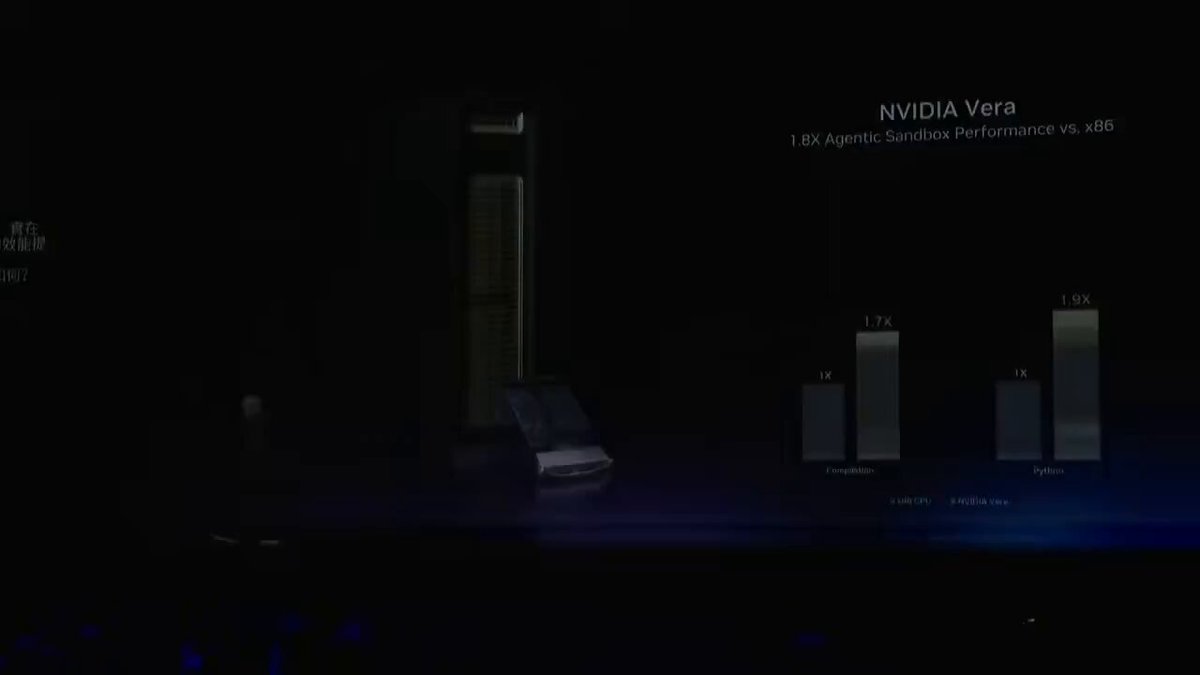
Jensen Huang just identified the next $200 billion market (Save this). The shift starts with a observation about agentic AI that changes everything about infrastructure. In the era of training and inference, the GPU was everything while CPU was a traffic cop, scheduling work, managing memory, dispatching tasks while the GPU did the heavy lifting. Agentic AI breaks that model entirely. An AI agent does not just run a single inference pass but rather it plans, calls tools, executes code in sandboxes, retrieves data from multiple sources and loops through complex multi-step reasoning sequences often thousands of times per second at scale. Every one of those operations runs through the CPU and the GPU sits idle waiting for the CPU to prepare the next task, supply the right context and execute the retrieval and tool calling logic fast enough to keep the accelerators fed. The CPU is now the conductor and the GPU is the orchestra and the bottleneck is the conductor falling behind. This is showing up in production AI factory utilization right now, which is exactly why Jensen built Vera from scratch rather than licensing x86. Vera achieves 40% lower peak memory latency than x86, 50% faster core to core communication, and 1.8 times the agentic sandbox performance of current x86 processors on a purpose-built architecture designed around the agentic loop. Now here is where the investment thesis gets interesting. The obvious beneficiary is Nvidia itself, and that thesis is real. Nvidia's CFO has guided for nearly $20 billion in Vera CPU revenue this fiscal year alone, a market Nvidia had zero presence in just three years ago. Intel held 60% of server CPU market share as recently as Q4 2025 and that transition is now happening at a pace Intel structurally cannot respond to. But the deeper question is, what architecture is Vera actually built on? Vera's Olympus cores are ARM compatible and every single Vera CPU deployed in every Vera Rubin rack in every data center in the world runs on ARM architecture. And ARM Holdings collects a royalty on every one of them. ARM does not make chips but rather licenses the instruction set architecture and CPU core designs that others build on top of. Every time Nvidia ships a Vera CPU, every time a hyperscaler deploys a Vera Rubin rack, every time an enterprise qualifies Vera for their AI factory, ARM earns a royalty. The secular tailwind here is almost perfectly constructed for ARM's business model. Amazon's Graviton, Microsoft's Cobalt, Google's Axion, Apple's silicon stack, and Qualcomm's data center push all run on ARM. And now Nvidia's Vera, which is projected to displace Intel as the largest server CPU supplier by revenue in a single fiscal year, is ARM. ARM's royalty rate on high end server chips is estimated at roughly 1 to 2% of chip selling price. At $5,000 per Vera CPU and 4 million units projected for FY2027, that is a royalty line growing from near zero to potentially $400 million to $800 million annually from Nvidia's data center CPU business alone before counting Amazon, Microsoft, Google, Apple, and Qualcomm. The total ARM addressable royalty base across all the silicon it already licenses is compounding at a rate that the current $130 billion market cap does not fully reflect. Jensen's CPU thesis is the most underappreciated catalyst in ARM's fundamental story, and the royalty compounding has barely started. Come join Milk Road Pro and get our full ARM royalty model and our entire AI trade thesis. Link below!

Milk Road AI

11,819 görüntüleme • 2 ay önce