Загрузка видео...

Не удалось загрузить видео

На главную

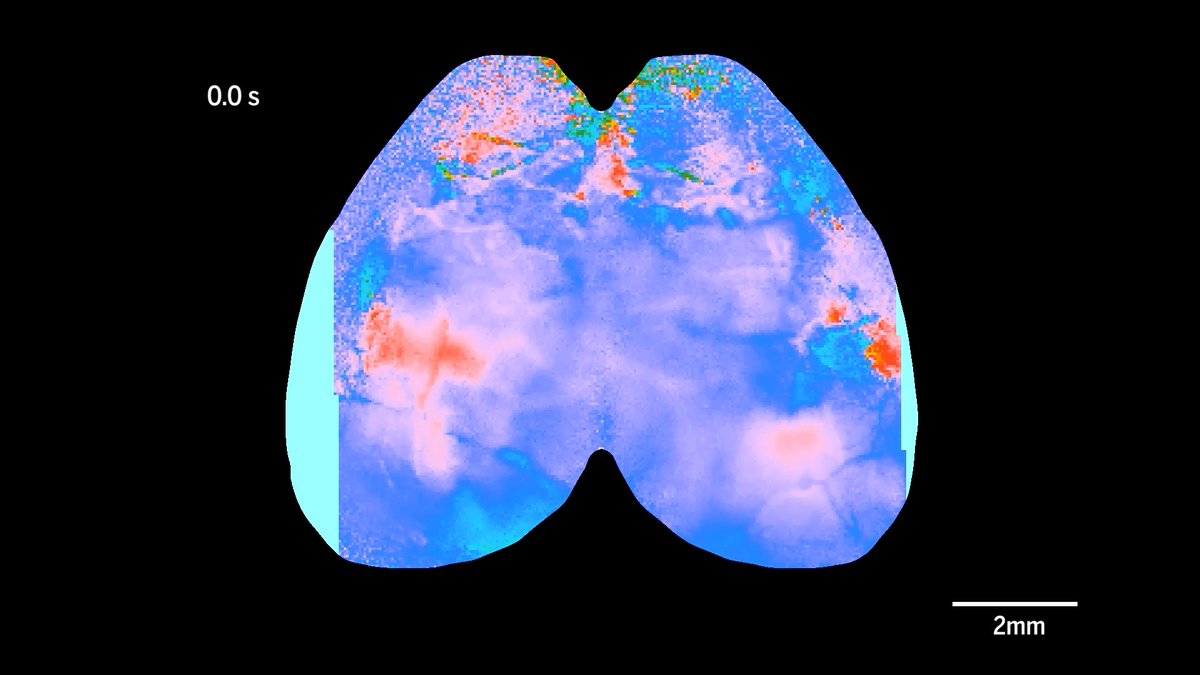
Neurons don’t physically touch—they communicate across tiny gaps called synapses. Signals travel as electrical impulses within a neuron and chemical neurotransmitters between neurons, enabling thought, memory, and movement

71,962 просмотров • 3 месяцев назад •via X (Twitter)

Комментарии: 0

Нет доступных комментариев

Здесь появятся комментарии из оригинального поста

Похожие видео

I've been editing this article about "brain mapping" and connectomics, and I'm just stunned by how quickly the cost estimates to map, say, a mouse brain have plummeted in just the last couple years. It actually seems feasible that we could map the entire human brain -- all 86 billion neurons, and their connections -- in this lifetime. In the 1970s, Sydney Brenner started mapping all the connections between neurons in C. elegans. His team sliced the worm into thin pieces, took photos using an electron microscope, and manually traced and reconstructed each synapse for 302 neurons total. This project took more than a decade of work, and it cost about $16,500 to reconstruct each neuron. Scaling this up to a human brain boggles the mind. Electron microscopy remained the norm in connectomics for decades, because it was the only option available to see synapses at a resolution high enough to be able to trace their paths. Each electron microscope costs several hundreds of thousands of dollars, though, and you need lots of them to map even a mouse brain in a reasonable timeframe. In 2023, the Wellcome Trust released a report estimating how long, and how expensive, it would be to map the mouse connectome (~70M neurons). They estimated that imaging alone would cost $200-300M, and that proofreading (or ensuring that traces between neurons are correct) would cost $7-21 BILLION. (A human can only manually trace about 1 mm of neuron per hour.) Also, the images would occupy about 500 petabytes of data, and getting those data would require 20 electron microscopes running in parallel for about 5 years, continuously. They estimated the whole project would take about 17 years of work. This is, understandably, insane. But now it seems like there's an actual path toward mapping the full mouse brain in about five years for ~$100M dollars. There have been three major breakthroughs in the last year or so: 1/ Expansion microscopy, first developed in 2015, showed that it's possible to "enlarge" the brain by about 5x using a swellable polymer. But an improved method increases this number to >20x expansion, meaning we can now expand brains and image neurons much more easily using cheap light microscopes, rather than expensive electron ones. 2/ E11 Bio (a nonprofit research org) developed protein barcodes that get delivered into brain tissue; each neuron gets a unique combination of barcodes. These cells are then stained with colorful antibodies, which stick to a matching protein barcode, causing each neuron to light up in a distinct color. This makes tracing neurons so much easier. 3/ Google Research released PATHFINDER this May, an AI-based neuron tracing tool that can proofread about 67,200 cubic microns of brain tissue per hour, with very high accuracy. It works on electron micrographs, but something similar could be presumably be developed for the E11 / colorful tag approach. This is an extremely exciting time for neuroscience. (C. elegans connectome below.)

Niko McCarty.

66,819 просмотров • 7 месяцев назад

Visual Preset #03 High Voltage High-end cinematic 3D realism fused with hyper-energized electrical phenomena. Every movement generates branching plasma arcs, snapping lightning filaments, electromagnetic distortion, ionized air ripples and cascading sparks that dance across surfaces instead of conventional energy effects. Electric currents crawl over characters, weapons and environments with rhythmic pulse patterns, while shockwaves illuminate drifting particles, vapor and debris in synchronized flashes. Aggressive camera movement, dramatic perspective, volumetric light shafts, dynamic exposure shifts and dense atmospheric haze amplify every discharge, creating a world where electricity constantly reshapes the surrounding space. Feature-film rendering, physically believable materials and realistic electrical interactions preserve scale, weight and cinematic realism. Seedance 2.0 Prompt for this video: @[character re] lowers into a sprint as brilliant blue-white electricity condenses around one outstretched hand, crackling with violent intensity. Every accelerating step tears glowing fractures through puddles, while branching lightning lashes across the ground and nearby structures. The air warps with electromagnetic distortion as the fighter bursts forward in a blinding dash, piercing through the opponent's guard with a single lightning-charged palm strike. The impact erupts into an explosive sphere of plasma arcs and cascading sparks, briefly freezing the battlefield in white-blue light before the electrical current dissipates into the storm-filled sky. ...rest is visual preset.

Kōda

28,898 просмотров • 21 дней назад

🚨 Scientists just discovered that flies may see the world FASTER than some modern cameras. A new Nature Communications study found that houseflies use a hidden neural process called: “Synaptic high-frequency jumping” allowing their visual system to process motion at nearly ~1000 Hz. For comparison: Human vision ≈ ~60 Hz Gaming monitors ≈ 144–360 Hz This fly system reached nearly 1000 Hz. The craziest part? The fly eye is NOT acting like a passive camera. Its photoreceptors physically MOVE while sensing. Tiny microscopic “microsaccades” dynamically reshape the fly’s visual field in real time reducing blur and predicting motion before signals fully arrive. Researchers found • Neural responses synchronized in ~13–20 milliseconds • Information transfer hit ~4100 bits/sec • Signal timing precision approached ~0.5 ms • Motion blur was actively counteracted during rapid movement Even more insane: The fly’s downstream neurons sometimes peaked BEFORE the incoming visual signal fully peaked. Meaning the system appears to “phase-advance” motion itself. Not consciousness. Not thought. Pure physics-driven predictive computation happening inside the synapse. This could reshape: • AI vision systems • autonomous drones • neuromorphic computing • robotics • event-based cameras Nature may have solved ultra-fast machine vision millions of years ago. And we’re only just noticing. Follow me if you want the newest breakthroughs in physics, quantum tech, AI, and the hidden structures shaping reality.

TheNewPhysics

43,464 просмотров • 2 месяцев назад