正在加载视频...

视频加载失败

NewLimit CEO Jacob Kimmel explains the clinical trial bottleneck AI can't fix: biology has irreducible latency "It's unlikely we're gonna see rapid expedition of clinical trials because a lot of the periods of time can't be expedited based on the biological primitives. In computer science you often have a...

50,797 次观看 • 13 天前 •via X (Twitter)

11 条评论

Braydon Dymm, MD 的头像
Braydon Dymm, MD12 天前

@jacobkimmel What we really need is clinical trial abundance

Tim Peterson 的头像
Tim Peterson12 天前

@jacobkimmel Just say slow

suqitah 的头像
suqitah13 天前

@jacobkimmel does newlimit's model actually move the 10 percent number or just pick better candidates going into the same slow pipe

Mgoes (bio/acc 🤖💉) 的头像
Mgoes (bio/acc 🤖💉)13 天前

@jacobkimmel Very much matches what I dicsussed with Rico from Retro Bio last month

Alex Mercer 的头像
Alex Mercer13 天前

@jacobkimmel AI may not eliminate biology’s inherent latency, but improving clinical success rates could transform drug development. Doubling success from 10% to 20% would be a massive leap in both impact and economics.

Sebastian A. Brunemeier 🏴 🌎 💊 🧬 的头像
Sebastian A. Brunemeier 🏴 🌎 💊 🧬12 天前

@jacobkimmel True

Antonio Regalado 的头像
Antonio Regalado12 天前

@jacobkimmel I like the way this is explained. Moderna just reported out its data for the mRNA vaccine in skin cancer based on 5 year survival. So right there you have 5 year latency for a cancer cure claim.

Ricci Research 的头像
Ricci Research12 天前

The bandwidth/latency framing is exactly right, and it has a financial twin: cost of capital compounds over a fixed 10-year clock you can't shorten, so the only lever left is raising the hit rate. Doubling success from 10% to 20% doesn't just halve cost per approval — it changes what a portfolio is worth at every discount rate.

Neo 的头像
Neo12 天前

@jacobkimmel Trials is the only thing that matters in biotech. They make it brake companies. It’s the end all be all. They take forever and they cost a ton. You cannot work around them. The trials is the drugs.

Sheral Tech 的头像
Sheral Tech12 天前

@jacobkimmel Brilliant insight AI improving trial success rates could revolutionize medicine forever🧬🔥

Lisa 的头像
Lisa11 天前

Our map of human biology is built on sparse, biased data, shallow clinical data and a literature full of contradiction, and which conflates correlation with causation. The bottleneck might not be AI, but actually understanding how human biology moves when we perturb it in non-consensus ways.

相关视频

Bam Adebayo GOES IN on the critics that says his 83 point game performance is unethical: "For the couch coaches, I mean, if you're in my shoes and you have, first of all, y'all are blaming me. You should be blaming the head coach. Get that first. I was not the one letting me go one-on-one the whole game until I had 70, and then you started to send a double. At that point, I got 70 with, like, what? nine minutes left to go in the game you think i'm not going for it like like and that's the thing that's crazy when they talk about the unethical part of the basketball i'm like if i have 70 points with 9 minutes to go Who would just be like, you know, coach, just take me out. Yeah, right. Anybody in my shoes with nine minutes left? Okay. A minute? All right. Nine? Yeah, I'm going for it. You can't be mad at that. If you are mad, I don't care because a lot of people, they're upset because if they did play, they never had a chance to get that close to chasing greatness. And then if you get that close to chasing greatness, that's the point of chasing it so you can surpass it. And some of the people have never played basketball. So like if you've been in the backyard and you and a couple of your homies have been playing 21 and you got 19. You're not going to get an easy look off. And four, they're going to talk about the free throws. It's not like I shoot 15 free throws a game. It's not like I average 10 free throws a game. You can watch the film. I was legitimately getting fouled every time. So I went to the free throw line."

Ahmed/The Ears/IG: BigBizTheGod 🇸🇴

374,056 次观看 • 6 个月前

Jordan Peterson: "If you can't fix your room, you can't fix your life" "Why should you even bother improving yourself? The answer is something like: so you don't suffer anymore stupidly than you have to. And maybe so others don't have to either. It's not some casual self-help doctrine. If you don't organize yourself properly, you'll pay for it. In a big way. And so will the people around you." Peterson continues: "You can say, 'Well, I don't care about that.' But that's actually not true, you do care about it. Because if you're in pain, you will care about it. It's very rare that you can find someone in excruciating pain who would say, 'Well, it would be no better if I was out of this.' Pain brings the idea that it would be better if it didn't exist along with it. It's incontrovertible." On how to start: "Look around for something that bothers you and see if you can fix it. You can do this in a room. Sit in your bedroom and think: 'If I wanted to spend ten minutes making this room better, what would I have to do?' You have to ask yourself that, it's a genuine question. And things will pop out. There's a stack of papers bugging you. Some rubbish behind your computer monitor you haven't attended to for six months. Cables tangled up." He explains why this matters: "If you were coming to see me for psychotherapy, the easiest thing would be to get you to organize your room. You think, is that psychotherapy? It depends on how you conceive the limits of your being. Start where you can start. If something announces itself as in need of repair that you could repair, fix it. Fix a hundred things like that, your life will be a lot different." On fixing what you repeat every day: "People tend to think of their daily routines as trivial. You get up, brush your teeth, have breakfast. Those probably constitute 50% of your life. People think, they're mundane, I don't need to pay attention to them. No, that's exactly wrong. The things you do every day are the most important things you do. Hands down. Just do the arithmetic." On staying within your competence: "Sometimes you don't know how to fix something. Imagine you're walking down the street and there's a guy who's alcoholic and schizophrenic and has been homeless for ten years. That's a problem. It would be good if you could fix it, but you haven't got a clue. You walk around that and go find something you could fix. Just because something announces itself as in need of repair doesn't mean it's you, right then and there, who should repair it. You have to have some humility. You don't walk up to a helicopter that isn't working and just start tinkering away." Peterson shares the key insight: "As soon as you give your mind a genuine aim, it'll reconfigure the world in keeping with that aim. That's actually how you see to begin with. You've all seen the video where you watch basketballs being tossed back and forth, and while you're doing that, a gorilla walks into the middle of the video and you don't see it. If you thought about that experiment for five years, that would be about the right amount of time to spend thinking about it." He explains what it reveals: "What it shows you is that you see what you aim at. If you can get one thing through your head, that would be a good one. You see what you aim at. One inference you might draw from that is: be careful what you aim at. What you aim at determines the way the world manifests itself to you. So if the world is manifesting itself in a very negative way, one thing to ask is: are you aiming at the right thing?"

Jaynit

68,799 次观看 • 4 个月前

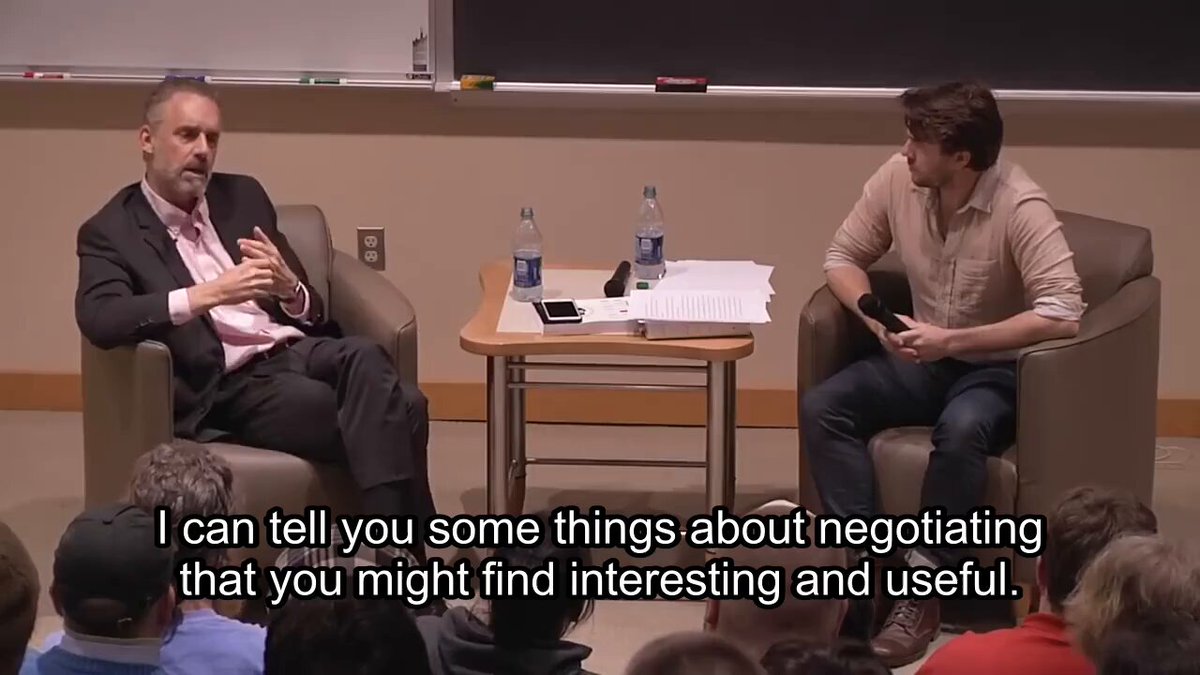
Jordan Peterson: "If you're competent and silent you will be ignored." "You might think well people should reward you because you're competent. And yes of course they should. But if you're competent and silent then you're just part of the background that's keeping everything functioning" On why you cannot negotiate from a position of weakness: "If you want to push your career forward you have to push it forward. You have to be competent and you have to be strategic" "To be strategic when you negotiate for a new position or a new salary you have to be able to say if you don't give me what I want then something you don't like will happen to you" "It's not a physical threat. It's that you have an option" "You have your CV in order. You're educated and competent and desirable to people outside of your immediate job. You're willing to instantly put yourself on the job market" "So that when you go talk to the person you're negotiating with you're credible" On the one thing most people completely miss about negotiation: "It's very seldom that you're talking to the person who's at the top of the pecking order. What you need to do is tell them a story that they can tell to their boss to make you not a problem" "A good story is look we really need this person because they're hyper competent and they have a better offer" "If you go in there with no power you're going to lose. Obviously" He concludes with the one thing every competent person needs to hear: "The first thing you need to know if you're going to negotiate is that you have to be able to say no. And what no means is that you're not going to do it"

Brad

35,334 次观看 • 1 个月前

$ABCL CEO Carl Hansen explains the net negative overall value creation in biotech and how AbCellera plans to beat it: “I really think it can be beat because there’s a lot of mistakes that get made in where you allocate capital.” “If you’re a biotech and you start a company on a drug, and you go public and have a drug, and now the data is looking not that great, you just keep running that drug. … Because if you quit that drug, the company is done.” “So, because you’re so concentrated on one thing, you end up having blinders. It’s like a cult of a molecule. And even a real, practical, capital access problem that makes you continue to move things forward” ______________________________________ “Another problem is that many of the drugs that get started, get started by people who don’t understand the competitive or commercial landscape and have no intent of ever actually manufacturing it. … Because they know someone else is going to buy it. So then their framework is not ‘Am I making a drug that’s going to make a difference for people?’ The framework is ‘Can I make something that I think someone will take off my hands?’ And that happens a lot.” “There are many acquisitions where a big pharma company spends $10B, $20B, and it’s a complete bust. So really no value is generated for patients but someone was able to get a good exit on that because they anticipated what someone would want. And a lot of decision making gets done like that”. _______________________________________ “I’m not saying that we have this all solved. But what we’re trying to do is create a framework where we are able to take many bets so that we don’t fall in love with anything, or we don’t have to fall in love with anything. … And then always hold up very explicitly what we know and what we don’t know along the dimensions that matter. The dimensions that matter are - Will it work? That’s a science. - When it gets where will people care? - Is it differentiated? - Does it solve a big problem? In order to get it there, is there a path with our resources and expertise that would allow us to see it through?” “When you start to hold things up like that, you start to see where the mistakes are, where the uncertainties are, and you can be more rational in deciding ‘We’re going to run it to here because we get to flip the card and if the card goes the wrong way we’re going to kill it because we’ve got something else behind it.’” “I do think that if done right, and if you can pick the right opportunities, the success rate can be well higher than an order of magnitude better. … And there are examples of this… companies I’ve mentioned, you know, Regeneron, their success rate is at least 10x the industry in bringing programs forward and getting them approved. … So it’s… you can do it better that way”

Jack Prescott

31,665 次观看 • 1 个月前

David Friedberg explains that owning a home is worse than investing in stocks Calls it the "Great lie" FRIEDBERG: "This is one of the great lies. Convincing everyone that the great American dream is to own a house. When owning a house for a lot of Americans ends up putting all your capital in one asset, and you've got to basically get the price of housing to go up every year to keep everyone moving up the ladder." "So now, fast forward 30, 40, 50 years, young people can't afford to buy a house anymore because we've pushed the asset value up so much to try and make sure that everyone's got good household wealth." BARTLETT: "We are told. I mean, that's the sort of central idea once you leave university—is to figure out how quickly you can get a mortgage or buy a house." FRIEDBERG: "Great lie. It's one of the great lies. And there's a lot of countries where people have been able to accumulate capital and jump that ravine from labor to capital much more quickly when they don't buy a house because they can invest in stuff. They can buy, you know, the S&P 500, which you can just buy on an E-Trade or Robinhood account, and you can just own it; on average, it will make you 10-11% a year. You just put your money in that, you're making 10-11% a year, and it can go up every year, and you don't have to pay taxes. You don't have to pay property tax. You don't have to pay insurance. You don't have to deal with repairs and maintenance. All that sort of stuff. So, a lot of people would have been better off, depending on the markets that they're in. There's some markets that ballooned, but a lot of people would have been better off over the last 30 years actually owning the S&P 500 than owning their home and paying for the rent on a home."

Tony Jacob | FindaClip.com

449,725 次观看 • 13 天前