Video yükleniyor...

Video Yüklenemedi

Ana Sayfaya Dön

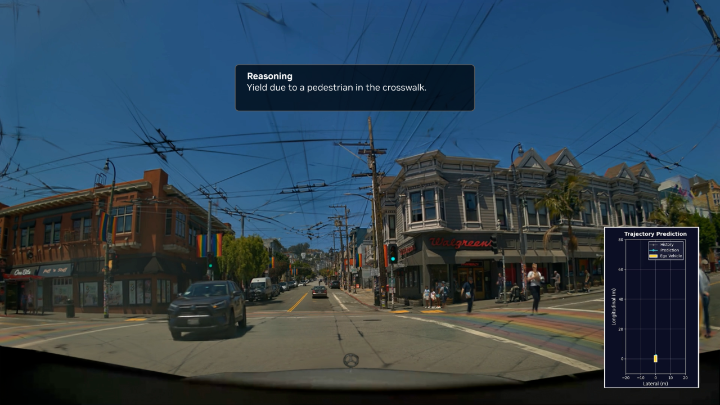
Nvidia has just announced Alpamayo 2 Super, an open 34 billion parameter reasoning vision-language-action model designed to accelerate the development of autonomous vehicles. This new model combines the NVIDIA Cosmos 3 Super reasoning model with a 2 billion parameter diffusion-based action expert model, and is post trained with reinforcement...

40,244 görüntüleme • 1 gün önce •via X (Twitter)

0 Yorum

Yorum bulunmuyor

Orijinal gönderinin yorumları burada görünecek

Benzer Videolar

NEWS: NVIDIA just announced Alpamayo, what CEO Jensen Huang calls the world’s first thinking, reasoning autonomous vehicle AI, launching on U.S. roads later this year, starting with the Mercedes CLA. Jensen: "It's trained end-to-end. Literally from camera in to actuation out; It reasons what action it is about to take, the reason by which is came about that action, and the trajectory." Alpamayo introduces Vision-Language-Action (VLA) models, which enable self-driving systems to interpret what they see, reason about complex driving scenarios, and generate driving actions. The platform includes large reasoning models, simulation tools for testing rare and edge-case scenarios, and open datasets for training and validation. NVIDIA says the approach improves transparency, safety, and robustness in autonomous systems, particularly in complex real-world environments, and supports progress toward higher levels of vehicle autonomy: "With a 10-billion-parameter architecture, Alpamayo 1 uses video input to generate trajectories alongside reasoning traces, showing the logic behind each decision. Developers can adapt Alpamayo 1 into smaller runtime models for vehicle development, or use it as a foundation for AV development tools such as reasoning-based evaluators and auto-labeling systems. Alpamayo 1 provides open model weights and open-source inferencing scripts. Future models in the family will feature larger parameter counts, more detailed reasoning capabilities, more input and output flexibility, and options for commercial usage."

Sawyer Merritt

1,603,926 görüntüleme • 7 ay önce

Small Language Models (SML) are the future of AI. "Small" (SML) instead of "Large" (LLM). These small models are highly specialized models with superhuman abilities on specific tasks. Here are two techniques to build these models: • Spectrum • Model Merging I give you a short introduction in the attached video, but here is a quick summary: Spectrum helps us identify the most relevant layers to solve one specific task. We can ignore everything else and focus on fine-tuning these layers. Using Spectrum, we can fine-tune models in a heartbeat. Model Merging combines multiple models into a unique, much better model than any of the individual input models. You can also combine models specialized in different tasks and get a model with multiple abilities. This is the state of the art of productizing models. It's what Arcee.ai's platform does behind the scenes. Arcee collaborated with me on this post and is sponsoring it. There are three main steps to produce a model for your particular use case: 1. You create a dataset by uploading your data. 2. You train a model. At this step, Arcee uses Spectrum and Model Merging to produce a highly specialized model for your task. 3. You can deploy that model to any environment you want. Three important notes: • Training process is 2x faster and 2x cheaper than regular fine-tuning. • Resultant models are smaller and have higher accuracy. • They create these specialized models from open-source models. Check this site so you can fully appreciate how this works: If you want to fine-tune an open-source model, consider Arcee's platform. This is the state of the art.

Santiago

164,162 görüntüleme • 2 yıl önce