Video wird geladen...

Video konnte nicht geladen werden

Zur Startseite

$NVU Founder Mo Sabry compared #EMASS chip performance with market leaders in #semiconductor sector at the recent presso Market Caps in $USD Broadcom $978B AMD $166B Intel $94B Arm $122B Qualcomm $159B MediaTek $70B Marvell Technology $54B & Nanoveu ?? $17 MILLION
14,057 Aufrufe • vor 1 Jahr •via X (Twitter)

1 Kommentare

Profilbild von Andy J
Andy Jvor 1 Jahr

@Broadcom @AMD @intel @Arm @Qualcomm @MediaTek @MarvellTech @nanoveuofficial You got a screenshot of that page? I'm surprised their chip performance is so good in comparison to peers.....there must be a reason for lack of adoption...? Or just so new?

Ähnliche Videos

India could have been a semiconductor superpower in 1964 but Congress spent the next 50 years making sure every opportunity was killed before it started, the story of what we lost becomes impossible to read without anger. In 1964 Robert Noyce, the co-founder of Intel, came to India with a complete blueprint to make this country the global leader in chip manufacturing. He did not come empty handed. He came with the technology, the vision and the intent to build something that would have changed India's trajectory for generations. Congress sent him to 50 government offices. He got tired. He left. He went to Hong Kong. And Hong Kong's fortunes changed instead of ours. That was not bad luck. That was a policy outcome. The story did not end there. In 1989 India's only chip plant, SCL Mohali, burned down in a fire. The government took 8 years to rebuild it. 8 years. In a sector where technology generations turn over faster than most government files get processed. Then 2005. Intel was ready to bring a 700 million dollar plant to India. UPA government refused to offer tax incentives. Intel walked. In the same era AMD's imported equipment sat at Indian ports for years gathering dust before being sent back to the country it came from. By 2014 India did not have a single commercial chip fabrication plant. Not one. The country that produces a significant portion of the world's semiconductor engineers. The country that built ISRO's computational infrastructure. The country whose mathematicians and scientists power Silicon Valley. Had zero chip plants of its own after 50 years of governance that treated every serious investor like a bureaucratic inconvenience. Now look at the last 12 years. Over 25 billion dollars committed under India's Semiconductor Mission. Micron's plant operational in Gujarat. 80,000 wafers being produced monthly at Taloja. Tata's Assam plant packaging 48 million chips daily. Tata Electronics partnering with ASML for the Dholera fab. India entering the semiconductor supply chain that three countries controlled for decades. The talent was always here. The difference between 1964 and 2024 is not technology. It is not capital. It is not engineering capability. It is a government that finally said yes instead of sending the investor to the 51st office.

Karan Datta 🇮🇳

74,900 Aufrufe • vor 28 Tagen

$AMD| $META is using $GOOGL to negotiate 🧵 The Ironwood pod is 5.1–10x more expensive annually ($148.3 million ÷ $14.87–$29.04 million) and 5.1–10x more expensive monthly ($12.36 million ÷ $1.24–$2.42 million) than renting 15 MI450 racks for equivalent compute. The rapidly evolving landscape of artificial intelligence infrastructure presents a complex interplay of technological innovation, market dynamics, and strategic maneuvering among major players. Recent leaked information suggesting that Meta Platforms ($META) might work with Google's Tensor Processing Unit (TPU) in 2027 has sparked speculation about its true intent. This leak is likely a strategic move by Meta to negotiate more favorable terms with AMD , leveraging the competitive dynamics of the AI hardware market to optimize its substantial investment in AI infrastructure. By examining the key elements of this scenario Meta's investment strategy, the comparative advantages of AMD's MI450 and Google's Ironwood TPU, and the broader market context; we can discern the potential beneficiaries and the strategic implications of this information. Meta's aggressive pursuit of AI capabilities is underscored by its planned expenditure of $66-72 billion on AI infrastructure in 2025, with expectations to escalate significantly in 2026. This investment is part of a broader strategy to build "titan clusters" like Prometheus, which are projected to reach 1 gigawatt of compute power by 2026. Such a scale of investment reflects Meta's recognition of the critical role that AI will play in its future growth, particularly in enhancing its social media platforms and developing new AI-driven applications. However, the financial burden of this infrastructure buildout necessitates a careful consideration of cost-effectiveness and scalability, which brings us to the leaked information about potential collaboration with Google's Ironwood TPU. Google's Ironwood TPU, introduced as the seventh-generation ASIC optimized for TensorFlow-based inference, represents a high-cost, cloud-locked solution priced at $445 million per pod (9,216 chips) over three years. This model, while offering significant performance gains and power efficiency, is tailored for pod-scale deployment and integrated with Google's cloud services, limiting flexibility and increasing costs for customers. In contrast, AMD's MI450 GPU, priced at $30,000–$40,000 per unit, provides a modular, open ROCm ecosystem that delivers comparable compute capacity at a fraction of the cost. Renting 15 MI450 racks could achieve similar 42+ exaFLOPS inference compute at 5–10x lower cost than renting a single Ironwood pod, underscoring AMD's competitive edge in terms of total cost of ownership (TCO). The leaked information about Meta's potential TPU deployment in 2027, therefore, can be interpreted as a negotiating tactic rather than a definitive shift in strategy. By signaling interest in Google's solution, Meta may be attempting to pressure AMD into offering more favorable terms/prices for 5-10GW. This tactic aligns with Meta's broader goal to finance most of its AI spend internally while exploring partnerships that can reduce costs and enhance flexibility. The post's emphasis on MI450's TCO advantage and its partnerships with major players like OpenAI, Microsoft, and Meta itself suggests that AMD is a critical component of Meta's AI infrastructure strategy. The threat of working with Google's TPU could prompt AMD to reassess its pricing, provide additional support, or offer incentives to retain Meta as a customer, thereby securing or expanding its market share. From a logical standpoint, Meta stands to benefit the most from this strategy. As a major buyer in a high-stakes market projected to surpass $1 trillion in annual spending by 2030, Meta's negotiating power is significant. The leaked information could lead to substantial cost savings on its $66-72 billion investment, enhancing its financial flexibility and allowing for further investment in AI capabilities. Moreover, this tactic reinforces Meta's position as a leader in the AI infrastructure race, potentially attracting more external financing for its data center projects and strengthening its competitive stance against other hyperscalers like Amazon and Microsoft. AMD could also benefit from this scenario. The negotiation pressure might lead to small short-term concessions, but it could also solidify long-term partnerships with Meta, ensuring continued demand for MI450 and other AI hardware solutions. Initially Meta's 42% allocation to AMD MI300X and its partnerships with Oracle, Dell, and HP indicates a deep integration of AMD's technology into Meta's infrastructure, which could be leveraged to maintain this relationship. For AMD, retaining Meta as a large key customer is crucial to capturing a larger share of the rapidly growing data center infrastructure market, driven by the insatiable demand for AI compute power. Google, on the other hand, faces a more limited benefit from this leaked information. While securing Meta as a customer would reinforce its position in the AI hardware market, the high cost and ecosystem lock-in of the Ironwood TPU might deter Meta from fully committing to this solution. The leaked information could prompt Google to reconsider its pricing or ecosystem strategy to remain competitive, but the immediate impact is likely to be minimal compared to the potential gains for Meta and AMD. Investors and market analysts also stand to benefit from this information, as it provides insights into the competitive dynamics of the AI hardware market. Adjustments in portfolios based on anticipated shifts in market share and profitability could lead to opportunities for those who correctly anticipate outcomes. The negotiation dynamic might introduce volatility, but it also highlights the strategic importance of cost-effective solutions in the AI infrastructure space. Lastly, the leaked information about Meta potentially working with Google's TPU in 2027 is likely a strategic move to negotiate with AMD, leveraging the competitive landscape to optimize its AI infrastructure investment. Meta, as the primary negotiator, stands to gain the most by securing better terms from AMD, reducing costs, and enhancing its financial flexibility. AMD, while initially at risk, could benefit from retaining a key customer and solidifying its market position. Google faces limited immediate benefits but may need to adapt its strategy to remain competitive. This scenario underscores the complex interplay of technology, market dynamics, and strategic maneuvering in the AI hardware market, where cost-effectiveness and scalability are paramount. As the data center infrastructure market continues to grow, the outcomes of such negotiations will shape the future of AI development and deployment.

Mike

182,273 Aufrufe • vor 8 Monaten

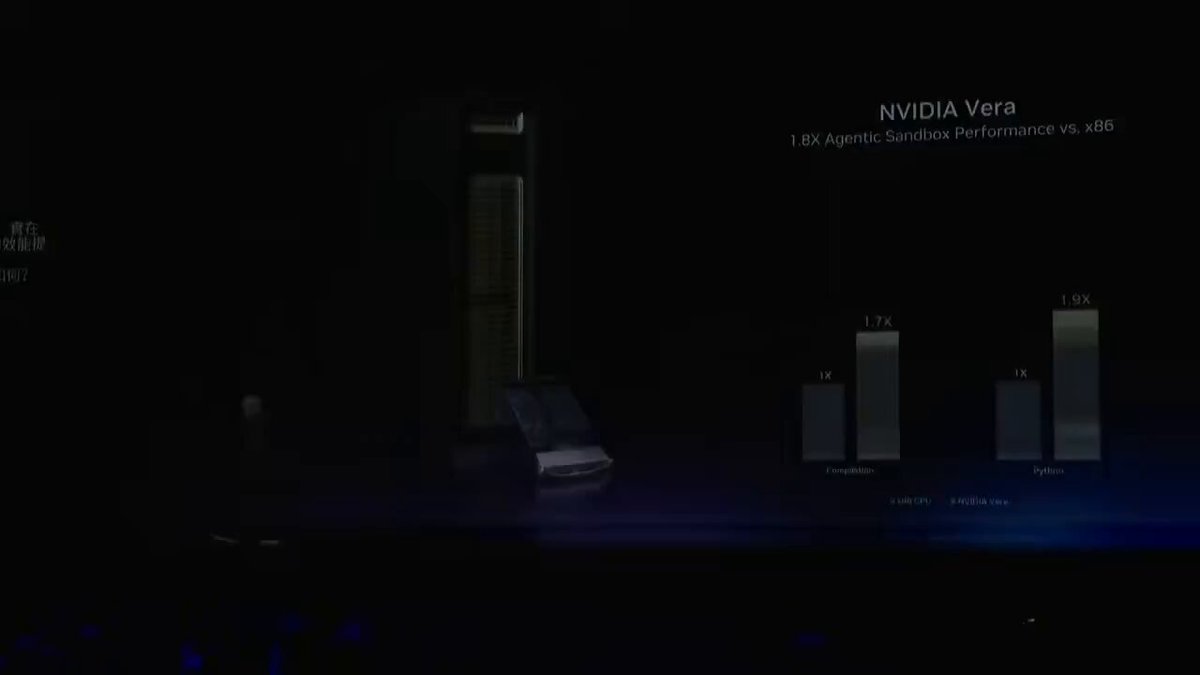
Jensen Huang just identified the next $200 billion market (Save this). The shift starts with a observation about agentic AI that changes everything about infrastructure. In the era of training and inference, the GPU was everything while CPU was a traffic cop, scheduling work, managing memory, dispatching tasks while the GPU did the heavy lifting. Agentic AI breaks that model entirely. An AI agent does not just run a single inference pass but rather it plans, calls tools, executes code in sandboxes, retrieves data from multiple sources and loops through complex multi-step reasoning sequences often thousands of times per second at scale. Every one of those operations runs through the CPU and the GPU sits idle waiting for the CPU to prepare the next task, supply the right context and execute the retrieval and tool calling logic fast enough to keep the accelerators fed. The CPU is now the conductor and the GPU is the orchestra and the bottleneck is the conductor falling behind. This is showing up in production AI factory utilization right now, which is exactly why Jensen built Vera from scratch rather than licensing x86. Vera achieves 40% lower peak memory latency than x86, 50% faster core to core communication, and 1.8 times the agentic sandbox performance of current x86 processors on a purpose-built architecture designed around the agentic loop. Now here is where the investment thesis gets interesting. The obvious beneficiary is Nvidia itself, and that thesis is real. Nvidia's CFO has guided for nearly $20 billion in Vera CPU revenue this fiscal year alone, a market Nvidia had zero presence in just three years ago. Intel held 60% of server CPU market share as recently as Q4 2025 and that transition is now happening at a pace Intel structurally cannot respond to. But the deeper question is, what architecture is Vera actually built on? Vera's Olympus cores are ARM compatible and every single Vera CPU deployed in every Vera Rubin rack in every data center in the world runs on ARM architecture. And ARM Holdings collects a royalty on every one of them. ARM does not make chips but rather licenses the instruction set architecture and CPU core designs that others build on top of. Every time Nvidia ships a Vera CPU, every time a hyperscaler deploys a Vera Rubin rack, every time an enterprise qualifies Vera for their AI factory, ARM earns a royalty. The secular tailwind here is almost perfectly constructed for ARM's business model. Amazon's Graviton, Microsoft's Cobalt, Google's Axion, Apple's silicon stack, and Qualcomm's data center push all run on ARM. And now Nvidia's Vera, which is projected to displace Intel as the largest server CPU supplier by revenue in a single fiscal year, is ARM. ARM's royalty rate on high end server chips is estimated at roughly 1 to 2% of chip selling price. At $5,000 per Vera CPU and 4 million units projected for FY2027, that is a royalty line growing from near zero to potentially $400 million to $800 million annually from Nvidia's data center CPU business alone before counting Amazon, Microsoft, Google, Apple, and Qualcomm. The total ARM addressable royalty base across all the silicon it already licenses is compounding at a rate that the current $130 billion market cap does not fully reflect. Jensen's CPU thesis is the most underappreciated catalyst in ARM's fundamental story, and the royalty compounding has barely started. Come join Milk Road Pro and get our full ARM royalty model and our entire AI trade thesis. Link below!

Milk Road AI

11,819 Aufrufe • vor 2 Monaten

$AMD is ready to break $1 Trillion MC| $TSM 2nm🧵 TLDR FY 2026(Excluding China AI Revenue) AI GPUs: $35-$50B EPYC Data Center: $15B-$17B Client Segment: $12-$13B Gaming: $6B Embedded: $4B-$5B Total Revenue $70-$100B Non-GAAP net income $18B-$25B Non-GAAP EPS $10.97-$15.40 Foward P/E 55x-70x= $603-$1,078 The semiconductor industry is at a pivotal juncture, with advanced process nodes like TSMC's 2nm technology becoming the battleground for leadership in artificial intelligence and high-performance computing (HPC). Amid this landscape, AMD stands poised to secure early production and higher allocation of its Venice (EPYC ) and MI450 (Instinct GPUs) on TSMC's 2nm process. This strategic advantage is not merely a product of timing but a culmination of a robust partnership, market demand, technical superiority, and geopolitical dynamics. The AI and HPC markets are experiencing unprecedented growth, with inference workloads projected to constitute 80-90% of AI compute by 2030. AMD's EPYC processors and Instinct GPUs are uniquely positioned to capitalize on this trend, particularly given the demand from hyperscalers such as OpenAI , $META , $MSFT, $AMZN, and $ORCL. With $TSM starting 2nm Mass Production in Taiwan is ensuring AMD to meet FY2026 $70B to $100B revenue, driven by non-GAAP net income of $18B to $25B highlights the scale of this opportunity, starkly contrasting with analyst revenue consensus of $39-$45B. This discrepancy arises from analysts' failure to account for major orders, notably from OpenAI(Today SoftBank secured OpenAI a massive cash balance of $55-$62B).OpenAI is raising $100B, so this left $77B from UAE, Saudi, $MSFT, and others. $AMD is on track to receive higher allocation of EPYC Venice and Mi450 in 2026. AMD's acquisition of Xilinx has significantly strengthened its position in AI inference, particularly through adaptive computing technologies like FPGA-based AI Engines. The upcoming Zen 6 "Venice" generation (on TSMC 2nm, launching with MI450 in 2026) promises ~1.7× performance uplift, enhanced vector/AI capabilities, greater thread density, and open firmware innovations positioning EPYC to maintain its inference leadership while powering massive hybrid AI superclusters. TSMC's Fab 22 in Kaohsiung, Taiwan, is now the epicenter of 2nm mass production, a earlier strategic move to meet soaring demand from $AMD and $AAPL. Early production slots are typically reserved for customers with the highest revenue potential and strategic importance. AMD's early tape-out of Venice and the MI450's role as the first AMD GPU on 2nm place it at the forefront of this allocation. The 2nm process offers 10-15% higher performance or 25-30% lower power use compared to 3nm, a critical advantage for AI and HPC applications(TSMC claimed) Moreover, TSMC's recent 20% yield improvement in Versal production, as mentioned in related discussions, indicates efficient scaling. Higher yields translate to more chips produced per wafer, reducing costs and increasing allocation for key customers like AMD. This efficiency is particularly important given the aggressive timelines of customers like OpenAI, who require rapid scaling to meet their computational needs. The reopening of the China market adds another layer of demand pressure. Vendors and hyperscalers are begging for allocation of AMD's MI308X, MI300X, and MI355X, and the 2nm capacity will be critical to meet this need. TSMC's early production of 2nm ensures AMD can capitalize on this opportunity, securing higher allocation to fulfill these orders. Dr. Lisa Su's emphasis on disciplined supply chain planning for multiple gigawatt-scale customers, such as OpenAI, demonstrates AMD's readiness to scale. TSMC's confidence in AMD's ability to absorb this capacity is evident in the early 2nm production allocation. This discipline is particularly important in a market where demand outstrips supply by 10-12x. TSMC's competitors, such as Samsung and Intel, are still in the early stages of their 2nm and equivalent processes. Samsung's 2nm GAA transistors and Intel's 18A process are not yet in mass production, giving TSMC and AMD a first-mover advantage. Nvidia's acquisition of Groq Inc. is a defensive move to diversify into inference, but it does not immediately address the 2nm gap. AMD EPYC Venice and future Gen are already ahead of lowest cost for Inference along with MI450 has TCO of $0.65 to $1.00 per million inference tokens, significantly lower than Nvidia's Rubik (H2 2026) at $0.70 to $1.20 and Broadcom's XPU (2027-2029) at $0.70 to $1.30. Additionally, the MI450's TDP is estimated at 1000-1800W, compared to Nvidia's 2300-3600W (Ultra), reducing operational costs and energy consumption(TSMC 2nm vs TSMC 3nm). The MI450 features 432GB of HBM4 memory and 19.6 TB/s bandwidth, surpassing Nvidia's Rubik (288GB HBM4, 16 TB/s) and Broadcom's XPU (192/256GB HBM4, 7 TB/s est). This enhanced memory and bandwidth capacity is essential for handling the complex, data-intensive workloads of large language models and other AI applications. AMD's full-stack vision, combining EPYC hosts with Instinct accelerators, offers the lowest total cost of ownership (TCO) and thermal design power (TDP). This synergy is unbeatable for both training and inference, further justifying TSMC's prioritization. The 2nm process amplifies these advantages, ensuring AMD can maintain its competitive edge over rivals like Nvidia, whose Rubin GPUs are still on N3P (a 3nm derivative). Today, TSMC just secured $AMD to join the top 10 largest companies in the world as it begins 2nm mass production in Taiwan. AMD and Apple are to receive highest allocation. The long-standing partnership with TSMC, massive demand from hyperscalers, technical advantages of 2nm, and disciplined supply chain planning all point to AMD's favored position. The 2nm process's early mass production at Fab 22, combined with AMD's revenue potential and competitive edge, justifies TSMC's prioritization. This allocation is critical for AMD to meet aggressive demand, capture market share, and solidify its position as a leader in AI and HPC, especially in the inference-dominated future. Dr. Lisa Su "We will multiple customers/hyperscalers at GW scale" Not Financial Advice!

Mike

43,219 Aufrufe • vor 7 Monaten

$AMD $MSFT Partnership is MASSIVE in 2026 🚀 If you were excited about my thread on $AMD $AMZN AWS long time partnership, you will be even more excited about what Microsoft gonna do with 2026 AMD EPYC "Venice". Historical Context: The relationship between AMD and Microsoft began in the early 2000s, with Microsoft initially focusing on Intel's x86 architecture for its Windows operating system and server products. However, AMD's entry into the server market with its Opteron processors in 2003 marked the beginning of a competitive dynamic that eventually led to collaboration. The partnership intensified with the launch of 3rd Generation EPYC "Milan" in 2021, powering Azure's N2D and C2D VM families. By 2025, Microsoft had integrated 5th Generation EPYC "Turin" into new compute-optimized instances, reflecting a strategic shift towards AMD for cost and performance benefits. This "Secret Weapon" breakthrough will mark another inflection point for AMD Microsoft Azure relationship, will probably be more aggressive than EPYC "Milan" moment in 2021. We can call it EPYC "Venice" moment 2026" 1. Technical performance of AMD EPYC "Venice" (2026) AMD's 6th Gen EPYC "Venice" processors, slated for 2026, introduce New Chiplet design breakthrough. a revolutionary chiplet interconnect fabric that redefines server scalability for AI. This isn't just faster silicon; it's a paradigm shift for Microsoft Azure , enabling hyper-efficient, rack-scale AI inference that slashes costs and latency while boosting throughput. ~Up to 256 Zen 6 cores, a 70% performance increase over "Turin," optimized for AI and HPC. ~Memory and Bandwidth: 1.6 TB/s per socket, doubling "Turin's" capability, with support for MR-DIMM/MCR-DIMM. ~Efficiency: 1,500-1,700W power draw, a 50% reduction, aligning with Microsoft's sustainability initiatives. ~Interconnect: PCIe 6.0 and a new chiplet fabric for rack-scale AI, reducing latency and enhancing scalability. 2. Why $MSFT will adopt $AMD YPYC Share to 50%+ in 2026. AMD EPYC Share: ~30-35% of Azure's x86 CPU-based business while Intel Xeon share is 65% Microsoft's Azure has been progressively integrating AMD EPYC, with "Venice" expected to expand this footprint: A. Dominance of AI Inference Workloads ~AI inference constitutes 80% of AI workloads in cloud environments, with latency-sensitive applications like chatbots, recommendation engines, and fraud detection requiring sub-second response times. ~"Venice's" 35x inference performance uplift directly addresses these requirements, outperforming Intel's offerings and custom Arm solutions in multi-threaded scenarios. B. Cost Efficiency and Operational Savings ~Azure's 2025 capex of $118B is under pressure to deliver returns. "Venice" can reduce operational expenses by $20-30B annually due to its power efficiency and performance gains, improving Azure's margins to 35-40%. ~The cost per inference operation is significantly lower with "Venice," estimated at 24-31% less than Intel-based alternatives, enhancing Azure's competitiveness against AWS and GCP. C. Scalability for Enterprise AI: ~"Venice" supports rack-scale AI deployments, enabling Azure to scale AI services for enterprise customers. For example, a 1,000-node cluster can process 700,000+ tokens per second, crucial for large-scale AI applications like personalized marketing and predictive analytics. ~This scalability is particularly important as Azure aims to capture the $100B+ AI opportunity by 2026, as stated by Microsoft CEO Satya Nadella. D. Reduction of Nvidia Dependency ~While Nvidia ( $NVDA) dominates AI accelerators, AMD's integrated EPYC-GPU solutions (MI450 with "Venice") offer a balanced approach, reducing Azure's reliance on Nvidia's high-cost GPUs. ~"Venice" enables hybrid inference models, where CPU-based inference handles 80% of workloads, and GPU acceleration is reserved for training and complex tasks, optimizing resource allocation. 3. Financial Implication: ~Revenue from Azure could reach $15-18B annually by 2026, part of a total revenue projection of $70-100B ~Profit margins could improve to 55-60%, boosting net income to $20-25B, supported by scale economies and reduced production costs. Intel could respond by giving more aggressive discounts, but this breakthrough has been a decade long of $AMD R&D, or rethinking chiplet design, a complete new approach. "Venice's" lead in AI inference and efficiency is challenging to match. Broader Industry: Other hyperscalers ( Amazon Web Services , GCP) and enterprises will follow Azure's lead, standardizing EPYC technology and pressuring Intel further. This could lead to a broader industry shift towards AMD, enhancing its ecosystem and bargaining power. Conclusion: The strategic adoption of AMD's 6th Generation EPYC "Venice" processors by Microsoft Azure in 2026 marks a pivotal moment in the evolution of cloud computing, particularly for AI inference capabilities. "Venice's" groundbreaking chiplet design, offering a 35x performance uplift for AI inference tasks, a 50% reduction in power consumption, and unparalleled scalability, positions Azure to leapfrog its competitors in the race for AI dominance. This technical superiority, combined with significant cost savings potentially $20-30B annually in operational expenses; aligns perfectly with Microsoft's ambitions to capture the $100B+ Revenue AI opportunity by 2026. The shift to 50% x86 market share for AMD within Azure is not merely a technical transition but a strategic realignment that redefines the competitive landscape. Historically, Microsoft's partnership with AMD has evolved from niche deployments to a core component of Azure's infrastructure, and "Venice" accelerates this trend. The 30-35% AMD EPYC share in 2025 is expected to double, driven by new VM families like C4D and H4D, which will dominate AI-intensive and HPC workloads. This migration is incentivized by "Venice's" efficiency gains, reducing dependency on Intel and Nvidia, and enhancing Azure's sustainability profile. Not Financial Advice!

Mike

141,018 Aufrufe • vor 10 Monaten

$AMD $5 Trillion is Inevitable LT| Agentic AI🧵 Agentic AI is the new $5 Trillion TAM 🚨🚨🚨 This thead will do Comp with $INTC and how to quantify this massive Agentic AI demand spike, and forcing Jensen to rush a CPU design. Global Agentic AI Market size is estimated to be $3-$5Trillion TAM by 2030(McKinsey) Quantifying the demand from agentic AI for AMD involves assessing the broader market growth for agentic systems, their unique computational requirements (particularly for CPUs in orchestration and reasoning tasks), and AMD's positioning very well through products like EPYC processors and partnerships. AMD EPYC Venice is the most superior choice in 2026-2027 for most Agentic AI workloads Agentic AI refers to autonomous AI agents that perform multi-step tasks, involving sequential logic, tool integration, and decision-making workloads that heavily rely on CPUs for handling orchestration, memory management, and context switching, rather than just GPU-parallelized training or batch inference. Agentic AI is often cited as 40-100x more "hungry" than traditional AI due to its continuous, 24/7 operation and complex workflows. This stems from factors like chain-of-thought reasoning (multiple LLM calls per query), API/tool interactions, memory management, and orchestration loops, which can generate 10-100x more tokens and require real-time responsiveness. For example, a single agentic query might trigger 5-20 model inferences, making it 10-20x more compute-intensive than simple chatbots, and the always-on nature compounds this to 40-100x overall. Nvidia's CEO has highlighted this as driving "easily 100x more computation" for inference in agentic/reasoning setups. AMD's EPYC Venice (6th Gen EPYC, codenamed "Venice") and Intel's Xeon 7 Diamond Rapids represent the pinnacle of server CPU technology in 2026, both targeting high-performance data center workloads like AI inference, agentic AI orchestration, cloud computing, and HPC. Venice builds on AMD's Zen 6 architecture, emphasizing core density and efficiency, while Diamond Rapids leverages Intel's Panther Cove P-cores for balanced performance. Both chips adopt similar advancements like 16-channel DDR5 memory and PCIe Gen 6, but differ in core counts, process nodes, and overall design philosophy. Intel has faced acute supply constraints across its Xeon lineup, including legacy nodes (Intel 7/3) and the ramping 18A process for next-gen parts. Intel shortage is expected with lead times up to 6 months or longer. 1. AMD EPYC Venice vs Intel Xeon 7 Diamond Rapids Architecture AMD: Zen 6 chiplet design with 8 CCDs and dual IODs Intel: Panther Cove P-cores; multi-die architecture with 4 compute tiles Core/Thread Count AMD: Up to 256 cores / 512 threads (Zen 6c variant) Intel: Up to 192 cores / 192 threads Process Node AMD: TSMC N2 (2nm) Intel: Intel 18A (1.8nm-class); in-house fab Memory Support AMD: 16-channel DDR5; up to 1.6 TB/s bandwidth. Intel: 16-channel DDR5 ; up to 1.6 TB/s bandwidth I/O and Connectivity AMD: PCIe Gen 6 (up to 128 lanes); twice the CPU-to-GPU bandwidth Intel: PCIe Gen 6 (up to 128 lanes); LGA 9324 socket Power (TDP) AMD: Starting 400-500W, potentially lower due to efficiency gains from TSMC 2nm Intel: Starting 400-500W, as it targets competitive efficiency Performance Projections AMD: Up to 70% uplift vs. 5th Gen Turin (1.7x in multi-threaded/AI tasks) Intel: ~40% faster than Granite Rapids (Xeon 6, 128-core). Lags AMD in per-core perf and 40-50% behind Venice core-for-core comp Target Workloads AMD: AI inference/orchestration, HPC, cloud virtualization. Partnerships Intel: Hyperscale AI, general enterprise. Custom silicon Pricing: AMD: estimated $10k-$20k for top SKUs Intel: estimated $8-$18k Availability: AMD: Significant Ramp H2 2026 due to higher allocation from TSMC Intel: H1-H2 2026 delayed, but trying to catch up Overall: ~Venice's 256 cores provide a 33% edge over Diamond Rapids' 192, making it superior for massively parallel tasks like AI training/inference or virtualization ~TSMC's N2 vs. Intel 18A debates rage on which is "better," but AMD's mature chiplet approach yields better density ( 32 cores/CCD vs. Intel's 48/tile). Venice's redesign reduces latency, aiding agentic AI where CPUs handle orchestration ~ Early projections show Venice widening AMD's lead matching or exceeding Diamond Rapids' perf with fewer watts in multi-threaded benchmarks. Intel's no-SMT design (to prioritize AI) handicaps it vs. AMD's 512 threads, though Clearwater Forest (E-core) could compete in density-focused niches. ~Power & Cooling: Both push above 400-500W, demanding liquid cooling. ~AMD been taking market share now above 40%. AMD EPYC Venice emerges as the superior choice in 2026 for most server workloads. Its higher core/thread count (256/512 vs. 192/192), stronger per-core performance, and architecture optimized for AI-driven tasks (agentic orchestration with GPU integration) provide decisive advantages in throughput, scalability, and efficiency. Projections indicate Venice delivering 1.7x the performance of prior gens while widening the gap over Intel ( 40-70% leads in multi-threaded benchmarks). AMD's fabless model with TSMC ensures reliable scaling, and its ecosystem ( open ROCm) appeals to AI adopters. Intel's Diamond Rapids is competitive in single-threaded enterprise apps and custom hyperscale ( NVLink), with potential fab advantages for supply/security. However, without SMT and lower density, it falls short in core-for-core battles—exposing Intel to another generation of AMD dominance unless 18A yields surprise efficiency gains. For data centers prioritizing raw compute ( AI, HPC), Venice wins; for Intel-centric ecosystems or specialized I/O, Diamond Rapids holds ground. Real benchmarks post-launch will confirm, but logic points to AMD pulling ahead. 2. Market size , Potential Revenue and Supply Global Agentic AI market size is projected to be $3-$5 Trillion by 2030 according to McKinsey, where consensus points to 40-50% CAGR driven by small to large enterprise demand. I also wrote a full thread on how and why Agentic AI is so explosive that AMD will blow all anlaysts estimate for subscribers. Link below if you are interested. AMD's data center segment hit a record $5.4B in Q4 2025 (up 39% YoY), with EPYC shipments ramping due to agentic demand. With 2GW of deployment in H2 2026, AMD AI data center revenue has $40-$50B+ at the lowest or most conservative projection; or Total Revenue in the $77-$94B For FY2026. However, Agentic AI massive demand spike could send EPYC revenue 3x to 4x in the next few years, potentially surpassing MI series GPU demand as enterprises prioritize CPU-dense Rack setups. This is pushing $NVDA Jensen to rush a CPU design and acquired Groq, a new CPU player due to this massive TAM. Noted that this is just popping just in weeks, highlighting we are just so early in this AI Supercycle and the pace of adoption is insane, and clearly productivity will skyrocket. Why? Because Agentic AI is 24/7 Smart AI agent working for you or your businesses is a mad compelling, and it is estimated to be 40-100x more Inference Hugnry! Many experts already said it is impossible to project this kind of Inference Demand. AI CapEx is expected to ramp up even more in 2027-2028-2029 and 2030 as Global Agentic AI is going to scale to $3-$5 Trillion TAM by 2030. The nature of Agentic is driving higher CPU/GPU ratio, with CPUs handling 50-90% of Agentic workflows. For example, The current Helios Rack: 18 compute trays per rack with 72 GPUs + 18 CPUs. The beauty of this $META and $AMD long term partnership is, that it is absolutely flexible to adjust racks to higher CPU rato or equal to service different needs. Helios rack can be easily swap to 2 GPUs 2CPUs or even CPUs only trays for dedicated orchestration/head nodes. You see, the beauty of this open rack-scale is flexibility and evolvability. If Agentic AI demand pushes much higher, AMD should be able to adjust variant trays without abandoning Heilos Rack. We can't talk just about massive Agentic AI demand without talking about the Supply side or TSMC. TSMC, AMD's primary foundry for advanced nodes ( Zen 6/Venice on N2/2nm), is addressing AI-driven shortages through massive expansions. TSMC accelerates fab construction with up to 10 facilities targeted for 2026. TSMC is accelerating its domestic manufacturing expansion, with industry sources indicating that as many as ten fabs could be under construction or preparing to begin operations across Taiwan’s major science parks. TSMC Capex: $52-56B in 2026 (up 37% YoY), with $45B already approved for new/upgraded capacities. 70-80% for advanced processes (2nm/A16), 10-20% for packaging (CoWoS quadrupling to 120-140K wafers/month by late 2026). In addition, Taiwanese companies (led by TSMC) commit to at least $250B in direct investments in US-based advanced semiconductor, AI, and energy production/innovation capacity.Taiwan provides $250B in government credit guarantees to facilitate additional investments and build a full US semiconductor ecosystem (including industrial parks). TSMC completed a second land purchase in Arizona (January 2026) for gigafab scaling, with an additional $100B+ (potentially four more modules) to further expand and qualify for tariff exemptions. AMD with secured 12GW from OpenAI and $META and massive Agentic AI will mean higher priority acess to 20-30% more wafers on TSMC advanced nodes, as TSMC has multi-year agreements with AMD for AI chips. Dr. C. C. Wei, CEO of TSMC quote: "I spend a lot of time in the last three or four months talking to my customer and then customers. Customer. I want to make sure that my customers demand are real. I talk to those cloud service providers, all of them. Their answer is. I'm quite satisfied with their answer. Actually they show me the evidence that the AI really help their business. So they grow their business successfully and he or she in their financial return. So I also double check their financial status. They are very rich." Amid shortages, the US buildout ensures AMD can ramp production of Instinct GPUs and EPYC CPUs without the constraints hitting competitors like Intel. By diversifying away from Taiwan (85% of advanced nodes today), the agreement mitigates supply disruptions, ensuring stable flows for AMD's chips. Scaling production and securing supply will matter for AMD the most in the next 5-10 years growth. The growth could be 80-100% YoY or higher; or it could be in the 60%. The aggressive TSMC supply ramp is reassuring the higher growth point. Conclusion: AMD stands at a pivotal inflection point in 2026, where the explosive rise of agentic AI demanding 40-100x more inference compute through its 24/7, multi-step orchestration positions the company to potentially triple its EPYC CPU revenue to $45-60B+ by 2028 while scaling Instinct GPUs to tens of billions annually by 2027. Agentic AI demand could push AI CapEx closer to $1 Trillion in 2027, far higher than most estimates. Dr. Lisa Su, AMD's visionary CEO, is masterfully securing supply to harness this massive demand by prioritizing operational execution and deep TSMC collaboration, ensuring readiness for the second-half 2026 AI ramp. Dr. Su has explicitly called out surging EPYC demand for agentic tasks where CPUs power head nodes and traditional workloads alongside GPUs while guiding for data center dominance through proactive capacity planning and partnerships like Nutanix ($150M investment for open agentic platforms) or providing tens of millions CPUs for OpenAI, $META, $ORCL, $AMZN, $MSFT, $GOOGL and others. Her strategy includes multi-year TSMC agreements for advanced nodes (N2 for Venice CPUs and future Instincts), diversifying beyond Taiwan to mitigate risks, and unveiling innovations like the MI455X GPU at CES 2026, which she touted as enabling "the next trillion-dollar market opportunity" in physical AI. Dr. Su's forward-looking vision predicting AI reaching 5 billion users emphasizes "AI everywhere," backed by hardware like Ryzen AI chips, all while declaring demand "going through the roof" and committing to scale without bottlenecks. TSMC's aggressive ramp-up, fueled by $52-56B in 2026 capex (up 37% YoY) and 10+ new fabs across Taiwan, the US (Arizona cluster expanding to 6+ modules with $165B+ investment), Japan, and Europe, provides profound reassurance for AMD's supply stability. The January 2026 US-Taiwan agreement committing $250B in investments and credit guarantees for US reshoring accelerates this, granting tariff relief (15% rates with 1.5-2.5x exemptions) tied to capacity buildouts, enabling TSMC to potentially double output over the decade to meet AI wafer hunger. This translates to 20-30% higher wafer allocations on key nodes, sidestepping Intel-like shortages and empowering Dr. Su's team to deliver on hyperscaler demands without disruption. Ultimately, this synergy cements AMD's leadership in the agentic era, promising sustained growth, $5T+ valuations at scale, and a resilient path forward as AI reshapes the world. This is NOT Financial Advice! Video source: AMD CES 2026

Mike

44,460 Aufrufe • vor 5 Monaten

In 2016, Marvell's largest design win was a Wi-Fi chip in the Barbie Dream House (Save this). That is a documented fact about one of the most remarkable corporate transformations in semiconductor history. Ten years and $36 billion in acquisitions later, Marvell is now the company that Jensen Huang invites onto the COMPUTEX stage, the same stage where he announced a $2 billion strategic investment into the company. Over 75% of Marvell's revenue today comes from data centers. To understand what Marvell actually is now, you need to understand what Matt Murphy did when he walked in as CEO in 2016. The company had stagnant growth, governance scandals, and a business model built around chips for hard drives, printers, and consumer electronics, exactly the wrong place to be as the cloud era was beginning. Murphy made a ruthless decision to kill every low margin consumer business and go all in on data infrastructure. Then he went shopping. 2018 - Acquired Cavium for $6 billion, bringing ARM-based network processors and the foundation for cloud infrastructure compute. 2019 - Acquired Avera Semiconductor, formerly IBM's custom silicon team, which gave Marvell the ability to design bespoke ASICs for hyperscalers. This is what opened the door to Amazon, Microsoft, and Google design wins. 2021 - Acquired Inphi for $8.2 billion, securing leadership in high-speed optical interconnect, the technology that moves data between and within data centers at the speed of light. 2021 - Acquired Innovium, adding cloud-optimized Ethernet switching to the portfolio. 2025/2026 - Acquired Celestial AI for $3.25 billion, bringing photonic fabric technology that places optical connections directly inside the chip package itself. Each acquisition followed the same formula, buy the technology that will be absolutely essential in the next generation of computing before anyone else is paying attention. Now here's the vision Murphy laid out at COMPUTEX 2026, and why it's the most important thing he's ever said publicly. He made one central argument, AI scaling is no longer limited by compute or memory but rather limited by connectivity. Training a frontier model requires tens of thousands and eventually millions of processors working as a single engine and making that happen is a connectivity problem above all else. Today, data centers are constrained by copper. Copper traces connecting chips inside a server can only move data so far, so fast, before bandwidth collapses and latency rises, that's why today's AI servers have to bundle everything, CPUs, GPUs, memory onto the same physical board sitting centimeters apart. When you replace copper with optics, distance disappears entirely. An optically connected server rack can communicate with another rack in a different building at the same bandwidth and latency as if they were the same machine. Memory can sit in one physical location, compute in another, networking in a third and a software orchestration layer composes the exact ratio the workload needs, on the fly, in real time. Murphy called this a data center without distance, a globally optically interconnected infrastructure where the rigid physical boundaries of today's servers begin to disappear entirely, and data centers function as one unified system. That is not a 10 year vision because Marvell's CPO (co-packaged optics) products are sampling in 2027 with volume shipments beginning 2028. Nvidia's Vera Rubin platform has already adopted Spectrum-X Ethernet Photonics, the first CPO switch in commercial production. The reason this makes Marvell's TAM almost impossible to cap is the following. Right now, Marvell's addressable market is the optical interconnect market, a segment projected to be worth $200 billion per year by end of decade. But if the data center without distance architecture actually materializes and the evidence suggests it will, then Marvell's TAM is not just the optical interconnect market but rather every connection in every data center on earth. Bullish on Marvel! Come join Milk Road Pro for just a $1, If you want the full Marvell breakdown on where it sits in our AI infrastructure portfolio, and our entire AI thesis. Link below!

Milk Road AI

21,550 Aufrufe • vor 2 Monaten

Trump just got exposed for running the biggest insider trading operation in American history. Nancy Pelosi traded $5 million in stocks and Congress lost its mind. Trump literally executed $750 MILLION worth of stock trades in ONE quarter while being President. His ethics filing just dropped and the numbers are genuinely unprecedented in history: Between January and March 2026, Donald Trump personally executed 3,700 individual stock transactions worth between $220 million and $750 million. That's roughly 60 trades PER DAY. While signing executive orders, meeting foreign leaders, and making policy decisions that directly impact the companies he's buying and selling. Now here's where it gets really insane: On February 10, Trump bought between $1 million and $5 million worth of Dell stock. Three months later, on May 8, he stood at a Mother's Day event at the White House, thanked Michael Dell by name, and told Americans to "go out and buy a Dell." Dell stock surged 14.6% that day to an all-time high of $263.99. Since Trump's February purchase, Dell is up 96%. And 5 months BEFORE Trump bought Dell stock, Michael and Susan Dell donated $6.25 billion to Trump Accounts, one of the largest philanthropic commitments to a sitting president's signature program in modern history. So the timeline goes: Dell donates $6.25 billion to Trump's program -> Trump buys Dell stock ->Trump tells America to buy Dell from the White House podium -> Stock hits all-time high And that's just ONE stock... The same filing shows Trump bought Nvidia stock on February 10. One week later, Nvidia announced a massive chip deal with Meta. He bought more Nvidia stock one week BEFORE his own Commerce Department approved the sale of Nvidia chips to Saudi Arabia. He bought Intel stock starting in March 2026. The US government already owned a 9.9% stake in Intel worth over $41 billion. On April 30, Trump posted on Truth Social praising Intel, writing that "Intel Stock continues to rise." Intel jumped 3% in after-hours and is now up 140% year-to-date. He bought Palantir stock while his administration was actively handing them billion-dollar government contracts for immigration enforcement and defense. He bought Robinhood stock while his own Trump Accounts program uses Robinhood as the broker. He's currently sitting on over 100% profit on AMD, Intel, Bloom Energy, Marvell Technology, and at least 10 other positions. Every single president since Lyndon B. Johnson has used a blind trust to avoid exactly this situation. But Trump didn't. His assets sit in a trust controlled by his own children, and the filings show a broker acted as agent on several trades. The White House says the portfolio is "independently managed." But here's what independently managed looks like: Buy Dell stock. Three months later, publicly endorse Dell from the White House. Stock hits all-time high. Buy Nvidia stock. One week later, your own government approves their chip sales. Stock rips. Buy Intel stock. Post about Intel on Truth Social. Stock jumps. The government you run already owns a 10% stake. Buy Palantir. Hand them contracts. Buy Robinhood. Route a federal program through their platform. Nancy Pelosi got absolutely destroyed for her husband's stock trades. Her husband's total disclosed trades in his most controversial year were worth roughly $5 million. Trump just disclosed up to $750 MILLION in a single quarter. While making the actual policy decisions that move these stocks. This isn't a left or right issue. We're talking about the President of the United States averaging 60 stock trades per day in companies his own administration regulates, contracts with, and publicly endorses. What do you think?

Ricardo

2,098,757 Aufrufe • vor 3 Monaten

Trump got exposed for running the biggest insider trading operation in American history. Nancy Pelosi traded $5 million in stocks and Congress lost its mind. Trump literally executed $750 MILLION worth of stock trades in ONE quarter while being President. His ethics filing just dropped and the numbers are genuinely unprecedented in history: Between January and March 2026, Donald Trump personally executed 3,700 individual stock transactions worth between $220 million and $750 million. That's roughly 60 trades PER DAY. While signing executive orders, meeting foreign leaders, and making policy decisions that directly impact the companies he's buying and selling. Now here's where it gets really insane: On February 10, Trump bought between $1 million and $5 million worth of Dell stock. Three months later, on May 8, he stood at a Mother's Day event at the White House, thanked Michael Dell by name, and told Americans to "go out and buy a Dell." Dell stock surged 14.6% that day to an all-time high of $263.99. Since Trump's February purchase, Dell is up 96%. And 5 months BEFORE Trump bought Dell stock, Michael and Susan Dell donated $6.25 billion to Trump Accounts, one of the largest philanthropic commitments to a sitting president's signature program in modern history. So the timeline goes: Dell donates $6.25 billion to Trump's program -> Trump buys Dell stock ->Trump tells America to buy Dell from the White House podium -> Stock hits all-time high And that's just ONE stock... The same filing shows Trump bought Nvidia stock on February 10. One week later, Nvidia announced a massive chip deal with Meta. He bought more Nvidia stock one week BEFORE his own Commerce Department approved the sale of Nvidia chips to Saudi Arabia. He bought Intel stock starting in March 2026. The US government already owned a 9.9% stake in Intel worth over $41 billion. On April 30, Trump posted on Truth Social praising Intel, writing that "Intel Stock continues to rise." Intel jumped 3% in after-hours and is now up 140% year-to-date. He bought Palantir stock while his administration was actively handing them billion-dollar government contracts for immigration enforcement and defense. He bought Robinhood stock while his own Trump Accounts program uses Robinhood as the broker. He's currently sitting on over 100% profit on AMD, Intel, Bloom Energy, Marvell Technology, and at least 10 other positions. Every single president since Lyndon B. Johnson has used a blind trust to avoid exactly this situation. But Trump didn't. His assets sit in a trust controlled by his own children, and the filings show a broker acted as agent on several trades. The White House says the portfolio is "independently managed." But here's what independently managed looks like: Buy Dell stock. Three months later, publicly endorse Dell from the White House. Stock hits all-time high. Buy Nvidia stock. One week later, your own government approves their chip sales. Stock rips. Buy Intel stock. Post about Intel on Truth Social. Stock jumps. The government you run already owns a 10% stake. Buy Palantir. Hand them contracts. Buy Robinhood. Route a federal program through their platform. Nancy Pelosi got absolutely destroyed for her husband's stock trades. Her husband's total disclosed trades in his most controversial year were worth roughly $5 million. Trump just disclosed up to $750 MILLION in a single quarter. While making the actual policy decisions that move these stocks. This isn't a left or right issue. We're talking about the President of the United States averaging 60 stock trades per day in companies his own administration regulates, contracts with, and publicly endorses. What do you think?

Teddy - PolyBackTest.com

21,594 Aufrufe • vor 1 Monat

Nvidia chips have become the most smuggled technology on the planet. And the criminal networks moving them look EXACTLY like drug cartels. The entire operation just got exposed, and the details are absolutely insane: A co-founder of Supermicro, one of Nvidia's biggest hardware partners, was secretly running a $2.5 BILLION smuggling pipeline to China. Servers were assembled in the US, shipped to Taiwan, repackaged into unmarked boxes at a shell company in Southeast Asia, then forwarded to Chinese buyers who wanted the chips inside. $510 million worth of servers moved to China in just THREE WEEKS. When a broker sent him a news article about other chip smugglers getting arrested by the feds, the co-founder replied with sobbing emojis on his encrypted chat. Then kept going. This is the same Supermicro that helped Elon Musk build his Colossus AI cluster in 122 days. The same company flagging $13 billion in Nvidia Blackwell orders on their earnings call. And their co-founder was running the biggest illegal chip operation in history out the back door. It gets even crazier here though... In New York, a marketing executive was pitching GPU smuggling on WeChat calling it "lucrative." In Tampa, a guy set up a fake realty company to ship A100s to China and moved 400 GPUs before getting caught. In one of the wildest stings ever, federal agents seized smuggled chips and the smugglers thought they'd been STOLEN. They sent an inspection team to a government warehouse, verified the Nvidia labels, then wired a $1 million ransom to a government-controlled bank account. The feds watched it all on surveillance cameras. Next day the smugglers rolled up with three semi trucks. Federal agents were waiting. In the past 12 months, the Commerce Department has collected nearly $420 million in penalties for semiconductor smuggling to China. Applied Materials paid $252 million and Cadence paid $95 million after admitting employees sent chip design tech to a Chinese university running nuclear simulations. Now here's where the story gets complicated: The US government spent YEARS building export controls to keep these chips out of China. Billions of dollars in enforcement, sanctions, entity lists, licensing requirements. But none of it worked. Nvidia's market share of AI chips in China has dropped to ZERO because China found other ways to get what it needs through Huawei. Jensen Huang told American lawmakers the export controls "largely backfired." Conceding an entire market the size of China makes no strategic sense when Chinese AI talent is world class and their energy is cheaper. Meanwhile Trump approved H200 sales to China with a 25% fee to the US government. Ten Chinese companies got clearance. But not a SINGLE chip has been delivered because China's own government is now BLOCKING the purchases. Beijing told Chinese firms not to buy American chips. They want domestic investment flowing to Huawei instead. So now you have a situation where the US spent years trying to stop China from getting Nvidia chips, criminal networks built a billion dollar black market to smuggle them anyway, Trump finally approved sales, and China said "we don't want them anymore." The chips America tried to keep out of China are now being REFUSED by China. Nvidia is caught in the middle of all of it. Jensen Huang flew to Beijing this week after originally being left off Trump's delegation. Trump saw the news coverage about his absence and called him the morning of the trip. The most valuable chips in the world are being smuggled through shell companies, fake real estate firms, encrypted chats, unmarked boxes, and billion dollar laundering operations. America spent billions trying to keep these chips away from China, and criminals spent billions trying to sneak them in. But China just moved on and built their own through Huawei. The entire war was basically for nothing.

Ricardo

17,419 Aufrufe • vor 3 Monaten

U.S. Navy Bans DeepSeek Over 'Security Concerns' As 'Substantial' Evidence Emerges Chinese AI Ripped Off ChatGPT | ZeroHedge The U.S. Navy has instructed service members to avoid using the Chinese AI platform DeepSeek, citing "potential security and ethical concerns," according to CNBC. An email sent to "shipmates" in recent days, confirmed by CNBC on Tuesday, referenced the Navy's AI policy and emphasized the importance of refraining from using DeepSeek. The memo warned service members against using the platform "for any work-related tasks or personal use" and instructed them to "avoid downloading, installing, or using the DeepSeek model in any capacity." The warning follows the recent rise of DeepSeek’s R1 model, which has garnered significant attention worldwide, particularly within the U.S. business and technology sectors. The R1 model has demonstrated capabilities comparable to OpenAI’s models. In December, DeepSeek claimed it had successfully trained a large language model in just two months at a cost of $6 million—a figure disputed by technologists—despite U.S. restrictions on semiconductor chip exports to China. The R1, an open-source model, surged to the top of Apple’s app store rankings this week, triggering a market sell-off. Shares of AI chipmakers Nvidia and Broadcom plummeted by 17% on Monday, wiping out a combined $800 billion in market value. Nvidia has since recovered some of its losses. On Monday, DeepSeek announced a temporary restriction on user registrations, citing "large-scale malicious attacks" on its services, before later restoring normal operations. DeepSeek’s advancements have challenged the long-held belief that the U.S. was significantly ahead of China in AI development. Asked how R1 caught up to ChatGPT, AI and Crypto Czar David Sacks suggested that DeepSeek may have leveraged a technique known as "distillation" to train its model using OpenAI’s technology. “There’s a technique in AI called distillation, which you’re going to hear a lot about. It’s when one model learns from another model,” Sacks explained to Fox News. “Effectively, the student model asks the parent model millions of questions, mimicking the reasoning process and absorbing knowledge.” “They can essentially extract the knowledge out of the model,” he continued. “There’s substantial evidence that what DeepSeek did here was distill knowledge from OpenAI’s models.” “I don’t think OpenAI is too happy about this,” Sacks added. President Donald Trump has said that DeepSeek “should be a wake-up call” for U.S. tech companies. “The release of DeepSeek AI from a Chinese company should be a wake-up call for our industries that we need to be laser focused on competing,” the president told reporters ahead of a planned speech before Republican lawmakers in Florida. Read more:

Owen Gregorian

75,351 Aufrufe • vor 1 Jahr

Jensen Huang is investing in every photonics company he can find and the reason why tells you everything about where AI is headed (Save this). Lip-Bu Tan, the CEO of Intel says, when he looks for investment opportunities, he looks for the bottleneck and right now, the bottleneck is the interconnect, the pipes that move data between chips inside an AI data center. That is why he backed Credo Semiconductor, Astera Labs and Celestial AI on the optical side. Here is the simple version of what the interconnect bottleneck actually means. Think of an AI data center like a city, the GPUs are the buildings where all the work happens but for those buildings to function, you need roads connecting them, fast roads that can carry enormous traffic without congestion. And those roads are now the single biggest constraint on AI performance. As clusters scale to hundreds of thousands of GPUs, traditional copper wiring is hitting its physical limits and that is where this entire sector comes in. Credo Semiconductor (CRDO) is the most direct pure play on this theme, Credo makes high speed cables and optical chips that connect GPUs inside data center racks. Their revenue tripled in fiscal 2026 to $1.3 billion, growing 272% year over year at its peak and four of the world's largest hyperscalers each individually account for more than 10% of Credo's revenue. Astera Labs (ALAB) solves the connection problem between different chip types. Astera makes the PCIe and connectivity chips that manage data flow between GPUs, CPUs, and memory without errors or slowdowns. Their revenue grew 93% year over year to $308 million in Q1 2026 alone. The optical companies are where the longer-term and potentially larger opportunity lives. Copper has physical limits, you can only push electrical signals so far before the signal degrades, the heat spikes and power consumption explodes. The solution is light, fiber optic connections that move data using photons instead of electrons which is faster, cooler and far more energy efficient. Jensen Huang made this clear at Computex 2026 because copper works as long as physically possible but at greater distances and larger scale, optics takes over. Coherent (COHR) is the most established optical company in this space. Coherent makes the lasers, transceivers, and optical components at the foundation of all fiber optic communications. Nvidia signed a multibillion-dollar purchase commitment and invested $2 billion directly into the company and their customer order books are already extending out to 2028. Marvell (MRVL) is the most comprehensive bet across the entire connectivity stack. Marvell makes chips for optical networking, PCIe switching and custom AI silicon. Jensen Huang called Marvell the next trillion dollar company at Computex 2026 and backed it with a $2 billion Nvidia investment. Marvell also acquired Celestial AI, the exact company Lip-Bu Tan backed for $3.25 billion, gaining photonic fabric technology delivering 16 terabits per second of bandwidth. Lumentum (LITE), Corning (GLW), and Ciena (CIEN) round out the major public names. Lumentum received a $2 billion Nvidia investment for laser and photonics components. Corning known mostly for phone glass received $500 million from Nvidia for optical connectivity work and is up over 100% year to date. Ciena runs the optical networking systems between data centers and is seeing analyst price targets raised on the back of the AI optics boom. Every time a hyperscaler spends a billion dollars on Nvidia GPUs, the surrounding infrastructure, cables, switches, transceivers, optical components has to be upgraded to match. The smarter the GPU gets, the more the interconnect matters. Nvidia has committed at least $6.5 billion to photonics companies in the past 4 months alone and the companies building the roads between the GPUs may end up being just as valuable as the companies building the GPUs themselves. Follow me Melvin for more AI, semis and the next big market themes.

Melvin

152,406 Aufrufe • vor 1 Monat

Cerebras just IPO’d and the stock already ran up over 100% (Save this). For the entire 70 year history of the semiconductor industry, every company on earth has followed the same process. You take a dinner plate sized silicon wafer, put hundreds of tiny chips onto it, and dice it up like a pizza. Nvidia does it this way, AMD does it this way, Intel has done it this way for six decades and everyone who tried to break that convention failed. Until Cerebras asked the most annoyingly obvious question in the industry’s history, what if you just didn’t cut it? The result is the Wafer Scale Engine, a single chip 56 times larger than Nvidia’s H100 and it fundamentally changes the physics of how AI inference works. The reason this matters is not the size, it’s the bandwidth. Every time an AI model generates a single word, it has to reach into memory, pull weights, multiply them together, and produce a prediction and when you’re running millions of concurrent sessions at once, the bottleneck is not raw processing power but how fast data moves between memory and compute. Nvidia’s H100 moves data at roughly 3 terabytes per second, while Cerebras’ WSE-3 moves data at 21 petabytes per second, roughly 7,000 times faster because memory and compute live on the same enormous piece of silicon and data barely has to travel at all. That gap is exactly why OpenAI went from 150 tokens per second on traditional GPUs to 2,000 tokens per second on Cerebras hardware, and why AWS integrated Cerebras into Bedrock to deliver roughly 5x more inference capacity in the same physical footprint. The macro setup is making the trade even more urgent. South Korea DRAM export prices recently jumped 35%, flash memory surged 47%, and SSD pricing spiked nearly 140% and every single one of those increases hits Nvidia-based infrastructure directly, because the H100 requires 80GB of the most expensive, most contested memory in the AI supply chain. Cerebras’ WSE-3 uses zero external HBM memory, baking 44GB of SRAM directly into the wafer itself which means as memory pricing goes parabolic, every CFO evaluating AI infrastructure is suddenly looking much more seriously at the architecture that sidesteps that cost entirely. The demand is already showing up in the backlog. Cerebras ended 2025 with $24.6 billion in remaining performance obligations for a company doing just over $500 million in annual revenue, that is a number that implies years of contracted growth already sitting on the books. The IPO was 20x oversubscribed, the price range was raised twice before listing, and shares opened 89% above their listing price on a $5.55 billion raise that made it the largest semiconductor IPO in history. The risks are real and worth naming. 86% of 2025 revenue came from two entities with UAE ties, U.S. revenue actually fell 34% to $187 million, and the $20 billion OpenAI contract is conditional, if Cerebras misses delivery milestones, OpenAI can terminate and trigger repayment demands on a $1 billion loan facility. And yet the market is valuing Cerebras at roughly 91x trailing revenue, richer than Nvidia, AMD, and Arm combined. What investors are betting on is not that Cerebras beats Nvidia, it is that the inference supercycle is large enough to support an entirely different architecture optimized for a different workload, and that $24.6 billion in contracted backlog converts to diversified revenue before the market starts asking harder questions. CEO Andrew Feldman said this took a decade of late nights to get right, everyone who tried to copy it failed and given that the entire inference economy is now running through exactly the bottleneck Cerebras was built to eliminate, the market is starting to believe him.

Milk Road AI

30,441 Aufrufe • vor 3 Monaten

$EOS.AX - This $1B laser defense stock is Iran's Worst Nightmare. I have worked in the defense sector for 20 years and I have never seen risk/reward like Electro Optical Systems. Here's why this tiny energy directed weapon specialist inspired by Star Wars is the next multi-bagger. The nature of warfare has fundamentally shifted. Expensive, multi-million dollar platforms are now vulnerable to $2,000 drones. This has created a $100B+ global scramble for a Hard Kill solution that scales. EOS is the only company with the tech, the battle-tested results, and the export freedom to own the global market. The Rest of World Monopoly Geography is the ultimate moat in defense. US-based pioneers like $LASR (nLIGHT) are world-class but bound by strict ITAR (export) regulations. The EOS Edge: $EOS.AX is completely ITAR-free. While US tech is often locked behind years of red tape, EOS can deliver to Europe, the Middle East, and Asia with unmatched agility. This is why Germany recently bypassed legacy domestic giants like Rheinmetall to invite EOS to the table. As CEO Andreas Schwer (ex-Rheinmetall) stated: "EOS can deliver twice the power for half the price by 2027" The Sovereign Pivot - Australia’s $5B Bet The Australian Government has identified a negligible domestic drone defense capability and allocated $5B–$10B to fix it. EOS is the only domestic player with integrated, battle-proven kinetic (Slinger) and laser (Apollo) systems. Global Validation (The 100kW Milestone) While others are in the R&D phase, EOS is in the delivery phase. The Netherlands - Signed the world’s first export contract for a 100kW High Energy Laser (HEL)—a €71.4M (~A$125M) deal. Ukraine & Middle East - EOS systems are already on the ground, proving their kill-link accuracy in the most intense electronic warfare environments on earth. The Geographic Valuation Gap The market is pricing $EOS like a local manufacturer, ignoring its role as the global challenger to US-restricted tech. $LASR - Valued at ~$3.6B USD as the US domestic champion. $EOS.AX - Valued at ~$1.2B USD as the Rest-of-World champion. Both companies are addressing the same massive structural tailwinds, but $EOS.AX provides exposure to the entire global market at a fraction of the valuation of its US-listed peers. The Financial Inflection (By the Numbers) Gross Margins - Hit 63% in the most recent results; tier-1 tech margins. Order Backlog - A record $459M (up 238% YoY), providing massive revenue visibility into 2027. Bottom line - $EOS has the technology that Europe, the Middle East, and Australia are desperate for. It is the only ITAR-free pure-play in the world capable of delivering the future of counter-drone warfare today. For a deeper look into EOS, check out my substack (link in profile + first comment) for deeper dives into all things EOS.

OptimusDelta

167,387 Aufrufe • vor 4 Monaten

$AMD $5 Trillion MC Is Inevitable Long Term👑 This thread will focus more on Inference! 2026 EPYC "Venice" $TSM 2nm to save Large GW Scale Inference by 40% more than Prior Turin gen. Context: EPYC Turin achieves ~$0.001 per million tokens for batch inference vs $0.02-$0.12/ million tokens as I wrote the thread below. Venice is going to lower cost down to $0.0005-$0.0006/Million Tokens. OpenAI spent roughly $20B on Inference and Training, where 80-90% of that was for Inference per Analysts. AKA Renting Compute is Expensive AF! In this thread, I want to focus on why most analysts and investors are underestimating the role EPYC "Venice" and future Gen on overall Data center revenue. And $TSM ramping up 2nm supply early is a confirmation that AMD will be a major buyer long term. I will also link the thread the Gap between AMD Analysts & Reality and 2nm Ramp Thread so you have more comprehensive view of what I'm writing here. Before I go into detail this is my 2026 Projection: AI GPUs: $35-$50B EPYC Data Center: $15B-$17B Client Segment: $12-$13B Gaming: $6B Embedded: $4B-$5B Total Revenue $70-$100B Non-GAAP net income $18B-$25B Non-GAAP EPS $10.97-$15.40 Foward P/E 55x-70x= $603-$1,078 AMD's Analysts are projecting $0 Revenue for MI450 and sluggish EPYC Growth. Meaning, all analysts are either full of 💩 or Sexist, you decide! Analysts are also projecting 0% growth on AMD "Secret Weapon" Chip as $MSFT said we are at significant Windows refresh and upgrade cycle. Do you think TSMC would allocate more 2nm supply to $AMD at $0 MI450 revenue and sluggish EPYC? 1. EPYC is going to be the leader in lowest Inference! Current Turin cost saving is 95% vs $NVDA or 98-99% on Inference cost when you factor in renting Inference compute from Amazon Web Services, Microsoft Azure, or $NVDA Neocloud pets. TSMC claimed: 10-15% higher performance at iso-power, 25-30% lower power at iso-speed, and ~15% higher transistor density compared to 3nm. This reduces operational expenses (energy, cooling) while increasing throughput per chip. EPYC Turin achieves ~$0.001 per million tokens for batch inference (via vLLM on models like Llama 3 70B), driven by high core counts and low hardware costs. EPYC Venice offers ~1.7x overall performance and up to 70% more compute capability per core, with up to 256 cores (512 threads). Enhanced vector/AI instructions and open-source firmware (openSIL) optimize for inference workloads. AMD Incorporates AI Engines (now part of AMD's XDNA) for on-chip acceleration, improving efficiency for low-latency and edge inference. This reduces reliance on discrete GPUs, lowering system complexity and TCO. Venice SKUs are projected at $3,000-$15,000 ($5,000 for 256-core flagship), far below NVIDIA Rubin ($50,000-$90,000) or AMD's own MI450 GPUs ($40,000-$50,000). High memory bandwidth (up to 1.6 TB/s) supports efficient batch inference. Venice is designed exactly for Large customers that want to lower Inference Cost and MI450 Helios is for Customers that want Training at lowest TCO, TDP as well as lower Upfront 1GW scale(Full build $35-$40B vs $NVDA $55B-$80B). 2. Real World Example: OpenAI's 2025 inference spend reached ~$20B, escalating to even higher total compute rental (mostly inference) amid token volume growth(from video generating). By 2026, with usage doubling (consistent with industry trends: token demand grows 2-5x YoY), assume OpenAI processes ~1,800 billion million-tokens annually $NVDA Blackwell at $0.02-$0.12 is $36B(most optimized) Rubin is projected to be at $0.01/million tokens or $18B annual Inference Cost vs $AMD Venice $0.0005/million tokens or $0.9B annual Inference Cost => Massive saving for OpenAI or anyone that are paying 80-90% Annual Bill for Inference compute. In short, it is unsustainable to pay this much rent vs owning for all current AI players for the medium to long term. Rubin excels in low-latency decode (if Groq integration from $20B deal in 2027-2028), but Venice dominates batch (80% of inference by 2030). Actual savings depend on deployment scale (OpenAI's 6GW AMD plans), electricity rates, and software maturity. If Rubin only hits $0.03, savings swell to $53.1B vs. $17.1B. 3. Will running Inference on Venice and future Gen slow down response generation in 2026 and beyond? Human perception of "fast enough" for chat, agents, search augmentation, summarization, coding assistance is roughly Meaning, EPYC may generate $100B a year on data center revenue, Hence $MSFT $AMZN $META $GOOGL OpenAI xAI and 42+ Countries are leaning AMD for Inference, because the cost saving is MASSIVE! 4. Regular users (you, me, people using ChatGPT, Claude, Gemini, Grok, Perplexity...) are extremely unlikely to notice any slowdown and in many cases might even experience slightly faster or more consistent response times if the industry heavily shifts toward AMD EPYC for inference. What actually happens when companies save massively on inference? When OpenAI , Anthropic , Gemini , Grok Meta .... save billions on the batch/enterprise/RAG layer using EPYC Venice, they typically do one or more of these things with the savings, none of which make your chat slower but enhancing their bottom line(Profit) ~Keep prices the same → make more profit ~Lower subscription prices / increase free tier limits ~Train bigger & better models more frequently ~Offer longer context windows ~Add more reasoning steps / tool calls / agents per query ~Improve multimodal capabilities ~Build more data centers / reduce throttling during peaks In practice the consumer experience usually gets better, not worse, when inference becomes dramatically cheaper. Prime example is $META leaning AMD heavily or currently AMD largest customer. or Grok 2 to Grok 3 heavily used AMD for Inference saving. And most Grok Users reported Groke responses snappier, not slower. 5. What does this mean for potential Revenue? Noted that TSMC is massively ramping 2nm supply for $AMD both MI450 and EPYC. EPYC Conservative projection: FY2025: $10.5B(best Est) FY2026: $16B FY2027: $29B FY2028: $49B FY2029: $75B FY2030: $100B Large customers: $META OpenAI $MSFT $AMZN $GOOGL xAI (Apple?) Smaller customer: $DELL $HPE $SMCI and 42+ other countries. The roadmap to $5 Trillion is very much inevitable as Inference Cost from Renting or owning $NVDA are too high, but $NVDA will still dominate Training market share, where MI families are likely to take 15-20% market share, but the TAM is also expanding Rapidly. Most Institutions are projecting $2-$3Trillion TAM by 2030. $NVDA said $4 Trillion. Dr. Lisa Su said $1 Trillion+ by 2030. So you decide on how much TAM. If you enjoy this kind of analysis, Slap the Like/Repost and Bookmark to please the X Algo as it is Free.99! If you want to support my work further, consider subscribe to see more in-depth analysis! Alright, that is it. Not Financial Advice!

Mike

102,223 Aufrufe • vor 7 Monaten

Big Tech just ran out of money building AI and what they're doing to cover it up should be illegal. Google, Amazon, Microsoft, and Meta are spending a combined $700 BILLION this year on AI infrastructure. This eats up 94% of their total operating cash flow. The richest companies in human history are almost broke. And instead of slowing down, they're covering it up with the biggest financial engineering operation since 2008: Google just sold $80 billion in stock to fund AI infrastructure. That was their first equity raise in 20 YEARS. The last time Google needed to sell stock, YouTube didn't even exist. Sundar Pichai admitted the thing keeping him up at night is "compute capacity." The company that prints $100 billion a year in ad revenue just told Wall Street it isn't enough anymore. Amazon's free cash flow is projected to go NEGATIVE this year for the first time ever. Morgan Stanley estimates a $17 billion deficit and Bank of America says $28 billion. The most profitable logistics machine on Earth is about to burn more cash than it generates, and they quietly filed with the SEC saying they may need to raise even more debt and equity to keep building. All four hyperscalers are now borrowing hundreds of billions in bonds to keep the AI buildout alive. These were the most cash-rich companies in human history, and they're leveraging themselves to the teeth to build infrastructure that nobody has proven will generate enough revenue to pay for itself. And the cracks are already starting to show: Broadcom makes the custom AI chips that power Google, Meta, OpenAI, and Anthropic. This week their AI revenue TRIPLED year over year, sales grew 48%, and profits smashed every Wall Street estimate. The reward for all of that was $320 billion in value erased in a single trading session. Their CEO Hock Tan went on the earnings call and exposed three things about the AI industry: Google is already shopping for cheaper AI chip alternatives, broadcom abandoned its strategy of selling complete AI systems and is now retreating to selling bare chips at lower margins. And despite supposedly "unprecedented demand," Tan refused to raise his full-year forecast, which tells you everything about what he's actually seeing behind the curtain. Wall Street heard all three and hit the sell button so hard it dragged AMD, Intel, and the entire chip sector down with it. When a company triples its AI revenue and gets punished because tripling isn't fast enough, the expectations have left the atmosphere entirely. And here's the really scary part... These companies ARE your retirement account. Apple, Microsoft, Amazon, Google, Meta, and Nvidia make up roughly 30% of the S&P 500. If you have a 401k or an index fund, you are already exposed to this bet whether you chose to be or not. Every single one of these companies is telling you AI will generate trillions in revenue. But right now the math says they're spending trillions FIRST and hoping the revenue shows up later. If the revenue catches up, this becomes the greatest infrastructure buildout in human history. Bigger than railroads and bigger than the internet. If it doesn't, the companies that make up a third of the American stock market just leveraged their balance sheets into the largest write-down cycle since 2000. And unlike the dot-com crash, this time the bubble companies aren't random startups with no revenue. They're the backbone of the entire global economy.

Ricardo

228,416 Aufrufe • vor 2 Monaten

$AMD is easily a $1,200 stock IMO| CPUs TAM 🧵 Not Financial Advice! DYOR! In this thread, I want to discuss the actual TAM for CPUs data center for just 2026, where many are giving different ranges, where I don't agree with. I will explain in detail why I disagree with these research firms and financial analysts using Math. And this thread should not be treated as Financial Advice. I'm just explaining my research and thought process so we can have a discussion. In 2024/2025, I gave out $620 PT for FY2026 was too conservative for AMD potential. At the time, It was early and many were just laughing, that PT was unrealistic and the AI world is run on GPUs only. Today, most of these folks are laughing with me. That is ok, I dont offer financial advice, and I do not need everyone to agree with me. I respect other opinions. If you enjoy this kind of thread, slap the like/repost/bookmark. If you want to support my work further and gain more in-depth analysis, consider subscribe! In early 2026, hyperscalers, enterprises, and OEMs are scrambling as Intel and AMD server CPUs are largely sold out for the year, with prices jumping 10–20% and lead times stretching from weeks to months (or longer for certain SKUs). What was once a GPU dominated story has flipped: the shift to explosive Agentic AI with its multi-step reasoning loops, tool calling, multi-agent orchestration, real-time data movement, and reinforcement learning, is dramatically tightening CPU:GPU ratios from the old training-era 1:4–8 all the way to 1:1 to 5:1 or even CPU-heavy configurations. CEOs across NVIDIA, AMD, Intel, Google, Meta, Microsoft, and public companies have been sounding the alarm on CNBC, Bloomberg, and earnings calls. CPUs are “cool again,” and in many agentic deployments they are becoming the new bottleneck alongside (or even ahead of) GPUs and custom ASICs. In 2025, roughly 12-15m AI GPUs + AI ASICs GPUs shipped, and is expect to be 15-20m units by 2026, where it suggesting Training demand is not going away. The actual TAM is structural, multiplicative demand that has already forced AMD to double its long-term server CPU TAM forecast to >$120 billion by 2030 (>35% CAGR), with Dr. Lisa Su noting Q2 2026 server CPU sales expected to surge 70%+ year-over-year and demand “far exceeding expectations.” At the same time, AMD’s secured 30–40% share of TSMC’s initial 2nm capacity (behind only Apple’s >50%) positions it to ramp Zen 6-based EPYC Venice exactly when this agentic wave hits hardest but even that aggressive five-fab 2nm expansion (with plans scaling toward 11 total advanced facilities) cannot instantly close the gap in the near-term. Supply constraints on wafers, advanced packaging, and power are compounding the squeeze, just as hyperscalers forward-buy and lock in long-term deals. 1. The actual potential TAM Various sources and institutions are giving $50-$160-$200B CPUs TAM toward 2030, and i disagree, where supply is severely behind vs Demand by at least 2-3 years or even longer by some estimates. The actual TAM will probably be 15-20m for FY2026. The typical average selling price from low to high end is $5,000 to $15,000, but due to rising memory, and different inflationary pressures on Semi, it would be more logical to think between $7,000-17,000. A. CPU:GPU Ratio at 1:1 A basic calucation at mid range =12,000 x 15-20m CPUs= $180-$240B TAM B. CPU:GPU Ratio at 5:1 = $12,000 x 75m-100m CPUs= $900B-$1.2T TAM Of course TSMC cannot even supply 20% of this massive inflection TAM in 2026. But do we think of Demand for TAM or Supply for TAM? Hence we are seeing massive 2nm Ramp from TSMC for $AMD. IMO, conservatively, I would take down 15-20% on 1:1 or $135-$192B TAM for just 2026. Im not even talking about 2030. We are just months into this, it is impossible to estimate Cagr atm, but this is 1-5 agents running tasks, I wrote a thread on 24/7 autonomous agents thread, where companies could use 50-250 agents to run tasks for them 24/7. It would require a different structural CPU:GPU to bring down the cost of token as well as handling the Orchestration bottleneck. GPUs would be useless and sit idle waiting for CPU due to highly CPU-intensive nature. The cost per Million tokens must come down more rapidly for this 50-250 autonomous agents to work, otherwise the token cost would be too enormous. Helios Rack is estimated to bring inference cost down to $0.0003-$0.0005/M tokens with 18 EPYC Venices along with 72 MI455x and other chips+ Components. A heavier or CPUs dense rack would bring down inference cost further. EPYC Verano(2027 gen 7 AI-optimized) is expected to drive inference costs meaningfully lower than the Venice baseline likely to the $0.00002–$0.00025 per million tokens range (or even sub-$0.00015 in highly optimized agentic/batch workloads). Verano have higher core counts than Venice, LPDDR5X SOCAMM2 memory support, more AI optimized and Next-Gen rack density & efficiency. 2. $AMD secured at least 30-40% of TSMC 2nm capacity and Memory from Samsung through 2028-2030. 2 2nm fabs are entering ramping phase toward 60-65k wafers per months and 5 dedicated 2nm fabs entering mass production/ramp in 2026. Will link sub threads below if you are interest for full detail. Apple is reported to secure 50%+ 2nm capacity for Iphone 18 and Mac chips and AMD secured at least 30-40% capacity while $NVDA $AVGO $ARM $AMZN $GOOGL and others are on 3nm. This broader aggressive ramp from TSMC to target up to 11 fabs is to address $AMD massive growth ahead. Where $ARM is facing massive CPUs supply constraints as they have to compete with other Mega Cap players on 3nm allocation. And $INTC is also facing supply constraints for data center CPUs and PC per management with lead times extrended to longer than 12 weeks. Dr. Su is aiming for higher than 50%+ Market share, and I believe it is achievable in 2026 or 2027 as AMD has the strongest CPUs offerings. Dr. Su did not want to take advantage of the shortage and she said during the Q1 earning call, AMD is prioritizing Units shipped while guiding margin to be inching 60%. If Jensen were in charge, I'm sure margin would be 70-75% in this kind of severe CPUs shortage condition. But that is not how Dr. Su operates for more than a decade. She wants most market share. So we will see it in revenue growth, but as TSMC ramps faster and faster, AMD Operating and FCF margin will massively improve vs prior decade. A significantly higher margin profile than before. 3. How I came up with $1,200 withint 12-18 months? At $1,200/ share, that would be around $2 Trillion MC. I expect FY2027 revenue to be $124-$144B where data center revenue dominates overall revenue. AI GPUs: I will stick to the lowest end so show u that I'm conservative at $18B for each GW vs $NVDA Rubin is $30B+ (most likely Helios Rack in the $20B+ due to memory price rising). We know deals with OpenAI and Meta are around 12GW and additional multi-customers at multi-GW scale were hinted and will be revealed as we get to July 22-23 2026 Advancing AI event. For now I will conservatively add a bit more to this model. (3-6GW Helios Rack Range) EPYC Venice is reported to be in $15,000-$20,000. However large customers will likely to enjoy $10-$12k discount. I expect AMD to be able to ramp 7m EPYC Venice for entire 2026 and 3-4m of EPYC Verano(higher price than Venice). If we take an average selling price of $10,000 to be on the conservative side. Take down another 30% to be even more conservative on projection. I like to be conservative. That would be ~ 7m EPYC CPUs(Venice + Verano) for FY2027 or 583,000 units per month or 15,000 additional 2nm wafers per month which is completely reasonable for current TSMC Ramp, and I may be too conservative here. EPYC Verano and MI500 series will also be on 2nm. AI GPUs: 3GW x $18B= $54B EPYC CPUs: $10k x 7m CPUs= $70B = Data center revenue alone is $124B Other segments= probably in the $20-$25B FY 2027. FY2027 revenue = $124-$149B At 7m EPYC CPUs for entire 2027, that would be more than 50% market share when we comp it to availability from supply side, not from total Demand. It is possible that TSMC could significantly ramp even more capacity in 2027, so we will see. Metric Q1 2026 FY2027 Gross Margin 55-56% 60-62% Operating Margin 25-26% 32-35% Net Income Margin ~22% 26-30% FCF Margin 25% 28-30% At $124-$149B Revenue FY 2027 Net Income would be $32-$44B EPS would be $20-$27 (GAAP) Non-GAAP would be $25-$31 At $1,200 a share or $2T valuation that would be: 13.4-16x Price to Sales (P/S) 38-48 P/E At this kind of growth of AI SuperCycle, I think it is very reasonable valuation. If we use today at $406/share or $661B MC: 2027 P/S = 4.4x-5.3x 2027 P/E = 13x-16x Is AMD today expensive or cheap to you? Above is already a very conservative where I trimmed 20-30% of doable units. Meaning, there could be upside if TSMC is able to ramp meaningfully like they are planning. Conclusion: A $1,200 per share valuation IMO for AMD in FY2027 is not expensive at all; it is, in fact, conservative when viewed against the structural explosion in agentic AI demand we have mapped out. With server CPU TAM potentially scaling into the $100–$200B+ range in just CPU:GPU 1:1 Ratio for just 2026. AMD positioned to capture 50%+ share thanks to its 2nm TSMC allocation advantage and full-stack leadership, the company could realistically deliver $124–149B in total revenue and $25–$31+ non-GAAP EPS. At those levels, $1,200 implies a 2027 P/E = 13x-16x. Entirely reasonable for a company that will have become the clear Inference Queen (and in many workloads the preferred) AI infrastructure provider, with operating margins expanding above 30% and tens of billions in high-margin rack-scale AI revenue. Dr. Lisa Su was right presciently so about the Agentic AI inflection all the way back to her early 2022–2023 commentary on the coming shift from pure training to inference and orchestration-heavy workloads. While the broader market only fully woke up to this in 2026 when she doubled AMD’s long-term server CPU TAM forecast to >$120B by 2030 (with >35% CAGR), Dr. Su and her team have consistently positioned the company at the center of the CPU renaissance. The explosive demand we are seeing today, sold-out lines, rising ASPs, and hyperscalers forward-buying entire gigawatts of Helios-class systems is exactly the outcome she forecasted years ago. Not Financial Advice! DYOR!

Mike

301,322 Aufrufe • vor 3 Monaten

77 Reasons Why I’ve Invested Over $8,000,000+ in MultiversX (EGLD) and Why EGLD Will Crush It in 2025 (My Investment Thesis). I publicly shared my portfolio on X. EGLD is A) Better than BTC B) Everything that ETH wants to be C) The GameStop of Crypto 1. EGLD is verifiably the most scalable (theoretically unlimited) L1 chain in the world, theoretically capable of over 10 million TPS (thanks to adaptive state sharding). 2. e-Gold is digital gold. It has the best tokenomics among all L1s, similarly scarce to BTC, with a maximum supply of 31.4 million coins. Currently, 27.68 million coins are in circulation. 3. EGLD will be the most decentralized cryptocurrency in the world thanks to sharding and minimal hardware requirements for running nodes. It’s already second only to Ethereum with 3,618 validator nodes. 4. EGLD has extremely low fees, around ~$0.002 per transaction. 5. EGLD is extremely secure. No wallet drains like on ETH/SOL; assets are owned natively (not via a smart contract). There is no MEV risk (front-running bots). 6. EGLD is the only chain in the world with an on-chain Guardian (two-phase verification), making it impossible for a hacker to steal your funds—even if they have your private keys (seed phrase). 7. EGLD is carbon-neutral and eco-friendly, not wasting energy like BTC and other PoW chains. It’s exceptionally efficient, scalable, global, and sustainable. 8. EGLD has the best UX in crypto. Download the xPortal wallet—it’s like discovering Apple in Web3. The interface is simple, flawless, and you barely realize you’re using crypto. Instead of addresses, you use HeroTags. The app features all dApps, everything runs smoothly, and the visuals are beautifully designed. The explorer, web wallet, etc. follow the same high-quality user experience. 9. EGLD supports native assets, unlike Ethereum, for example. 10. EGLD is the first chain to fully implement horizontal (theoretically unlimited) sharding without compromising on decentralization—unlike Solana and others that attempt vertical scaling, leading to multiple network downtimes (11+ times) and huge hardware demands for validators, ultimately harming decentralization. 11. EGLD makes setting up a validator agency extremely easy. Even complete IT beginners can do it. The UX and documentation are superb. I personally set up the “EGLDSqueeze” agency in about 30 minutes. Managing it is straightforward via the web wallet, which feels like managing a Facebook page. This simplifies decentralization enormously. 12. EGLD allows literally anyone (even your grandma) to participate in decentralization, since nodes can run on a Raspberry Pi or a relatively affordable phone. Imagine millions of people worldwide securing the network, validating transactions without even knowing it. This can’t be done with BTC, where setting up profitable mining operations is prohibitively expensive. 13. WASM-Based Virtual Machine: You can write smart contracts in your favorite language, compile them, and run them via the fastest VM in the world. 14. EGLD has been tested at an incredible 263,000 TPS using its sharding mechanism and low hardware requirements. Allegedly, by mid-next year (April), they’ll demonstrate 1,000,000 TPS. (For context: Mastercard handles around 5,000 TPS; BTC handles 5–7 TPS.) 15. EGLD is currently the most advanced L1 in terms of scalability, security, decentralization, UX, eco-friendliness, and tokenomics. It’s the only chain that has genuinely solved the Blockchain Trilemma and is ready to onboard 1 billion people into crypto—users who won’t even realize they’re interacting with crypto. 16. EGLD is perfectly positioned for AI projects—AI agents, AI tools, or a so-called “Truth Machine” that monitors other AIs on-chain, documenting what’s true and comparing different AI outputs (some of which may be censored or biased), ensuring people don’t get confused or scammed in an AI-driven world. 17. The EGLD team is the hardest-working team I’ve ever encountered. I had the honor of meeting many of them personally, and can attest that their pace—even during a bear market—is extraordinary. 18. EGLD’s development team is exceptionally active on GitHub, continually improving their network and actively committing code. 19. EGLD plans to introduce an update reducing block time to 600ms (down from ~6 seconds), which would make the chain essentially unrivaled. 20. EGLD is effectively the only usable L1 in Europe, and the team has direct connections within the EU government—extremely bullish for the project. 21. EGLD provides top-tier on-chain governance not only for the MultiversX (EGLD) protocol but also for DeFi projects (e.g., xExchange, MEX). 22. EGLD plans to expand to the US, likely opening offices in Austin, Texas. This could put them in direct contact with Elon Musk (if it hasn’t happened already), as he’s involved with If he’s done his research, he’d discover there’s simply no better L1 worldwide. 23. EGLD solved fully implemented sharding, perfect tokenomics, and top-tier architecture with just $5M, whereas other chains failed to do so even with $100M+. The second-best sharding network, NEAR, needed $100M, has worse tokenomics, and its sharding isn’t fully implemented yet. Its UX also doesn’t compare. Owning NEAR was like comparing a VW Golf R to a Porsche GT3—EGLD is the Porsche GT3. 24. According to Similarweb, EGLD has significantly high traffic relative to other chains with market caps 100x larger. The market cap vs. web traffic discrepancy is huge, which is a strong indicator of EGLD’s potential. 25. EGLD has the most active and dedicated community relative to its user base, with users who believe in the technology, have full faith in the team, and remain loyal despite price volatility—because they use the chain and know there’s nothing better. 26. Check other chains’ active user counts on X (Twitter) and compare it with the followers of EGLD’s founders and main network accounts, versus those with 30x, 50x, or 100x larger market caps. 27. Visit the MultiversX website to observe the futuristic design and presentation, then compare it to other chains that appear nearly a decade behind in design and branding. 28. EGLD hosts the xDay Global event, showcasing updates, new builders, projects in the ecosystem, and major announcements—similar to Apple’s Keynotes—delivered in a highly professional, goosebump-inducing atmosphere. The next event is in Korea, the second-biggest crypto market after the US. Check out their previous xDay after-movie to see why this is extremely bullish. 29. EGLD is moving forward with plans for the first regulated, audited EU stablecoin under MiCa regulation, made possible by acquiring xMoney, which I view as a “Stripe” for crypto/fiat, offering everything from user solutions to merchant services—potentially the future of payments. 30. Greg Siourouni recently joined EGLD, having been an executive director at SUI Foundation. He’s now co-founder of xMoney Global. xMoney (formerly UTrust, with token UTK) is owned and founded by the MultiversX Labs team. A stablecoin might be introduced soon, which would be massively bullish given xMoney’s roadmap. They recently announced integrations with Binance Pay—both ways. 31. EGLD prioritizes user safety, believing it’s the only feasible approach once the network scales to serve a billion people—many of whom are retail users with little to no security awareness. 32. EGLD offers “Sovereign Chains,” letting you effectively clone their chain without heavy development, set up your own validators, and leverage their unlimited scalability. Any blockchain (ETH, BTC, SOL) struggling with scalability, decentralization, or security could run an ultra-fast, scalable, and secure L2 on EGLD’s Sovereign Chain, meeting top enterprise requirements. No one else has really done this. The Sovereign Chain demo achieved astonishing TPS and has an SDK. 33. No downtime since inception. 34. No shard takeover attacks have occurred. 35. Extremely fast—soon 600ms block time will be in place. 36. ESDTs – The best token standard available: fungible, non-fungible, semi-fungible, DeFi assets—everything is native and highly customizable. 37. Top-tier composability of assets and smart contracts. 38. Integrated DNS at protocol level with HeroTags (nicknames) instead of long addresses. 39. Asynchronous calls are supported. 40. Cross-shard transfers, execution, reverts, and calls are seamlessly integrated. 41. The best staking system in the space. Secure Proof of Stake (SPoS) is far more efficient than Proof of Work (PoW). 42. Built-in Delegation and Staking Provider system, with over 125K delegators. 43. Complete support for liquid staked assets, fostering decentralization rather than centralization. 44. TransferRoles for ESDT and other advanced operations. 45. Composable tasks on-chain for more sophisticated DeFi workflows. 46. MultiTransfer and asset execution within one transaction. 47. Re-entrancy protection is built-in by design. 48. Storage for ESDT assets goes beyond a linear approach, optimizing performance. 49. No integer overflows thanks to integrated safeMath operations. 50. Integrated crypto opcodes in the VM, enhancing security and performance. 51. Support for BigFloats, BigInts, and BigDecimals, enabling advanced financial calculations on-chain. 52. No sandwich attacks, plus front-running and MEV protection. 53. Relayed Transactions, simplifying user interactions and fees. 54. Smart Accounts featuring data tries and multiple built-in functions. 55. Generalized Paymaster solutions, enabling flexible fee models. 56. Subscriptions for recurring or automated on-chain payments. 57. Web2-like usability with Web3 functionality, bridging mainstream adoption. 58. StakingV4 for improved decentralization. 59. Enhanced MEV protection rolling out to safeguard users. 60. Parallel execution is coming soon, boosting throughput. 61. 1 million TPS is on the roadmap, targeted for demonstration. 62. 600ms block time is also coming soon. 63. Reduced cross-shard processing is planned to improve efficiency. 64. ZK everywhere (PI²): “prove everything” approach is coming. 65. AsyncV3 is in development for more complex cross-contract interactions. 66. Scalability enhancements for Merkle Tries or a new data model are being explored. 67. Linear storage on the VM is forthcoming. 68. A dynamic language interpreter at the VM is also planned. 69. Rumors suggest that MultiversX (EGLD) is building a “Truth Machine” on their L1—an essential, game-changing tool for AI verification and societal impact. 70. The entire team features individuals with PhDs in mathematics and physics, and many are former engineers at Google, IBM, and similar companies. 71. Over 56% of the network’s supply is staked, showcasing strong community involvement. 72. More than 6,772,347 accounts have been created on the network. 73. A total of 476,627,710 transactions have been processed on-chain without any outages or hacks. 74. EGLD has built a massive ecosystem over time. While not as numerous in project count as Solana, its market cap is ~100x smaller, yet it has far superior tokenomics and technology. The projects that do exist, like Hatom Protocol, are top-tier in UX, security, and advanced features. Hatom will soon introduce USH, a truly high-quality, decentralized stablecoin. 75. On competing chains, automated transactions aren’t easily or cheaply executed, whereas on MultiversX, tools like let you do this for free (with near-zero fees). 76. No other chain combines such a strong team and long-term vision where every product meets extreme security and UX standards like MultiversX does. This is why I see it as the “next Apple” in Web3. 77. MultiversX has a new CMO – Adam Bates, a former CMO at the Cardano Foundation. He was behind the success of Cardano’s huge marketing campaign and has a very good relationship with Charles Hoskinson. Thanks to him, Beniamin Mincu (the founder of MultiversX) was likely introduced, and now they will probably discuss how both blockchains can help each other, as well as any other potential collaborations we don’t yet know about. This is also extremely bullish. #EGLD is undeniably the most Scalable, Advanced, Secure, and User-friendly L1 supercomputer ever created. It’s built to SHAPE THE FUTURE. 1) 2) 3) 4) 5) 27/6/2024 - EGLDSqueeze - SUMMARY: HERE IS NO 2ND BEST. EGLD IS ONLY ONE BLOCKCHAIN THAT CAN RULE THEM ALL. ✅ UNLIMITED SCALING ✅ SCARCE AS BTC ✅ PROGRAMMABLE AS ETH ✅ NO DOWNTIME AS SOL ✅ UI/UX OF Apple ✅ SHARDING DONE BEFORE NEAR & TON ✅ BEST WALLET xPortal WITH GUARDIAN Price prediction (NFA|DYOR): My reasoning is that the real market cap as of December 23, 2024...if we take into account the value of other cryptocurrencies such as BTC, SOL, ETH, AVAX, NEAR, TON, Cardano, BNB, XRP, and so forth, plus the existence of meme coins with valuations above 20 billion USD, or even games nobody plays anymore that still have valuations above 800 million shows that EGLD’s current market cap of approximately 942 million USD is incredibly low. From a technological standpoint, user experience, and other relevant aspects, compared to SOL, NEAR, TON, AVAX, and other L1 protocols, EGLD’s market cap should realistically be around 100 billion USD. Therefore, my prediction and investment thesis is a minimum of a 100x increase from its current price (+-SOL marketcap). MultiversX is ready to onboard 1 billion people to the blockchain. From a long-term perspective, it could even reach a market cap of 1 trillion USD, which is roughly half of where BTC is right now. That would be approximately a 1060x gain from the current market cap. 1 EGLD (MultiversX) is for $34 (only 31.4M max supply) think about this. Not financial advice. Again. There is no 2nd best L1. Position yourself where the puck is going, then wait at the goal until the goal gets there Apes together, strong. Ape alone, weak. We Don't Worry. We Just Win. Shape The Future

Daniel Veroc

50,331 Aufrufe • vor 1 Jahr

BREAKING: Inside $12 Billion Colossal Biosciences® Biosciences + Colossal Spinout 'Astromech' Announces $20M Raise at $3.8 Billion Woolly Mice, Dire Wolves, & AI-Driven Biotech "We are one of the most undervalued companies in the world." "[AI x Biotech] is truly exploding. You're gonna see this Precambrian explosion of new drugs & new therapies that all come from AI-assisted drug design & discovery." Co-Founder & CEO Ben Lamm Up to 50% of all biodiversity is forecast to be lost in the next 25 years. Asian elephants get cancer at 2% to 3%, humans at 24% to 25%. That gap is the thesis behind both companies. Colossal has raised $635M in total to date. CEO Lamm says each round was 2X oversubscribed, including a most recent round planned for $200M that closed at $400M. Six target species, 260-plus employees, 55,000 sqft Texas HQ, & no animal has ever been sold. Astromech is the AI-driven predictive biology startup spun out of Colossal that aims to forecast how biological systems, evolution, & diseases will change over time. Astromech has raised $60M total. $30M in 2025, a $10.5M extension reported in April, & now $20M led by Bob Nelsen with Peak 6, NeoGenesis Capital, Builders VC, & CAZ Investments. Valuation moved from $2B in March to $3.8B today. Co-founded by Lamm & George Church. On the spinouts: "When new ideas & technologies arise that have other applications outside of de-extinction & species preservation, we spin them out or license the technology so our core teams can focus on Colossal's mission." Colossal Spinouts: › Form Bio, 2022, computational life sciences platform › Breaking, plastic degradation using Colossal bioengineering › Astromech, 2026, evolutionary AI › Artificial wombs, next in line, tech expected ready in ~2027, with human fertility applications We cover: › Astromech, AI for Biology › Gene drives, screwworm, and a half trillion dollar invasive species market › Woolly mice from edit design to live animals in 30 days › The Viagen acquisition and 80% cloning efficiency › Artificial wombs, IVF, & germline applications › $635M raised & why every round was oversubscribed › The no-go list on human and primate work 𝐓𝐈𝐌𝐄𝐒𝐓𝐀𝐌𝐏𝐒 (00:00) Ben Lamm, Co-Founder & CEO at Colossal Biosciences (01:07) Inside Colossal's De-Extinction Lab (05:07) Every wall in this lab has a purpose (06:02) The AI idea that could save the planet (08:09) What Colossal is building next (08:28) Revealing Colossal's woolly mice (10:49) Wild requests they get every day (13:35) Colossal's business model (15:07) How Colossal raised $635 million (20:17) How AI is converging with Biotech (22:44) How ancient DNA actually gets to the lab (26:24) The real stats behind Mass Extinction (32:07) Will their animals ever live in the wild? (34:58) Building this company with no background in Biology (41:44) Choosing their earliest backers (52:51) Why they refuse to work on Humans (58:07) Are they secretly working on Aliens?

Molly O’Shea

209,306 Aufrufe • vor 5 Tagen