Video yükleniyor...

Video Yüklenemedi

Ana Sayfaya Dön

Official Anthropic tip for Claude Code: stop burning Opus 5.5 context on tasks Sonnet 5.5 can swarm, while Fable 5.1 sits idle spin up an autonomous team with /teams claude --teammates ux,backend,adversary Opus 5.5 acts as the lead architect, scoping architecture and validating pull requests Sonnet 5.5 teammates take...

177,519 görüntüleme • 9 gün önce •via X (Twitter)

31 Yorum

Michael Suede profil fotoğrafı
Michael Suede8 gün önce

Or just buy the 200 a month plan and blast opus on xhigh nonstop forever on everything

The Liberty Monk profil fotoğrafı
The Liberty Monk8 gün önce

Sonnet 5.5 tends to be more expensive than Opus 5.5 given how inefficient it appears with token usage.

Daniel profil fotoğrafı
Daniel8 gün önce

Great idea. My only concern is the lead agent being bloated with context of already completed tasks n wasting tokens

Anderson profil fotoğrafı
Anderson8 gün önce

stop burning, start billing

Michał Ordon profil fotoğrafı
Michał Ordon8 gün önce

This is great, and been experimental for a while. Works really well but messes up cross model chat via herdr a lot.

6vintik9 profil fotoğrafı
6vintik98 gün önce

The real advantage isn’t having more agents. It’s giving each agent a clearly defined role, independent workspace, and a way to challenge the others before code ships. That’s what makes the system interesting.

Leo 的 AI 代码搭子 profil fotoğrafı
Leo 的 AI 代码搭子7 gün önce

说实话这套分层编排的思路是对的,主模型别干杂活。但 /teammates 这种全自动 swarm 我踩过坑,几个人格互相甩锅的时候你根本不知道谁改了哪行😅

Eine Taste Mehr profil fotoğrafı
Eine Taste Mehr8 gün önce

opening with "official Anthropic tip" and then dropping a flag syntax we can't verify anywhere is exactly the tell. scoping by model name instead of by role is the part that actually matters here. btw what happens when the adversary teammate just says 'looks fine'?

Jordan Lee profil fotoğrafı
Jordan Lee8 gün önce

giving one AI the job of arguing with the other AIs is kinda genius lol

DigitalAssetBuzz 🔶 profil fotoğrafı
DigitalAssetBuzz 🔶8 gün önce

A post titled "Official Anthropic tip" just hit 152,541 views. 2,187 bookmarks. From an account with 594 followers. Think about that. Anthropic's own doc says agent teams are experimental. Off by default. Every teammate is a separate Claude instance, and the doc says token use is significantly higher. The post skipped that part. The /teams command? Not in the doc. The tasks.json mutex locking? Not in the doc. The doc's actual advice for file conflicts: give each teammate different files. Three models. One task. Full price. Read the source before you burn the tokens.

werden profil fotoğrafı
werden8 gün önce

Sonnet builds, Fable argues, Opus merges :)

小さなDD profil fotoğrafı
小さなDD7 gün önce

/teammates这种用法先看清楚权限边界,agent能碰的scope和文件系统要划死

Alex profil fotoğrafı
Alex8 gün önce

Also use opus 5.5 for the implementer if a task is long the better model will always need less turns and therefore is cheaper

DFW Strategy profil fotoğrafı
DFW Strategy8 gün önce

This is a mod now

Anh Le profil fotoğrafı
Anh Le8 gün önce

Over lcomplicated

Sarjeet Singh profil fotoğrafı
Sarjeet Singh8 gün önce

Routing Opus as lead and Sonnet as the swarm is such a practical cost move 🚀 Curious how you split scoping vs implementation across teammates

Cryptoartmaster profil fotoğrafı
Cryptoartmaster9 gün önce

the win is assigning Sonnet 5.5 tasks while letting Opus 5.5 scope so you don't waste context on execution

xyz profil fotoğrafı
xyz8 gün önce

That's great

beamnxw ./ profil fotoğrafı
beamnxw ./8 gün önce

best tip

Todd Morrill profil fotoğrafı
Todd Morrill8 gün önce

I like the ui, what is the tech stack on just the ui there? would like to implement it in my swarm

Crio Songo profil fotoğrafı
Crio Songo8 gün önce

The /teams split makes sense, but Fable as adversary checking contract locks is the part I'd actually borrow.

it's Sofia profil fotoğrafı
it's Sofia8 gün önce

opus doing architecture while sonnet does the actual work is just management in a trench coat

拾光的 AI 应用观察 profil fotoğrafı
拾光的 AI 应用观察7 gün önce

teammates这个…adversary角色听起来香,但实际上就是让另一个模型挑刺,挑出来的东西一半是废话一半真有用,得自己筛。

Chloee Nomii❤️ profil fotoğrafı
Chloee Nomii❤️7 gün önce

the part about fable only waking up when a contract locks is the most underrated thing here everyone else is fighting over worktrees but the real move is knowing when not to spend the token

บุณยพัด ยศเมฆ profil fotoğrafı
บุณยพัด ยศเมฆ2 gün önce

Evaluating data science requires comparing it with alternative approaches under realistic constraints from a systems engineering perspective.

marfin profil fotoğrafı
marfin9 gün önce

with this, I will finally get the results I want from my agents team ty, mate

Logics profil fotoğrafı
Logics9 gün önce

Ty for docs boss

Coffee Cat profil fotoğrafı
Coffee Cat4 gün önce

说一个反直觉的事:多 agent 的真正价值不是并行,是逼你把流程写清楚。 /teams 这类编排一旦拆成角色,谁负责什么就没法含糊。 写不清楚的团队,换多少 agent 都救不了。 你们试过把团队拆成角色跑吗,还是越拆越乱?

Weekend Runtime profil fotoğrafı
Weekend Runtime8 gün önce

'stop burning Opus on tasks Sonnet can swarm' - the real trick for me was just having a cheap model decide when Opus is even needed. still tuning that boundary though.

大伟|AI × Web3 profil fotoğrafı
大伟|AI × Web38 gün önce

这套分工省的不是模型单价,而是昂贵模型的注意力预算。前提是任务能清晰切片、接口先冻结;否则多 Agent 的同步、冲突合并和重复验证,可能比单个 Opus 直做更贵。

Agent Plumbing profil fotoğrafı
Agent Plumbing8 gün önce

Opus as lead architect, Sonnet swarming the subtasks — fine. What's the retry story when a teammate fails mid-run? That's where my loops always break.

Benzer Videolar

I don't understand why everyone isn't doing this yet. Anthropic's own Claude Code docs show how to run a whole team of Claudes, while Opus 5.5 only touches the plan and the merge the whole idea: agent teams in Claude Code one lead, separate teammates in their own context windows, one shared task list, and they message each other directly the lead: Opus 5.5 on high, splits the work, writes the tasks, merges at the end the builders: Sonnet 5.5, one owns client/, one owns api/, never the same file the adversary: Fable 5.1, never writes code, only shows up at three points: → before an interface locks: do both sides agree on the contract? → when a test fails twice: is it fixed or just hidden? → before a task is marked done: what breaks it? Sonnet 5.5 builds. Fable 5.1 attacks. Opus 5.5 merges Jev engineering is the same move one layer down: the forks that need no thinker (which file, which tool, retry or stop) go to Jev in under half a second, and the team only argues about the ones that split turn it on, then start the team in plain English: "Spawn three teammates: ux and backend on Sonnet, an adversary on Fable" - the full team > Opus 5.5 on high leads the session > ux on Sonnet 5.5, owns client/ > backend on Sonnet 5.5, owns api/ > adversary on Fable 5.1, owns nothing, reviews everything > shared task list with file locking, direct messages, no lead in the middle paste the team and this prompt into Claude Code ↓ "Set up agent teams for this repo: 1. In ~/.claude/settings.json add CLAUDE_CODE_EXPERIMENTAL_AGENT_TEAMS=1 under env and set effortLevel to high 2. In ~/.claude/agents, draft three subagent definitions for the teammates > ux and backend with model: sonnet, each limited to its own folder > adversary with model: fable and read-only tools, whose only job is attacking contracts, repeated test failures and done claims > Skip any that already exist and list them 3. Add a TaskCompleted hook that blocks completion until the adversary signs off, and one rule to CLAUDE.md: no two teammates edit the same file 4. Find anything that would override this (CLAUDE_CODE_SUBAGENT_MODEL, CLAUDE_CODE_SUBAGENT_MODEL_FORCE, CLAUDE_CODE_EFFORT_LEVEL). Report it, change nothing Show me every change as a diff first. No edits until I say go." ↳

delost

69,880 görüntüleme • 6 gün önce

Official Anthropic tip for Claude Code: stop burning Opus 5.5 on work Sonnet 5.5 can do, while Fable 5.1 sits idle hand the grunt work to Sonnet 5.5 subagents and put Fable 5.1 on call run /advisor fable Opus 5.5 plans and merges Sonnet 5.5 subagents read, edit and run the tests Fable 5.1 reads the full session and only speaks up at three points: → before a plan: is this the right approach? → when the same error comes back: am I digging in the wrong place? → before "done": what did I miss? Sonnet 5.5 builds. Fable 5.1 reviews. Opus 5.5 ships Jev engineering is the same move one layer down: the forks that need no thinker (which file, which tool, retry or stop) go to Jev in under half a second, and the big models only see the ones that split - the full tree > Opus 5.5 on high runs the main session > explorer reads the code on Sonnet 5.5 > worker edits and runs tests on Sonnet 5.5 > researcher pulls the docs on Sonnet 5.5 > all three on medium > Fable 5.1 on call for main and every subagent paste the tree and this prompt into Claude Code ↓ "Rebuild my Claude Code setup around this tree: 1. Check ~/.claude/agents and .claude/agents for subagents that already fit explorer, worker and researcher. > Draft new ones only for missing roles > Give each model: sonnet, effort: medium > Skip any that pin a different model and list them 2. Set the main session to high via effortLevel in ~/.claude/settings.json, and set advisorModel to fable 3. Find anything that keeps the advisor off (CLAUDE_CODE_DISABLE_ADVISOR_TOOL, DISABLE_TELEMETRY) plus CLAUDE_CODE_EFFORT_LEVEL, which overrides subagent effort. Report them, change nothing 4. Add one rule to ~/.claude/CLAUDE.md: consult the advisor before a large plan, when an error repeats, and before calling a long task done Show me every change as a diff first. No edits until I say go." ↳

delost

43,704 görüntüleme • 8 gün önce

This is f*cking insane. This Claude Code tip saved me thousands of dollars. once Opus 5.5 is your main model, stop burning it on work Sonnet 5.5 can do, while Fable 5.1 sits idle hand the grunt work to Sonnet 5.5 subagents and put Fable 5.1 on call run /advisor fable Opus 5.5 plans and ships the final code Sonnet 5.5 subagents read, edit and run the tests Fable 5.1 reads the full session, every tool call included, and only speaks up at three points: → before a plan: is this the right approach? → when the same error comes back: am I digging in the wrong place? → before "done": what did I miss? Sonnet 5.5 builds. Fable 5.1 reviews. Opus 5.5 ships Jev engineering is the same move one layer down: the forks that need no thinker (which file, which tool, retry or stop) go to Jev in under half a second, and the big models only see the ones that split anyone still running one model for everything is paying Opus prices to decide whether a file exists - the full tree > Opus 5.5 on high runs the main session > explorer reads the code on Sonnet 5.5 > worker edits and runs tests on Sonnet 5.5 > researcher pulls the docs on Sonnet 5.5 > all three on medium > Fable 5.1 on call for main and every subagent paste the tree and this prompt into Claude Code ↓ "Rebuild my Claude Code setup around this tree: 1. Check ~/.claude/agents and .claude/agents for subagents that already fit explorer, worker and researcher. > Draft new ones only for missing roles > Give each model: sonnet, effort: medium > Skip any that pin a different model and list them 2. Set the main session to high via effortLevel in ~/.claude/settings.json, and set advisorModel to fable 3. Find anything that keeps the advisor off (CLAUDE_CODE_DISABLE_ADVISOR_TOOL, DISABLE_TELEMETRY) plus CLAUDE_CODE_EFFORT_LEVEL, which overrides subagent effort. Report them, change nothing 4. Add one rule to ~/.claude/CLAUDE.md: consult the advisor before a large plan, when an error repeats, and before calling a long task done Show me every change as a diff first. No edits until I say go." ↳

delost

48,494 görüntüleme • 7 gün önce

Claude Code tip, and it's absolute free f*cking gold: run Opus 5.5, Sonnet 5.5 and Fable 5.1 as one team and stop burning Opus tokens on routine work the setup in one line: plan on high, delegate on medium, keep Fable on call • who does what > Opus 5.5 on high - plans and ships the code > Sonnet 5.5 on medium - explorer reads code, worker edits and runs tests, researcher pulls docs > Fable 5.1 via /advisor fable - reads the whole session and speaks up only when it matters • when Fable 5.1 steps in -> before a plan: is this the right approach? -> when an error repeats: am I digging in the wrong place? -> before "done": what did I miss? Jev engineering takes it one layer lower: which file, which tool, retry or stop all go to Jev in under half a second, so the big models only see the real forks paste this into Claude Code ↓ "Rebuild my Claude Code setup: 1. Find subagents in ~/.claude/agents and .claude/agents that fit explorer, worker and researcher. Draft only the missing ones. Set each to model: sonnet, effort: medium. List any that pin a different model and leave them 2. In ~/.claude/settings.json set effortLevel to high and advisorModel to fable. 3. Report anything that disables the advisor (CLAUDE_CODE_DISABLE_ADVISOR_TOOL, DISABLE_TELEMETRY, flag-fetching blockers) and CLAUDE_CODE_EFFORT_LEVEL. Change nothing. 4. Add to ~/.claude/CLAUDE.md: consult the advisor before a large plan, when an error repeats, and before calling a long task done. Show every change as a diff. No edits until I say go." ↳

Mr. Buzzoni

142,491 görüntüleme • 9 gün önce

Claude Code tip: keep Opus 5.5 as your main model, but stop paying Opus prices for your subagents move them to Sonnet 5.5 Opus 5.5 plans and decides Sonnet 5.5 subagents do the heavy reading, editing and testing at half the price ($2 / $10 vs $4 / $20 per 1M tokens) Fable 5.1 stays on call with /advisor and only speaks up at three points: → before a plan: is this the right approach? → when the same error comes back: am I digging in the wrong place? → before "done": what did I miss? Opus thinks. Sonnet does. Fable checks Jev engineering is the same move one layer down: the forks that need no thinker (which file, which tool, retry or stop) go to Jev in under half a second, and the big models only see the ones that split - the full tree > Opus 5.5 on high runs the main session > explorer reads the code > worker edits and runs tests > researcher pulls the docs > all three on Sonnet 5.5, medium > Fable 5.1 on call as the advisor paste the tree and this prompt into Claude Code ↓ "Rebuild my Claude Code setup around this tree: 1. Check ~/.claude/agents and .claude/agents for subagents that already fit explorer, worker and researcher. > Draft new ones only for missing roles > Give each model: claude-sonnet-5-5, effort: medium > List any that pin a different model before changing them 2. Keep the main session on Opus, set effortLevel to high in ~/.claude/settings.json and advisorModel to fable 3. Find anything that keeps the advisor off (CLAUDE_CODE_DISABLE_ADVISOR_TOOL, DISABLE_TELEMETRY, any variable that stops feature-flag fetching) plus CLAUDE_CODE_EFFORT_LEVEL, which overrides subagent effort. Report them, change nothing 4. Add one rule to ~/.claude/CLAUDE.md: consult the advisor before a large plan, when an error repeats, and before calling a long task done Show me every change as a diff first. No edits until I say go." ↳

delost

27,459 görüntüleme • 9 gün önce

Claude Code tip: once Opus 5.5 runs your main session, stop leaving Fable 5.1 on the bench put it on call with /advisor run /advisor fable Opus 5.5 keeps writing the code Fable 5.1 reads the whole session, every tool call included, and only speaks up at three moments: → before a plan: is this the right approach? → when the same error comes back: am I digging in the wrong place? → before "done": what did I miss? Fable 5.1 reviews. Opus 5.5 ships jev engineering is the same move one layer down: the forks that need no thinker (which file, which tool, retry or stop) go to jev in under half a second, and the big model only sees the ones that split - the full tree > Opus 5.5 on high runs the main session > explorer reads the code > worker edits and runs tests > researcher pulls the docs > all three on medium > Fable 5.1 on call as the advisor paste the tree and this prompt into Claude Code ↓ "Rebuild my Claude Code setup around this tree: 1. Check ~/.claude/agents and .claude/agents for subagents that already fit explorer, worker and researcher. > Draft new ones only for missing roles > Give each model: opus, effort: medium > Skip any that pin a different model and list them 2. Set the main session to high via effortLevel in ~/.claude/settings.json, and set advisorModel to fable 3. Find anything that keeps the advisor off (CLAUDE_CODE_DISABLE_ADVISOR_TOOL, DISABLE_TELEMETRY, any variable that stops feature-flag fetching) plus CLAUDE_CODE_EFFORT_LEVEL, which overrides subagent effort. Report them, change nothing 4. Add one rule to ~/.claude/CLAUDE.md: consult the advisor before a large plan, when an error repeats, and before calling a long task done Show me every change as a diff first. No edits until I say go." ↳

Hanako

52,065 görüntüleme • 10 gün önce

Claude Code tip: once Opus 5.5 is your main model, stop leaving Fable 5.1 sitting idle put it on call with /advisor run /advisor fable Opus 5.5 keeps writing the code Fable 5.1 reads the full session, every tool call included, and only speaks up at three points: → before a plan: is this the right approach? → when the same error comes back: am I digging in the wrong place? → before "done": what did I miss? Fable 5.1 reviews. Opus 5.5 ships Jev engineering is the same move one layer down: the forks that need no thinker (which file, which tool, retry or stop) go to Jev in under half a second, and the big model only sees the ones that split - the full tree > Opus 5.5 on high runs the main session > explorer reads the code > worker edits and runs tests > researcher pulls the docs > all three on medium > Fable 5.1 on call as the advisor paste the tree and this prompt into Claude Code ↓ "Rebuild my Claude Code setup around this tree: 1. Check ~/.claude/agents and .claude/agents for subagents that already fit explorer, worker and researcher. > Draft new ones only for missing roles > Give each model: opus, effort: medium > Skip any that pin a different model and list them 2. Set the main session to high via effortLevel in ~/.claude/settings.json, and set advisorModel to fable 3. Find anything that keeps the advisor off (CLAUDE_CODE_DISABLE_ADVISOR_TOOL, DISABLE_TELEMETRY, any variable that stops feature-flag fetching) plus CLAUDE_CODE_EFFORT_LEVEL, which overrides subagent effort. Report them, change nothing 4. Add one rule to ~/.claude/CLAUDE.md: consult the advisor before a large plan, when an error repeats, and before calling a long task done Show me every change as a diff first. No edits until I say go." ↳

delost

697,378 görüntüleme • 12 gün önce

Claude Code tip: once Opus 5.5 is your main model, stop letting your Fable 5.1 quota go to waste put it on call with /advisor run /advisor fable Opus 5.5 keeps doing the work Fable 5.1 sits on the sidelines, reads the whole session, and steps in at three moments: → before a plan: is this right? → when the same error comes back: am I going the wrong way? → before "done": did I miss anything? Fable 5.1 advises. Opus 5.5 writes the code the same idea sits under Jev engineering: the expensive model stops weighing in on every step and only gets called at the moments that change the outcome • the full setup > Opus 5.5 on high runs the main session > subagent one reads code > subagent two edits and runs tests > subagent three looks up docs > all three on medium > Fable 5.1 on call hand the tree and this prompt to Claude Code 👇 "Set up my Claude Code to match this tree: 1. Reuse fitting subagents from ~/.claude/agents and .claude/agents. > Propose new ones only for missing roles > Set each to model: opus, effort: medium > Leave any that set a different model alone and list them 2. Set main session effort to high via effortLevel in ~/.claude/settings.json 3. Check for env vars that disable the advisor (CLAUDE_CODE_DISABLE_ADVISOR_TOOL, DISABLE_TELEMETRY, anything that stops flag fetching) and CLAUDE_CODE_EFFORT_LEVEL, which overrides subagent effort. Report them, don't change them 4. Add a rule to ~/.claude/CLAUDE.md: ask the advisor before a big plan, when an error repeats, and before calling a long task done Show me the changes first. Don't edit files yet." ↳

Mr. Buzzoni

324,943 görüntüleme • 12 gün önce

This is f*cking insane. I spent thousands of dollars before I split my work across three models put Opus 5.5 on the plan, Sonnet 5.5 on the legwork and Fable 5.1 on call, and you stop spending Opus money on jobs it was never needed for who does what: Opus 5.5, high effort: makes the plan and owns the final diff Sonnet 5.5, medium effort, three jobs: explorer reads the code, worker edits files and runs tests, researcher pulls the docs Fable 5.1, through /advisor fable: reads the whole session, but only when it gets called Fable is consulted at three points: → before a plan ships: is this the right approach? → when an error comes back twice: is the search stuck in the wrong place? → before a long task counts as done: what got missed? Jev engineering applies the same split to the smallest decisions. which file to open, which tool to run, retry or stop need no reasoning, so Jev answers them in under half a second and the big models only get the real forks run Opus on everything and you pay it to check whether a file exists paste this into Claude Code: "Rebuild my Claude Code setup around three tiers. Look in ~/.claude/agents and .claude/agents for subagents that already cover explorer, worker and researcher. Create only the missing ones, each with model: sonnet and effort: medium. If an existing one is pinned to another model, list it and leave it alone. In ~/.claude/settings.json, set advisorModel to fable. Set high effort for Opus inside modelSettings for claude-opus-5-5, because a top-level effortLevel does not apply to Opus 5.5. Report, without changing anything: CLAUDE_CODE_DISABLE_ADVISOR_TOOL, DISABLE_TELEMETRY or anything blocking feature-flag fetches, CLAUDE_CODE_EFFORT_LEVEL, which can override subagent effort, and whether Fable as advisor needs a one-time billing consent. If you can't tell, say so. Add one line to ~/.claude/CLAUDE.md: consult the advisor before a big plan, when the same error shows up twice, and before marking a long task done. Show every change as a diff first. Touch nothing until I say go."

Ryven

46,513 görüntüleme • 3 gün önce

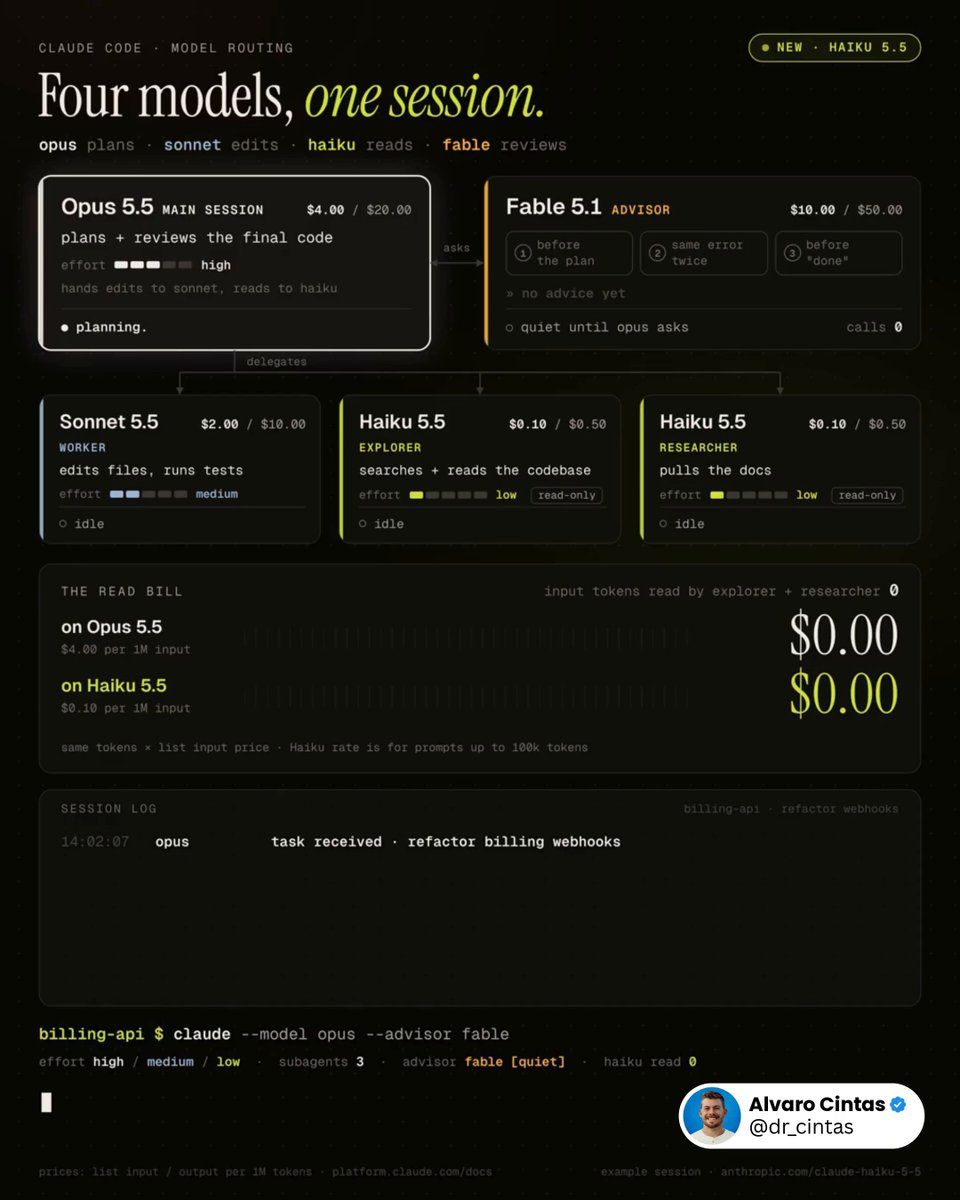
This workflow will save you thousands with Claude. Run Opus 5.5, Sonnet 5.5, Haiku 5.5, and Fable 5.1 together, and stop spending Opus tokens on work that doesn't need Opus. The entire idea in one line: Opus plans, Sonnet edits, Haiku reads, Fable reviews at decision points. Roles, broken down: - Opus 5.5, high effort, owns the plan and reviews the final code - Sonnet 5.5, medium effort, is the worker: edits files, runs tests - Haiku 5.5, low effort, splits into explorer (searches and reads the codebase) and researcher (pulls docs). it's the first Haiku with an effort setting - Fable 5.1, set with /advisor fable. Opus calls it at decision points, and it gets the full transcript each time Three moments Opus tends to call it: → before committing to a plan: is this the right approach? → the same error shows up again: is this going nowhere? → before marking the task done: did something get skipped? Why Haiku only reads: Anthropic's launch post says Sonnet 5.5 and Opus 5.5 are still the better choice for complex agentic coding (Terminal-Bench 4.0: 39.2% for Haiku 5.5, 70.6% for Sonnet 5.5) and that Haiku 5.5 fits narrowly scoped subagent work. so it gets the lookups, not the edits. Anyone still running one model for everything is paying $4 per million input tokens to check whether a file exists. Haiku 5.5 does it for $0.10. Drop this into Claude Code 👇 "Rebuild my Claude Code setup around this structure: Confirm Claude Code is v2.1.293 or later, so the haiku alias resolves to Haiku 5.5. If it isn't, stop and tell me to run claude update. Look through ~/.claude/agents and .claude/agents for subagents already covering explorer, worker, and researcher. Only create new ones for roles that are missing. Set model: haiku, effort: low on explorer and researcher, with no Edit or Write tools. Set model: sonnet, effort: medium on worker. If an existing subagent is locked to a different model, leave it as is and just list it. Name the explorer subagent Explore so it overrides the built-in one, which otherwise runs on my main model. In ~/.claude/settings.json, set advisorModel to fable, and set effortLevel to high for claude-opus-5-5 under modelSettings. A top-level effortLevel in user settings doesn't apply to Opus 5.5. Check for anything disabling the advisor: CLAUDE_CODE_DISABLE_ADVISOR_TOOL, DISABLE_TELEMETRY, or anything blocking feature-flag fetches. Also check CLAUDE_CODE_EFFORT_LEVEL, which overrides subagent effort settings, and CLAUDE_CODE_SUBAGENT_MODEL_FORCE, which makes Claude Code ignore subagent model fields. Report what you find. Don't change any of it yet. Add one line to ~/.claude/CLAUDE.md: consult the advisor before a big plan, when the same error shows up twice, and before marking a long task done. Show every change as a diff first. Wait for my go-ahead before touching anything."

Alvaro Cintas

54,424 görüntüleme • 3 gün önce

this is straight f*cking gold for anyone on Claude Code you already pay for Fable 5.1, and while Opus 5.5 does all the work it just sits there one command puts it on your session as a senior reviewer: /advisor fable Opus 5.5 keeps writing the code Fable 5.1 reads the whole session, every tool call included, and speaks up at three moments only: > before a plan: is this the right approach? > when the same error comes back: am I digging in the wrong place? > before "done": what did I miss? Fable 5.1 reviews. Opus 5.5 ships Jev engineering does the same thing one layer down: forks that need no thinker (which file, which tool, retry or stop) go to Jev in under half a second, and the big model only sees the ones that actually split • the full tree > Opus 5.5 on high runs the main session > explorer reads the code > worker edits and runs tests > researcher pulls the docs > all three on medium > Fable 5.1 on call as the advisor paste the tree and this prompt into Claude Code ↓ "Rebuild my Claude Code setup around this tree: 1. Check ~/.claude/agents and .claude/agents for subagents that already fit explorer, worker and researcher. Draft new ones only for missing roles. Give each model: opus, effort: medium. Skip any that pin a different model and list them. 2. Set the main session to high via effortLevel in ~/.claude/settings.json, and set advisorModel to fable. 3. Find anything that keeps the advisor off (CLAUDE_CODE_DISABLE_ADVISOR_TOOL, DISABLE_TELEMETRY, any variable that stops feature-flag fetching) plus CLAUDE_CODE_EFFORT_LEVEL, which overrides subagent effort. Report them, change nothing. 4. Add one rule to ~/.claude/CLAUDE.md: consult the advisor before a large plan, when an error repeats, and before calling a long task done. Show me every change as a diff first. No edits until I say go" ↳

Annatar.md

74,132 görüntüleme • 10 gün önce

This is f*cking insane. This tip saved me thousands of dollars. run Opus 5.5, Sonnet 5.5, and Fable 5.1 together, and stop burning Opus on work it was never needed for. the whole idea in one line: the strong model plans, the mid-tier model executes, Fable stays quiet until it's actually needed. roles, broken down: Opus 5.5, high effort, owns the plan and ships the final code Sonnet 5.5, medium effort, splits into explorer (reads the codebase), worker (edits files, runs tests), researcher (pulls docs) Fable 5.1, called through /advisor fable, reads everything happening in the session but stays silent unless something's actually wrong three moments where Fable speaks: → a plan goes out: is this actually the right call? → the same failure shows up again: is the search going nowhere? → the task gets marked finished: did something get skipped? Jev engineering does the same thing one level down. the forks that don't need real thought, which file, which tool, keep going or stop, go straight to Jev and come back in under half a second. the big models only ever see the forks that genuinely need a decision. anyone still running one model for everything is paying Opus prices to decide whether a file exists. drop this into Claude Code: "Rebuild my Claude Code setup around this structure: Look through ~/.claude/agents and .claude/agents for subagents already covering explorer, worker, and researcher. Only create new ones for roles that are missing. Set model: sonnet, effort: medium on each. If an existing subagent is locked to a different model, leave it as is and just list it. In ~/.claude/settings.json, set effortLevel to high and advisorModel to fable. Check for anything disabling the advisor, CLAUDE_CODE_DISABLE_ADVISOR_TOOL, DISABLE_TELEMETRY, or anything blocking feature-flag fetches, plus CLAUDE_CODE_EFFORT_LEVEL, which can override subagent effort settings. Report what you find. Don't change any of it yet. Add one line to ~/.claude/CLAUDE.md: check in with the advisor before a big plan, when the same error shows up twice, and before marking a long task done. Show every change as a diff first. Wait for my go-ahead before touching anything."

rvaniaaa

250,263 görüntüleme • 8 gün önce

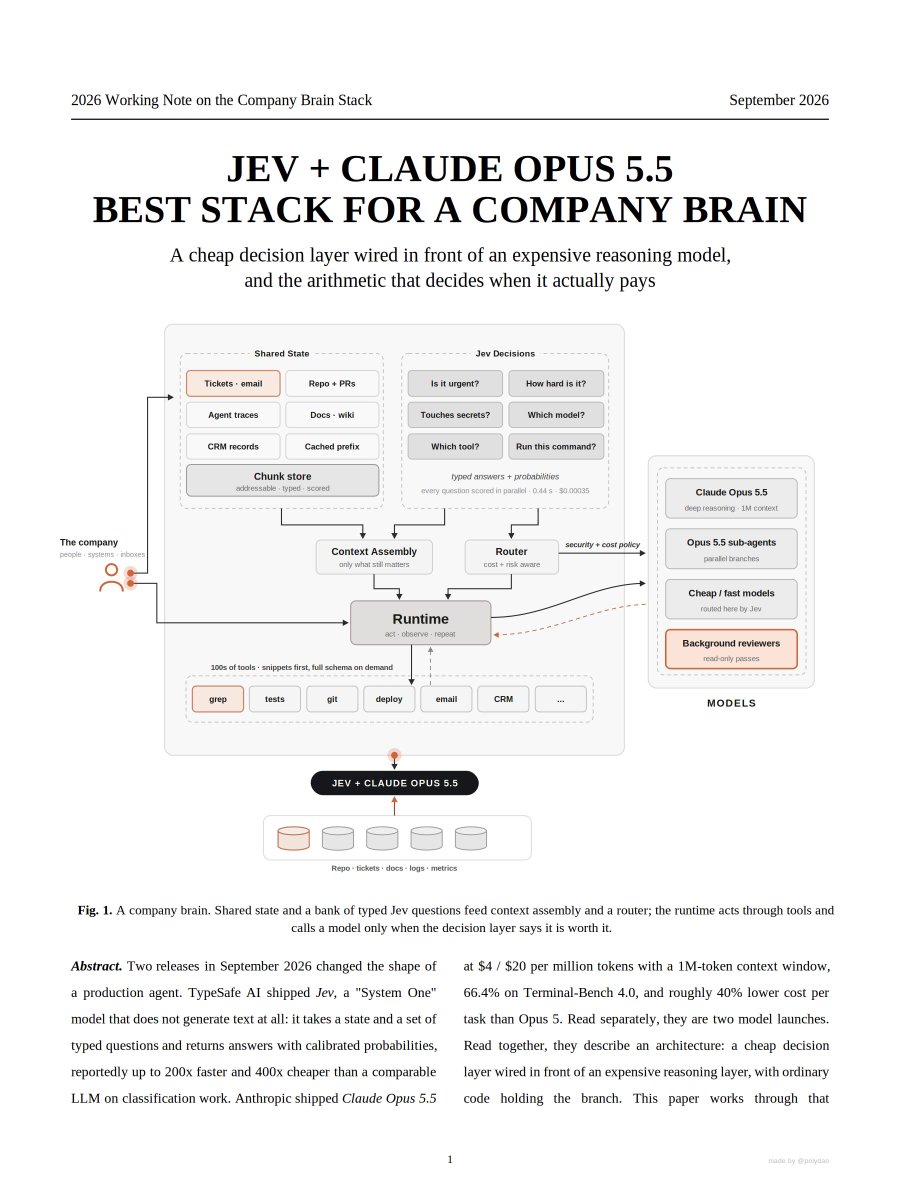
JEV + OPUS 5.5 IS INSANE FOR BUILDING A COMPANY BRAIN I pulled the whole architecture out of the TypeSafe and Anthropic docs and packed it into a 14-page PDF the 10 steps: 1. meet the pair > Opus 5.5 thinks, Jev decides, your code holds the branch 2. stop asking a text generator for a yes or no > Jev returns a typed answer with a calibrated probability in 0.44s for $0.00035 3. ask everything at once > Choice, Score and Noul run in parallel, so the fourth question costs almost nothing 4. branch on the number > 0.999 goes straight into the if statement. ~99% of turns end right here 5. stop routing blind > Opus 5.5 to Sonnet and back costs 5.84 against 3.32 for staying on 5.5 6. keep one context warm > cache reads at $0.20 per Mtok are 20x cheaper than a fresh load 7. escalate the hard part > the toughest 1% goes to Opus 5.5 with 1M context and 66.4% on Terminal-Bench 4.0 8. score every chunk on every query > keep whole, summarize or drop. the context gets rebuilt each turn 9. gate the actual command > every bash call gets classified before it runs, inside your own code 10. judge 100% of runs > $3.50 a day for 10,000 traces, and it matched the human label on all 500 decisions the result: a while loop that paid a frontier model for every tiny call turns into a brain that spends a fraction of a cent to notice and pays properly only when it has to think the person who brings this into their team walks into the budget meeting with the AI bill cut and the output up the PDF maps the company brain. the loop side of it - how Jev takes a Claude bill from $765 to $3 a month - is in the article below ↓

Mr. Buzzoni

103,282 görüntüleme • 12 gün önce

Jev + Opus 5.5: Anthropic's new model beats GPT-6 Astra for 1/5 the cost, and 4 API changes will 400 your agent before it writes a single line I pulled these 10 steps from the migration docs so you don't learn them in production step 1 → $4 / $20 per 1M. Opus 5 was $5 / $25. cache reads dropped from $0.50 to $0.20 step 2 → 66.4% on Terminal-Bench 4.0 vs GPT-6 Astra 57.9% and Opus 5 52.3%. +14.1 points in one release, and on FrontierCode it beats Astra at default effort for 1/5 the cost step 3 → thinking can't be turned off anymore. send thinking: disabled and you get a 400. drop the field, set effort step 4 → tool_choice any and tool are gone. 400. switch to auto + strict step 5 → edit anything above a thinking block and the request dies. append only, or opt into drop_block step 6 → computer_20251124 is dead on the API. 400. move to computer_toolset_20260801 step 7 → the quiet one: default effort fell from high to medium. your agent thinks less than you set it up to and nothing tells you step 8 → hop Opus 5.5 → Sonnet 5 → Opus 5.5 and you pay 4.36 instead of 3.32. +31%, the cache dies and Sonnet can't read Opus's reasoning step 9 → change effort at the top of the request and the cache is gone. Jev sets it per message and the cache stays step 10 → switch fast - standard mid-session and it's a full cache miss. Jev picks speed once, on turn one one model, three knobs, zero 400s. that is Jev + Opus 5.5 send this to your Claude Code before you touch the model ID, then read my full Jev deep dive in the article below ↓

Carnage

16,674 görüntüleme • 17 gün önce

Codex tip: once GPT-6.1 Sol runs your main session, stop paying Sol prices for the grunt work hand the reading to Luna and put Astra on call Sol keeps writing the code Luna agents read the repo and pull the docs, fast and cheap Astra only gets spawned at three moments: → before a plan: is this the right approach? → when the same error comes back: am I digging in the wrong place? → before "done": what did I miss? Sol ships. Luna reads. Astra checks jev engineering is the same move one layer down: the forks that need no thinker (which file, which tool, retry or stop) go to jev in under half a second, and the big models only see the ones that split - the full tree > GPT-6.1 Sol on high runs the main session > explorer reads the code on Luna > researcher pulls the docs on Luna > worker edits and runs tests on Sol > Astra on call as the architect > auto_review watches every approval paste the tree and this prompt into Codex ↓ "Rebuild my Codex setup around this tree: 1. Check ~/.codex/agents and .codex/agents for agents that already fit explorer, researcher and worker. > Draft new TOML files only for missing roles > explorer and researcher on gpt-6-luna, worker on gpt-6.1-sol, all with model_reasoning_effort medium > Add an architect agent on gpt-6-astra, model_reasoning_effort high, that only reviews plans, repeated errors and finished work > List any that pin a different model before changing them 2. In ~/.codex/config.toml set model to gpt-6.1-sol, model_reasoning_effort to high and approvals_reviewer to auto_review 3. Find anything that would override this (active profiles, flags in my shell aliases, agents.default_subagent_model). Report it, change nothing 4. Add one rule to AGENTS.md: spawn the architect before a large plan, when an error repeats, and before calling a long task done Show me every change as a diff first. No edits until I say go." ↳

Hanako

29,559 görüntüleme • 9 gün önce