Video wird geladen...

Video konnte nicht geladen werden

Zur Startseite

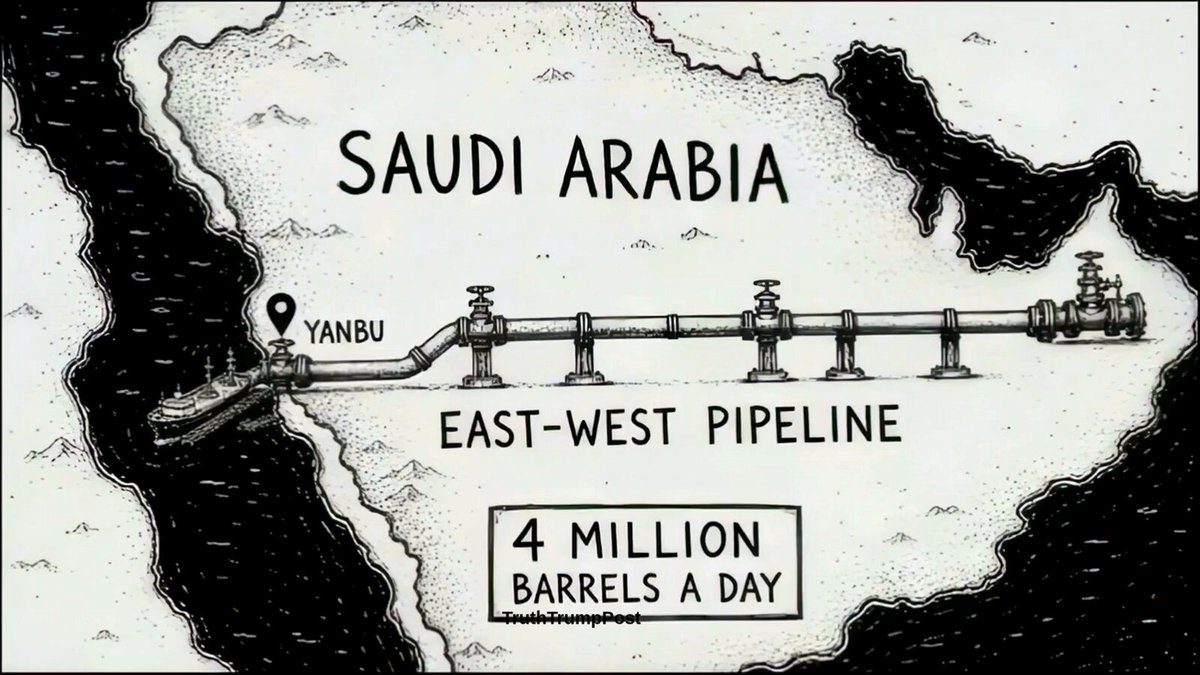
🇸🇦 🇾🇪 Oil analyst Rory Johnston warns that Ansarallah’s attacks present a serious threat to Saudi Arabia’s main workaround for the Strait of Hormuz crisis. Saudi Arabia had shifted about 5 million barrels a day (~3 million offset from Hormuz) through its East-West Pipeline to the Red Sea, but...

59,485 Aufrufe • vor 25 Tagen •via X (Twitter)

0 Kommentare

Keine Kommentare verfügbar

Kommentare vom Original-Post werden hier angezeigt

Ähnliche Videos

OIL JUMPS AGAIN #Saudi oil output slumps 23% to a 36-year low as Hormuz and Red Sea routes close in Saudi Arabia’s oil production collapsed to 6.24 million barrels a day in August, down 23% from July and the lowest monthly level reported by the kingdom since 1990. The number is a stark measure of what the war with Iran and the Houthi campaign in the Red Sea have done to the world’s biggest oil exporter. #Saudi Arabia still has the wells, pipelines and theoretical spare capacity. What it increasingly lacks is a reliable way to get the barrels out. In July, #Saudi production had recovered to around 8.14 million barrels a day during a brief lull in the fighting. By August, that recovery was gone. Output fell by roughly 1.9 million barrels a day. Exports were hit even harder. Tanker tracking put #Saudi crude shipments at only around 3.1 to 3.2 million barrels a day, the weakest level in more than a decade. Before the war, #Saudi Arabia regularly exported more than 7 million barrels a day. The problem is geography. The Strait of #Hormuz, through which roughly a fifth of the world's seaborne oil normally passes, became a war zone after the conflict with #Iran escalated. Tanker traffic collapsed as attacks and the threat of further strikes made the #Gulf route increasingly difficult to use. #Saudi Arabia had an obvious alternative. Its East-West pipeline was built precisely for a Hormuz crisis. It carries crude across the kingdom to Yanbu on the Red Sea, allowing Saudi oil to reach tankers without passing through the Strait. But the alternative route is now under attack as well. The Houthis in #Yemen have turned the southern Red Sea and Bab el-Mandeb into another danger zone. Their attacks on shipping, combined with strikes against Saudi targets, have made the Red Sea route far less dependable. That leaves #Riyadh squeezed between two maritime chokepoints. When crude cannot be exported, production eventually has to come down. Storage tanks can absorb the first shock. They cannot absorb an unlimited number of barrels every day. Aramco therefore has an increasingly simple choice: reduce production or keep filling storage with oil that has nowhere reliable to go. There is an important distinction in the numbers. Saudi Arabia reported 7.12 million barrels a day of “supply to the market” in August, almost 900,000 barrels above its reported production. The difference points to inventory being drawn down to keep customers supplied. That provides breathing room. It does not solve the problem. Inventories can bridge a temporary disruption. They cannot permanently replace functioning export routes. The market has begun pricing that distinction. Brent crude moved above $100 a barrel this week and traded around $107 as attacks on shipping and Saudi energy infrastructure intensified. That is a sharp move from the roughly $70 level seen before the war. Saudi Arabia has already experienced a similar production shock during the conflict. Output fell to around 6.32 million barrels a day in April before recovering in June and July. The pattern is becoming difficult to ignore. When one export route is threatened, Saudi Arabia can reroute barrels. When both Hormuz and the Red Sea are contested, the kingdom's spare capacity becomes much less useful. And that is the bigger problem for the oil market. Saudi Arabia is traditionally the producer everyone expects to turn to when supplies disappear. Riyadh can normally open the taps and send additional crude into the market. But spare capacity sitting behind a closed or dangerous shipping route is not the same thing as spare capacity available to consumers. The same problem applies to other Gulf producers. Much of the region's oil ultimately depends on a small number of strategic waterways. Disrupt one and cargoes can be rerouted. Threaten both at the same time and the entire logistics system starts to tighten. The 6.24 million-barrel figure should therefore not be viewed simply as another monthly production statistic. It is a warning about infrastructure. Saudi Arabia spent decades preparing for a Hormuz crisis. The East-West pipeline was one of the kingdom's insurance policies against precisely such a scenario. Now the war is testing the insurance policy itself. If the fighting continues and both routes remain contested, Saudi Arabia will have to rely increasingly on inventories, limited shipping corridors and whatever tanker traffic is willing to accept the risk. That leaves the oil market with a very different question from the one it faced before the war. It is no longer simply how much oil can Saudi Arabia produce? It is how much oil can Saudi Arabia reliably deliver? Right now, the answer is falling fast. If you want, I can also make this more Inside Paradeplatz / Lukas Hässig style, with a more provocative opening and a harder final paragraph.

Russian Market

13,191 Aufrufe • vor 5 Tagen