Loading video...

Video Failed to Load

Go Home

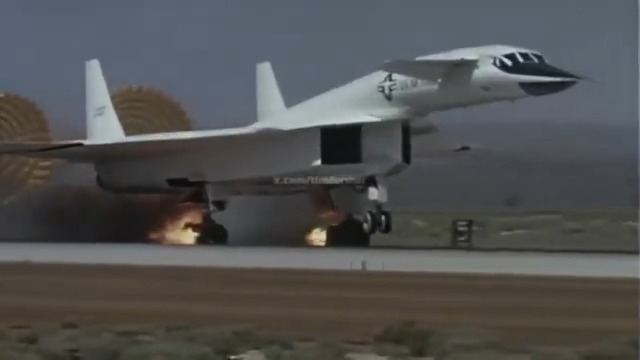
On October 12, 1964, during its third test flight—and first, 20min sustained supersonic run—the XB-70 Valkyrie lost approximately 15% to 25% of its white paint, which peeled off in large patches. The, aerodynamic friction caused temperatures to exceed the paint's bonding capabilities, exposing the stainless steel skin. To resolve...

371,029 views • 6 months ago •via X (Twitter)

0 Comments

No comments available

Comments from the original post will appear here

Related Videos

LIST OF ALL STARSHIP FLIGHTS IN ORDER • Back on April 20, 2023, Starship Flight 1 blasted off with an explosive debut – it lifted off strong but lost control and broke apart minutes later. • November 18, 2023’s Flight 2 pulled off the first hot-staging separation successfully, sending the ship higher even though neither stage survived to the end. • On March 14, 2024, Flight 3 reached space for the first time, completed major test objectives, and proved real progress despite a rough reentry. • June 6, 2024 brought Flight 4 and the first controlled soft splashdowns for both booster and ship – reusability was starting to feel within reach. • October 13, 2024’s Flight 5 was unforgettable: they caught the returning Super Heavy booster with the tower arms on the very first try. • November 19, 2024 saw Flight 6 carry the first payload to space and nail a beautiful daylight ship splashdown in the ocean. • January 16, 2025 marked Flight 7 and the Block 2 era – another booster catch but the ship was lost to a propellant issue. • March 6, 2025 on Flight 8 delivered yet another successful tower catch despite some engine trouble on the booster. • May 27, 2025’s Flight 9 pushed the limits of booster reuse but ran into landing problems, while the ship faced its own reentry challenges. • August 26, 2025 Flight 10 shone bright with successful satellite deployment, an in-space engine relight, and a spot-on ship splashdown. • October 13, 2025’s Flight 11 wrapped up the Block 2 program on a high with excellent reentry performance and precise targeting. • May 22, 2026 brought Flight 12 with the new V3 Starship launching from Pad 2 – it deployed payloads and had the ship mostly ace its profile, though the booster had a tough ocean impact.​​​​​​​​​​​​​​​​​​​​​​​​​​​​​​​​​​​​​​​​​​​​​​​​​​ Clip: Nic Cruz Patane

🌋🌋 Deep₿lueCrypto 🌋🌋

35,814 views • 2 months ago

BREAKING: For 10 years the world believed there was one way to reuse a rocket: land it upright on its engines, the way SpaceX does. Today China refused to copy it, and pulled off something SpaceX never managed on a first flight. It caught the rocket instead. The Long March 10B lifted off from Hainan, China this morning, and about 6 minutes later its first stage came back down toward a 25,000-ton ship at sea. It did not land. Hooks on the falling booster snagged a net of tensioned steel wires strung across the deck, the wires riding robotic rails that slid into place to meet it. No landing legs. No touchdown. A rocket plucked out of its own descent by a moving net, on the maiden flight of a brand-new vehicle. No one handed China this. SpaceX guards its rocket tech as “trade secrets”, not “patents”, precisely so it cannot be read and copied. China watched a decade of public flights and then built an entirely different machine to reach the same prize, catching instead of landing, which sheds the heavy legs and spares the fuel a soft touchdown burns to hover. And this was never about cheaper satellites, though it delivers those too, feeding the thousands of birds in China's Starlink rival. Its deeper purpose is the Moon. That booster shares its core with the rocket meant to land Chinese astronauts on the lunar surface by 2030. In the same season, America's own Moon rocket, Starship, has flown 12 times and still has not shown the single maneuver its lunar plan depends on. One flight does not dethrone SpaceX. It has landed hundreds. What ended today is not SpaceX's lead. It is Uncle Sam’s belief that it owns the only road to the Moon. The piece works out which way of coming home actually wins.

Shanaka Anslem Perera ⚡

2,630,614 views • 1 month ago

NEW: President Trump has signed an executive order to scrap regulations that ban supersonic commercial air travel. The supersonic flight regulation was imposed in 1973 due to noise concerns. Trump's order "seeks to revolutionize supersonic aviation in the United States" by letting aircraft fly faster than the speed of sound. "The US used to be the global leader in this technology, but stifling regulations have grounded progress for generations," said director of the WH Office of Science and Technology Policy, Michael Kratsios. "The reality is that Americans should be able to fly from New York to LA in under four hours." More from the White House: - This Order removes regulatory barriers so that U.S. companies can dominate supersonic flight once again. - The Order directs the FAA to repeal the prohibition on overland supersonic flight, establish an interim noise-based certification standard, and repeal other regulations that hinder supersonic flight. - The Order instructs the FAA Administrator to establish a standard for supersonic aircraft noise certification that considers community acceptability, economic reasonableness, and technological feasibility. - The Order advances the coordination of supersonic research, development, test and evaluation efforts through the National Science and Technology Council with leadership from the Office of Science and Technology Policy. - It promotes international engagement through the FAA and other agencies to align global supersonic flight regulations and secure bilateral agreements for international operations. The following video is a collaboration between Boom Supersonic and United Airlines, showing what the future could look like with supersonic flights.

Collin Rugg

595,656 views • 1 year ago