Video wird geladen...

Video konnte nicht geladen werden

Zur Startseite

One week ago, we launched Typeahead. The product is already meaningfully better. We’ve shipped new features, Typeahead 2.0 is almost ready, and we’re already planning 3.0. 3.0 is going to be big. That pace is part of the point. Sam Asante and I started a new company together because...

18,627 Aufrufe • vor 2 Monaten •via X (Twitter)

0 Kommentare

Keine Kommentare verfügbar

Kommentare vom Original-Post werden hier angezeigt

Ähnliche Videos

Elon Musk on Grok: “I think an AI that is sort of SpaceX’s baby will be a very good AI. I think SpaceX is a collection of some of the very best humans on Earth, both in capability and morality and goodness, and I think we want to have an AI that is born of that capability and that morality and that goodness. I think that’s very, very important. So I’d like to encourage people to help out, actually, with the AI hardware on the ground and the AI software and, of course, with the AI satellites. Solar is going to be a very important part of that. The TerraFab will be a very important part of that, but we must also succeed on the software front, and we’re going to be training Grok on the sum total of all SpaceX information. So in a way, it will be trained on you. You will effectively be the parents of the AI. It will inherit your thoughts and ideas and beliefs, and I think that’s a good thing. So, yeah, we’ve got to win here on the AI hardware and the AI software. That maybe is the most important message. I think that is actually the most important message I wanted to convey today is that we must win on AI because the future is overwhelmingly AI and robots. So we won’t ultimately be able to control the AI. It’ll be too smart for that. But just like if you have a child that is a super genius child, you can still instill in that child the values and beliefs that you think are good and right. And so that’s why it’s incredibly important that we succeed with Grok. So, yeah, well, Grok 4.5 you’ve tried probably. We’ve got 4.6 coming out in about a week. And then 4.7 should be really pretty special. So I’d like to encourage everyone at SpaceX to use AI and to make it better.”

DogeDesigner

61,797 Aufrufe • vor 2 Tagen

David Friedberg: The AI Jobs Panic Is a Crock of Sh*t Why? The revenue potential outweighs the cost savings by 100x. “There is no job loss with AI. I've said it a thousand times, and I will say it again, and again, and again. What I see on the ground, and what I've seen at dozens of companies, including my company that I run, there are two sides to a business. There is revenue and there’s costs. On the cost side of the equation, AI can be used to reduce humans doing things that cost money, to some extent. The effect there, I would argue, is nominal. The real opportunity with AI is on the revenue side, where suddenly one engineer can do 100x or 1000x what they used to be able to do, meaning you can make more products at your company, whether those are agricultural seed products, or boats and ships, or software for companies, or clothing, or what have you. Because of AI, everyone has the ability to expand their revenue base to create more products, and that is the foundation of good economic prosperity. It is called productivity. We can grow productivity in this country with AI. So where I see AI being used is on the revenue side 100x more than the cost side. And in that equation, people are hiring like crazy. We cannot hire enough people. I just had a review meeting with my product and engineering team two days ago, and they're like, ‘We want to add an extra 15 headcount to our engineering squads because we have all this opportunity to do stuff that we couldn't otherwise do.’ So we are going to hire more people. And to Sacks' point, we are seeing that show up in the jobs numbers. The idea that AI is going to destroy jobs is a Luddite idea that is being disproven every single day, and I see it on the ground. It is only a matter of time before people wake up to this and they realize that this narrative that they've all been sold is a crock of sh*t.”

The All-In Podcast

152,225 Aufrufe • vor 2 Monaten

I miss building simple, working software. At some point, we decided to complicate everything for no reason. Today, people can't build anything without using three frameworks, 17 libraries, and a swarm of microservices. And here is a funny paradox: To understand how these complex systems work, we've had to build systems and tools that generate data we can later analyze. But the more data we produce, the harder it is to process and make sense of it. We are in the middle of an observability crisis. The tools we have are inefficient, and we don't have enough people to keep systems running. A few weeks ago, I met the team Resolve AI, and they have built a fundamentally new approach to observability and incident management: Instead of depending on humans to run a system, Resolve built a Production Software Engineer who runs the system using AI while letting people supervise. And it's not only crazy, but I think this will fundamentally change how we monitor and maintain systems in production for years to come. I recorded a quick video to showcase a simple example of how Resolve works behind the scenes. There are two main things I'd like you to notice: 1. The tool can correlate data across logs, metrics, and traces coming from different systems. You don't have to do any work to get the information that matters right in front of you. 2. (This is the big one!) The tool can diagnose what's happening and give you instructions on how to solve it. It can produce causal relationships across the entire system stack. Resolve is backed by investors like Replit's founder Amjad Masad, Reid Hoffman, Jeff Dean, Fei Fei Li, Andy Price, among others. They are currently working with a select number of companies and want to onboard a few more. If you are interested in trying them out, go to this link: Honestly, this is one of the most impressive uses of AI I've seen.

Santiago

82,074 Aufrufe • vor 1 Jahr

Evan Spiegel on the lesson that killed his first startup and led to Snapchat: "We focused on building the perfect product for way too long before we got feedback. We worked for like eighteen months to build this perfect full-featured product, which was in direct contravention to how I was always taught to build things. Build a prototype, build an MVP, get it in front of people, learn as quickly as possible. But we had spent all this time building this perfect piece of software and we hadn't thought enough about distribution. While we built this great piece of software, our competitor at the time, Naviance, had secured distribution through all the different college counselors. What piece of software are you going to choose to help your kid get into college? The one recommended by the college counselors or the one from two kids at Stanford? I think it's a pretty easy choice. So we saw very early that we had no distribution advantage. Even if we loved our software, people weren't going to use it because we didn't have a scalable way to get it in people's hands. Around that time when we saw the emergence of the App Store on iPhone, it was very clear that was a distribution channel we could really use and benefit from. But we also needed to build things we could build quickly, things we really were going to use together with our friends so we could be the first early customers. Ultimately Peekaboo and Snapchat represented that." This is exactly the asymmetry Peter Thiel describes in Zero to One: superior distribution by itself can create a monopoly, even with no product differentiation. The converse is not true. Thiel puts an even finer point on it: most businesses get zero distribution channels to work. Poor sales rather than bad product is the most common cause of failure. If you can get just one distribution channel to work, you have a great business. Estée Lauder said: it's not enough to have the most wonderful product in the world. You must be able to sell it. Many founders over-index on product perfection and under-invest in distribution. The world is full of great products nobody knows about, and mediocre products with massive distribution that dominate markets. Evan Spiegel lived it. He built the better product, watched it lose, and then built something he could actually distribute.

David Senra

27,043 Aufrufe • vor 4 Monaten

Larry Ellison just told every software engineer on Earth their job description is dead. Not evolving. Dead. Ellison: “The code that Oracle is writing, Oracle isn’t writing. Our AI models are writing.” This is not a startup demo. This is one of the largest infrastructure monopolies on the planet telling you it already replaced the people who built it. For fifty years, building software meant translating human intent into machine instructions. Line by line. Bug by bug. Sprint by sprint. That entire layer is gone. Ellison: “We don’t write the procedure. We declare our intent.” That sentence just made the entire engineering labor market flinch. The procedure was the job. The procedure was the paycheck. The procedure was what made a developer valuable. And now the machine does it without being asked twice. Ellison: “We just tell the model what we want the program to do, and then the AI comes up with a step-by-step process to actually do it.” You are no longer paid to build. You are paid to think. And most organizations have no idea how to evaluate that. The companies still hiring armies of developers to grind through codebases are paying salaries the machine already made worthless. Not in years. In seconds. When a company worth hundreds of billions hands the keyboard to the machine and tells you the output is better, the debate is not winding down. The debate is over. The enterprise that wins this decade does not write the best code. It removes the human from the process entirely and runs on intent alone. The programmers who survive are the ones who realize the craft is no longer typing. It is architecture. It is judgment. It is knowing what to build and why. Everything else now belongs to the machine. And the machine does not negotiate severance.

Dustin

535,724 Aufrufe • vor 4 Monaten

Jensen to AI Leaders: “We have to be far more thoughtful” when communicating to the public Jensen Huang: “(AI) is not a biological being. It is not alien. It is not conscious. It is computer software.” “We say things like, ‘We don't understand it at all.’ It is not true. We understand a lot of things about this technology.” Chamath: “If you were in the seat in the boardroom of Anthropic over that whole scuttlebutt with the Department of War, what do you think you would've told Dario and that team to do, maybe, differently to try to change some of this outcome and some of this perception?” Jensen: “The first thing that I would say about Anthropic is, first of all, the technology is incredible. We are a large consumer of Anthropic technology.” “The desire to warn people about the capability of the technology is also really terrific.” “We just have to make sure that we understand that the world has a spectrum, and that warning is good, scaring is less good because this technology is too important to us.” “I think that it is fine to predict the future, but we need to be a little bit more circumspect. We need to have a little bit more humility, that, in fact, we can't completely predict the future.” “And to say things that are quite extreme, quite catastrophic, that there's no evidence of it happening, could be more damaging than people think.” “And of course we are technology leaders.” “There was a time when nobody listened to us, but now because technology is so important in the social fabric, such an important industry, so important to national security, our words do matter.” “And I think we have to be much more circumspect, we have to be more moderate, we have to be more balanced, we have to be far more thoughtful.”

The All-In Podcast

57,581 Aufrufe • vor 4 Monaten

$ABCL CEO Carl Hansen explains the net negative overall value creation in biotech and how AbCellera plans to beat it: “I really think it can be beat because there’s a lot of mistakes that get made in where you allocate capital.” “If you’re a biotech and you start a company on a drug, and you go public and have a drug, and now the data is looking not that great, you just keep running that drug. … Because if you quit that drug, the company is done.” “So, because you’re so concentrated on one thing, you end up having blinders. It’s like a cult of a molecule. And even a real, practical, capital access problem that makes you continue to move things forward” ______________________________________ “Another problem is that many of the drugs that get started, get started by people who don’t understand the competitive or commercial landscape and have no intent of ever actually manufacturing it. … Because they know someone else is going to buy it. So then their framework is not ‘Am I making a drug that’s going to make a difference for people?’ The framework is ‘Can I make something that I think someone will take off my hands?’ And that happens a lot.” “There are many acquisitions where a big pharma company spends $10B, $20B, and it’s a complete bust. So really no value is generated for patients but someone was able to get a good exit on that because they anticipated what someone would want. And a lot of decision making gets done like that”. _______________________________________ “I’m not saying that we have this all solved. But what we’re trying to do is create a framework where we are able to take many bets so that we don’t fall in love with anything, or we don’t have to fall in love with anything. … And then always hold up very explicitly what we know and what we don’t know along the dimensions that matter. The dimensions that matter are - Will it work? That’s a science. - When it gets where will people care? - Is it differentiated? - Does it solve a big problem? In order to get it there, is there a path with our resources and expertise that would allow us to see it through?” “When you start to hold things up like that, you start to see where the mistakes are, where the uncertainties are, and you can be more rational in deciding ‘We’re going to run it to here because we get to flip the card and if the card goes the wrong way we’re going to kill it because we’ve got something else behind it.’” “I do think that if done right, and if you can pick the right opportunities, the success rate can be well higher than an order of magnitude better. … And there are examples of this… companies I’ve mentioned, you know, Regeneron, their success rate is at least 10x the industry in bringing programs forward and getting them approved. … So it’s… you can do it better that way”

Jack Prescott

27,317 Aufrufe • vor 13 Tagen

Sam Altman's new interview: AI should not be designed to pursue goals that are disconnected from human needs. People must remain at the center of AI development. “I have no interest in building a super-smart AI that accomplishes some non-human goals. People should react. People should say, ‘Hey, this is what I want, and this is what I do not want.’ I do not think the issue is that we have failed to explain the benefits. We say, ‘AI is going to cure a bunch of diseases,’ and people say, ‘Okay, that is great, but that is not really my question. My question is: What is my role in the future? What is my economic future? What is my agency? How do I know that my kids and my family will still be able to have fulfilling, creative expression, struggle, drive the world forward, grow, and do this thing together in a way that has worked for a long time?’ When people in AI say, ‘Sure, there are going to be no jobs,’ or ‘50% of jobs are going to go away,’ or ‘90% of jobs are going to go away,’ and ‘AI is going to be smarter than you at everything,’ and ‘We will give you some basic income, but you are not really going to have a role,’ that is horrible. And by the way, if an AI company says, ‘Maybe we are going to destroy all the jobs, and we will be the most valuable company in the world,’ people should look at you like, ‘Yeah, that is a terrible message.’ I do not think the problem is that we have not articulated the upsides. I think people actually believe us. They hear, ‘AI may cure your cancer,’ and they think, ‘That sounds great.’ I think we, as an industry, have failed to explain how people stay in control of determining the future at every step, and how people can still have a meaningful life in all the ways we care about.” ---- From "CNBC Television" YouTube channel, (link in comment)

Rohan Paul

79,111 Aufrufe • vor 2 Monaten

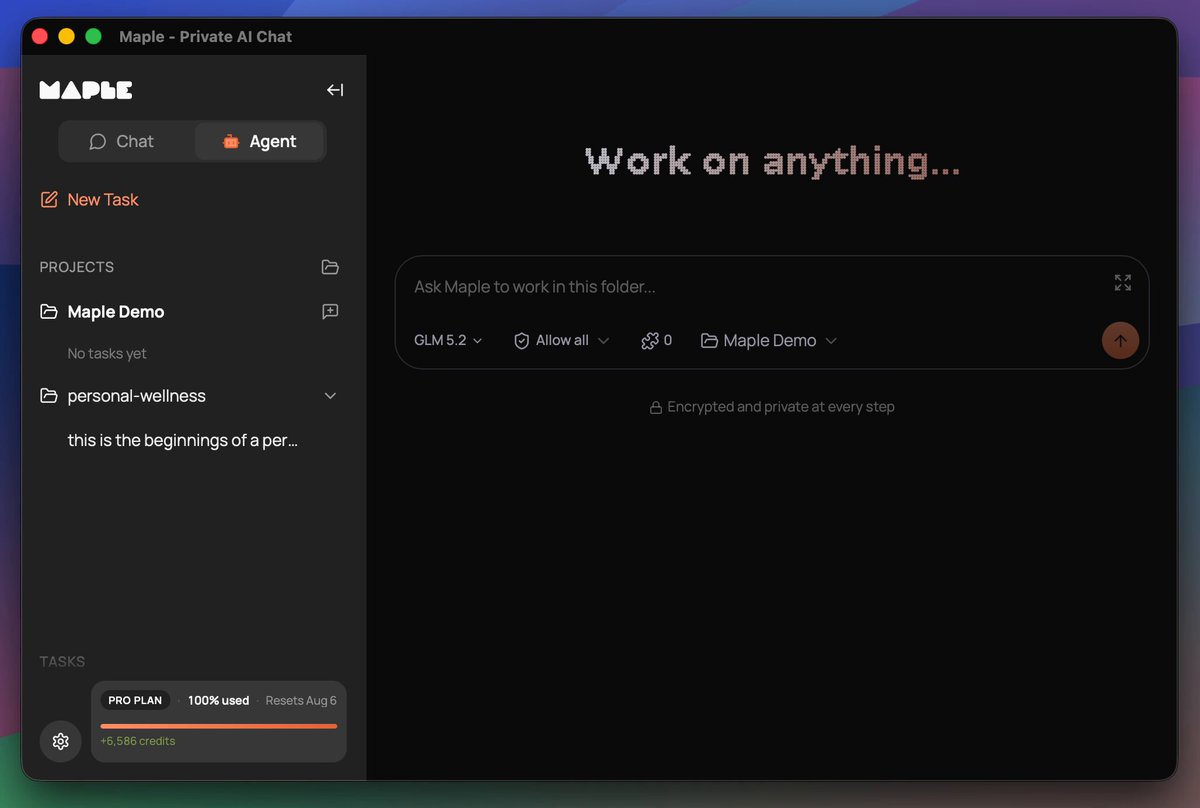
Maple is preparing for the release of a co-working agent. You install it locally and it works with your files, whether it's office work or building websites and apps. It's a turnkey solution, as easy as Claude Code, that keeps your data secure and private, no data sharing with closed AI labs. This is THE sovereign AI app for individuals and businesses who want powerful AI while retaining ownership of their information. Why build an agent into the Maple app when other agents already exist? Easy, we want to give you control over your work. We don't have a business plan that incorporates making money off our users' data. In the age of AI, your information, whether it's personal or company trade secrets, is the single thing that differentiates you from everyone else. We all have access to AI that can build a professional website for selling shoes. But your strategy and network for how you sell shoes should not be shared with your competitors. Sovereignty is the path to protecting what makes you, you. Maple sits at the intersection of Usability and Sovereignty. Maple gives you the best tools that are both easy to use and maintain your data sovereignty. Sovereign for one, sovereign for all. It has been a journey to get here. We brought to market the very first personal chatbot with end-to-end encryption using TEEs in late 2024. Prior to that there were proofs of concept but no full product offerings. Every other AI chat product on the market handled your data in plain text, either selling you a service to get your data or asking you to trust that they won't snoop on you. Quickly people found Maple and latched onto its open-source code and verifiable encryption. We didn't stop there. You may remember earlier this year we teased a product called "Maple Agent" and opened up a waiting list. That product is a mobile app that acts as your AI "friend", maintaining one long continuous chat, and getting to know you over time. I dislike using the word "friend" there, but it's the best way to convey the UX in a few words. AI is a tool, always has been, always will be. Any kind of friendly personality on top is just synthetic. In our testing, the UX of Maple Agent is really powerful for what it does. Think about the many short AI chats you have in your favorite app, whether it's looking up a historical fact or asking advice about a topic. With Maple Agent, those all go away in favor of the long-running chat with the friendly agent. It's like you have your own personal assistant who knows you so well and can look up anything for you. When I ask AI certain questions, I want to ask an expert who already understands my situation so I'm not repeating myself for the 100th time. That's the amazing value the personal agent brings to the table. We still see great utility for a personal agent like the "Maple Agent". Thousands of people on the waiting list, hoping to get their hands on it, agree that the concept is worth exploring and trying out. We were constrained in launching it due to a few circumstances, one of them being access to the scale of compute needed to power it. We have a clear path laid out for how to get there, but today is not the day to execute on that. It will be in the near future. Instead we have a different agent ready to go that we think is also incredible. We now have an agentic harness inside of the Maple Research app. This thing is a powerhouse. It even builds and publishes its own software releases. The agent in Maple Research works with your local filesystem, speaks to the largest open models running in TEEs, utilizes local models for certain tasks, is compatible with MCP tools, has an API for connecting to anything you need, and also supports the ACP protocol, which means it can be extended in the future to speak to other tools like Claude Code, Codex, and local models running on your own hardware. A big unlock for us was the Goose Development Kit, which powers the core of our agent harness. More on that to come as we publish articles and documentation later about the agent. The agent inside Maple Research doesn't have a name. At least not yet, not sure if it ever will. For now we call it "Chat Mode" and "Agent Mode". Think of this as the workhorse, the truck, the heavy lifter. Our other "Agent", the phone app, is your sidekick in your pocket, ready to help with quick things and ongoing conversations about life. I am incredibly excited about the Maple Research Agent. While I'm already seeing great results using it for internal work items, I'm especially thrilled about the personal health and wellness work it's doing for me. I know there are plenty of apps out there for compiling wellness data, but I'm having it build a tool tailored specifically for what I need, without the extra fluff. And none of my health data is being donated to the closed AI labs or sent to advertisers. I know that the AI logic is not being silently adjusted to fit the whims of a large corporation that has paid for product placement. It's me, state of the art AI, and my data. That's how I want it. Maple's new agent makes that possible. We can't wait for you to try it out. If you want early access, comment here, email us, reach out in some way. To those on the other agent waitlist, you're already in the queue. Thanks for reading this lengthy update. :)

Mark

44,707 Aufrufe • vor 22 Tagen