Video wird geladen...

Video konnte nicht geladen werden

Zur Startseite

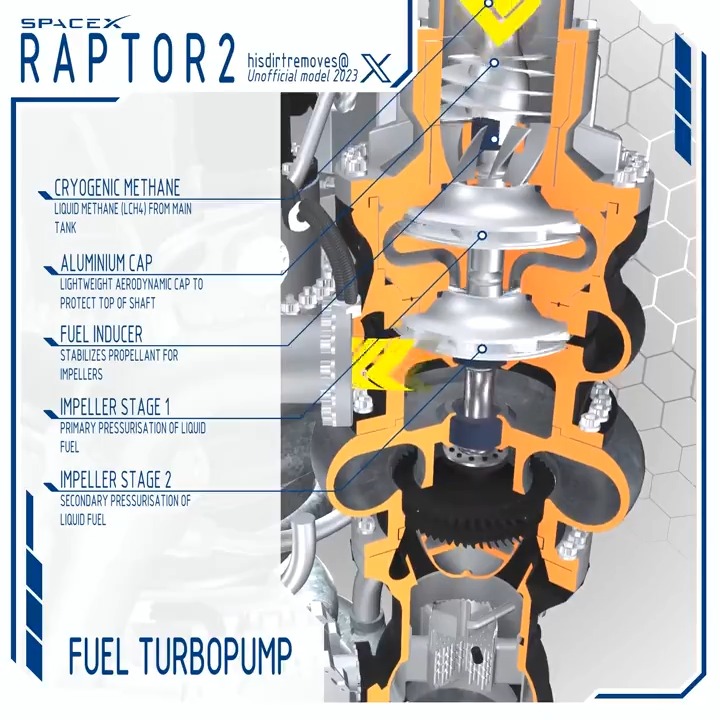
One wrong microsecond during ignition, and a Starship engine explodes. Here’s why Raptor needs multiple startup steps... Starting a SpaceX Raptor engine isn't as simple as turning a key or flipping a switch—it requires a fast, highly orchestrated sequence to safely ignite one of the most complex machines on...

13,600 Aufrufe • vor 19 Tagen •via X (Twitter)

2 Kommentare

Profilbild von 🌹EvE🌹
🌹EvE🌹vor 19 Tagen

Beautiful images!

Profilbild von Dennis P
Dennis Pvor 18 Tagen

👍

Ähnliche Videos

ISRO shares a detailed update on its LOX-Methane engine programme, the propulsion planned for the Next Generation Launch Vehicle (NGLV) and for the future heavy-lift vehicle for India's crewed lunar landing (target 2040). Why methane? - Clean combustion - Low maintenance, which helps reusability - Can be made on Mars from CO2 + water ice, which helps future Mars missions and human settlement LM20-TD: the demonstrator (2019–2020) - 20-tonne thrust technology demonstrator built from existing CE-20 cryogenic engine subsystems - Converted to LOX-CH4 by modifying the propellant flow control and engine start-up systems - Gas generator cycle, with thrust chamber, fuel-rich GG, LOX & fuel turbopumps, igniter, and a mixture ratio control valve with electric drive - Test sequence worked out with an in-house mathematical model - 1 cold flow + 5 hot tests at IPRC - Gave key data on chill-down, ignition, engine start, combustion and rotor-dynamics LME1100: the main engine (started 2023) - 1100 kN thrust, Gas Generator Cycle - Designed to be industry-friendly and cost-effective - Over 70% of components made by additive manufacturing (3D printing) with industry partners across India Gas Generator - 3D printed, in qualification tests at IPRC - Sub-scale GG tests worked out the ignition sequence with a spark torch igniter and tested the 3D-printed injector elements - First ignition test of the full-scale GG on October 9, 2026, with more tests planned Thrust Chamber - Sub-scale hot test campaign at IPRC - Proved the new manufacturing methods planned for the full-scale chamber - Settled the best injector configuration - Showed both oxidiser-rich and fuel-rich spark torch igniters working Turbopumps - LOX and methane turbopumps made by Indian industry - 3D-printed LOX pump impeller spin-tested at LPSC up to its rated speed - Seals and bearings in qualification at LPSC and IPRC - Cold flow tests of the integrated turbopumps ongoing at IPRC Ignition systems - GOX-GCH4 spark torch igniters, oxidiser-rich and fuel-rich - Semiconductor spark plug igniter (LPSC + VSSC + IIST) - Laser ignition, demonstrated with GOX-GH2 and GOX-GCH4 What's next - Integrated LME1100 engine ready by mid-2027, followed by a hot test series including different thrust throttling profiles - Design completed for a 2400 kN Full Flow Staged Combustion Cycle (FFSCC) engine, meant for a future human-rated heavy-lift launch vehicle for crewed lunar landing missions Source: #ISRO #LOXMethane #LME1100 #NGLV #IndianSpace

indianspaceflight.in🇮🇳

44,793 Aufrufe • vor 27 Tagen

I often wonder about how SpaceX plans to actually pull off multiple Starship flights per day. As Elon Musk has pointed out, computer simulations have steep limits you can't just simulate a vehicle traveling at 17,000 mph and experiencing 6 Gs on a screen. The answer is a massive, relentless physical testing pipeline that turns years of administrative certification into a rapid industrial manufacturing loop. To handle this cadence without bottlenecking the actual launch pads, SpaceX isolates its testing geographically: McGregor, Texas: The primary acceptance gate. Every single Raptor engine is shipped here for full-duration firings to qualify the combustion chambers and turbopumps. Massey's Outpost: Instead of risking the main orbital pads, ships and boosters go to this dedicated site for structural testing, static fires, and destructive evaluations. Before any Starship or Super Heavy booster is ever stacked for flight, it runs a strict 4-step gauntlet: → Cryo-Proofing: The vehicle’s tanks are pressurized and filled with extreme-cold liquid nitrogen or oxygen to verify the stainless-steel welds can handle thermal shock and flight-like stress. → Spin-Primes: Engine turbopumps are spun up to full operating speed with high-pressure gas—stopping just milliseconds before ignition—to test fluid dynamics without risking pad damage. → Static Fires: The vehicle is anchored down and the engines are hot-fired to test thrust vectoring, the aft dome's structural integrity, and the pad's water deluge system. → Wet Dress Rehearsal: A completely fueled, fully simulated launch countdown right down to the final seconds before ignition. Now, SpaceX is duplicating this entire operation on the East Coast. With a massive new facility at Florida's Roberts Road and dedicated on-site liquefaction plants at LC-39A, they are laying the groundwork to support up to 44 launches a year.

Lacey

15,686 Aufrufe • vor 2 Monaten

When a gas chamber filled with a fuel-air mixture is ignited, the flame does not instantly appear everywhere. Instead, it starts at the ignition point and spreads outward as a moving "flame front." For combustion to happen, fuel molecules must react with oxygen molecules. When a spark or flame provides enough energy, the first few molecules ignite and release heat. This heat then warms the nearby unburned gas, causing those molecules to reach their ignition temperature as well. The process repeats rapidly, creating a chain reaction that pushes the flame through the chamber. Think of it like a row of dominoes. The spark knocks over the first domino, which triggers the next one, and so on. In a gas chamber, heat and highly reactive particles called free radicals play the role of the falling dominoes. As the flame spreads, the hot combustion gases expand dramatically. This expansion creates pressure waves that move ahead of the flame. The speed of flame propagation depends on factors such as the fuel type, the fuel-to-air ratio, temperature, pressure, and turbulence inside the chamber. Turbulence mixes the gases more effectively, allowing the flame to spread much faster. In engines, this controlled flame spread is essential because it releases energy smoothly. However, if the flame spreads too rapidly or transitions into a shock wave, it can become a detonation or explosion,producing a sudden and destructive pressure spike. In short, a flame spreads because each burning region heats and ignites the next region, creating a self-sustaining wave of combustion that moves through the fuel-air mixture.

Mechanical Knowledge

11,937 Aufrufe • vor 2 Monaten