Video wird geladen...

Video konnte nicht geladen werden

Zur Startseite

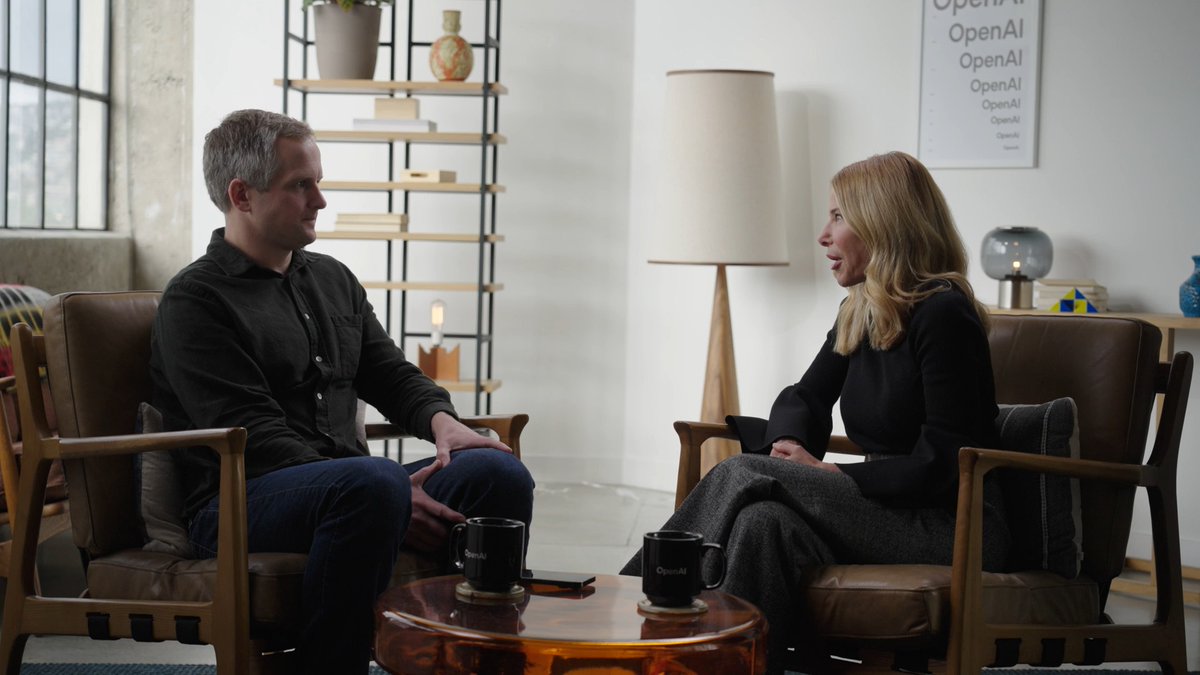
OpenAI Lead Researcher, Lukasz Kaiser: Reasoning models already handle most computer tasks — writing, coding, clicking, though still quirky Competition among labs is speeding progress, with research improvements in the pipeline "before 2030, much desk work will shift to AI"

82,622 Aufrufe • vor 9 Monaten •via X (Twitter)

0 Kommentare

Keine Kommentare verfügbar

Kommentare vom Original-Post werden hier angezeigt

Ähnliche Videos

We benchmarked leading multimodal foundation models (GPT-4o, Claude 3.5 Sonnet, Gemini, Llama, etc.) on standard computer vision tasks—from segmentation to surface normal estimation—using standard datasets like COCO and ImageNet. These models have made remarkable progress; however, it is unclear exactly where they stand in terms of understanding vision in detail. Especially when it comes to tasks beyond question-answering. How well do they understand an object's segments or geometry? Our analyses yield an assessment that is quantitatively and qualitatively detailed and is compatible with evaluations developed in the field of computer vision over the past decades. Observed trends: 🔹 The foundation models consistently underperform task-specific SOTA models across all tasks. However, they are respectable generalists, which is remarkable as they are presumably trained primarily on image-text-based tasks. 🔹 They perform semantic tasks notably better than geometric ones. 🔹 GPT-4o performs the best among non-reasoning models, getting the top position in 4 out of 6 tasks. 🔹 Reasoning models, e.g., o3, show improvements in geometric tasks. 🔹 The 'image generation' models, e.g., GPT-40 Image Generation, which have been natively trained multimodally, exhibit quirks. E.g., hallucinated objects, misalignment between the input and output, etc. 🔹 While the prompting techniques affect performance, better models exhibit less sensitivity to variations in prompts. We control for the variance introduced by the prompting methods in our experiments. 🌐 Detailed analyses, visualizations: ⌨️ code: 🧵 1/n

Amir Zamir

73,074 Aufrufe • vor 1 Jahr

Thanksgiving-week treat: an epic conversation on Frontier AI with Lukasz Kaiser -co-author of “Attention Is All You Need” (Transformers) and leading research scientist at OpenAI working on GPT-5.1-era reasoning models. 00:00 – Cold open and intro 01:29 – “AI slowdown” vs a wild week of new frontier models 08:03 – Low-hanging fruit, infra, RL training and better data 11:39 – What is a reasoning model, in plain language 17:02 – Chain-of-thought and training the thinking process with RL 21:39 – Łukasz’s path: from logic and France to Google and Kurzweil 24:20 – Inside the Transformer story and what “attention” really means 28:42 – From Google Brain to OpenAI: culture, scale and GPUs 32:49 – What’s next for pre-training, GPUs and distillation 37:29 – Can we still understand these models? Circuits, sparsity and black boxes 39:42 – GPT-4 → GPT-5 → GPT-5.1: what actually changed 42:40 – Post-training, safety and teaching GPT-5.1 different tones 46:16 – How long should GPT-5.1 think? Reasoning tokens and jagged abilities 47:43 – The five-year-old’s dot puzzle that still breaks frontier models 52:22 – Generalization, child-like learning and whether reasoning is enough 53:48 – Beyond Transformers: ARC, LeCun’s ideas and multimodal bottlenecks 56:10 – GPT-5.1 Codex Max, long-running agents and compaction 1:00:06 – Will foundation models eat most apps? The translation analogy and trust 1:02:34 – What still needs to be solved, and where AI might go next

Matt Turck

168,007 Aufrufe • vor 8 Monaten