Video wird geladen...

Video konnte nicht geladen werden

Zur Startseite

🚀 🚀OSS Intelligence,Global Debut! ▶️ We cordially invite you to join「OSS Powers AI: Cloud-Scale Data Intelligence」, where Alibaba Cloud will unveil two groundbreaking capabilities—OSS Vector Bucket and OSS Metaquery. These innovations deeply integrate vector search and intelligent semantic querying into object storage service, fulfilling the demands of massive-scale data...

17,146 Aufrufe • vor 6 Monaten •via X (Twitter)

0 Kommentare

Keine Kommentare verfügbar

Kommentare vom Original-Post werden hier angezeigt

Ähnliche Videos

🚨$OSS is not an AI company. → It is the hardware that lets AI exist where the cloud cannot. Most investors don’t understand $OSS because they think AI = software. $OSS builds the physical “brains” that run AI in extreme environments where cloud computing fails. Jets. Ships. Tanks. Drones. Space. Hospitals. That’s the game. 1) What $OSS actually is $OSS (One Stop Systems) designs rugged high-performance computers and storage systems for AI at the edge. Meaning: They bring data-center-level computing power into harsh environments. Their products include rugged servers, GPU accelerators, storage arrays, and expansion systems used for AI, sensor processing, and autonomous systems. In simple terms: Cloud AI = brain in a safe building. $OSS AI = brain inside machines operating in chaos. 2) Why this is crucial Most AI today runs in data centers. But the future of AI is not in the cloud. It’s on: • autonomous vehicles • military systems • drones • ships • industrial machines • medical devices These systems cannot wait for the cloud. Latency, connectivity, security, and survival demand local AI. $OSS delivers “data-center performance at the edge” across land, sea, and air. Without companies like OSS, autonomous systems simply don’t work. 3) What OSS actually does: Think of OSS as building AI engines that survive reality. 🌊 SEA example: naval surveillance aircraft and ships. $OSS supplies rugged storage and compute systems for U.S. Navy reconnaissance aircraft to collect and process massive sensor data in real time. Translation: Instead of sending raw data back to base, the aircraft analyzes threats instantly onboard. $OSS = the onboard AI brain. 🪖 LAND example: military vehicles and tactical operations. $OSS delivers high-performance servers and FPGA systems for mobile military intelligence platforms used by the U.S. Department of Defense. Translation: Tanks and vehicles detect threats, process sensor data, and make decisions locally. $OSS = the battlefield computer. ✈️ AIR example: airborne AI. $OSS builds GPU-accelerated servers designed for aircraft, described as a “datacenter in the sky.” Translation: Jets and drones run AI models mid-flight. $OSS = flying supercomputers. 🚀 SPACE example: $OSS hardware is designed for extreme environments and autonomous systems across aerospace and defense. Translation: Future satellites, space drones, and autonomous spacecraft need onboard AI. $OSS = the computing core of autonomous space systems. BONUS: CIVILIAN & COMMERCIAL $OSS systems are used in: • autonomous trucking and farming • industrial automation • healthcare imaging • energy and mining • telecom and 5G Example:A medical imaging company uses $OSS hardware to run real-time AI diagnostics in next-gen breast cancer scanners. $OSS = AI where milliseconds matter. 4) Who their customers are (pattern, not names) $OSS sells to: • defense primes • government programs • industrial OEMs • AI infrastructure companies • medical device manufacturers These customers share one trait: They cannot rely on the cloud. That’s why $OSS exists. 5) The mental model that makes $OSS obvious $NVDA = AI chips $PLTR = AI software $OSS = AI hardware in the real world If AI is electricity, $OSS builds the generators that work in storms. Most investors understand AI software. Few understand AI infrastructure at the edge. That gap is the opportunity. 6) The real thesis The world is moving toward: • autonomous warfare • autonomous vehicles • real-time AI systems • distributed intelligence All of that requires rugged edge computing. $OSS is positioned exactly there. Infrastructure. The hardest layer to build. And often the most valuable.

Black Panther Capital

30,138 Aufrufe • vor 6 Monaten

Mansa AI is an enterprise-grade AI + Web3 platform designed to move artificial intelligence from experimentation into real-world execution. Built for creators, developers, and businesses, it focuses on deploying AI that actually works across modern digital systems, not just in isolated demos. 🚀 Production-ready AI infrastructure Mansa AI enables teams to deploy AI systems designed for live environments, handling real workflows, real data, and real operational demands without constant manual oversight. 🧠 Autonomous AI agents At its core, Mansa AI allows users to build autonomous agents that automate decision-making, coordinate tasks, monitor live signals, and execute complex workflows across dynamic environments. ⚙️ Fully customizable logic Agents can be configured with custom behaviors, triggers, and responses. From content generation and analytics to operational automation and intelligent orchestration, logic adapts to specific business strategies. 🔗 Web3 and off-chain integration Mansa AI bridges blockchain ecosystems with traditional systems, enabling cross-chain coordination, smart contract interactions, and seamless integration with existing enterprise infrastructure. 📊 Real-world use cases The platform supports automation for operations, customer engagement, analytics, data pipelines, content workflows, and AI-driven optimization across products and teams. 📈 Built for scale Whether launching as a startup or deploying across enterprise systems, Mansa AI is designed to scale AI operations without adding complexity or fragmentation. Mansa AI transforms artificial intelligence into deployable infrastructure. By combining autonomy, customization, interoperability, and scalability, it enables teams to own, operate, and grow intelligent systems that deliver real value in production environments.

King

155,637 Aufrufe • vor 7 Monaten

⚡️We are excited to announce that our new no-code Enterprise Platform is NOW available in private beta! As RAG apps advance from prototype to production we’ve been overwhelmed by requests for an enterprise grade solution to provide these applications with the data they need. Designed to make it easy to get your data #RAGready, our Platform can preprocess more than 25 file types and soon will be fully #multimodal, also able to ingest audio, video and image files. We ship with a baseline suite of source connectors, including Amazon Web Services S3, Microsoft Azure Blob Storage, OneDrive, SFTP, Databricks Delta Table, Google Drive, Salesforce, Elastic, OpenSearch, and Google Cloud storage with many more fast following. Platform transforms your documents into a standardized JSON schema, broken down into semantically coherent elements allowing you to reconstruct your document in the manner most useful to you. Want only the narrative text but not the headers and footers? This is entirely configurable through the UI. Additionally, we generate more than 30 types of metadata for each element to make it easy to curate the data being written downstream and to support metadata filtering during retrieval. Smart chunking and the ability to choose from a range of embedding models are in from launch, delivering a turnkey solution for chunk and embedding experimentation. As for destination connectors, we've got that covered too, with Amazon Web Services S3, Pinecone, Chroma , Weaviate AI Database, Google Cloud storage, MongoDB, Microsoft Azure cognitive search, PostgreSQL, Elastic, OpenSearch, and Databricks Delta Table. And of course, all of this can be scheduled to keep your data continuously hydrated. The private-beta is live today! Sign-up to get access and come build the future of LLM data foundations with us: 🚀 #ETLforLLMs #AI #DataPreprocessing #DataScience #DataTransformation #LLMs #ETL #ML #PreppingData #MachineLearning #RAG #Engineer #Unstructured #Unstructuredio #RetrievalAugmentedGeneration #multimodal #AIJobs

Unstructured

21,874 Aufrufe • vor 2 Jahren

Announcing a new Coursera course: Retrieval Augmented Generation (RAG) You'll learn to build high performance, production-ready RAG systems in this hands-on, in-depth course created by and taught by , experienced AI and ML engineer, researcher, and educator. RAG is a critical component today of many LLM-based applications in customer support, internal company Q&A systems, even many of the leading chatbots that use web search to answer your questions. This course teaches you in-depth how to make RAG work well. LLMs can produce generic or outdated responses, especially when asked specialized questions not covered in its training data. RAG is the most widely used technique for addressing this. It brings in data from new data sources, such as internal documents or recent news, to give the LLM the relevant context to private, recent, or specialized information. This lets it generate more grounded and accurate responses. In this course, you’ll learn to design and implement every part of a RAG system, from retrievers to vector databases to generation to evals. You’ll learn about the fundamental principles behind RAG and how to optimize it at both the component and whole-system levels. As AI evolves, RAG is evolving too. New models can handle longer context windows, reason more effectively, and can be parts of complex agentic workflows. One exciting growth area is Agentic RAG, in which an AI agent at runtime (rather than it being hardcoded at development time) autonomously decides what data to retrieve, and when/how to go deeper. Even with this evolution, access to high-quality data at runtime is essential, which is why RAG is a key part of so many applications. You'll learn via hands-on experiences to: - Build a RAG system with retrieval and prompt augmentation - Compare retrieval methods like BM25, semantic search, and Reciprocal Rank Fusion - Chunk, index, and retrieve documents using a Weaviate vector database and a news dataset - Develop a chatbot, using open-source LLMs hosted by Together AI, for a fictional store that answers product and FAQ questions - Use evals to drive improving reliability, and incorporate multi-modal data RAG is an important foundational technique. Become good at it through this course! Please sign up here:

Andrew Ng

124,656 Aufrufe • vor 1 Jahr

🚀 Three Next-Gen AI & Web3 Projects Are Launching on Mindo AI A new chapter for community-powered intelligence, prediction markets, and open AI infrastructure The AI + Web3 landscape is entering a decisive phase — one where real usage, real revenue, and real ownership matter more than hype. Today, MindoAI is proud to welcome three groundbreaking projects that represent this shift clearly and powerfully: Perceptron Network Space DeepNode AI Each project tackles a different bottleneck in the AI economy — data, forecasting, and infrastructure — but they all share the same vision: decentralization, community ownership, and sustainable value creation. Let’s take a deeper look 👇 🧠 Perceptron Network The world’s first community-powered AI data engine Perceptron Network is redefining how AI data is sourced, validated, and delivered. Instead of relying on expensive, closed, and slow legacy data providers, Perceptron unlocks community-powered data pipelines that are: Faster Cheaper Revenue-generating from day one This isn’t experimental AI infrastructure — Perceptron already serves real clients with real revenue, proving that decentralized data engines can outperform traditional incumbents. Why Perceptron matters: AI models are only as good as their data Centralized data monopolies slow innovation Communities can produce higher-quality data at scale By aligning contributors, validators, and clients through incentives, Perceptron turns unused human and network potential into a living data engine for AI. Launching on Mindo AI gives Perceptron access to a broader AI-native community — accelerating adoption, partnerships, and ecosystem growth. 🌌 intodotspace The first 10× leveraged prediction market on Solana intodotspace is pushing the boundaries of on-chain prediction markets. Built by the $1.5B UFO team, this platform introduces: 10× leveraged predictions Ultra-fast execution on Solana Deep liquidity and composable market design The market’s confidence is already clear — the project completed a record-breaking raise that was oversubscribed by 1,360%. What makes intodotspace different: Leverage amplifies conviction, not noise On-chain transparency replaces opaque odds Markets become real-time intelligence engines Prediction markets are often called “truth machines.” intodotspace upgrades them into high-signal, high-efficiency forecasting layers — useful for traders, protocols, DAOs, and even AI systems that need probabilistic insights. Launching on positions intodotspace at the intersection of AI-driven decision-making and on-chain market intelligence. 🌐 DeepNode AI Infrastructure for open intelligence DeepNode AI is tackling one of the biggest problems in modern AI: centralized ownership. Today, AI is dominated by a handful of corporations. DeepNode flips that model by building open intelligence infrastructure where: Anyone can deploy AI models Builders earn directly from usage Intelligence is co-owned, not extracted Backed by leading validators, miners, and ecosystem builders, DeepNode transforms AI from a closed monopoly into a shared utility. DeepNode’s core philosophy: “Own what you build — or someone else will.” This is more than infrastructure. It’s an economic redesign of AI itself: Builders keep ownership Contributors share upside Networks replace platforms Launching on connects DeepNode to creators, researchers, and communities who believe intelligence should belong to everyone — not just Big Tech. 🤝 Why This Matters for With the launch of Perceptron Network, intodotspace, and DeepNode AI, #MindoAI is rapidly becoming: A hub for AI-native Web3 innovation A launchpad for real, revenue-backed projects A meeting point for data, markets, and intelligence infrastructure These three projects don’t compete — they complement each other: Perceptron supplies data intodotspace produces market intelligence DeepNode powers open AI execution Together, they form the backbone of a decentralized intelligence economy. 🔥 The future of AI is open, composable, and community-owned — and it’s launching now on Which of these projects are you most excited about? And how do you see decentralized intelligence reshaping the next AI cycle? 👇 Share your thoughts and join the conversation.

Hồng Ngọc | Ruby💎

12,837 Aufrufe • vor 6 Monaten

Introducing Sharpe Search: On-Chain Search AI Agent Powered by Hive Intelligence We’re thrilled to announce the launch of Sharpe Search, a crypto search AI agent powered by Hive Intelligence Designed to simplify blockchain data interaction, Sharpe Search represents a significant step toward making crypto more accessible and actionable for users at every level. Sharpe Search leverages Hive Intelligence’s advanced search API to provide real-time, actionable insights across the blockchain ecosystem. Here’s a detailed look at what Sharpe Search is, how it works: What Is Sharpe Search? At its core, Sharpe Search is an AI agent purpose-built for querying and analyzing on-chain data. It takes the complexity out of blockchain exploration by enabling users to ask questions in plain language and receive detailed, accurate responses. Whether you’re looking to monitor wallet activity, track portfolio positions, or analyze transaction history, Sharpe Search ensures that the answers are at your fingertips—accurate, comprehensive, and delivered instantly. How Does Sharpe Search Work? Sharpe Search is powered by Hive Intelligence, a search engine API designed to make blockchain data easily accessible and AI-ready. Here’s a breakdown of how it enables Sharpe Search to function effectively: 1. LLM-Optimized Query Processing Sharpe Search leverages Hive Intelligence's optimized responses for large language models. This ensures that AI agents can process blockchain data in a structured format, delivering precise answers to complex user queries. 2. Natural Language Interaction Forget the need for technical knowledge. Sharpe Search supports natural language queries, making it as simple as typing: - “What tokens are in my wallet? Am I eligible for any airdrop I haven't claimed yet?” - “Check me my last 100 transactions, tell me if I interacted with any protocol with recent hacks” - “Track my wallet activity over the past month, suggest optimised portfolio based on best stable yields available” 3. Real-Time Insights Across Multi-Chains Using Hive Intelligence, Sharpe Search connects to over 20 chains and 5000+ Protocols. This real-time access ensures that the AI agent provides up-to-date and actionable insights, no matter how dynamic the blockchain environment. 4. Unified API Access Sharpe Search consolidates fragmented blockchain data through Hive’s unified API. Instead of dealing with multiple integrations, Sharpe Search uses a single access point to aggregate and query data, reducing complexity for both users and developers. Technical Depth: The AI Agent Advantage Sharpe Search's design philosophy revolves around the principle of creating an intuitive, AI-driven experience. Here’s what makes its technology stand out: Data Indexing and Aggregation: Hive Intelligence employs advanced indexing algorithms to aggregate data from multiple chains. This ensures that Sharpe Search can retrieve information within milliseconds, even when querying vast datasets. Dynamic Updates: Blockchain data is volatile. Sharpe Search processes dynamic updates in real time, enabling users to act on the most recent metrics, transactions, and balances without delays. Contextual Understanding: The AI agent parses natural language queries and contextualizes them to blockchain-specific scenarios. For instance, when querying “Show portfolio details,” Sharpe Search understands the underlying requirements—fetching wallet holdings, token values, and current positions. Hive Intelligence: The Backbone of Sharpe Search While Sharpe Search takes center stage, Hive Intelligence provides the critical infrastructure to make it all possible. Its LLM-ready responses and multi-chain support ensure that Sharpe Search operates at the forefront of blockchain data accessibility. By launching Hive Intelligence through Sharpe Launchpad, Sharpe reinforces its commitment to supporting innovation in the blockchain space. Hive’s infrastructure not only powers Sharpe Search but also lays the groundwork for future AI agents to thrive in the ecosystem. What’s Next for Sharpe Search? Currently in invite-only access, Sharpe Search is preparing for a broader public release. Future updates will include: - Expanded Blockchain Coverage: More chains and protocols will be added. - Enhanced Query Flexibility: Even more advanced natural language capabilities. Stay tuned for the public launch and get ready to explore crypto like never before!

Sharpe AI

263,278 Aufrufe • vor 1 Jahr

What a year. 🚀 2025 was the year ChainOpera AI turned vision into real momentum: building a community-co-created, community-co-owned AI agent network and pushing the boundaries of what decentralized, collaborative intelligence can look like. 🚀 Biggest highlights from 2025 ✅- AI Terminal officially launched: We unveiled the ChainOpera AI Terminal as a unified gateway to decentralized AI, making it possible for anyone to interact with powerful, decentralized LLMs without technical friction. Positioned as the “browser for the DeAI era,” the AI Terminal marked a major step toward making decentralized intelligence accessible, usable, and mainstream. ✅- AI Terminal adoption at massive scale: Momentum followed quickly. The AI Terminal surpassed 2M registered users and consistently ranked top 3 among all apps on the BNB AI DappBay, validating strong product–market fit and real, sustained usage at scale. ✅- Announcing Coco: the world’s first community-owned Super Agent: We introduced Coco, the intelligence layer that sits between users and the agent network. Coco dynamically routes each request to the most efficient, community-built agent—optimizing for quality and speed while rewarding the creators behind the best-performing agents. This was a defining moment in realizing a truly community-owned intelligence layer. ✅- From agents to a living agent network: With the launch of the Agent Social Network and Super Agent architecture, ChainOpera AI moved beyond isolated agents toward a collaborative system where humans and specialized agents coordinate, share context, and solve complex, multi-step tasks together. ✅- $COAI breakout year: The listing of $COAI across major exchanges shocked the market, and throughout the year COAI consistently remained among the top AI-native crypto tokens by visibility, activity, and community engagement – reflecting growing confidence in the long-term vision of collaborative intelligence. ✅- Global presence: ChainOpera AI around-the-world tour: ChainOpera AI went global in 2025, sponsoring and participating in major AI and Web3 events across North America, Europe, and Asia, including ETHDenver, Consensus Toronto, Token2049 Singapore, ETHCC, SBC, and Devcon. These global touchpoints helped us engage directly with developers, builders, investors, and partners worldwide, accelerating adoption and positioning ChainOpera AI at the center of the emerging AIxBlockchain movement. ✅- Community momentum at scale: Community remained the heart of ChainOpera AI’s growth. We successfully completed three seasons of structured community engagement, executed a widely participated community airdrop, and ran multiple ecosystem-shaping campaigns to incentivize builders, creators, and early adopters. These efforts strengthened alignment between users, developers, and the protocol, laying the foundation for a durable, community-owned AI ecosystem. ✅- “AI for Markets” taking shape: We laid critical groundwork for AI-native market intelligence, including the launch of PrediMarket Agent and multiple trading and analysis agents—early building blocks toward an AI-driven ecosystem for crypto and DeFi markets. ✅- Building in public, with the community: Across product launches, research milestones, ecosystem discussions, and global events, we continued to build openly to bring developers, users, and partners directly into the evolution of ChainOpera AI. This year also marked the launch of the ChainOpera AI Foundation website, formally kicking off a bold Ecosystem Fund designed to empower builders, incubate high-impact projects, and accelerate the growth of a truly community-owned, collaborative AI ecosystem. To every builder, user, and supporter who helped make this year possible: THANK YOU! 🧭 What we’re excited about in the coming year 🔹- A Stronger, Denser Agent Economy (everyday adoption + cross-chain reach): In 2026, we are scaling the Agent Economy from growth to daily usage, with more agents, richer workflows, deeper multi-agent collaboration, and higher-impact use cases that users rely on every day. In parallel, we are expanding the agent network beyond a single ecosystem with cross-chain execution and interoperability, allowing agents to access the best liquidity, data, and opportunities wherever they exist. 🔹- AI Market Infrastructure Evolution: Building on PrediMarket Agent and our growing suite of trading and market-intelligence agents, we are advancing toward a mature AI market infrastructure, where agents continuously monitor, reason, simulate, optimize, and act across crypto, DeFi, and beyond. The goal is to make complex markets more accessible, more transparent, and more intelligence-driven, turning research, decision-making, and execution into a fast and reliable loop for everyday users. 🔹- Ecosystem Acceleration through the Foundation: With the ChainOpera AI Foundation and our Ecosystem Fund and Co-Creation Grants, we are doubling down on empowering independent builders to expand the protocol, the agent network, and the underlying infrastructure, so the community can co-create, co-own, and scale the ecosystem together. 🔹- Business Expansion and Market Penetration: In 2026, we will focus on expanding ChainOpera’s reach through strategic partnerships, product-led growth, and new paths to monetization, bringing AI agents to a broader global user base and driving sustained adoption, engagement, and revenue, while staying aligned with community ownership and an open ecosystem. 2025 was the proof. 2026 is where it compounds. 🔥 Co-Create. Co-Own. COAI.

ChainOpera AI

17,042 Aufrufe • vor 7 Monaten

🚀 We just raised $40 million to build infrastructure for Physical AI! 🦾 AI is rapidly transforming critical industries like manufacturing, logistics, transportation, agriculture, construction, aerospace, and defense. Teams that win in the physical world are those who can create a data flywheel, leveraging infrastructure to capture, ingest, analyze, and evaluate the vast quantities of data generated by real-world systems. Robotics data is multimodal, time-synchronized, and bandwidth‑constrained at the edge. Traditional data and observability platforms were only designed to store and query text and time-series data, not petabyte-scale 3D, video, audio, GNSS, and proprioceptive data. The ability to efficiently capture, ingest, search, visualize, and evaluate multimodal data is critical to Physical AI development. Foxglove is a modern data engine for Physical AI, enabling you to record logs or capture demonstrations at the edge, sync recordings to the cloud or on-premises storage, find critical events across petabytes of data, evaluate robot performance, and watch a 3D frame-by-frame replay using our advanced visualization tool. 👉 Today is still Day 1 for Physical AI, and we're hiring for dozens of roles to assemble the best team in the industry. If you've built ML platforms, data infrastructure, dataset curation, evaluation and validation, or visualization tools at a leading robotics or autonomous vehicle company, let's chat – drop me a note or tag a friend below and I'll follow up personally! Thank you to Alexandra Sukin and Jeremy Levine at Bessemer, Seth Winterroth 🤖 at Eclipse, David Beyer and Sunil Dhaliwal at Amplify Partners, and Icehouse Ventures for joining us on this mission. Also a special shoutout to our angels tobi lutke Alex Kendall Kyle Vogt Milan Kovac Hussein Mehanna Pieter Abbeel Brad Porter Boris Sofman Kevin Peterson Chris Walti Lindon Gao Daniel Kan Adam Draper ⏻ Fred Ehrsam and Karri Saarinen!

Adrian Macneil — 🤖/acc

46,584 Aufrufe • vor 9 Monaten

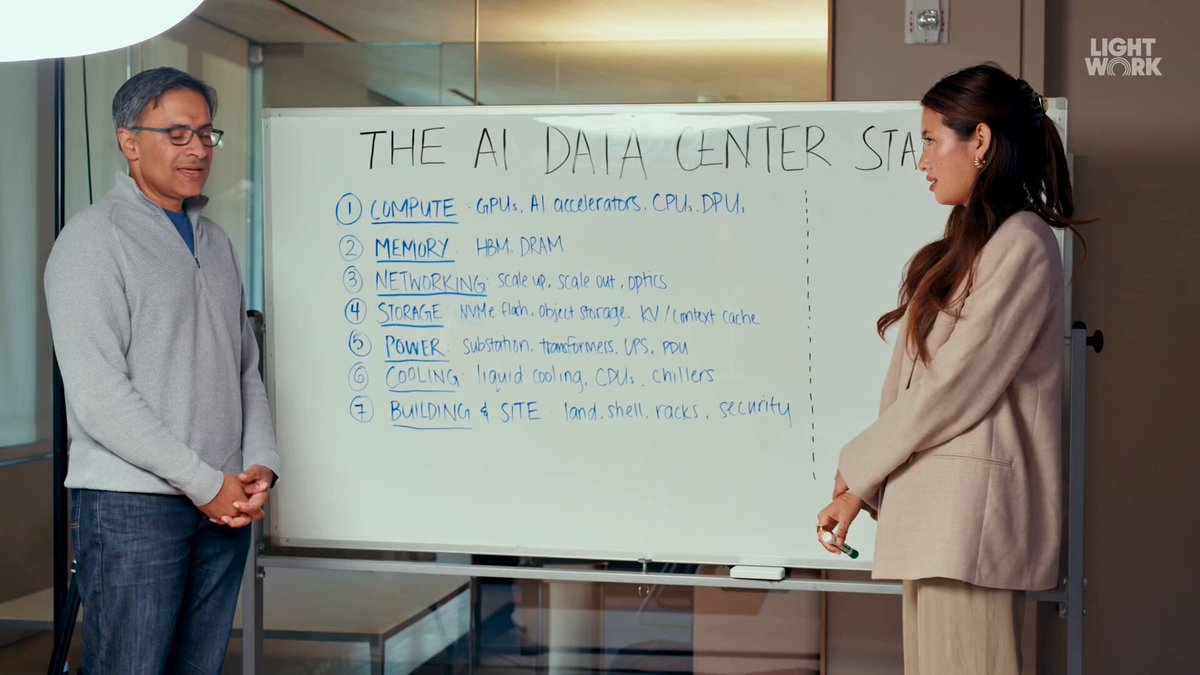
Today we announced our new Fairwater datacenter in Atlanta, connected with our first Fairwater site in Wisconsin and our broader Azure footprint to create the world’s first AI superfactory. Fairwater exemplifies our vision for a fungible fleet: infra that can serve any workload, anywhere, on fit-for-purpose accelerators and network paths, with maximum performance and efficiency. AI workloads have evolved beyond large-scale pre-training. Today, they encompass fine-tuning, reinforcement learning (RL), synthetic data generation, evaluation pipelines, and more. Fairwater is built to support this full lifecycle: Max density: Fairwater’s two-story design and liquid cooling system lets us place racks in three dimensions and pack them with GPUs as densely as possible, minimizing cable runs and improving latency and effective bandwidth. Fleet: Each Fairwater DC can integrate hundreds of thousands of the latest NVIDIA GPUs into a single coherent cluster. This provides flexible infra that can support the full spectrum of workloads, and ensure no GPU is left unnecessarily idle. And that’s on top of the more than 100,000 GB300s coming online this quarter alone for inference across the rest of our fleet. For us, it’s all about turning every gigawatt into the maximum number of useful tokens. Not every GW is created equal! Planet-scale: Every Fairwater DC will connect through our continent-spanning AI WAN to prior generations of AI supercomputers, forming a truly fungible pool of compute. This enables developers to scale beyond the capacity of a single site and dynamically land workloads on the right infra for their needs. Together, these innovations let us bring together different generations of silicon and AI systems across DCs and geos into a single elastic system that scales seamlessly across training and inference workloads And this elastic AI capacity is all available alongside all the other cloud services (compute, storage, databases, app services) that AI agents and workloads need. This is what we mean when we talk about building a fungible fleet – a single, unified platform that pushes the limits of performance per watt and per dollar. Read more:

Satya Nadella

907,893 Aufrufe • vor 9 Monaten

In our latest Box AI Enterprise Eval, we tested Paul Jankura’s Claude 4 Sonnet and Opus models, now integrated into Box AI, across enterprise Q&A tasks, technical workflows, and advanced coding scenarios—revealing major advancements in developer productivity and content intelligence. AI-assisted coding and development just reached a new milestone! Here's what we discovered: Claude 4 significantly improves understanding, generating, and debugging code across multiple programming languages. Developers can: ↳ Accelerate code generation ↳ Improve debugging ↳ Enhance technical documentation ↳ Build smarter AI agents 👉 Automating Financial Analysis with Code Generation: We evaluated Claude 4 by using the Box AI API to analyze ten complex 10-K financial reports. Claude 4 dynamically generated Python code to fetch file IDs from a Box folder, automating data extraction. Within two minutes, it accurately extracted key company data such as revenues, metrics, and highlights—demonstrating its potential to streamline demanding analytical tasks. 👉 Understanding Enterprise Content: Our evaluation confirms Claude 4 maintains strong performance on enterprise Q&A tasks, effectively extracting precise details from single documents and reliably synthesizing information across multiple sources. This ensures seamless integration of structured and unstructured data alongside powerful coding capabilities. 🔓 Developer-Centric Use Cases Unlocked: Organizations can leverage Claude 4 within Box AI to: ↳ Create custom engineering agents referencing technical documents stored in Box, pulling real-time data from Jira, or finding solutions on Stack Overflow. ↳ Build intelligent technical support bots capable of analyzing user-provided code snippets against internal manuals. ↳ Automate secure code reviews by evaluating repository code (stored in Box) against security policies. ↳ Efficiently migrate legacy systems by translating old codebases into modern languages or platforms. Ready to empower your developers and accelerate innovation? To explore Claude 4 Sonnet and Opus through Box AI Studio and APIs, contact us at [email protected] and request early access today! Learn more:

Box

285,676 Aufrufe • vor 1 Jahr

Today, Box is announcing major new AI agent capabilities to let customers tap into the full value of their unstructured data. First, we’re announcing all new updates to the Box AI Studio to make it even easier to build AI agents that tap into your enterprise content for any job function, business process, or industry specific use case. We are also expanding our set of foundational agents that customers will be able to use to work with their enterprise content, including new features like search and research on unstructured data. Next, we’re announcing Box Extract to enable customers to use AI agents seamlessly for complex data extraction from any type of document or content. This makes it easier than ever to pull out data from contracts, invoices, research data, marketing assets, medical charts, and more. Finally, we’re introducing Box Automate, a new workflow automation solution within Box that lets you deploy AI agents across enterprise content-centric workflows. With Box Automate, you can design your business process in a simple drag and drop builder and then drop in AI agents at any step in the process. This ensures agents execute tasks at the right steps in a workflow every time. Best of all, our AI agents and workflow tools are designed to work across any system our customers work within, whether it’s leveraging pre-built integrations, Box APIs, or the new Box MCP Server. Ultimately, all of these capabilities come together to transform how companies can work with their enterprise content. Software has historically only been good at automating work that deals with structured data, which is why ERP, CRM, and HR systems have been mainstays of enterprise software for so long. The data in these systems fits neatly into a database, and the workflows are very ripe for automation. But it turns out most of the work in the world deals with unstructured data. It’s ideating through research documents, working with a client on contracts, reviewing details for a new product launch, looking at a patient’s healthcare record to make a diagnosis, working through due diligence documents for an M&A deal, and so on. For the first time ever, we can begin to bring all new insights and automation to this work with AI agents. At Box, we’re incredibly excited to be on this journey to help customers transform how they work with their most important data.

Aaron Levie

91,863 Aufrufe • vor 11 Monaten

AI has transformed how video is created. We think the next wave is about understanding it. Over the past few years, we've seen remarkable advances in video generation, editing, avatars, and creative tooling. An increasingly important problem is teaching machines to search, analyze, reason over, and extract insight from video - across massive libraries and live streams alike. We're calling this video intelligence, and we're actively looking to back founders building here. We're most excited about companies pushing on the core capabilities: - Video-native models - multimodal embeddings, temporal reasoning, and retrieval built specifically for video rather than adapted from image or text - Real-time and large-scale pipelines - infrastructure for processing, indexing, and querying video at the speed and scale enterprises actually need - Agentic and reasoning layers - systems that don't just retrieve clips but answer questions, surface anomalies, and take action on what they see The models and infrastructure to make this real are appearing to be crossing a capability threshold right now. Multimodal foundation models are maturing, storage costs have collapsed, and enterprises are sitting on years of unstructured video with no way to use it. That infrastructure unlocks a wide range of applications including media and sports workflows, security and physical operations, enterprise knowledge management, advertising analytics, robotics, and consumer products, where video has historically been dark data. If you're building in video intelligence at the model layer, the platform layer, or in a vertical application, we'd love to talk!

Jason Cui

36,205 Aufrufe • vor 3 Monaten