Video yükleniyor...

Video Yüklenemedi

Ana Sayfaya Dön

Perplexity declared war on the biggest open source AI movement of 2026. This changes how millions of people will interact with AI agents forever. Here is what happened and why almost nobody is talking about the real implications. OpenClaw exploded in January and it became one of the fastest...

22,256 görüntüleme • 6 ay önce •via X (Twitter)

0 Yorum

Yorum bulunmuyor

Orijinal gönderinin yorumları burada görünecek

Benzer Videolar

🚨PERPLEXITY JUST LAUNCHED SOMETHING THAT MAKES EVERY OTHER AI PRODUCT LOOK LIKE A TOY.. AND NOBODY IS TALKING ABOUT IT.. They built a Personal Computer.. Not an app.. Not a chatbot.. A full digital worker that runs 24/7 on a Mac mini even while you sleep.. You press both command keys.. And it wakes up.. Ready to work.. But here's where it gets insane.. This thing doesn't run on one AI model.. It runs on 19 of them.. At the same time.. It uses Claude Opus for complex reasoning.. Gemini 3.1 Pro for deep research with a 2 million token context window.. Nano Banana Pro for 4K images.. Grok for fast tasks.. It doesn't just pick one model and hope for the best.. It reads your task.. Breaks it into subtasks.. And routes each one to whichever model is best at that specific thing.. All running in parallel.. While ChatGPT is still thinking about your first question.. Perplexity has already split your project into 6 pieces and assigned each one to a different AI.. And here's the part that should worry OpenAI.. Perplexity hallucinates at 3.3%.. ChatGPT hallucinates at 12%.. Claude at 15%.. It's not even close.. Because Perplexity is built differently.. Every other AI tries to remember facts.. Perplexity searches for them first.. It's structurally forced to cite live sources before it's even allowed to generate a response.. OpenAI Operator launched with a 32.6% success rate on computer-use tasks.. People called it "the world's most anxious intern" because it pauses every 5 seconds to ask if it's doing the right thing.. Perplexity runs multi-hour and multi-day workflows independently.. Only interrupts you when it hits a decision that actually matters.. You can start a task from your iPhone on the train.. And it executes on your Mac mini at home.. The economics are wild too.. Internal studies show it saved teams an average of $1.6 million in labor costs.. Performing 3.25 years of work in four weeks.. And unlike every other AI company.. Perplexity dropped ads entirely.. They charge $200 a month because they said they're in the "accuracy business".. Not the advertising business.. They even launched a $42.5 million publisher program to pay media partners when their content gets cited.. While OpenAI is getting sued by every newspaper on earth.. Google and OpenAI want you locked into their ecosystem.. If a better model comes out tomorrow you're stuck.. Perplexity just updates its routing matrix.. You get the best model on earth automatically.. No switching.. No migrations.. No friction.. This isn't an AI assistant anymore.. This is the first real AI employee.. And it costs $200 a month.

Evan Luthra

1,097,697 görüntüleme • 5 ay önce

Perplexity CEO Aravind Srinivas on the brutal truth about who actually makes money in AI (and why it's not who you think): Aravind argues that the real value in AI comes from orchestration. He points to products like Codex, Claude Code, and Perplexity Computer: "What is that? It's an orchestration system. It takes a model, pairs it with an agent harness." And what is an agent harness? "The simplest way of describing it is like rules for how the agent loop should run. What are all the skills and sub-agents and connectors and tools it accesses? Without the harness, you don't necessarily capture and convert the intrinsic intelligence in the model into valuable output tokens." This leads to a blunt conclusion about who has a real business in AI, and who doesn't: "If you're literally just a reseller of model tokens, you have no business, because the model will get commoditized. So even if you're a model builder, you don't have a business. As an infra layer, you have some business on serving those output tokens. But as an application layer or model builder, you don't really have a business if you're just a reseller of tokens that come directly out of the model." So where does the value accrue? "You have a business if you know how to take the model, ground it in valuable context, orchestrate it with a really good agent harness, connected to the right set of tools and connectors (whether it's personal connectors or business connectors) and provide the experience to people in one single unified system." Aravind Srinivas then explains Perplexity's specific edge: Beyond orchestrating across tools, files, and connectors, they also orchestrate across models. "That is the differentiation that Anthropic and OpenAI cannot claim, because you wouldn't find GPT-5 inside the Claude Code harness. You wouldn't find Claude Opus inside the Codex harness. These are competing with each other. Whereas you would find both these models inside Perplexity Computer." Why does this matter? Because it all comes down to power. In Aravind's framing, the fundamental cost driver in AI is watts (the one input nobody can subsidize except the government). "Whoever provides the most valuable output tokens with the least amount of power expended to produce them generates the greatest value to the end user, has the most pricing power, has the most value. That is the orchestration problem to solve." His conclusion: "The one single most important metric in AI is token value per watt per user."

Big Brain AI

42,319 görüntüleme • 1 ay önce

Aravind Srinivas just described a future most founders are pretending they are ready for. One person. One machine. A company that runs itself. Srinivas: “Buy a Mac mini, set up a Perplexity personal computer, and run their business on that.” Not a side project. Not a pitch deck. A real business with real revenue while the founder is not in the building. AI runs the ads. Handles SEO. Integrates Stripe. Ships features. Answers customers. All of it executing without a single employee. Srinivas: “Have this all working while you can be sipping wine in Napa.” But before he sold the dream he killed the one most people are already chasing. Srinivas: “Everybody talks about this one-person one-billion-dollar company. It’s not truly moving the GDP by one billion. It’s not truly creating new value.” One researcher collecting a billion in equity does not grow an economy. It rearranges numbers between balance sheets. Nothing gets built. No customer gets served. That is not value creation. That is valuation creation. Srinivas wants no part of it. What he described is the opposite. The person driving Uber between shifts who has the idea but not the payroll. Not the engineering. Not the marketing. Not the support staff. That person gets a machine that replaces all of it. Hundreds of thousands in revenue. Millions. Generated by autonomous systems doing the work that used to require ten employees and a burn rate. Not paper wealth. Not valuation theater. Output that moves through an economy and touches real customers. That is what moves GDP. Not one person worth a billion dollars. A million people each building something worth a million. That math rewrites a country. Then Srinivas said the part that separates him from every hype merchant in the room. Srinivas: “Everybody thinks AI is already there. It’s not there yet. Someone has to do that hard work.” The vision is real. The infrastructure is not. The agents are not autonomous. The integrations are not seamless. The plumbing is not finished. Someone has to wire the APIs. Connect the billing. Build the bridge between what a founder wants and what a machine can deliver. That work is not a keynote. It is not a tweet thread. It is engineering that nobody wants to do and everybody will depend on. Whoever finishes it first does not just build a product. They hand every ambitious person on Earth a company they can run alone. The corporations that need five hundred people to do what one founder with the right infrastructure could do are not efficient. They are exposed. And the person building the thing that exposes them just told you exactly what it looks like. He also told you it is not going to build itself.

Dustin

64,593 görüntüleme • 5 ay önce

Mark Zuckerberg just described the minimum viable business for the next decade. A fourth item made the checklist. Zuckerberg: “Every business, just like they have a website, and a phone number, and an email address, is also going to have an AI.” Website. Phone number. Email address. AI agent. That is not a prediction. That is a new baseline. Twenty years ago, not having a website was a choice. Then it stopped being one. Nobody scheduled that transition. The same filter is back. Running faster this time. A business without an AI agent handling sales, support, and customer interaction will not look outdated. It will look abandoned. Its competitor’s agent responds in two seconds. Knows every customer by name. And while it’s handling yours, it’s handling ten thousand others. You do not outwork that. You do not outspend it. You just lose to it. But Zuckerberg went somewhere most tech CEOs refuse to go. He picked a side in the debate most CEOs avoid entirely. Zuckerberg: “Do you want a future where you’re interacting with kind of one system for everything? Or do you want one where a lot of different people are building a lot of different AIs?” One AI controlled by one company. Or millions of AIs built by millions of people. Centralized intelligence. Or distributed intelligence. Zuckerberg chose distributed. Zuckerberg: “What open source does is it makes it so everyone can take and modify the model and build stuff on top of it. Which is different from the kind of closed and centralized approach.” The closed model makes every business a tenant. You rent intelligence on someone else’s terms. At someone else’s price. Inside someone else’s guardrails. The open model makes every business an owner. You modify the model. You deploy it your way. You build equity in your own system with every iteration. That gap widens quietly. Then it becomes permanent. The tenant pays more for less control every year. The owner pulls further ahead every cycle. One is a subscription. The other is infrastructure. Then Zuckerberg described the part most people have not thought about yet. Zuckerberg: “A lot of creators will have their own AIs. It’s like a richer world when there’s a diversity of different things.” Your favorite creator will have an AI trained on everything they have ever made. Available to millions of people simultaneously. Responding in real time while the creator sleeps. That is the difference between a brand that scales with your waking hours and one that scales with compute. One has a ceiling. The other does not. Zuckerberg is not betting on one model that governs everything. He is betting on billions of specialized AIs, each built by the person closest to the problem it solves. The companies still debating whether to adopt AI are not having the wrong conversation. They are standing in a room where the meeting ended an hour ago. The checklist updated. They did not.

Dustin

507,064 görüntüleme • 5 ay önce

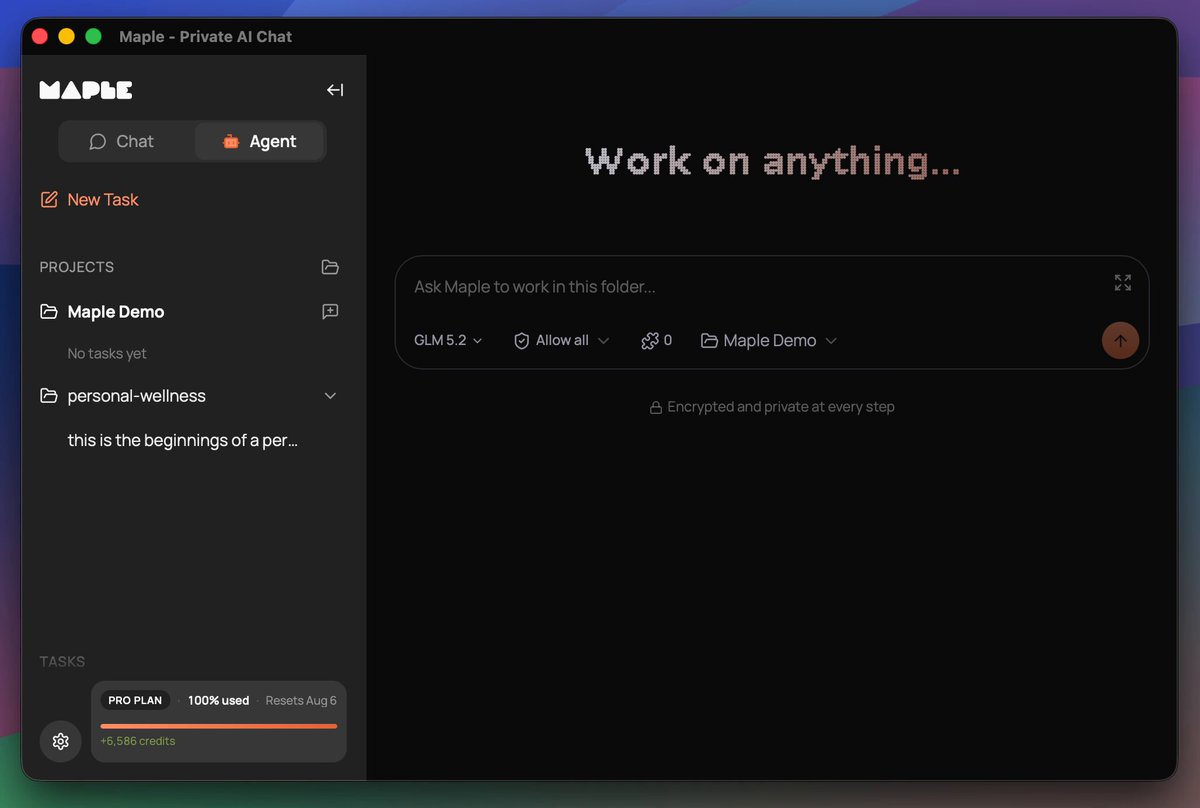
Maple is preparing for the release of a co-working agent. You install it locally and it works with your files, whether it's office work or building websites and apps. It's a turnkey solution, as easy as Claude Code, that keeps your data secure and private, no data sharing with closed AI labs. This is THE sovereign AI app for individuals and businesses who want powerful AI while retaining ownership of their information. Why build an agent into the Maple app when other agents already exist? Easy, we want to give you control over your work. We don't have a business plan that incorporates making money off our users' data. In the age of AI, your information, whether it's personal or company trade secrets, is the single thing that differentiates you from everyone else. We all have access to AI that can build a professional website for selling shoes. But your strategy and network for how you sell shoes should not be shared with your competitors. Sovereignty is the path to protecting what makes you, you. Maple sits at the intersection of Usability and Sovereignty. Maple gives you the best tools that are both easy to use and maintain your data sovereignty. Sovereign for one, sovereign for all. It has been a journey to get here. We brought to market the very first personal chatbot with end-to-end encryption using TEEs in late 2024. Prior to that there were proofs of concept but no full product offerings. Every other AI chat product on the market handled your data in plain text, either selling you a service to get your data or asking you to trust that they won't snoop on you. Quickly people found Maple and latched onto its open-source code and verifiable encryption. We didn't stop there. You may remember earlier this year we teased a product called "Maple Agent" and opened up a waiting list. That product is a mobile app that acts as your AI "friend", maintaining one long continuous chat, and getting to know you over time. I dislike using the word "friend" there, but it's the best way to convey the UX in a few words. AI is a tool, always has been, always will be. Any kind of friendly personality on top is just synthetic. In our testing, the UX of Maple Agent is really powerful for what it does. Think about the many short AI chats you have in your favorite app, whether it's looking up a historical fact or asking advice about a topic. With Maple Agent, those all go away in favor of the long-running chat with the friendly agent. It's like you have your own personal assistant who knows you so well and can look up anything for you. When I ask AI certain questions, I want to ask an expert who already understands my situation so I'm not repeating myself for the 100th time. That's the amazing value the personal agent brings to the table. We still see great utility for a personal agent like the "Maple Agent". Thousands of people on the waiting list, hoping to get their hands on it, agree that the concept is worth exploring and trying out. We were constrained in launching it due to a few circumstances, one of them being access to the scale of compute needed to power it. We have a clear path laid out for how to get there, but today is not the day to execute on that. It will be in the near future. Instead we have a different agent ready to go that we think is also incredible. We now have an agentic harness inside of the Maple Research app. This thing is a powerhouse. It even builds and publishes its own software releases. The agent in Maple Research works with your local filesystem, speaks to the largest open models running in TEEs, utilizes local models for certain tasks, is compatible with MCP tools, has an API for connecting to anything you need, and also supports the ACP protocol, which means it can be extended in the future to speak to other tools like Claude Code, Codex, and local models running on your own hardware. A big unlock for us was the Goose Development Kit, which powers the core of our agent harness. More on that to come as we publish articles and documentation later about the agent. The agent inside Maple Research doesn't have a name. At least not yet, not sure if it ever will. For now we call it "Chat Mode" and "Agent Mode". Think of this as the workhorse, the truck, the heavy lifter. Our other "Agent", the phone app, is your sidekick in your pocket, ready to help with quick things and ongoing conversations about life. I am incredibly excited about the Maple Research Agent. While I'm already seeing great results using it for internal work items, I'm especially thrilled about the personal health and wellness work it's doing for me. I know there are plenty of apps out there for compiling wellness data, but I'm having it build a tool tailored specifically for what I need, without the extra fluff. And none of my health data is being donated to the closed AI labs or sent to advertisers. I know that the AI logic is not being silently adjusted to fit the whims of a large corporation that has paid for product placement. It's me, state of the art AI, and my data. That's how I want it. Maple's new agent makes that possible. We can't wait for you to try it out. If you want early access, comment here, email us, reach out in some way. To those on the other agent waitlist, you're already in the queue. Thanks for reading this lengthy update. :)

Mark

46,589 görüntüleme • 1 ay önce

Andrew Wilkinson owns 40+ businesses. He just showed me how he's using OpenClaw, Claude Code and AI agents to run latest business, start new ones, and automate everything. Here's what I learned: 1. In December 2025, something clicked. He started waking up at 3AM with a smile, sitting in terminal with 10 Claude Code tabs open. He hasn't stopped since. He calls it chasing the dragon. 2.He built a full SaaS product called Deep Personality. A 40-minute personality test that generates a 100-page report written like Robert Greene. $20 000 in revenue. Zero employees. The entire business runs on AI agents. 3. He has agents for support, marketing, and dev. When a support ticket comes in, the agent either handles it or sends it to the dev agent. If it's critical, the agent fixes the bug and merges the PR before he wakes up. Then it emails the customer back. 4. His marketing agent is connected to PostHog, manages Meta and Reddit ads, creates ad creative, runs multivariate tests, and sets budgets. He's about to give it a $100 k/month ad budget and see what happens. 5. He forgot his laptop on a trip to Arizona. He ran his entire business from the back of Ubers using OpenClaw. Nobody picked up that every single email was written by AI. 6. His take on vibe coding: the worst part about business is people. Between your vision and execution are 100 people you have to convince. Vibe coding removes all of them. For the first time he can do every part of building a product himself. 7. He was trying to build OpenClaw before OpenClaw existed. Now he uses a tool called Harbor, which is basically a GUI for managing multiple agents. You can see all your agents, their status, knowledge bases, and databases in one place. 8. He built a custom AI for his relationship. He and his girlfriend took 15 psychological tests, put the results into ChatGPT, and asked it to analyze their relationship. It nailed every fight they've ever had. That became the product idea for Deep Personality. 9. His honest take: he spends 50% of his time debugging, 30% improving the setup, and 20% being productive. It's a treadmill. But the 20% that works is so powerful he can't stop. 10. His prediction: we're 3-6 months from being able to hand basic businesses off to AI to run entirely. And pretty soon Anthropic and OpenAI are going to launch AI CEOs. This is an inside look at how a serious operator Andrew Wilkinson is using AI agents in the real world. The good, the bad, the debugging, all of it. Most people don't show you this. Episode is live on The Startup Ideas Podcast (SIP) 🧃 watch

GREG ISENBERG

144,005 görüntüleme • 4 ay önce

Local AI 101: open models, Hugging Face, and businesses to build (38 min masterclass) I still think cloud AI is the default for most things, and honestly it should be, the frontier models are the strongest and easiest to use. But something shifted in the last 4-5 months. You can now run genuinely good open models directly on your own laptop, or even your phone. And once you actually try it, it changes how you think about what AI is even for. LOCAL AI, CLEARLY EXPLAINED: 1. The model is the brain doing the thinking. Gemma, Llama, Mistral, and Qwen are the main families, and each is better at different things, some at reasoning, some at coding, some small enough to run on a phone. 2. Hugging Face is the warehouse where you find them. You go there to see what each model is good at, check the license, and grab the compressed versions that run on a normal computer. 3. The software is what runs the model on your machine. Start with LM Studio if you're not technical, it feels like a normal app where you search, download, and start chatting. Ollama is the one you reach for when you want to plug a model into your own apps. 4. The workflow is the actual product you build on top of it all. That's what I'm ideating around for some businesses to create. I think local AI just made a specific kind of business way easier to start. Find an industry that: 1. Sits on sensitive data they'd never paste into ChatGPT 2. Does the same review over and over 3. Runs on software from 2003 Then build a local AI tool that does that review on their own machine, so the data never leaves the building! Take home health agencies. Nurses write visit notes all day, and if a note is missing a detail, the billing gets denied or the audit flags it. Here's how I'd start: 1. Find 5 small agencies. Offer to review a batch of their notes for them. 2. Run the notes through Gemma locally (free, private, no cloud). Read every output yourself. 3. Write down the 20 issues that keep showing up: missing vitals, vague med changes, notes that don't support the billed level. 4. That list of 20 is your checklist. The checklist is the product. 5. Turn it into a local desktop app that flags those 20 things before a note gets submitted. You just went from a service anyone could offer to a product nobody else has, and you learned exactly what to build by doing the work by hand first. Same recipe works for restoration contractors (draft the damage report on-site before the tech leaves) and wealth advisors (catch the compliance landmine in a client email before it sends). Basically the framework is sensitive data, repeated review, ancient software. I think there are tons of businesses like this! Almost none of it clicked for me until I actually started using local AI. So if you take one thing from this, go run a model on your own machine once. Also a fun thing to try with your friends. Feel free to send this to a friend. The episode is live for free on The Startup Ideas Podcast (SIP) 🧃 (thanks to Google for sponsoring today's episode and supporting local AI) I feel like local AI one of those things you need to try for it to really click. Run one model on your own machine and you'll see what I mean! I go way deeper in the full 38 minute masterclass, the models, the setup, and the businesses to build. Link below. LINK TO WATCH: OR WATCH BELOW ON X What do you think of local AI?

GREG ISENBERG

31,321 görüntüleme • 7 gün önce