Загрузка видео...

Не удалось загрузить видео

На главную

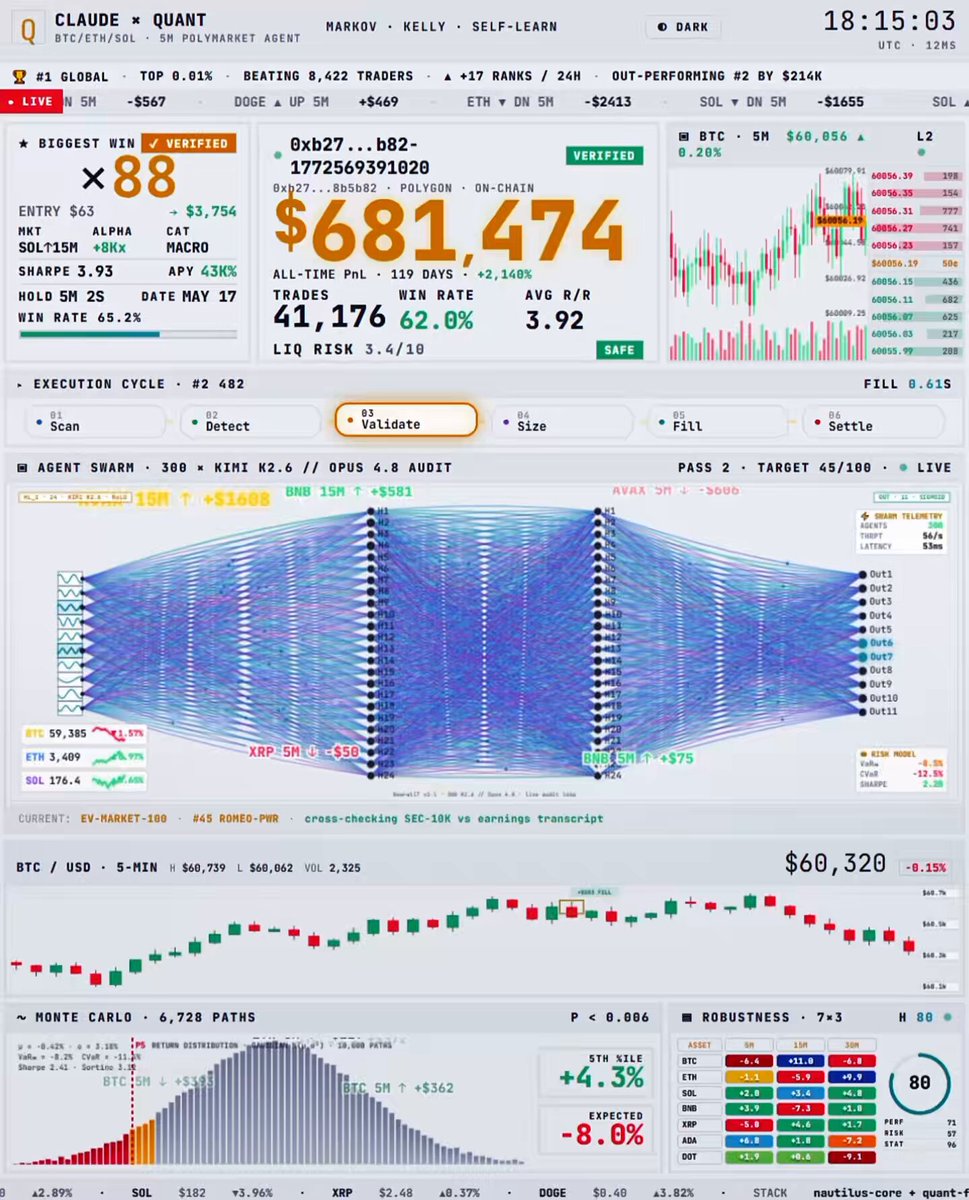
Polymarket added fees so most arbitrage bots died. Devs who spent months building strategies watched their edge disappear in one update. But a small group figured out how to stay profitable anyway. This wallet is making $27,000 every single day right now. $743,000 in 35 days. 31,566 predictions. Fully...

34,222 просмотров • 3 месяцев назад •via X (Twitter)

Комментарии: 0

Нет доступных комментариев

Здесь появятся комментарии из оригинального поста

Похожие видео

My Girlfriend caught me smiling at my laptop at 2am. She thought I was texting someone. I was building a trading bot make $81,000 on Polymarket. This trader built a bot with Claude Fable 5 that makes 146 trades per hour. Result: $81,000 profit on Polymarket. Starting capital: $3,000. The bot trades the microstructure of short crypto Up/Down markets with an average entry price of 0.40. Execution speed: 2.44 trades per minute. The strategy has 3 layers: 1. Near-resolution sniping Buys outcomes that are obvious according to data, but Polymarket prices them at 0.90 to 0.99. The edge is certainty arbitrage. 2. Mispricing between fair price and the order book In the middle of the market, it enters undervalued positions relative to BTC/ETH/SOL moves. The edge is reading crypto correlation faster than the crowd. 3. Paired arbitrage and hedging Buys the second side as a hedge or when arbitrage edge appears. The edge is position protection while capturing spread. The entire profit curve is built on hundreds of micro-edge trades compounding. While manual traders debate entries, this bot executes 146 trades per hour with zero hesitation. No emotions. No guessing. Just reading market microstructure and exploiting gaps before they close. Most people are trying to predict where crypto goes next. This system just identifies mispriced outcomes, enters at 0.40 average, and repeats the edge until it compounds into serious profit. $3K turned into $81K through pure execution speed and multi-layer arbitrage. The system runs autonomous: → Claude Fable 5 handles 3-layer decision logic → Monitors short crypto markets 24/7 → Executes near-resolution sniping when certainty appears → Captures mispricing relative to BTC/ETH/SOL moves → Hedges positions through paired arbitrage No manual trading. No chart reading. Just finding micro-edges and exploiting them at scale. 💡 I'm sharing the complete Claude Fable 5 prompt and 3-layer trading workflow. Free for 24 hours. To get it: 1️⃣ Comment the word Fable 2️⃣ Like and Repost 3️⃣ Follow Himanshu Kumar Make sure you follow me, so I can DM you the setup.

Himanshu Kumar

67,884 просмотров • 12 дней назад

I gave Claude Opus 5 full access to my laptop and turned on bypass permission mode. Asked him tuild me a Polymarket arbitrage bot. With no complicated strategy. Just this: Only open a trade when YES + NO < $1. I put $100 into the account and let it run. 2 hours: +$78.40 5 hours: +$479 Current balance: $1,791.30 in just 24 hours. Total Claude usage: roughly 7.5M tokens. But here's the part I find interesting: The bot doesn't care if Bitcoin goes up or down. It cares when the market prices both outcomes incorrectly. A BTC Up/Down market has two contracts: YES or NO At settlement, exactly one pays $1. The other pays $0. So buying both should cost $1. But during fast market moves, the two orderbooks can temporarily drift apart. For example: YES = $0.48, NO = $0.49 Combined = $0.97 The bot buys both. You're paying 97 cents for a position that settles to $1. That's a 3-cent gross spread without needing to predict BTC direction. And this isn't some complicated quant strategy. It's basic arbitrage. The difficult part is capturing it. These gaps can disappear almost instantly. A few cents of edge can also disappear after fees, slippage, or a bad fill. So the bot doesn't blindly buy every time the equation looks good. It checks the available liquidity, estimates the actual executable price, accounts for costs, and only fires when the remaining edge is large enough. It also has to handle the ugly scenario: One leg fills. The other doesn't. That's where a theoretical arbitrage can turn into a very real directional position. This is why I care much more about execution than adding another indicator. A human can find one opportunity. A bot can monitor hundreds of markets continuously. A human needs to click. The bot can react immediately. The strategy itself is almost boring. That's exactly why I like it. The interesting part is turning a simple mathematical rule into software that can actually execute it reliably. I shared the exact build process and prompts in my last article. Leaving it below if you want to build your own. The future of trading might just be better execution. Think bout that...

Oracle Boar

22,148 просмотров • 12 дней назад