Video wird geladen...

Video konnte nicht geladen werden

Zur Startseite

PowerInfer - a high-speed inference engine for deploying LLMs locally. Just came across this super interesting project on speeding up inference. It's not MoE but it's a simple approach that exploits the high locality in LLM inference to design a GPU-CPU hybrid inference engine. Hot-activated neurons are preloaded onto...

261,622 Aufrufe • vor 2 Jahren •via X (Twitter)

10 Kommentare

Profilbild von elvis
elvisvor 2 Jahren

source: github:

Profilbild von Adam Pippert
Adam Pippertvor 2 Jahren

This is HUGE. I always suspected that there would be a way to break up the architecture of a model to alleviate the GPU cost and availability bottleneck. Will play with this on LLaMa2, but highly anticipating Mistral-7B.

Profilbild von Hamid R. Darabi
Hamid R. Darabivor 2 Jahren

It's very interesting! 11.69x improvement over llama.cpp sounds a lot, given that it's already super efficient. Are you sure it's not 11.7%? Even that could be a good result.

Profilbild von Loki (cute/acc)
Loki (cute/acc)vor 2 Jahren

I almost tried this before I realized it's one more model exchange format 🥲 ".powerinfer.gguf" Can't all of you just use onnx and move on in life? 😭

Profilbild von catid (e/acc)
catid (e/acc)vor 2 Jahren

Nice I was working in this direction recently noting the same things. 12x speedup is very respectable compared to 8x being the best so far achieved by any one approach (e.g. pruning/quantization)!

Profilbild von Filippo Pedrazzini
Filippo Pedrazzinivor 2 Jahren

15 GiBs of weights? And this is supposed to run on Consumer Devices?! 🧐

Profilbild von Medium Boss - 70b_Float16.Q8.gguf
Medium Boss - 70b_Float16.Q8.ggufvor 2 Jahren

The week I got a new PC with a beefy CPU. Fucking nice.

Profilbild von Sahar Mor
Sahar Morvor 2 Jahren

Paper tl;dr

Profilbild von s3nh
s3nhvor 2 Jahren

Fastest bookmark 🤫🤫🤫

Profilbild von Ruairi
Ruairivor 2 Jahren

Noob question, is this just for the activation function or is it also cutting down the number of entries for GPU matrix multiplication as well?

Ähnliche Videos

I had to test it myself to believe this unreal inference speed. 3,000 tokens/s for 1 user on standard datacenter GPUs. They leveraged a hidden efficiency gap in how GPUs generate tokens. Kog just achieved 3,000 tokens/s on 8× AMD MI300X GPUs and 2,100 on 8× NVIDIA H200 (FP16, no speculative decoding). Their tech preview is on a 2B model, and they show how their techniques will scale to large frontier MoE models at similar speeds. That's a huge number because normal low-batch GPU decoding for 2B to 8B models is usually closer to 100 to 300 tokens/s per request, so Kog is claiming something like a 10X to 30X jump in the speed one user actually feels. Their trick: they are getting the speed by treating LLM decoding as a memory streaming problem, not mainly a math problem. For 1 user at batch size 1, the GPU is not doing big, efficient matrix-matrix work like in training or large-batch serving; it is repeatedly pulling the model’s active weights from high-bandwidth memory for each new token, so speed depends on how smoothly those weights keep flowing. Normal inference stacks keep breaking that flow. They run many separate GPU programs for different parts of the model, move intermediate results through memory, wait at synchronization points, talk back to the CPU for scheduling or sampling, and then repeat this token after token. Kog’s answer is to co-design 3 things that are usually tuned separately: the runtime, the low-level GPU code, and the model architecture. The biggest engineering move is the monokernel, where the whole decode pass runs as 1 persistent GPU-resident program, including sampling, so the system does not keep stopping for kernel launches, CPU scheduling, and intermediate memory round trips. They also rebuilt synchronization, because their own measurements say grid sync was eating around 35% of token-generation time; instead of making every compute unit wait at a broad barrier, each unit waits only for the exact data it needs. On AMD MI300X, they also map memory access around the chiplet layout, because memory latency changes depending on which die makes the request. Then their Laneformer model uses Delayed Tensor Parallelism, which lets cross-GPU communication happen in the background instead of blocking every layer.

Rohan Paul

13,148 Aufrufe • vor 1 Monat

Dylan Patel on the importance of memory and storage Two key quotes: "An $NVDA GPU is faster than an $AMD GPU in most cases, but because AMD GPUs have more memory, they can outperform Nvidia in certain workloads." “It is a difficult, multivariable problem. Generally, you need the best GPU, such as a GB300, but you also need the best storage solutions. I will not spoil who comes out on top, but storage solutions matter a lot, memory solutions matter a lot, and frontend networking also matters significantly" Full Quote: “We have over $80 million of compute: GPUs from $NVDA and $AMD, TPUs from Google, and Trainium from Amazon. We constantly run this benchmark using the newest inference engines, drivers, PyTorch versions, and other software. It runs every day through automated CI across the latest Chinese models from GLM, Zhipu, Moonshot, Kimi, Alibaba, and others. Initially, when we were benchmarking the differences between these chips, inference engines, and parallelism schemes, we used fixed context lengths. But with Agent X, we have now analyzed more than $5 million worth of Claude Code traces. This is real production traffic that users have donated to us, combined with internally generated data, so we now understand what an actual agent workload looks like. When we implement those workloads and run the benchmarks, it turns out that the chip you are using is very important, but how you handle memory offload can be even more important. An Nvidia GPU is faster than an AMD GPU in most cases, but because AMD GPUs have more memory, they can outperform Nvidia in certain workloads. Similarly, you can use a less powerful GPU with a much better storage solution and outperform the best GPU when it lacks those solutions. Simply buying the newest GPU does not necessarily give you the best inference economics. You need to layer in other innovations, including storage and memory.” Interviewer: “Who is the top player on your chart? Can you tell us?” Dylan Patel: “It is a difficult, multivariable problem. Generally, you need the best GPU, such as a GB300, but you also need the best storage solutions. I will not spoil who comes out on top, but storage solutions matter a lot, memory solutions matter a lot, and frontend networking also matters significantly.”

Daniel Romero

38,220 Aufrufe • vor 17 Tagen

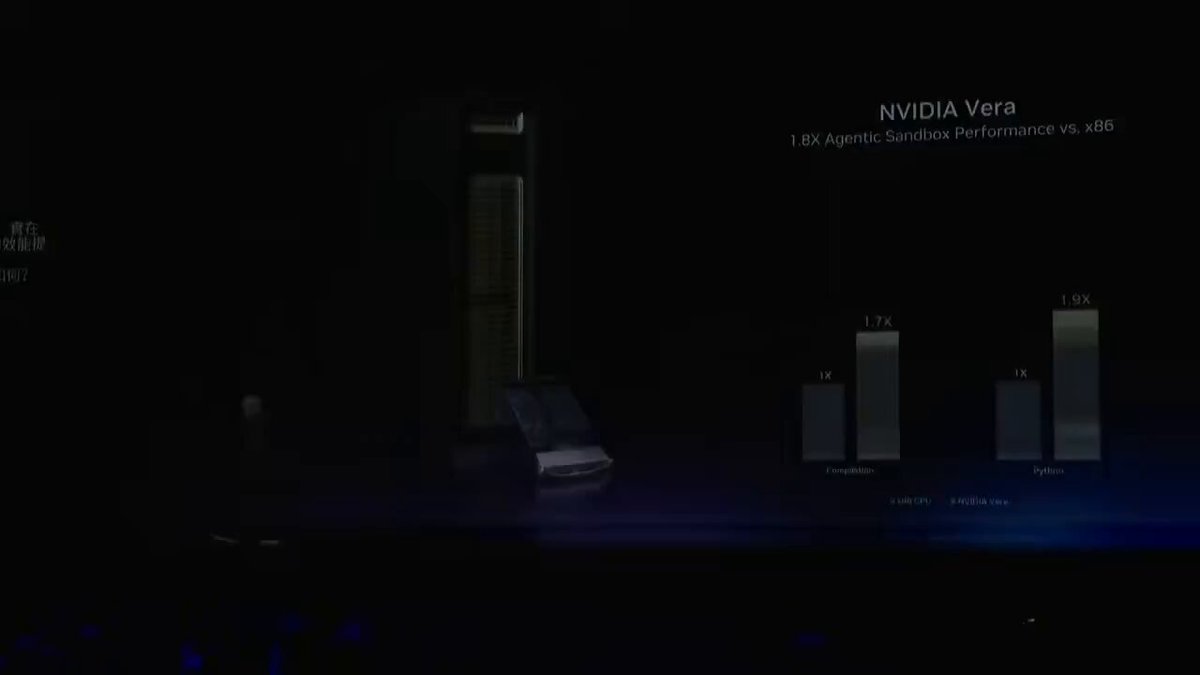
Jensen Huang just identified the next $200 billion market (Save this). The shift starts with a observation about agentic AI that changes everything about infrastructure. In the era of training and inference, the GPU was everything while CPU was a traffic cop, scheduling work, managing memory, dispatching tasks while the GPU did the heavy lifting. Agentic AI breaks that model entirely. An AI agent does not just run a single inference pass but rather it plans, calls tools, executes code in sandboxes, retrieves data from multiple sources and loops through complex multi-step reasoning sequences often thousands of times per second at scale. Every one of those operations runs through the CPU and the GPU sits idle waiting for the CPU to prepare the next task, supply the right context and execute the retrieval and tool calling logic fast enough to keep the accelerators fed. The CPU is now the conductor and the GPU is the orchestra and the bottleneck is the conductor falling behind. This is showing up in production AI factory utilization right now, which is exactly why Jensen built Vera from scratch rather than licensing x86. Vera achieves 40% lower peak memory latency than x86, 50% faster core to core communication, and 1.8 times the agentic sandbox performance of current x86 processors on a purpose-built architecture designed around the agentic loop. Now here is where the investment thesis gets interesting. The obvious beneficiary is Nvidia itself, and that thesis is real. Nvidia's CFO has guided for nearly $20 billion in Vera CPU revenue this fiscal year alone, a market Nvidia had zero presence in just three years ago. Intel held 60% of server CPU market share as recently as Q4 2025 and that transition is now happening at a pace Intel structurally cannot respond to. But the deeper question is, what architecture is Vera actually built on? Vera's Olympus cores are ARM compatible and every single Vera CPU deployed in every Vera Rubin rack in every data center in the world runs on ARM architecture. And ARM Holdings collects a royalty on every one of them. ARM does not make chips but rather licenses the instruction set architecture and CPU core designs that others build on top of. Every time Nvidia ships a Vera CPU, every time a hyperscaler deploys a Vera Rubin rack, every time an enterprise qualifies Vera for their AI factory, ARM earns a royalty. The secular tailwind here is almost perfectly constructed for ARM's business model. Amazon's Graviton, Microsoft's Cobalt, Google's Axion, Apple's silicon stack, and Qualcomm's data center push all run on ARM. And now Nvidia's Vera, which is projected to displace Intel as the largest server CPU supplier by revenue in a single fiscal year, is ARM. ARM's royalty rate on high end server chips is estimated at roughly 1 to 2% of chip selling price. At $5,000 per Vera CPU and 4 million units projected for FY2027, that is a royalty line growing from near zero to potentially $400 million to $800 million annually from Nvidia's data center CPU business alone before counting Amazon, Microsoft, Google, Apple, and Qualcomm. The total ARM addressable royalty base across all the silicon it already licenses is compounding at a rate that the current $130 billion market cap does not fully reflect. Jensen's CPU thesis is the most underappreciated catalyst in ARM's fundamental story, and the royalty compounding has barely started. Come join Milk Road Pro and get our full ARM royalty model and our entire AI trade thesis. Link below!

Milk Road AI

11,819 Aufrufe • vor 1 Monat

Dylan Patel of SemiAnalysis says a worse GPU with better storage and memory now beats the best chip without them, so buying the newest GPU alone no longer wins inference. So, an AMD GPU with more memory can outperform Nvidia in some cases. "So what we have is we have over $80 million of compute, GPUs from Nvidia, AMD, TPUs from Google, Trainium from Amazon, and we run this benchmark constantly on the newest inference engine, newest drivers, newest PyTorch version, whatever it is." "Every day it runs on an automated CI, and we run it on all the latest Chinese models, from GLM, Zhipu, Moonshot, Kimi, Alibaba, all these models we run." "Initially, when we were benchmarking the difference between these chips and different engines, different schemes for parallelism, we were just running it fixed context length." "But now with Agent X, we've analyzed over $5 million worth of Claude Code traces. This is real production traffic that people have donated to us as well as internally generated. Now we know what the actual agent workload looks like." "And then as we implement that and run those benchmarks, it turns out yes, the chip you're using is very important, but now even more important is how are you handling this memory offload?" "And so while an Nvidia GPU is faster than an AMD GPU in most cases, because AMD GPUs have more memory, they actually end up outperforming in some cases." "Or you can have a worse GPU, but a much better storage solution, and now you can outperform what the best GPU can do without those solutions. So just buying the newest and latest GPU alone doesn't get you the best inference economics." "Actually, you need to layer in all these other innovations including storage and memory." [ Who's the top player on your chart? ] "That really is a difficult multivariable problem. And generally that means you need to have, yes, you need to have the best GPU, a GB300, but you also need to have the best storage solutions. And so I won't spoil who's the best right here, but I will say that storage solutions matter a lot and memory solutions matter a lot, as does your front-end networking. That matters a lot."

Fireside Alpha

165,565 Aufrufe • vor 1 Tag

Etched is deploying two new technologies in chip design: low-voltage inference and cluster-scale memory. CEO Gavin Uberti says they'll make their chips much more power-efficient and way, way faster than today's leading GPUs. He breaks it down: "We looked at a lot of early research directions, and we realized the key things that models need are way more compute and way faster memory." "If you think about inference, there are two key parts: prefill and decode. For prefill, it's a compute-bound problem. You need to have more FLOPS, more operations per second on each of your chips." "On our GPU, the bottleneck's actually thermals. You can't really run a GPU at more than around 50% of what it could theoretically do, or it'll melt." "So we're using a new technology today called low-voltage inference to try to solve this problem. You bring the voltage of the chip down dramatically, which allows us to have way, way better efficiency in terms of how much power is drawn per unit of math, and thus fit way way more flops onto the chip..." "For decode, it's all about bandwidth. Not just bandwidth on a chip, but bandwidth across your cluster. That's why we have this technology we call cluster-scale memory. It reduces the amount of time it takes to communicate from one chip to another dramatically." "As a result we can go use all of our HBM, HBM bandwidth, SRAM, SRAM bandwidth, and our scale-up domain as a single coherent pool. And that means if you're a user, you can go get much faster tokens per second, while still keeping your costs low."

TBPN

20,404 Aufrufe • vor 27 Tagen

Micron is going to $4,000 and once you understand what inference actually is, the number stops sounding crazy (Save this). Dylan Patel just said that by 2030, OpenAI and Anthropic alone will need over 100 gigawatts of compute combined and by 2040, we may not even be measuring AI infrastructure in gigawatts anymore. We may be talking about terawatts. Every single one of those gigawatts needs memory to function. Without it, the compute is worthless. Most people heard that and thought about Nvidia but they should be thinking about Micron. Every AI model generating a response has two phases. The first is prefill, processing your prompt which is compute-heavy and the second is decode generating each word one token at a time and that phase is almost entirely memory-bound, not compute-bound. During decode, the GPU's processing units sit idle more than 95% of the time, waiting for data to arrive from memory. Google confirmed it in a research paper that decode-phase bottlenecks are dominated by memory bandwidth and capacity not raw compute. The GPU is not the bottleneck but the memory feeding the GPU is. This matters because inference is now where all the money lives. Training a model happens once, Inference happens billions of times a day every ChatGPT response, every Claude output, every agentic workflow running in the background and every one of those token streams is a billing event tied directly to memory performance. Adding more GPUs does not fix this because GPUs are already underutilized in inference because they are sitting idle waiting on memory. Adding more memory bandwidth and capacity is what directly reduces token cost, reduces latency, and allows the same cluster to serve dramatically more users simultaneously. Longer context windows compound the problem further, a model running a 1 million token context window requires dramatically more memory per session than a 10,000 token window, and every new model generation pushes context longer. The market treats memory as a downstream beneficiary of Nvidia orders. The correct framework is the opposite, Micron is the upstream constraint on how much value every Nvidia GPU can actually generate at inference scale. Micron guided Q4 to $50 billion in revenue, has HBM4 ramping at twice the pace of the prior generation, and CEO Sanjay Mehrotra has said supply will not catch demand before the end of 2027. At 8x forward earnings on $112 projected FY2027 EPS, Micron is the most undervalued infrastructure company in the entire AI stack. Inference is memory. Memory is Micron and the inference ramp has barely started. Milk Road Pro members are already up massively on this position and we're just getting started. If you want the full breakdown of what we're buying and why, come join us for just a dollar using the link below!

Milk Road AI

128,522 Aufrufe • vor 27 Tagen

six months ago this wasn't happening on 8gb vram. running unsloth's Q4_K_XL quant of gemma 4 26b-a4b-it-qat, a sparse MoE model with only 4b active params on a single rtx 4060 laptop gpu, 8gb vram, 20+ tok/s decode. no cloud, no api, no offload hacks. just a gaming laptop on battery. what makes it fit: google's QAT (quantization aware training), plus MTP (multi token prediction) support in the latest llama.cpp builds. that combo is the single biggest unlock for local inference on low vram. rtx 3060, rtx 3070, gtx 1070, gtx 1080, rtx 4050, rtx 4060, rtx 5050, rtx 5060 — any 6-8gb consumer gpu, old or new — this model runs on it. world cup season, so i told it to build a soccer themed flappy bird clone. one shot, zero iteration, fully playable. six months ago an 8gb model could barely clone vanilla flappy bird. now it's shipping a themed game from a sparse MoE model running locally on a laptop battery. inference benchmarks: - decode throughput: 30 tok/s - context: 64k. this is the real unlock. 64k ctx is what makes a hermes agent loop viable locally on this model, not just single-turn chat. llama.cpp flags: -m gemma-4-26B-A4B-it-qat-UD-Q4_K_XL.gguf -c 64000 -cmoe --port 8080 game's deployed on my own site, built and shipped end to end with open source llm, zero closed source api dependency in the pipeline. link in the description. gguf weights on huggingface, link in the comments. pull it down, run it on whatever 8gb card is sitting in your rig. try the game and tell me your score and what you want in v2. local llms on consumer gpus stopped being a meme.

Alok

60,866 Aufrufe • vor 1 Monat

The creator of High Bandwidth Memory (HBM) put a number on the AI build that should stop every infra investor cold. A cluster of a million GPUs runs at roughly 10-20% utilization (Save this). Kim Jung-ho spent thirty years building what feeds the GPU, and his claim is that the GPU is barely working. Here is what is actually happening. Every time a model generates output, the data has to be read out of memory, computed, and written back. The read and the write swallow almost the entire cycle. While that data moves, the GPU does nothing. It sits there, fully powered, fully paid for, waiting. By Kim's estimate the memory is doing only about 30 percent of the work it needs to do. The processor idles the rest. So a million installed GPUs run at 10 to 20 percent. You are not compute constrained. You are memory constrained, and the expensive part is standing around. Adding more GPUs does not fix this. It gives you more processors starving for the same data. Here is the part that decides the next decade. Memory can grow. When a cell cannot shrink any further, you stack it into a high-rise, layer on layer. A GPU cannot be stacked. It runs too hot and needs a cooler bolted to its back, so the one move that rescues memory is closed to the processor. The thing that can keep stacking compounds. The thing that cannot plateaus. The marginal dollar in an AI build now buys more by fixing the memory path than by bolting on another idle GPU. Which is why the companies that control memory bandwidth and supply are not suppliers to the AI trade. They are the AI trade.

Fireside Alpha

38,370 Aufrufe • vor 28 Tagen