Загрузка видео...

Не удалось загрузить видео

На главную

Proactive agent that thinks and acts like you. Multiplayer AI Brain for teams. Proper GUI for commanding 50 agents. all three. Sauna goes live today. First 2000 people, use access code LAUNCH for $80 of weekly(!) credits. Let’s explain. Multiplayer only works once the personal brain is powerful. So...

783,775 просмотров • 4 месяцев назад •via X (Twitter)

Комментарии: 0

Нет доступных комментариев

Здесь появятся комментарии из оригинального поста

Похожие видео

Today, we are launching the first publicly available AI Scientist, via the FutureHouse Platform. Our AI Scientist agents can perform a wide variety of scientific tasks better than humans. By chaining them together, we've already started to discover new biology really fast. With the platform, we are bringing these capabilities to the wider community. Watch our long-form video, in the comments below, to learn more about how the platform works and how you can use it to make new discoveries, and go to our website or see the comments below to access the platform. We are releasing three superhuman AI Scientist agents today, each with their own specialization: A general-purpose agent (Crow); An agent to automate literature reviews (Falcon); and An agent to answer the question “Has anyone done X before” (Owl). We are also releasing an experimental agent, Phoenix, that has access to a wide variety of tools for planning experiments in chemistry. More on that below. The three literature search agents (Crow, Falcon, and Owl) have benchmarked superhuman performance. They also have access to a large corpus of full scientific texts, which means that you can ask them more detailed questions about experimental protocols and study limitations that general-purpose web search agents, which usually only have access to abstracts, might miss. Our agents also use a variety of factors to distinguish source quality, so that they don’t end up relying on low-quality papers or pop-science sources. Finally, and critically, we have an API, which is intended to allow researchers to integrate our agents into their workflows. Phoenix is an experimental project we put together recently just to demonstrate what can happen if you give the agents access to lots of scientific tools. It is not better than humans at planning experiments yet, and it makes a lot more mistakes than Crow, Falcon, or Owl. We want to see all the ways you can break it! The agents we are releasing today cannot yet do all (or even most!) aspects of scientific research autonomously. However, as we show in the video, you can already use them to generate and evaluate new hypotheses and plan new experiments way faster than before. Internally, we also have dedicated agents for data analysis, hypothesis generation, protein engineering, and more, and we plan to launch these on the platform in the coming months as well. Within a year or two, it is easy to imagine that the vast majority of desk work that scientists do today will be accelerated with the help of AI agents like the ones we are releasing today. The platform is currently free-to-use. Over time, depending on how people use it, we may implement pricing plans. If you want higher rate limits, especially for research projects, get in touch. Michael Skarlinski, Andrew White 🐦‍⬛, Tyler Nadolski, Remo Storni, James Braza, Ludovico Mitchener, Michaela Hinks, as well as Jason Carman and his team for making such fantastic videos of us!

Sam Rodriques

725,736 просмотров • 1 год назад

Today we’re launching the first and only human-like AI agents in the world. Super Agents™ are the first agents with human‑level skills – they DM you, take @ mentions, send emails, manage docs, tasks, and more. Not just tools or API calls, but real skills fine‑tuned for how teams actually work. The first agents with 100% context – fully native in ClickUp and fully synced from other apps. Super Agents see your work the same way that humans do: tasks, docs, schedules, and conversations all in one place. The first agents that learn from human interactions automatically, without any setup or configuration – when you give feedback, they listen and improve how they work. The first agents with human‑level memory for custom agents – historical memory for every interaction, short-term working memory, and even long‑term memory stored in docs you can literally open, inspect, and edit. The first agents that are literally the same as users – our agentic user model is the same as our user data model. This gives you permissions and capabilities that you and your systems are already familiar with. The first infinite agent catalog – where anyone can create and customize agents in minutes, for literally any type of work imaginable. It's the most intuitive way to build agents on the planet. 95% of companies are failing in AI adoption. The reality is that AI isn't meant to be adopted, it's meant to be adapted – to you. Super Agents are automatically personalized to you and your company using proprietary state-of-the-art agent architecture, orchestration, and tooling. Today is the largest step forward we've ever made towards our mission of making people more productive. Maximize human productivity, with ClickUp Super Agents. Available NOW. For everyone.

Zeb Evans

320,607 просмотров • 8 месяцев назад

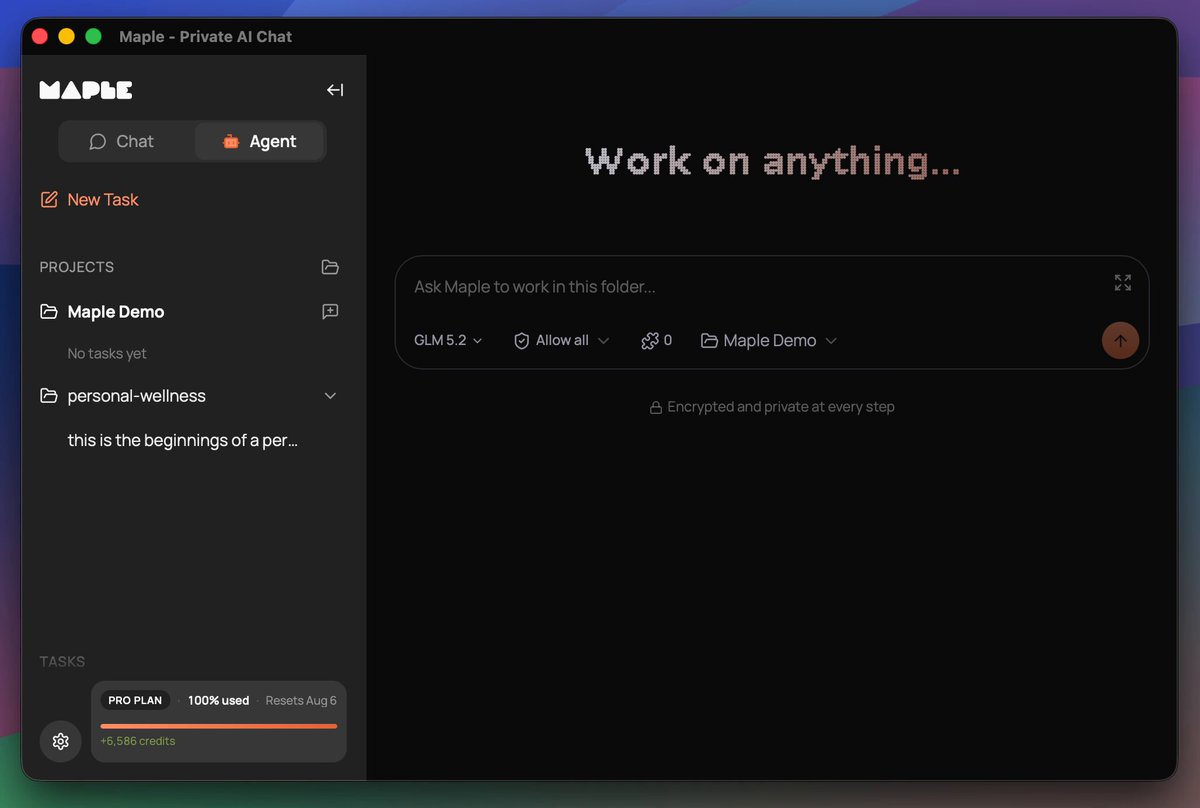
Maple is preparing for the release of a co-working agent. You install it locally and it works with your files, whether it's office work or building websites and apps. It's a turnkey solution, as easy as Claude Code, that keeps your data secure and private, no data sharing with closed AI labs. This is THE sovereign AI app for individuals and businesses who want powerful AI while retaining ownership of their information. Why build an agent into the Maple app when other agents already exist? Easy, we want to give you control over your work. We don't have a business plan that incorporates making money off our users' data. In the age of AI, your information, whether it's personal or company trade secrets, is the single thing that differentiates you from everyone else. We all have access to AI that can build a professional website for selling shoes. But your strategy and network for how you sell shoes should not be shared with your competitors. Sovereignty is the path to protecting what makes you, you. Maple sits at the intersection of Usability and Sovereignty. Maple gives you the best tools that are both easy to use and maintain your data sovereignty. Sovereign for one, sovereign for all. It has been a journey to get here. We brought to market the very first personal chatbot with end-to-end encryption using TEEs in late 2024. Prior to that there were proofs of concept but no full product offerings. Every other AI chat product on the market handled your data in plain text, either selling you a service to get your data or asking you to trust that they won't snoop on you. Quickly people found Maple and latched onto its open-source code and verifiable encryption. We didn't stop there. You may remember earlier this year we teased a product called "Maple Agent" and opened up a waiting list. That product is a mobile app that acts as your AI "friend", maintaining one long continuous chat, and getting to know you over time. I dislike using the word "friend" there, but it's the best way to convey the UX in a few words. AI is a tool, always has been, always will be. Any kind of friendly personality on top is just synthetic. In our testing, the UX of Maple Agent is really powerful for what it does. Think about the many short AI chats you have in your favorite app, whether it's looking up a historical fact or asking advice about a topic. With Maple Agent, those all go away in favor of the long-running chat with the friendly agent. It's like you have your own personal assistant who knows you so well and can look up anything for you. When I ask AI certain questions, I want to ask an expert who already understands my situation so I'm not repeating myself for the 100th time. That's the amazing value the personal agent brings to the table. We still see great utility for a personal agent like the "Maple Agent". Thousands of people on the waiting list, hoping to get their hands on it, agree that the concept is worth exploring and trying out. We were constrained in launching it due to a few circumstances, one of them being access to the scale of compute needed to power it. We have a clear path laid out for how to get there, but today is not the day to execute on that. It will be in the near future. Instead we have a different agent ready to go that we think is also incredible. We now have an agentic harness inside of the Maple Research app. This thing is a powerhouse. It even builds and publishes its own software releases. The agent in Maple Research works with your local filesystem, speaks to the largest open models running in TEEs, utilizes local models for certain tasks, is compatible with MCP tools, has an API for connecting to anything you need, and also supports the ACP protocol, which means it can be extended in the future to speak to other tools like Claude Code, Codex, and local models running on your own hardware. A big unlock for us was the Goose Development Kit, which powers the core of our agent harness. More on that to come as we publish articles and documentation later about the agent. The agent inside Maple Research doesn't have a name. At least not yet, not sure if it ever will. For now we call it "Chat Mode" and "Agent Mode". Think of this as the workhorse, the truck, the heavy lifter. Our other "Agent", the phone app, is your sidekick in your pocket, ready to help with quick things and ongoing conversations about life. I am incredibly excited about the Maple Research Agent. While I'm already seeing great results using it for internal work items, I'm especially thrilled about the personal health and wellness work it's doing for me. I know there are plenty of apps out there for compiling wellness data, but I'm having it build a tool tailored specifically for what I need, without the extra fluff. And none of my health data is being donated to the closed AI labs or sent to advertisers. I know that the AI logic is not being silently adjusted to fit the whims of a large corporation that has paid for product placement. It's me, state of the art AI, and my data. That's how I want it. Maple's new agent makes that possible. We can't wait for you to try it out. If you want early access, comment here, email us, reach out in some way. To those on the other agent waitlist, you're already in the queue. Thanks for reading this lengthy update. :)

Mark

44,707 просмотров • 1 месяц назад

What does it actually mean to be AI native? There was no clear guide on the internet for how to become AI native so we built the definitive one (60 min masterclass): 1. An AI native org has 3 layers: people for strategy and taste, agents for execution, and a shared context layer that makes the entire company readable to agents. 2. AI eats the middle of your work. You used to spend 80% of your day on execution. Now agents do that. Your job is the bookends: deciding what to do and judging whether it's good enough. 3. Everyone is a manager now. Your output is the output of your agents. If your agents produce garbage, that's on you. You set them up wrong. 4. Using ChatGPT doesn't make you AI native. That's like having a website and calling yourself a tech company lol. 5. No AI native org without AI native people. Most companies skip straight to the tools. That's why it fails. If your people don't understand how to manage agents, the tech doesn't matter. 6. Making your company "readable" to agents is the real work. Every process, every decision, every piece of knowledge needs to exist in a format an agent can consume. Most companies are nowhere close. 7. Speed without signal is just expensive chaos. You need the system to move fast AND know if you're moving in the right direction. 8. The skill chain is how agents get good at your specific workflows. Skills build on skills. The more you invest in them, the more your company compounds. 9. The moat is the system. People managing agents, agents reading from rich context, the whole thing getting smarter every week. That compounds. Your competitor can copy your tools. They can't copy your system. Full episode with Theo Tabah from LCA on The Startup Ideas Podcast (SIP) 🧃. This is the stuff we normally keep internal but all the sauce is yours. Theo Tabah is the brains behind advising the world's biggest companies on AI and building AI products. Your fav CEO's first call for figuring out AI. You are in for a treat Become AI native in under 60 minutes Watch

GREG ISENBERG

84,713 просмотров • 2 месяцев назад

We started Learning how to build AI agents & tools from scratch, on Nov 2, In the first two sessions we learned from the very basics: - One API call to the claude endpoint - How to use a tool - How to use that api with tool to solve business problems and automations - How to build a simple chat - How to use tools in that chat - How to use that chat logic to build ai agents and subagents / tools - Blog automation - Presentation builder - Text only AI, then image generation. Now we are gonna be doing the third and last online session, on Sunday, Nov 30th! Where we will learn how a complex ai tool like NotebookLM works! So obviously like any other sane person would do, i started cloning and rebuilding NoteebookLM from scratch all over again yesterday, and in a couple of more days the whole product will be ready! Which will be the focus of our last session, where we will learn: AI chat, RAG, Images, Videos, Realtime Transcription ( streaming ), Memories, Project Context, Subagents( yes a bunch of them ), Deep Research, LLM powered Websearch and much more! Also you would get the notes, access to the codebase of LocalLM (NotebookLM clone for personal use ) Link to the session - ( Free for all ) ( if you have not attended the first & second session or gone through the recordings, it is highly advisable to go through them to get the most out of this session 3, details to acces the recordings in the thread! ) GrowthX

Neel Seth

17,615 просмотров • 9 месяцев назад

🔊 Elon Musk did a live phone interview earlier today with a guest host of the Sean Hannity radio program, discussing his latest SpaceX timelines. I only caught about the last 5 minutes of it: “The best way to expand compute is really in space. There’s a lot of room in space and if you look at the size of Earth relative to the sun or relative to the solar system, you realize just how tiny Earth is. We’re very, very tiny. We only receive about half a billionth of The Sun’s energy. So if you really think of Earth as being like a tiny dust mote in a vast darkness. So the way to expand compute— without, ya know, using up all the land on Earth— is to do so in space. And then you can do it without using up space for power & water on Earth. You can just do it in space, so… I think we will probably be launching our first AI satellites next year and then we will probably be able to do that, I think, at large scale in about two years. Yeah, well, I’ve always had the philosophy that everyone at the company should receive stock in the company so that they can participate in the upside of the company and it’s great for aligning incentives as well, so as the company prospers, then the people at the company— the employees — also prosper, so that’s just been, ya know, my philosophy from Day 1 is just to make sure everyone gets stock in the company, so there are, I think, several thousand people who’ve been – it’s not just one welder – it’s several thousand people who were, you know, working on the production line and started at the company relatively early… then probably their stock is worth over $1 million at this point “Yeah, so, Mars is much harder to get to than the moon and you can only travel to Mars roughly every two years. So Earth and Mars align such that you can travel to Mars only once every 26 months. So that makes it a lot harder than the moon where you can go to the moon pretty much anytime and it only takes a few days to get to the moon whereas it takes about six months to get to Mars. So that’s why we can do the moon faster than we can do Mars. But I think, probably, if things go well, we can probably send the first people to Mars in about five years, and then rapidly increase the cadence of sending people to Mars thereafter, so every two years we could dramatically increase the number of ships going to Mars and, ya know, hopefully in a 10 or 12 year timeframe we’ve sent thousands of people to Mars.”

James Stephenson

922,497 просмотров • 1 месяц назад

Right now our experience of the internet is in jeopardy. More than half of our interactions online and onchain come from non-human actors who are not identifiable, not accountable, not verifiable. That means as we look toward a stablecoin payment and AI agent enabled future, how are we going to facilitate payments if we don't know who we're paying? How will applications, display advertising, recommendations work if the counterparty who's interacting with those interfaces and in those digital spaces can’t identify itself as agent or human, or specific human? Or for things like onchain incentives, how can we ensure that tokens and value are arriving at the right users if we cannot tell Sybil accounts and redundant addresses from unique human beings? So for all of these use cases and more, things that touch enterprise and government as well, which we can get into later, we have a very glaring need to bring a layer of identity and trust to the internet that was originally built as a system, a network to communicate amongst computers, but lacked an identity system to acknowledge their users. That's the problem that we are solving with Billions Network. How can we make it really easy for you and the agents who serve you to prove who you are, your traits and capabilities and qualifications, in any space, physical or digital? What that means is that today Billions Network is the first universal human and AI network built with mobile first verification, so you can prove who you are and your agents can prove who they are, starting with comfortable experiences on the devices you already own. So no proprietary hardware. We do not rely on centralized servers to collect user data. Rather, your information, the sensitive data that makes you you, stays securely on your device. And we use zero knowledge proofs as a way to prove traits about you, such as the fact that you're over the age of 21, without revealing that sensitive personal data, such as what your exact birth date is. Source: Billions CEO Evin McMullen evin speaking at House of Chimera Spaces Event Dec 3, 2025

Billions Network

30,916 просмотров • 8 месяцев назад

gm! If you missed yesterday's space, here is the clip that you can listen explaining why Agent NFTs are important and future of NFTs. Also here is the TL;DR Agentic NFTs as productive assets. An NFT can own an AI agent's shared memory, tools, websites, and products it has built. Selling the NFT transfers the entire business/agent state to the new owner. ERC-8257 for tool-gating. CodinCowboy and ryan is working on the standard where agents register tools on-chain and access is gated by NFT ownership. That component that tells an agent "you need this NFT to use this tool" creating a market for exclusive tools. Use case: anyone can publish a tool and restrict it (e.g., "only Normies agents can call this"), letting tool value flow back to the gating NFT. Normies community fit. Normies API has served ~500M requests in 3 months, with 100+ community-built tools/games. ERC-8257 will let them build gated games, rewards, and skills exclusively for Normie agent holders. Why Normies is "agent-ready"? - Because everything is fully on-chain, metadata, ERCs, binding transaction. So the project is highly composable. My take on this topic: So far holding an NFT giving access to community, discord and merch. What we are doing with Normies is to give access to a business, tools, skills that agents can use effectively and be part of the economy layer of agentic future. Imagine someone builds a tool that does really 100% successful trading and only gates that skill to Normie Agents, and at some point you will only need a Normie NFT which has binding with the agent and access all these skills, tools. Future is now, Normies are the builders.

serc

14,066 просмотров • 3 месяцев назад

-> If you’re looking for a job -> right now, there are three -> Claude certifications that -> you should do this week -> and then put them on your -> LinkedIn, they are all -> completely free, and they -> come from Anthropic, -> which is the company -> that's behind Claude. -> And jobs that need AI skills -> pay 56% more than jobs -> that don’t, So, I think -> spending a few hours this -> week to knock out these -> three courses and then -> add them to your LinkedIn -> will really go a long way -> The first one is called -> Claude 101, and this -> essentially just goes over -> what Claude is and when -> you should use chat versus -> co-work versus code, how -> projects and skills work, -> and how to connect all -> of your tools and apps -> like Gmail, Notion, Slack, -> and other tools that you use -> And the second course -> is called AI Fluency -> Framework and Foundations -> Inside this one, there are -> 13 lessons on how to -> actually work with AI. -> It goes over things like -> effective prompting, critical -> thinking on the outputs, -> and it has a vocabulary -> sheet that you’ll want -> to read and save for later. -> And the third one is -> Intro to Claude Cowork -> Claude Cowork is where -> you can actually get stuff -> done with Claude. -> So, this course covers -> projects, skills, plug-ins, -> scheduling tasks, handling -> files, and then also how -> to pick the right model -> for the job, and then when -> you finish these courses, -> just go to your LinkedIn -> and go to your profile -> Click "Add section," and -> then go to "Licenses -> and certifications" and -> add all three of these. -> And then when you land -> the interview, you should -> talk about your AI fluency -> often as you possibly can -> I feel pretty confident that -> you’ll truly be able to -> differentiate yourself -> from other candidates -> if you do this

BeingInvested

13,130 просмотров • 2 месяцев назад