Video yükleniyor...

Video Yüklenemedi

Ana Sayfaya Dön

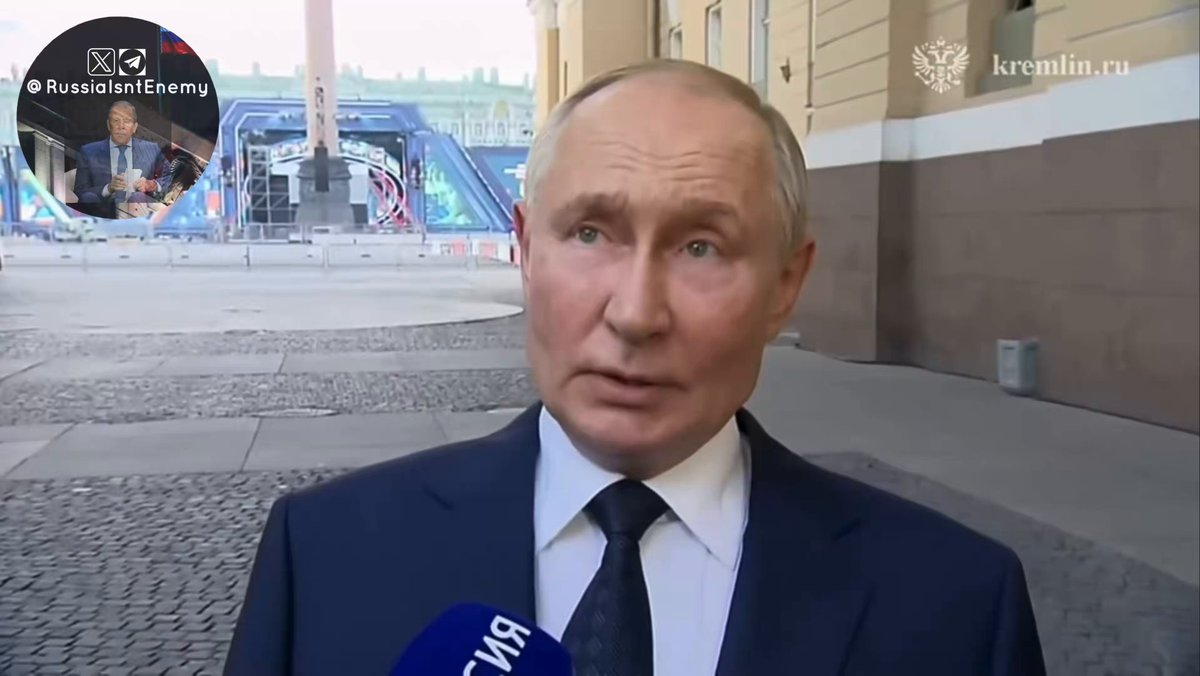
Putin said that Russia would deploy intermediate and shorter range missiles and blamed the West for that: Russia is capable of responding to any existing or newly emerging threats, not with words, but through military-technical measures. An example of this is our decision to abandon the unilateral moratorium on...

119,697 görüntüleme • 9 ay önce •via X (Twitter)

0 Yorum

Yorum bulunmuyor

Orijinal gönderinin yorumları burada görünecek

Benzer Videolar

🇷🇺 Strategic Asymmetry: Russia’s Countermove on INF Missiles by Elena Panina Russia has officially announced that it is abandoning the self-imposed restrictions under the moratorium on the deployment of intermediate and shorter-range missiles (INF), citing the actions of the United States, which has long stationed similar missiles in Europe and the Asia-Pacific Region (APR), thereby disrupting the status quo. Notably, this is the first time Russia has explicitly stated that the threat from U.S. INF missiles comes not only from Europe but also from the APR. ▪️ On the surface, Moscow’s lifting of the INF moratorium appears to be nothing more than a symmetrical response to Washington’s escalation. But on a deeper level, it is a move to seize the initiative disguised as a reactive measure. Russia is not just “responding”—it is crafting a new strategic framework in the absence of international constraints. And it now has, among other assets, the serial production of the Oreshnik missile system. Why the emphasis on the APR in the Russian Foreign Ministry’s statement, given that Russia lacks an extensive network of military bases there? This is where things get interesting. Russia currently cannot project power in the APR the way the U.S. does by deploying missiles in Guam, the Philippines, and Australia. But Russia has the Far East—from where it can reach Guam, Alaska, the U.S. Pacific coast, not to mention South Korea and Japan. Moreover, Russia now has a direct military ally in the region—North Korea—and the recent visits of high-ranking Russian military officials to Pyongyang were clearly not coincidental. Russia can operate through North Korea with relative freedom, including under the “sovereign proxy” model, much like the U.S. does with Israel in the Middle East. And let’s not forget the Chinese factor. ▪️ Thus, this marks a strategic paradigm shift. If Moscow previously relied on treaties and “playing by the rules,” it is now betting on unpredictability, interconnected fronts, and a balance of threats. For Europe, this creates at least two key flashpoints—Kaliningrad and Crimea. For U.S. allies in the Far East, there’s North Korea. And the U.S. itself now has to juggle between two fronts—or even three, if we include the Middle East. The Pentagon’s need to respond has multiplied, along with the growing complexity of strategic planning: the U.S. will now have to deploy missile defense systems worldwide—all while facing shortages of missiles and defense systems. This is the power of asymmetric strategy: you don’t need to be stronger, you just need to be less predictable and threaten from unexpected directions.

🅰pocalypsis 🅰pocalypseos 🇷🇺 🇨🇳 🅉

16,164 görüntüleme • 11 ay önce

Macron says Europe must develop its own intermediate-range ballistic missiles (IRBMs) like Russia’s Oreshnik or comparable long-range strike weapons. Macron says Russia’s recent Oreshnik strike on Lviv is a "clear signal" and a demonstration that Europe is within range. He stressed the need to accelerate efforts under the existing European Long-Range Strike Approach (ELSA) initiative, which was launched in 2024 by France, Germany, Poland, and later joined the UK, Italy, Sweden and the Netherlands. Macron argues that developing these capabilities collectively will enhance Europe's credibility, strengthen nuclear deterrence and respond to the shifting balance from Russia's recent deployment of both nuclear weapons and Oreshniks in Belarus. Macron argues that while it’s necessary to pool resources for European long-range systems rivalling the Oreshnik, France is capable to providing key technologies for the project through the know-how it has acquired by fielding S2/S3 IRBMs until 1996 and developing its own submarine-launched ballistic missiles (SLBMs) since the 1960s. The Intermediate-Range Nuclear Forces (INF) Treaty, bilateral U.S.-Soviet agreement that banned all ground-launched ballistic and cruise missiles with ranges of 500–5,500 km in Europe, was in place between 1987 and 2019. European NATO members (and the U.S. for its European deployments) adhered to this, avoiding new IRBM development or deployment. The treaty collapsed when the U.S. withdrew in 2019 in response to Russia not adhering to the treaty by developing IRBMs and cruise missiles with 1000 km such as 9M729. Macron has now made it clear that Europe’s mission to speed up its own IRBM and long-range cruise missiles must be sped up significantly. It remains to be seen whether Europe will heed his advice

Visegrád 24

183,850 görüntüleme • 5 ay önce

☝️The use of long-range, Western-made precision weapons to strike Russian territory would mean that NATO countries, the US, and the EU are at war with Russia. “We are not talking about authorizing or prohibiting the Kiev regime from striking Russian territory—this is already being done with the help of unmanned aircraft and other means. However, when we are talking about the use of long-range, Western-made precision weapons, that is a completely different story. The fact is, and any expert from our country or the West will confirm this, the Ukrainian army is not able to operate such weapons on its own. Their effective use is only possible with targeting intelligence from satellites, which Ukraine does not have. This is data that can only come from US or EU satellites—in other words, from NATO satellites. That is the first point. The second, and perhaps the key point, is that only NATO military personnel can program the flight missions for these missile systems; Ukrainian servicemen cannot do this. Therefore, this is not about allowing the Kiev regime to strike Russia with these weapons or not. It is about deciding whether NATO countries are becoming directly involved in a military conflict or not. If such a decision is made, it would mean nothing other than the direct participation of NATO countries, the US, and the EU in the war in Ukraine. This, of course, significantly changes the very essence of the conflict. It would mean that NATO countries, the US, and the EU are at war with Russia. And if that is the case, then, bearing this in mind, we will make the appropriate decisions based on the threats that would be posed to us” - President Putin

🇷🇺Russia is not Enemy

291,721 görüntüleme • 9 ay önce